
Garden Missing Numbers: 5 Brilliant Bloom Trail Games
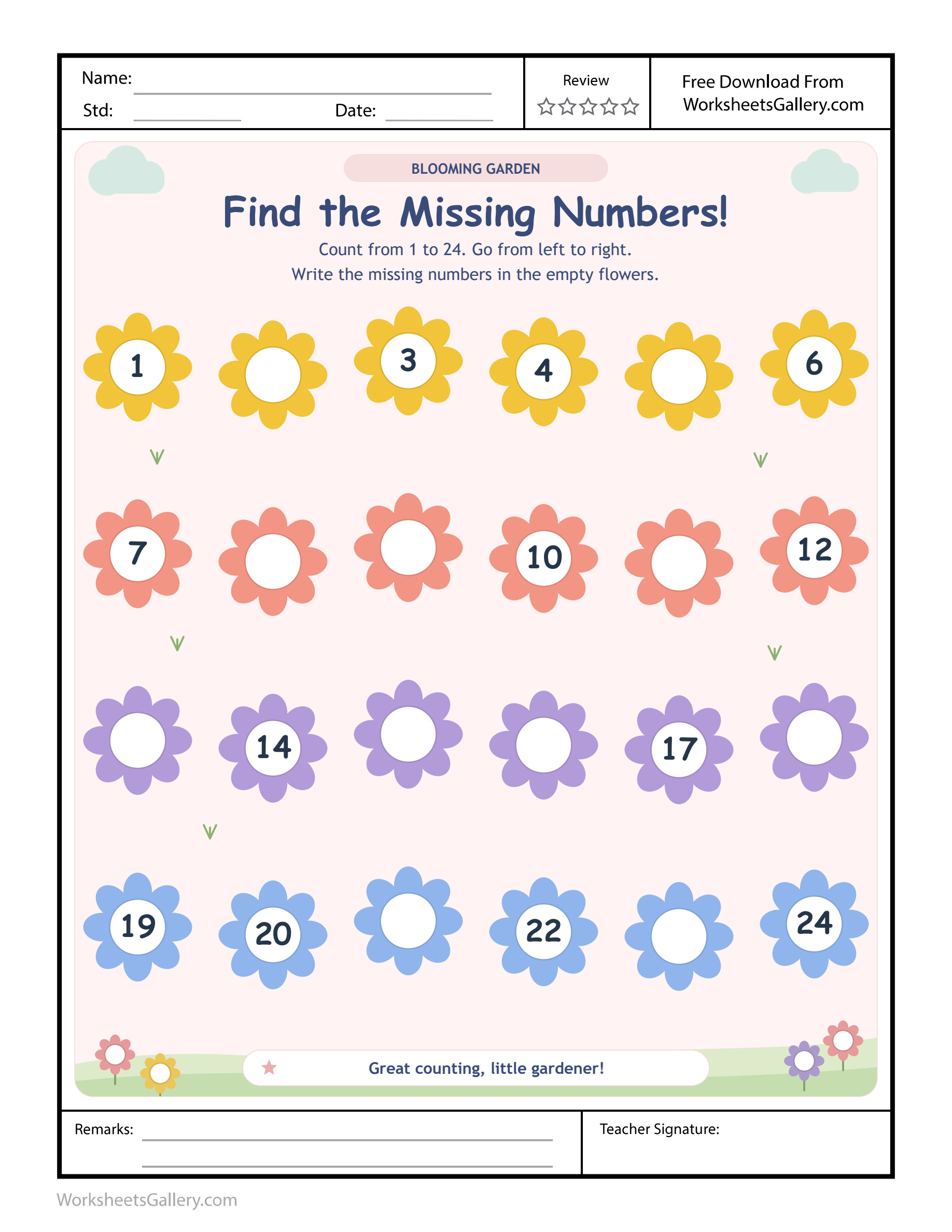
An empty flower still has a place in the counting trail. Garden Missing Numbers invites children to find that place before deciding what to write, using the printed neighbors as clues. Across four colorful beds, the route continues from one to twenty-four; a new row changes the eye's position without restarting the count. A beginner might solve one opening aloud, while a more confident writer repairs several gaps. The gardening theme gives both children a shared purpose: restore the labels so another visitor can follow the same sensible path through the flowers.
🌼 Lina opens a Garden Missing Numbers potting station
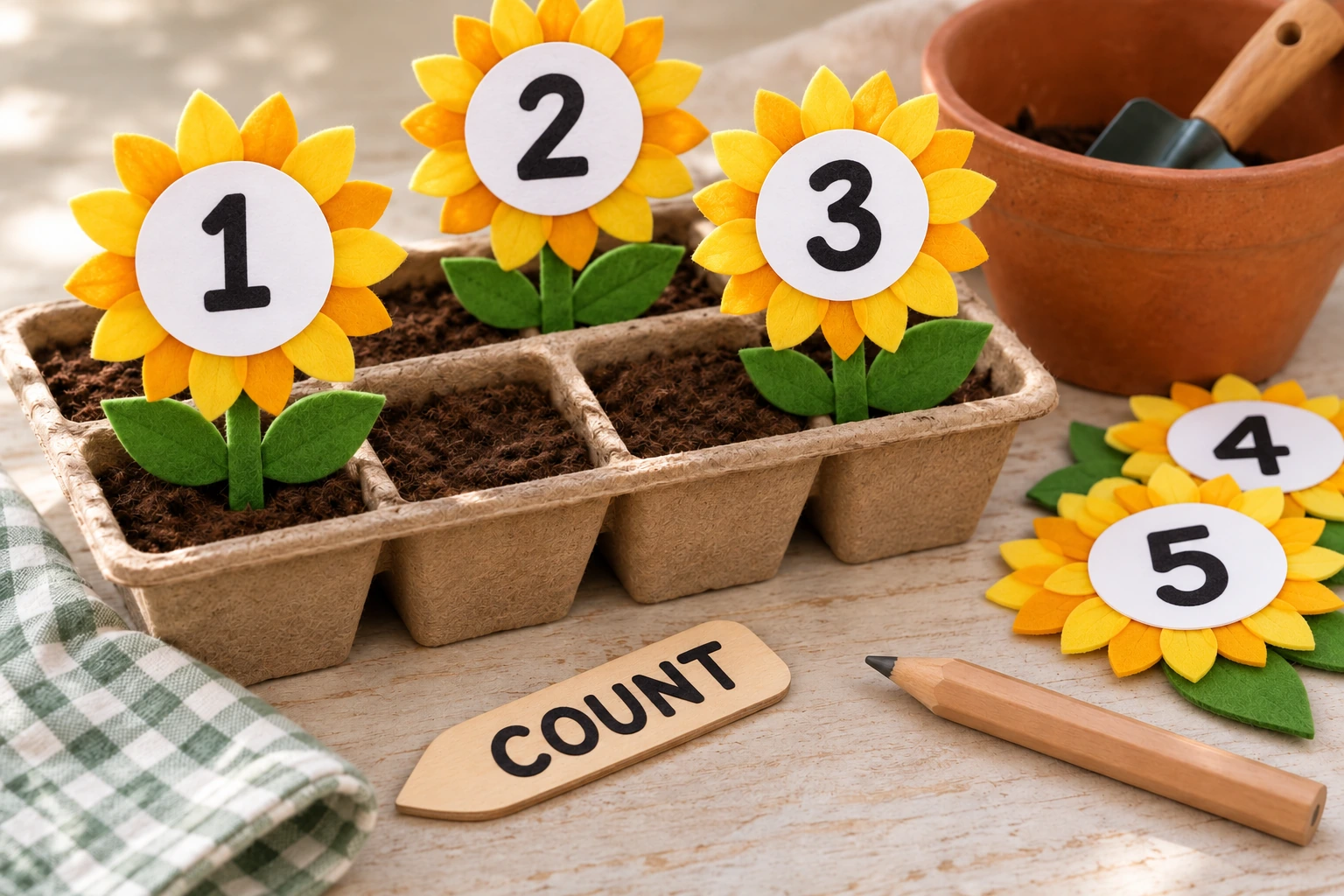
Lina and her aunt inspect numbered paper flowers beside a marker labeled COUNT. Their Garden Missing Numbers sheet becomes a map of numbered growing spaces. Lina notices the empty center between 1 and 3 and says two. Her aunt asks her to touch the same flower while repeating that answer. Only after matching the spoken number to its position does Lina choose whether to write it.
At home, Garden Missing Numbers can begin with just the yellow bed. Cover the lower beds with plain paper if the full display feels busy. An adult reads the direction, then moves a finger across each flower center, including the empty ones. Lina takes over the pointing for a second pass. Garden Missing Numbers remains a number-order problem; its petals are decoration rather than separate objects to count.
Garden Missing Numbers is most suitable for children around four to six who are becoming comfortable with an ordered count beyond ten. A younger child can join a short supported conversation, but recognizing twenty-four numerals should not be assumed from age alone. Notice whether the learner knows the spoken sequence, recognizes a printed numeral and can form its written shape. Those are three different demands.
Read a Garden Missing Numbers gap through its position

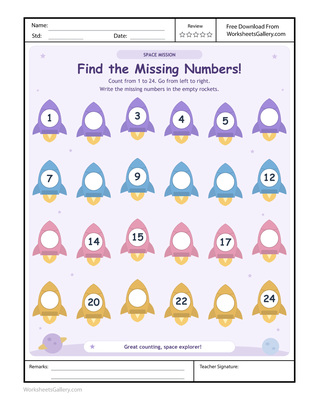
The first Garden Missing Numbers bed reads 1, empty, 3, 4, empty, 6. It needs 2 and 5. Point through the entire row rather than naming only the entries already printed. Otherwise, during Garden Missing Numbers, a child may say one, three, four and unconsciously treat the skipped positions as if they do not exist. The blank changes the writing task, not the underlying order.
There are twenty-four flower positions on Garden Missing Numbers: six in each of four rows. Thirteen numerals are supplied and eleven centers are empty. That total describes the worksheet's structure; it is not an additional question asking the child to count every decorative flower around the border. Follow the main centers from left to right, then return to the next bed's left edge.
Garden Missing Numbers needs a continuous count at each row return
The second bed starts at 7, immediately after the yellow bed's 6. Garden Missing Numbers does not start a fresh one-to-six sequence whenever the color changes. An adult can make a broad return gesture from the far-right flower toward the next row's leftmost center, then resume saying the numbers. The change in location becomes visible without adding arrows or writing over the source.
When Garden Missing Numbers writing is difficult, invite a spoken answer and let the adult record it on a separate practice card. A learner who says the correct value but reverses its digits has shown something different from a learner who cannot yet locate the value in the sequence. Keep the reasoning visible before choosing whether the next useful task is counting, numeral recognition or formation.
Two middle steps in the Garden Missing Numbers purple bed

The purple Garden Missing Numbers row begins with missing 13, then printed 14. Farther along, two empty centers come before 17. Count on from fourteen: fifteen, sixteen, seventeen. The known destination checks both gaps together. Putting 15 in each opening would fill the spaces while breaking the sequence, so reread the connected run after any pair of answers.
Garden Missing Numbers offers a reason to explain a choice: “This flower comes after fourteen, so it needs fifteen.” The child does not need to recite that full sentence. A gesture from 14 to the next center may convey the same idea. Listen for the relationship, and supply ordinary words such as before, next or between when they clarify what the learner is already noticing.
Six Garden Missing Numbers observations for an adult
A Garden Missing Numbers blank keeps its place
Touching an empty center while speaking its number preserves the correspondence between the route and the count. The learner begins to treat the gap as meaningful information instead of skipping an inconvenient part of the picture. This is a useful observation even before a numeral is written.
Garden Missing Numbers can start from a known clue
A child who recognizes 14 can count onward from that point rather than restarting at one for every answer. Keep restarting available when it is helpful. The aim is discovering a dependable strategy, not insisting on an efficient shortcut before the sequence feels secure.
Garden Missing Numbers separates two adjacent answers
The paired purple gaps require different consecutive values. Checking arrival at 17 provides evidence that both were handled correctly. This small connected run encourages reasoning across more than one space instead of regarding each empty center as an unrelated guessing opportunity.
Garden Missing Numbers gives number words a written partner
After a Garden Missing Numbers oral choice, a child can identify or write the corresponding numeral. Two-digit entries need their digits kept in order inside one center. An adult can distinguish a correct mathematical decision from a cramped or reversed written response and support the particular difficulty.
Garden Missing Numbers invites purposeful visual tracking
The eye travels across six flowers before returning left. A finger or a plain paper guide can keep the current bed easy to locate. This supports attention to the route without requiring a child to manage the entire colorful page at once.
Garden Missing Numbers practice can leave a useful memory
An adult might note that Lina solved a single gap independently but needed a count through the paired ones. That observation suggests a specific starting point for the next visit. Recording a successful strategy is more useful than simply marking how much of the page was filled.
Check the Garden Missing Numbers blue bed together

The last Garden Missing Numbers bed gives 19, 20, a space, 22, another space and 24. The missing entries are 21 and 23. Let the learner read a completed short run back to a listener. Saying nineteen, twenty, twenty-one makes the decade transition audible; the printed 22 then provides a nearby check rather than a value to copy into the previous gap.
| Garden bed | Numbers to supply in reading order |
|---|---|
| Yellow, positions 1–6 | 2, 5 |
| Coral, positions 7–12 | 8, 9, 11 |
| Purple, positions 13–18 | 13, 15, 16, 18 |
| Blue, positions 19–24 | 21, 23 |
This Garden Missing Numbers answer reference is for checking a selected attempt. Give the child time to use the pictured clues before reading off the table. If a choice differs, ask which printed number could help test it. A reasoned correction is part of the activity. The useful result is a route that makes sense, rather than a page that only looks complete.
Five Garden Missing Numbers games after a short visit
1. Give a Garden Missing Numbers visitor a spoken tour
One person points along a selected flower bed while another says the complete sequence, including its gaps. Exchange the pointing and speaking roles. The listener can pause where the route becomes uncertain and return to a nearby printed clue. Keeping the two jobs separate can reveal whether the difficulty concerns following the picture or remembering the spoken count.
2. Make a removable Garden Missing Numbers plant label
Write one chosen answer on a loose card and place it beside the intended flower, leaving the original center unchanged until the learner agrees. Read the local run to check the location. A card that can be moved makes a revision simple and keeps the discussion focused on position, especially when erasing would make the writing space crowded.
3. Plan a Garden Missing Numbers pair before writing
Choose the two purple gaps between 14 and 17. Let the child explain which number comes first and which follows it, then compare the spoken run with the printed destination. An adult may write the pair on separate cards. This extension explores the relationship between adjacent answers without making handwriting speed part of the challenge.
4. Build a tiny Garden Missing Numbers row elsewhere
Arrange a short run of adult-made numeral cards on a table and temporarily remove one. Invite the learner to restore it using the neighbors, then let the child choose a different card to hide for an adult. Keep the range familiar. The new row is an extra game, so it need not reproduce all twenty-four flower positions or become a second long worksheet.
5. Save a Garden Missing Numbers gardener's explanation
Ask the learner to dictate one sentence about how a gap was solved. An adult can record the explanation beside a simple flower drawing, then read it back on another day. The child may revise the Garden Missing Numbers explanation or demonstrate the same strategy with a finger. This gives regular practice a remembered idea instead of a recurring demand to finish more boxes.
A Garden Missing Numbers conversation in class
At a small-group potting desk, offer Garden Missing Numbers partners different jobs: route guide, number speaker and optional recorder. Begin with one bed, exchange responsibilities and ask each child for a clue they used. Avoid turning the page into a race. Two learners may contribute sound reasoning while needing different support for recognizing or writing the same two-digit numeral.
If a child counts petals, jumps straight downward or copies a neighbor into a gap, return to the relevant Garden Missing Numbers center and model one short run. Keep the flower's place, then choose its numeral. A quieter oral turn is a sensible alternative when the pencil hand tires. Stop after a successful explanation and leave another bed available for a later gardening visit.
Download Garden Missing Numbers for your next planting story
The original Garden Missing Numbers PDF is the free edition. For eligible active members, a different Garden Missing Numbers premium file removes website-name lettering, domain branding and watermark wording. Its printable pages contain no embedded adverts. Print in portrait on US Letter paper, checking that the outer border and every flower center remain inside the preview before making a class set.
For a smaller numerical starting point, try five through a pictured counting and writing task. Broader hand movements can begin with gentle routes for a first pencil journey or more varied changes along a traced line. Adults can explore NAEYC's family mathematics collection and PBS Family Math on number sense and counting. A thoughtful gardener can leave the next bed for tomorrow.
Popular Worksheets
Printable resources families and teachers are downloading now.
 Free
 Free
 Free
 Free