
Number 10 Worksheet: 5 Powerful Balloon Party Wins
Attached Premium Package
Finish the numbered sequence with the balloon ticket activity, then revisit any earlier quantity in the same collection. The $3 Number Bundle supplies the complete clean set from one kite through ten balloons as a single ten-page PDF.
A party ticket has room for one number, even when that number needs two written characters. This Number 10 Worksheet introduces that small surprise through ten balloons, paired tracing guides and a search for complete 10 entries. Children count a real pictured amount before keeping 1 beside 0 on the page. Designed for ages three to six, the balloon activities invite conversation, careful looking and manageable pencil work. A familiar celebration becomes a reason to check what a ticket says, rather than simply filling every available space with color.
Read the complete Number 10 Worksheet entry
Begin with the recognition panel, where a lone 1 and a lone 0 sit among other choices. A Number 10 Worksheet target consists of both neighboring characters printed as one entry. Invite your child to frame a complete 10 with two pointing fingers before picking up a crayon. That brief pause makes the unit of the search visible: one written number, containing two digits.
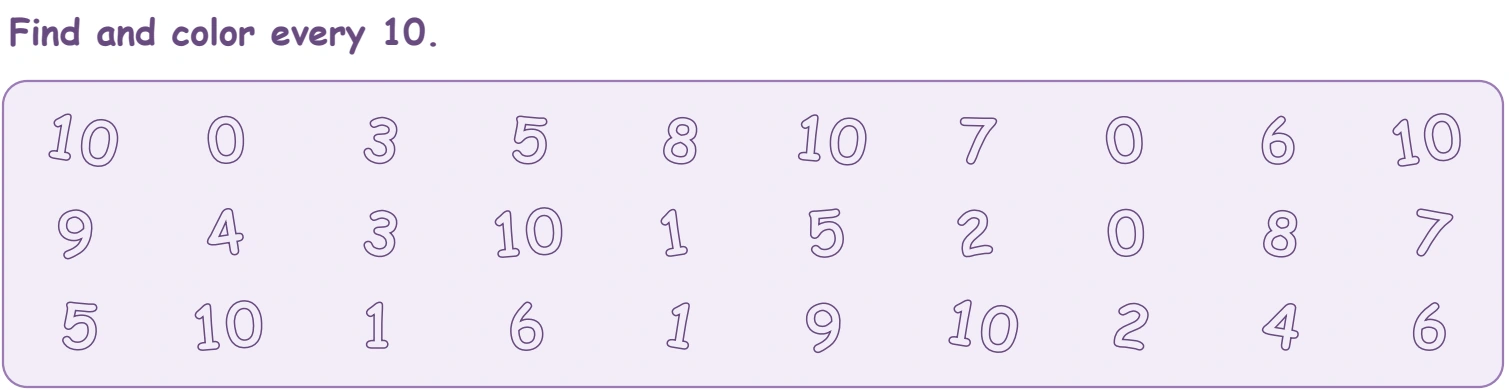
The Number 10 Worksheet has thirty printed positions across three rows. Six positions contain 10; the target quantity does not mean there must be ten matches. For an adult checking the original arrangement, the first row contains targets at columns one, six and ten; the middle row at column four; and the bottom row at columns two and seven. Count columns from the left, treating each complete printed entry as one position.
Keep that answer information for your own review. During Number 10 Worksheet practice, ask for a reason: “What belongs beside this 1?” A child can name the zero, show the whole entry and then color both characters. Avoid coloring an isolated 1 now and hoping a nearby, separately spaced 0 completes it. The page already supplies the pairs that belong together.
One report, two neighboring characters
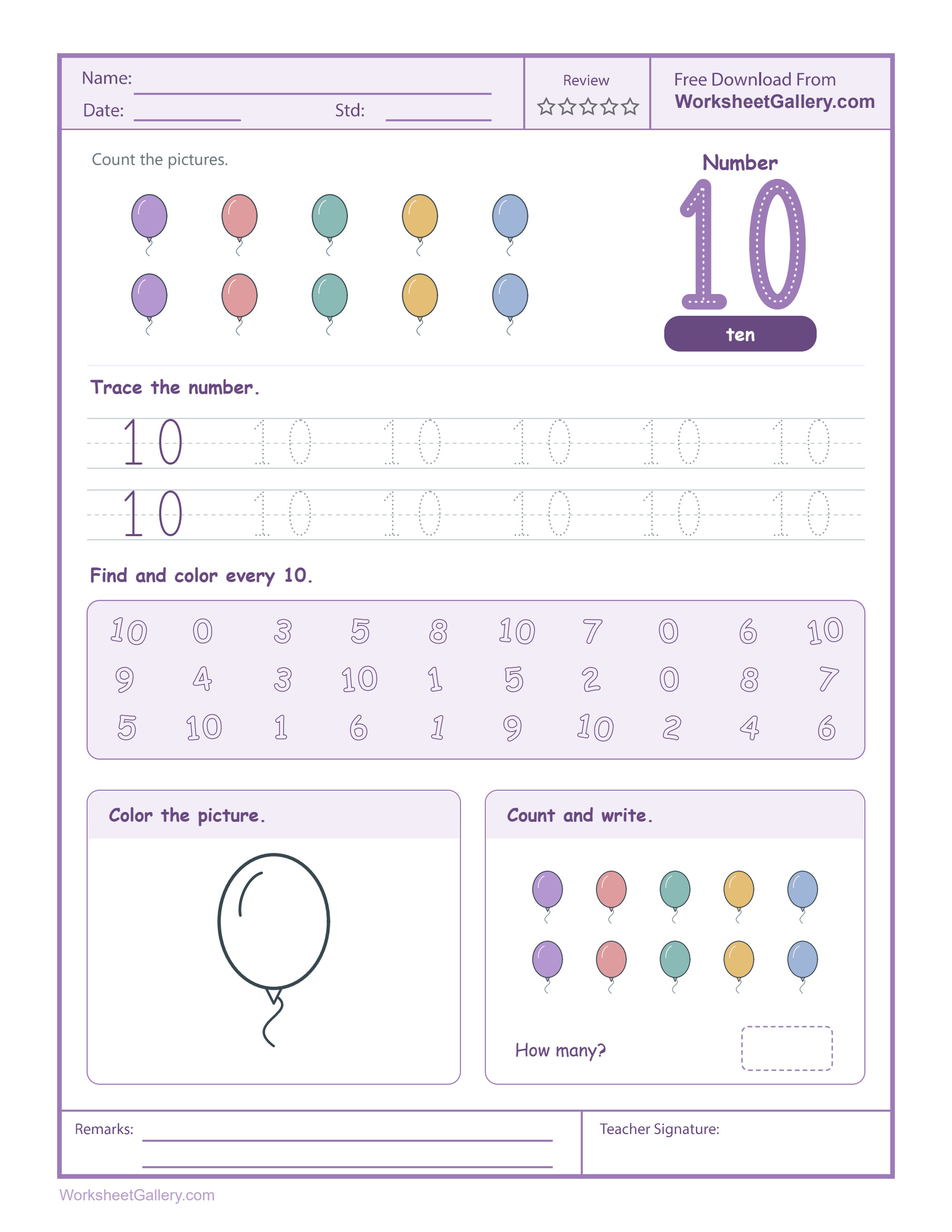
The largest model on the Number 10 Worksheet places 1 before 0 and labels the number ten. Say the word ten once while sweeping a finger underneath the entire symbol. Then look at the upper balloons: five occupy the first row and five the next. These are ten whole balloons, not twenty separate pieces made by counting each balloon and its string independently.
For a young learner using the Number 10 Worksheet, identifying the amount and copying its numeral are enough. An adult may describe 10 as one ten with no extra ones when that language is already familiar, but a formal place-value lesson is unnecessary here. Keep a useful distinction: there are ten pictured objects, while the written answer has two digits. Neither statement changes the other.
The Number 10 Worksheet tracing rows offer repeated practice of the full numeral. Follow the printed 1, move across to its neighboring 0 and leave the intended gap between successive 10 examples. If a child produces a long string such as 101010, cover later models with a spare strip of paper. Reveal one Number 10 Worksheet pair at a time until each complete example has a clear boundary.
Owen checks the party admission strip
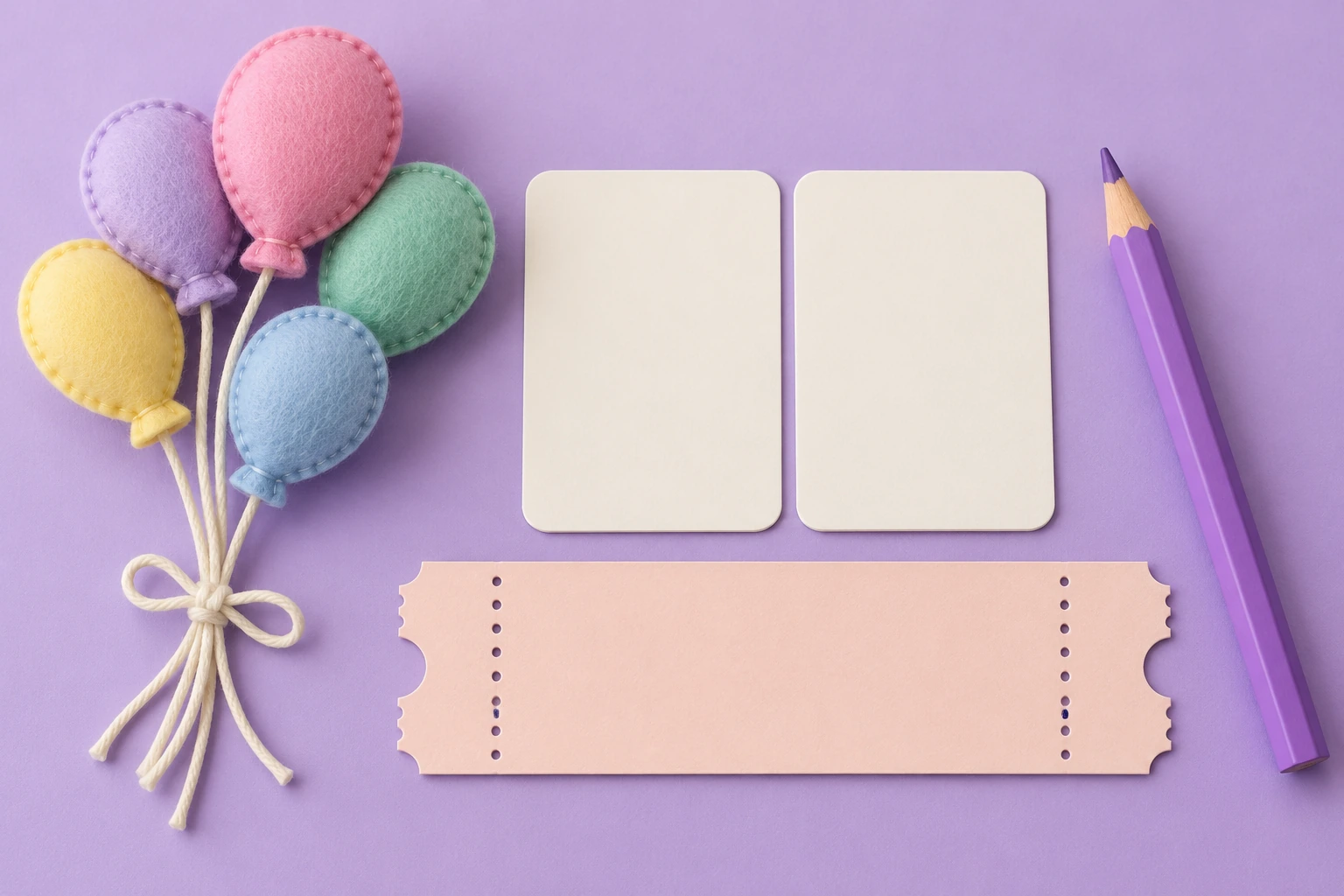
Owen and his grandmother prepare a pretend party ticket beside the Number 10 Worksheet. She offers two blank tiles and says, “Our balloon display needs a number.” Owen counts the upper pictures slowly, then chooses a 1 tile and a 0 tile. He places the 1 first. When the tiles drift apart, his grandmother slides the ticket underneath both, making their shared purpose easier to see.
Their Number 10 Worksheet conversation stays concrete. “Does this zero mean we have no balloons?” Owen points back to the ten pictures and says no. His grandmother reads the whole ticket as ten. She does not ask him to explain every rule of the decimal system; she asks whether the report agrees with the counted display. Two written characters can work together to name the Number 10 Worksheet amount.
At home, use the Number 10 Worksheet with a soft pencil, a coloring tool and a quiet place for a short turn. Start with a spoken count, attempt one complete tracing example and choose a remaining activity together. The decorative felt balloons in the illustration are story props; their quantity is not the printed counting answer. Return to the worksheet pictures whenever a report needs checking.
Five ticket-desk games after Number 10 Worksheet practice
1. Reunite the numeral partners
Prepare separate 1 and 0 cards for a Number 10 Worksheet follow-up. Put a small blank ticket below them and invite your child to arrange the cards so the ticket says ten. Read the result from left to right. If the zero comes first, compare the arrangement with the large Number 10 Worksheet model and let the child move the cards. Keep the correction visible and reversible.
2. Admit only a complete entry
Make several paper tickets: some showing 10, others showing only 1 or only 0. After Number 10 Worksheet recognition work, a pretend attendant admits the complete ten tickets into a little envelope. The child must point to both characters before choosing. Take turns as attendant and visitor, so explaining a Number 10 Worksheet decision becomes part of the game instead of an adult test.
3. Build a display without extra guests
Place ten large paper balloon shapes on a table. The Number 10 Worksheet arrangement can guide two rows of five, but another arrangement is welcome once every shape is counted once. Add loose cord pieces beside the shapes and ask whether these are new balloons. Name them as strings or decorations, then count only whole balloon shapes before writing a ticket that agrees with the Number 10 Worksheet.
4. Deliver the spoken order
One partner says “ten balloons” while another writes the matching report on a spare card. Use the Number 10 Worksheet model when needed, then compare the card with the complete numeral. Switch jobs. This Number 10 Worksheet game joins listening, remembering and writing without demanding speed. A partner can supply the spoken word again rather than correcting a hesitant writer halfway through a digit.
5. Repair the party notice
Write a pretend notice with an incomplete numeral, such as a 1 followed by an empty space. Consult the Number 10 Worksheet and ask what must be supplied for the notice to say ten. Try a second notice with a zero but no leading 1. Let your child add the missing character, read the repaired report and check it against the Number 10 Worksheet balloons.
Six gains worth noticing beyond a finished page
Number 10 Worksheet searches ask a learner to treat adjacent characters as a complete entry. That attention to boundaries supports clearer recognition when several choices share a digit.
Touching one balloon for each spoken count word gives Number 10 Worksheet practice a checkable rhythm. The last word names the quantity after every pictured balloon has received one count.
Number 10 Worksheet guides require a shift from the straight character to the rounded character. A comfortable pace allows each movement to finish before attention transfers to its neighbor.
A sentence such as “I chose that entry because the zero follows the one” gives Number 10 Worksheet decisions a spoken explanation. Accept pointing or a short phrase before expecting a full sentence.
Number 10 Worksheet balloons include strings. Naming a string as part of a balloon gives an adult a practical way to discuss what is being counted without adding extra objects.
The lower Number 10 Worksheet response provides a reason to compare a written answer with visible evidence. A child can revise a ticket after recounting, making revision a useful action rather than a failure.
The lower balloon display needs its own count
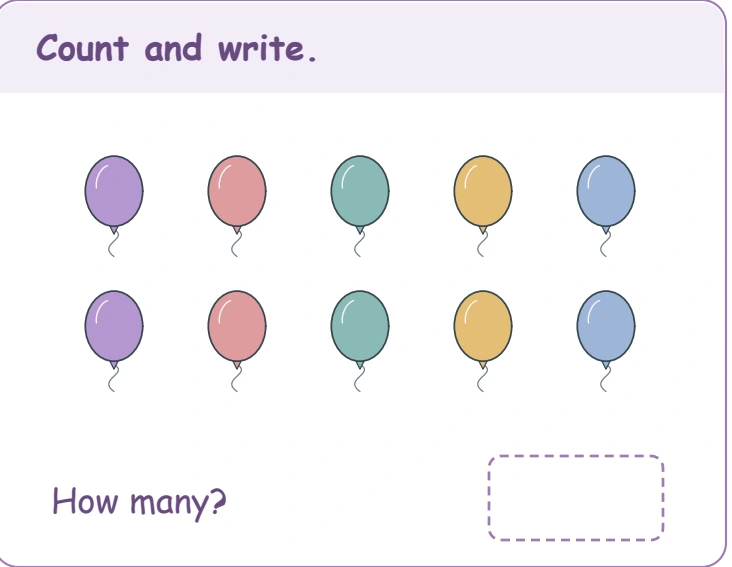
The lower-right Number 10 Worksheet panel repeats ten balloons above a small response box. Count this group independently of the upper pictures. Five sit above five, and all ten belong to this activity. Do not continue counting from the top of the sheet; the two panels are separate opportunities to represent the same amount.
A Number 10 Worksheet answer should fit both digits inside the response area. Before writing, your child can hover a finger where the 1 will go and then where the 0 will go. Leave space for both characters rather than squeezing the zero outside the box at the last moment. A larger practice card is a useful intermediate step when the Number 10 Worksheet box feels demanding.
In a classroom Number 10 Worksheet session, partners can hold different responsibilities. One points through the ten lower balloons, while the other listens for one count word per picture. Both read the Number 10 Worksheet answer together. Exchange responsibilities on a fresh loose-paper display, so the second child gets to count without needing another full worksheet immediately.
Adult notes for three common mix-ups
| What you notice | A response to try |
|---|---|
| The child colors every isolated 1. | Return to the complete 10 model and frame both printed characters together before choosing another entry. |
| The written report ends after 1. | Point to the space beside it and compare with the large numeral; ask which neighboring character belongs there. |
| Each string receives an extra count. | Outline one whole balloon with a finger, name its string as a part, and restart with one count per balloon. |
A Number 10 Worksheet correction works best when it addresses one visible difficulty. If the spoken count is secure but the zero is missing, work on the written pair. If the pair is copied accurately but the counting skips a balloon, return to object-by-object pointing. The same finished Number 10 Worksheet answer can hide different needs, so watch the process before choosing the next prompt.
A small celebration, followed by a sensible return
Offer Number 10 Worksheet choices that preserve the task: which crayon to use, whether tracing or the single balloon outline comes next, and who will read the party ticket aloud. A child who enjoys decorating may spend time on the large outline without treating every colored section as another counted object. Interest can sustain attention without turning the page into a race.
Repeat Number 10 Worksheet work in brief, varied visits. One day might involve the search panel; another might begin with ten real paper shapes and a handwritten ticket. Pause when the hand tightens or attention fades. Notice a specific action such as leaving space for the zero, then save one manageable next step. Finishing every Number 10 Worksheet activity in one sitting is optional.
Choose the download and print a readable copy
- Select the edition you can access.
- Save the PDF before printing.
- Inspect one sheet before making classroom copies.
Use the Number 10 Worksheet free download for the original sample, or choose the protected premium edition through an eligible active membership. The premium PDF removes the worksheet's website branding and watermark text. No advertisements are embedded in that printable file. Website download controls and membership availability appear on the published page; the local preview is for reviewing the lesson and images.
For Number 10 Worksheet printing, select US Letter paper, portrait orientation and a setting that preserves the page border. Review the print preview before committing the sheet, especially the pale tracing guides and the lower answer box. A normal-quality print should keep the dotted characters readable. Let a child test a pencil on spare paper rather than pressing hard enough to tear the printed guides.
The Attached Premium Package offers the complete ten-page number collection in one PDF for $3. This Number 10 Worksheet is its last numbered activity, following the kite, sailboat, rocket, teddy bear, turtle, duck, umbrella, ice cream and fish pages. Purchasing that collection and using the individual membership download are separate choices presented by the website.
For another short visit, try five-object counting with a simpler written symbol. Build pencil comfort with five approachable line paths, or revisit careful scanning through pictured fruit groups that lead into addition. Choose the next activity from what you observed, not from a requirement to complete more pages today.
Popular Worksheets
Printable resources families and teachers are downloading now.
 Free
 Free
 Free
 Free