
Number 9 Worksheet: 4 Brilliant Fish Survey Adventures
Attached Premium Package
Keep the nine-fish survey with the complete numbers collection. Purchase the $3 package for a single ten-page PDF, with each of the supplied worksheets cleaned and placed in number order.
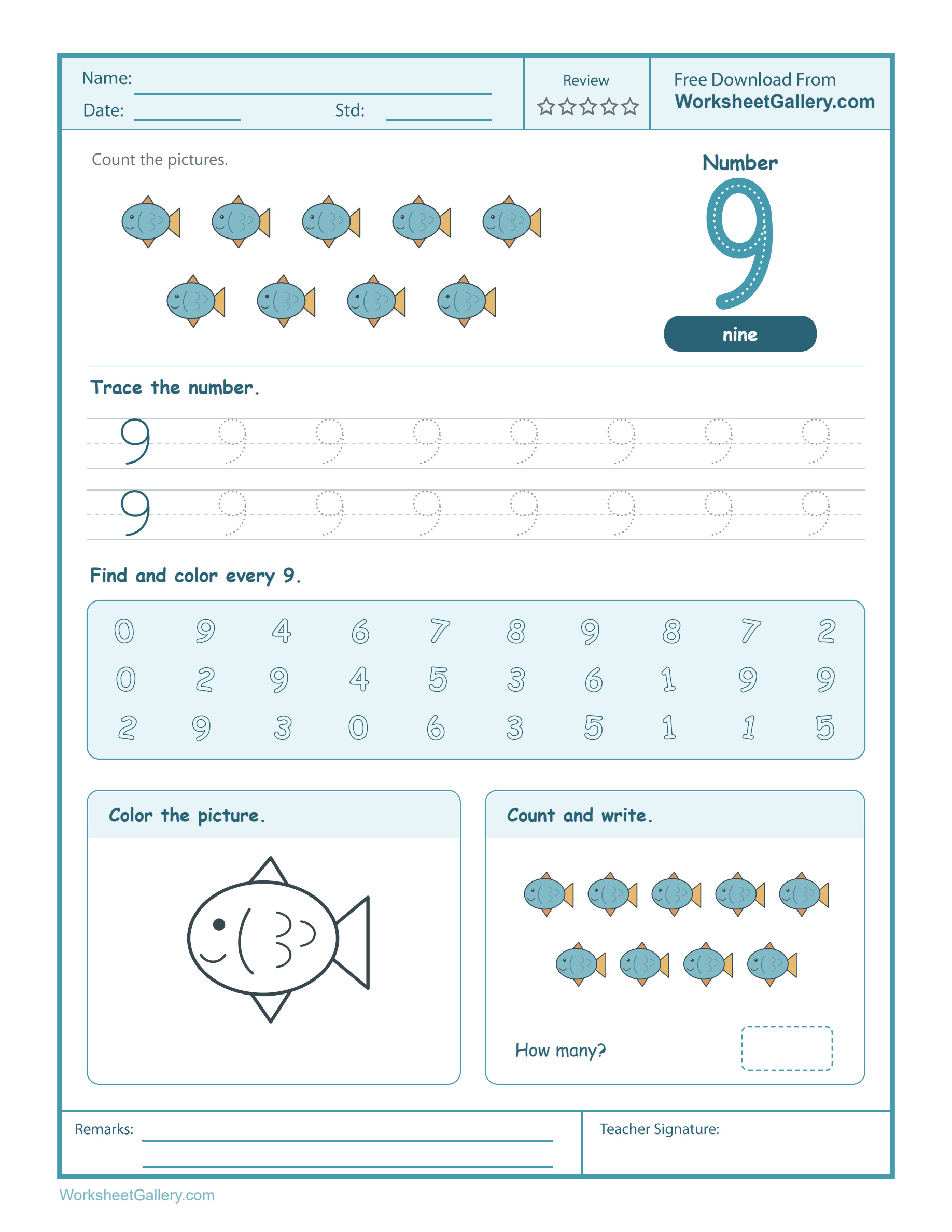
A first glance can start a fish survey, but a checked count should finish it. Number 9 Worksheet investigation asks a learner to inspect nine fish arranged five above four, then connect that amount with the printed numeral and word nine. Tracing, a mixed-symbol search, outline coloring and a lower count response give the report several ways to be examined. Use the Number 9 Worksheet as an observation notebook: an initial impression may change, and the learner can show which fish supplied the evidence for the revised amount.
Let the Number 9 Worksheet lower fish enter the survey
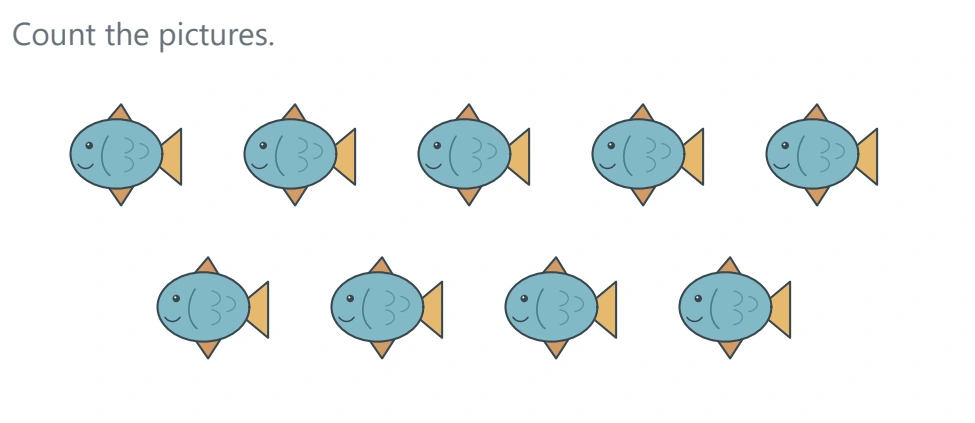
The upper collection contains five fish across its first row and four across its second. All nine complete fish belong to the same selected group. A full count needs both rows, including the offset drawings beneath the first five.
Each fish's fins and tail remain parts of its picture. Number 9 Worksheet quantity counting does not give additional numbers to those details. Establish the whole fish as the unit before discussing whether a report includes every object.
Invite a pointing route that another person can follow. If a learner says eight, ask which fish received a number and whether one remains outside the route. A missed drawing can be located and included without treating the first answer as the end of the discussion.
The Number 9 Worksheet large model can confirm how nine is written, but it does not demonstrate that a child counted the collection. Ask for a brief explanation or a visible route when the origin of the answer is unclear.
Sana's Number 9 Worksheet notebook allows a revised report
Sana and her older cousin imagine they are surveying a paper pond. Sana offers a quick first estimate of the fish amount. Her cousin leaves a blank report space and asks how the estimate could be checked before it becomes the notebook's final entry.
Sana follows the upper row, then the lower one, giving each complete fish a count. She reports nine after inspecting the whole group. If her initial estimate differed, she can explain which additional fish became visible during the careful route.
The Number 9 Worksheet story makes a change of mind useful. A revised report supported by newly noticed evidence is a successful investigation, even if the first impression was different. The adult listens to what changed in the method.
The supporting paper-fish desk contains an unfilled notebook. It does not provide a guessed quantity or a solved answer. Number 9 Worksheet evidence stays with the source pictures, and a family can use a plain sheet instead of a notebook or magnifying-glass prop.
Four Number 9 Worksheet survey experiments
Save a Number 9 Worksheet first impression without marking the answer
Ask for an optional estimate before a careful count. Keep it as a spoken idea rather than writing it into the final response box. Then invite a route through all the fish and compare the checked result with the first impression.
The Number 9 Worksheet experiment is not a test of guessing accurately. It gives the learner a reason to distinguish an initial look from an amount established by inspecting every object.
Locate Number 9 Worksheet evidence for a correction
If a count misses a fish, identify the particular drawing that was omitted. Ask the learner to describe its location, perhaps below an upper gap or near the end of the lower row.
Rebuild a complete count with the fish included. Number 9 Worksheet feedback becomes actionable when the child can show what changed, rather than merely repeat the corrected final number.
Compare Number 9 Worksheet large and small survey pictures
Count the upper group and then the smaller lower group independently. Both represent nine fish, despite their different drawing sizes. Ask which group the learner's current report describes before recording anything.
Number 9 Worksheet comparison does not ask for the total of both groups. Each panel supplies evidence for its own activity, so the lower response should refer only to the lower pictured set.
Dictate a Number 9 Worksheet survey note
Have the child tell a listener the checked amount and one detail about the route. The listener writes a short note on spare paper while the learner indicates the relevant fish pictures.
Use the page's model when a numeral is needed. Number 9 Worksheet participation can remain mathematical when an adult supplies handwriting support, because the count and its explanation still come from the learner.
A smaller Number 9 Worksheet fish group still reports nine
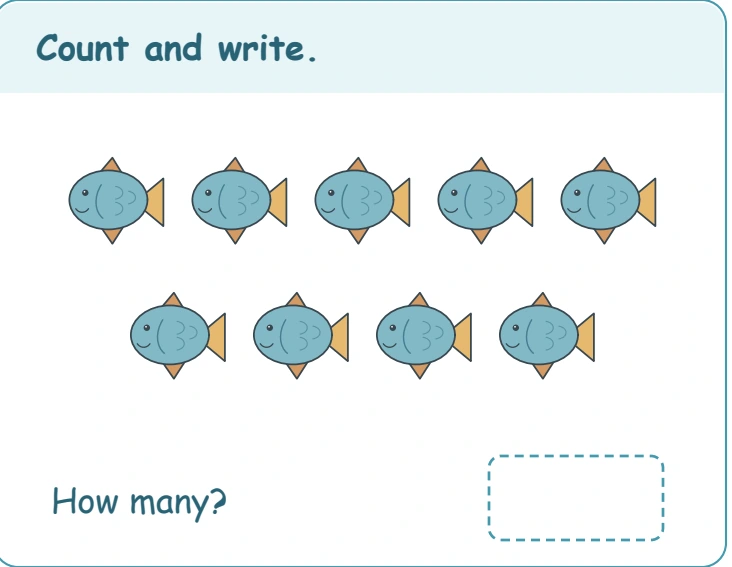
The lower-right activity contains nine smaller fish, again displayed five above four. Count this selected group and write 9 in the blank box. Check the entire lower row before ending the report.
If the child remembers nine from the upper task, invite a brief verification rather than assuming the lower group was inspected. Number 9 Worksheet recording is an opportunity to connect a counted set with a numeral supplied without dotted guidance.
The single large fish at the lower left belongs to coloring. It is not an extra survey fish for this response. Ask the learner to indicate the relevant panel when there is uncertainty about which drawings belong in the current amount.
Seven Number 9 Worksheet observations for a field notebook
- Number 9 Worksheet evidence. A complete object count gives a quantity report support beyond an initial impression.
- Number 9 Worksheet attention. Including the offset lower row requires looking beyond the longest and most noticeable picture line.
- Number 9 Worksheet unit definition. Keeping fins and tails with their fish makes the counted object clear.
- Number 9 Worksheet explanation. Describing an omitted drawing gives a partner a location to inspect.
- Number 9 Worksheet revision. A supported change in the report shows how checking can improve an answer.
- Number 9 Worksheet symbol orientation. Inspecting the upper loop and descending continuation helps distinguish the printed 9 form.
- Number 9 Worksheet recording. A blank quantity box asks for the counted amount to be represented independently of a dotted model.
The observations involve cognitive checking, spoken description and directed movement. A child may be ready to explain a count while still needing help forming 9. Another may recognize the symbol yet benefit from adult-supported pointing through the longer collection.
Read Number 9 Worksheet symbol evidence separately
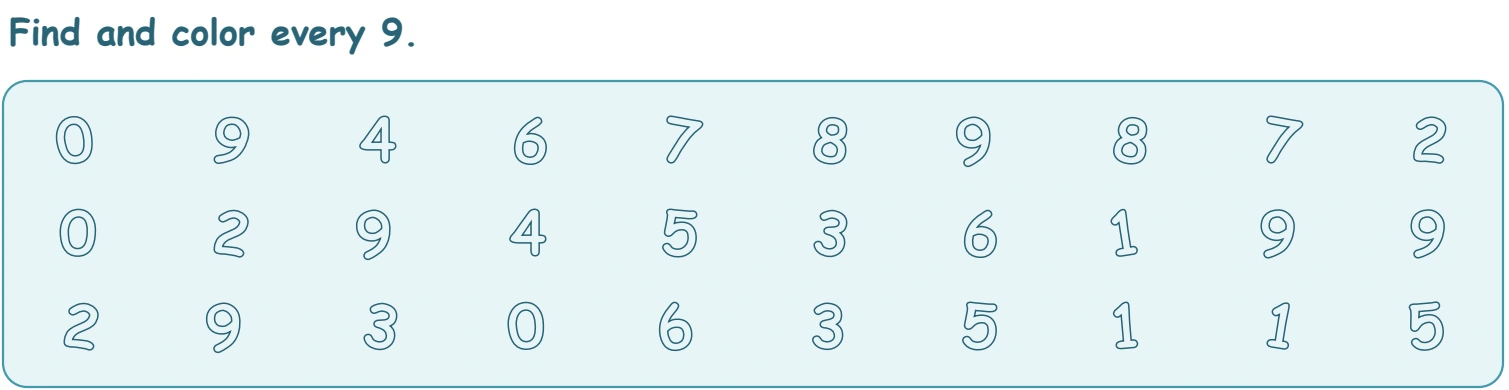
The numeral hunt includes thirty entries with six targets matching 9. Row one has targets in columns two and seven. Row two has targets in columns three, nine and ten. Row three has a target in column two.
These positions are counted left to right for an adult check. Number 9 Worksheet symbol searching ends with six matches, while a fish quantity group ends with nine objects. The results differ because the tasks ask different questions.
Inspect the adjacent targets near the end of the middle row as separate entries. A learner can use a pointing scan to check each position rather than jumping ahead after recognizing the first correct symbol in a pair.
If a nonmatching shape is colored, compare its complete outline beside the Number 9 Worksheet target. Round parts alone do not establish a match. The location of the loop and the continuation of the shape both contribute to the intended numeral.
Keep the Number 9 Worksheet loop above its downward continuation
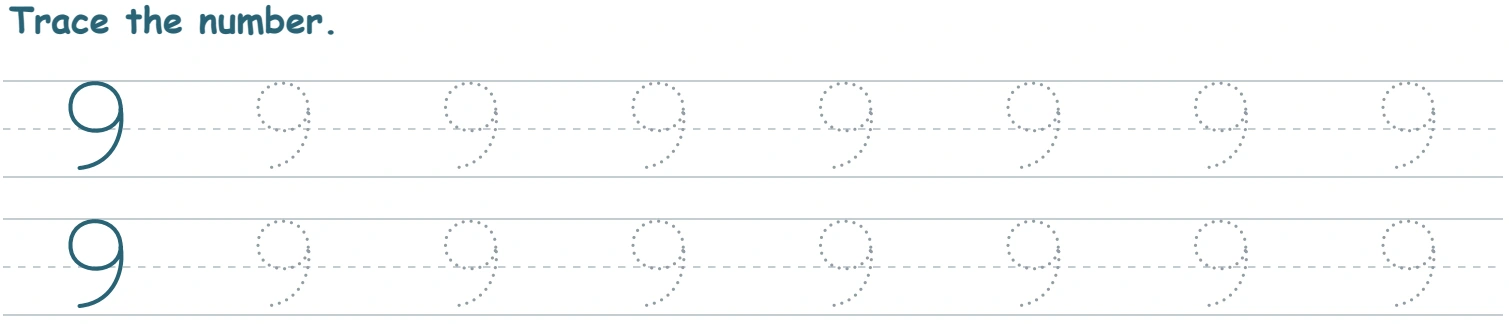
The solid 9 provides a model with its loop in the upper region and a curved part continuing downward. Look at that orientation with the page upright before tracing. It differs from the low-loop 6 printed among the search distractors.
Follow a single Number 9 Worksheet dotted form with a finger, then try a pencil if appropriate. An adult can draw the same model on scrap paper, leaving space for the learner to compare where the loop sits.
If a loop is placed low and the result resembles 6, inspect the particular difference rather than only renaming the numeral. If the downward continuation is absent, show which portion of the model has not yet been represented.
The Number 9 Worksheet rows offer repeated opportunities, not an obligation to fill every form during one session. A meaningful attempt can involve noticing and adjusting one part of the shape.
Set up a Number 9 Worksheet classroom survey conversation
One learner reports an initial impression while a partner asks how it could be checked. The pair then chooses a visible counting route. Let the checker follow the pointer, noticing whether the lower four fish are included.
Ask what evidence supports the final report and whether anything changed after inspection. Number 9 Worksheet conversation should welcome an understandable correction, instead of treating the first spoken answer as a permanent score.
For preschool or kindergarten work at ages three to six, share the demands as needed. A teacher might supply number words, organize the route or write a dictated amount while the learner points. Others may be ready to explain the full method independently.
The outline fish can provide a creative pause. Number 9 Worksheet coloring invites a chosen pattern and a description of picture features, with the counted group available when attention returns to quantity.
An adult Number 9 Worksheet notebook guide
| Evidence source | What belongs in the check |
|---|---|
| Upper fish survey | Five fish above four; nine complete objects |
| Formation model | Upper loop with downward continuation |
| Numeral hunt | Six matching 9 entries within thirty positions |
| Row target pattern | Two matches, then three, then one |
| Outline picture | One fish for chosen coloring |
| Lower recorded amount | Nine smaller fish support the written 9 |
Use the guide to interpret what the learner did. A missing lower fish, a selected distractor and an unfinished numeral need different next steps. The visible result alone may not reveal which demand caused the difficulty.
Make another Number 9 Worksheet visit about a useful second look
Begin a later session with one check that proved helpful: following the lower row, comparing the upper loop, or inspecting two adjacent search entries. Invite the child to show that check before offering a new demand.
Number 9 Worksheet encouragement can name a concrete discovery: “Your second look found the fish beyond the one you stopped at.” A correction supported by a clear location gives the learner a method to reuse.
For movement preparation, the introductory line-control worksheet keeps the focus on basic paths. The ten-path tracing practice resource offers varied routes. The number-five counting and coloring activity can provide a smaller pictured amount when useful.
Prepare a Number 9 Worksheet paper copy and find its package
Select the original branded PDF for the free sample. Current members with eligible access can retrieve the clean Number 9 Worksheet premium copy. Website-name and domain watermarks are removed from that file, with no ads added to its printable content.
Set the print dialog to Letter paper, portrait orientation, and a scale that retains the complete sheet. Inspect all four lower-row fish and the dotted 9 continuations on a test print. Keep the lower response area visible rather than enlarging only the top collection.
A $3 combined PDF is available through Attached Premium Package, bringing this fish survey together with the other nine number worksheets. A checked report can improve on a first impression. Let the child explain what the second look revealed.
Popular Worksheets
Printable resources families and teachers are downloading now.
 Free
 Free
 Free
 Free