
Ocean Missing Numbers: 4 Wonderful Shell Bridge Tasks
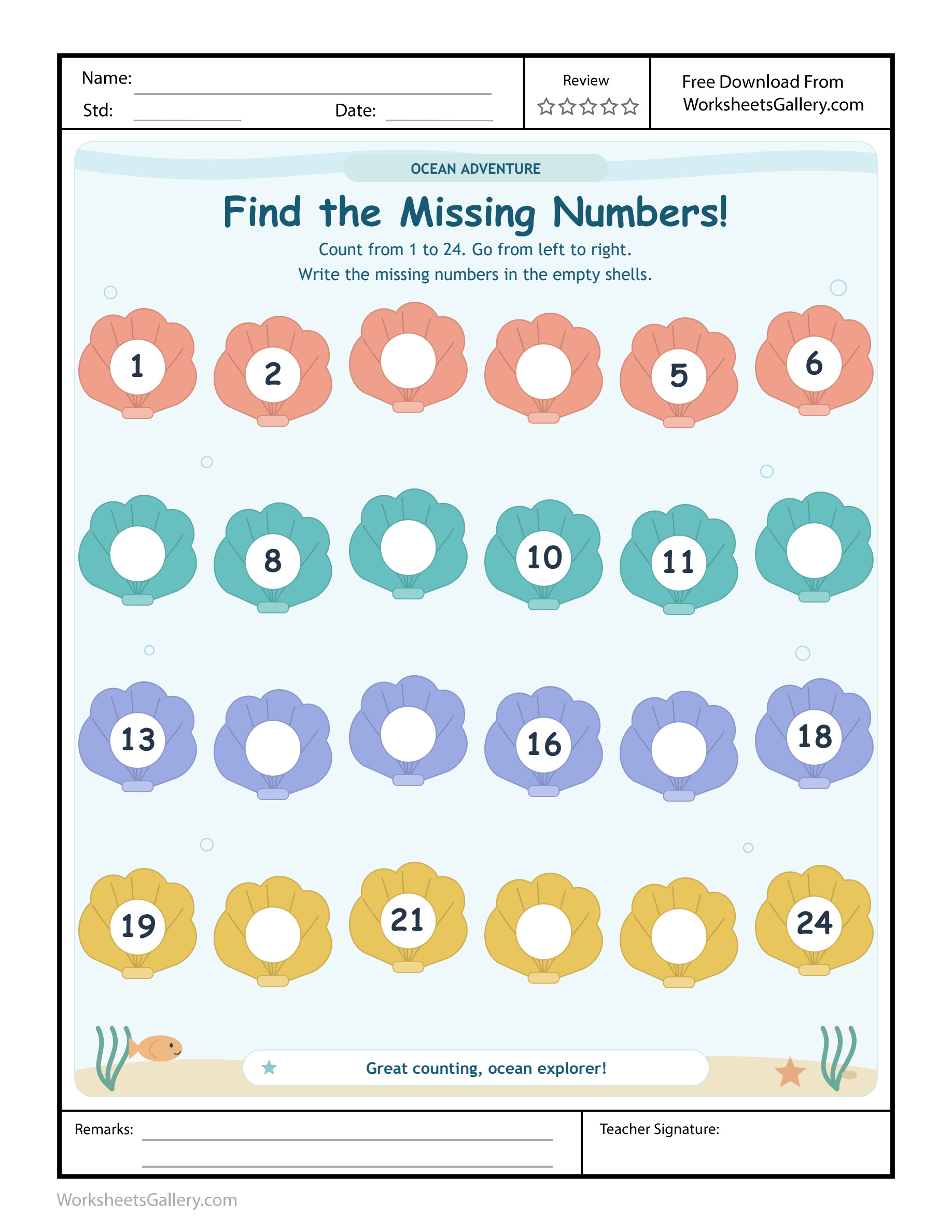
Two empty shells between known numbers are a little bridge waiting to be built. Ocean Missing Numbers asks a child to travel across that bridge one step at a time, then see whether the route reaches the printed number on the far side. The picture is playful, but the evidence is precise: shell positions run from one through twenty-four. A learner can say the missing pair, move a finger along its places and write only when ready. The destination provides a way to check an answer without turning every uncertain gap into a guess.
🐚 Which Ocean Missing Numbers shore can you trust?

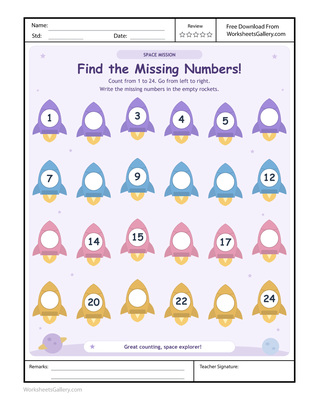
The coral shell row on Ocean Missing Numbers gives 1, 2, two empty centers, 5 and 6. Starting at 2, speak the next values as a finger visits each gap: three, four, five. Reaching the already printed 5 checks the bridge. The two blanks therefore need different consecutive entries. Neither blank takes 5 simply because that is the nearest visible numeral on its right.
An Ocean Missing Numbers clue is a numeral already supplied in its proper position. A neighbor can support an answer from the left or help check it from the right. At first, a learner may need to count from 1. Later, recognizing 2 or 13 may allow a shorter restart. Both approaches can be useful; the important part is keeping one spoken number with each main shell center.
Ocean Missing Numbers contains twenty-four main shells, arranged as four rows of six, with eleven unanswered spaces. Their colored groups mark rows, not separate counting systems. Continue from 6 to 7 when moving down, and from 12 to 13 at the next return. The small bubbles, fish and starfish decorate the ocean setting and do not join the numbered route.
Listen before judging an Ocean Missing Numbers answer
Ask a child to explain one Ocean Missing Numbers bridge without writing. If the correct spoken numbers fit the positions but a pencil response reverses digits, work on the written representation separately. If the oral run also changes order, keep the known shore visible and count slowly through the spaces. These observations lead to different support, even when the finished-looking answer initially appears equally uncertain.
Ocean Missing Numbers is a practical choice for many four- to six-year-olds who are extending their count into the twenties. Readiness varies. A younger child might point through the first short bridge with an adult, while an older beginner may still prefer numeral cards. The sheet should invite a supported next step, not act as a test that every preschool child ought to finish alone.
A small Ocean Missing Numbers support menu
| What the bridge reveals | A useful response |
|---|---|
| The child knows the spoken pair but cannot write it. | Offer adult-written numeral cards beside the shells. |
| Both blanks receive the same numeral. | Touch each Ocean Missing Numbers position while counting onward. |
| The count restarts at one on a new row. | Read the old row ending and new beginning together. |
| The hand tires before the reasoning does. | Let an oral bridge complete the current turn. |
Use Ocean Missing Numbers feedback to describe the particular decision that worked. “You kept going after thirteen” tells the child more than a broad judgment about being good at math. A checked route is stronger evidence than a hurried filled space. Offer a chance to reconsider an Ocean Missing Numbers answer before recording it permanently in a small center.
Benji builds an Ocean Missing Numbers bridge at home
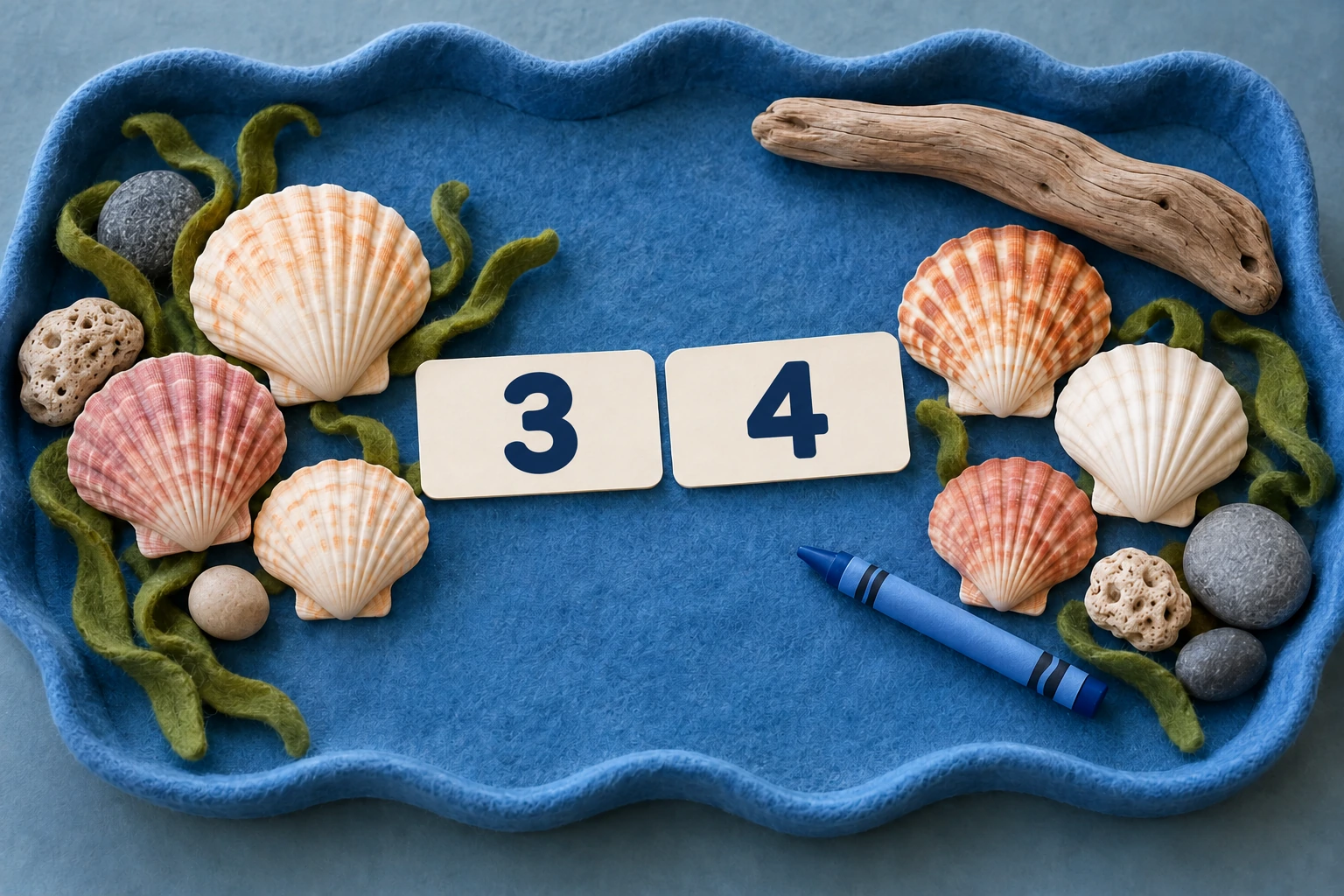
Benji and his father place the numeral cards 3 and 4 between shell props in a blue felt tray. The Ocean Missing Numbers sheet stays nearby as the real source of the problem. His father points to the printed 2 and 5; Benji assigns three and four to their two intervening positions. They say the whole short run again, making the known far shore part of the explanation rather than a number copied into a gap.
For a home Ocean Missing Numbers visit, first read the direction aloud. Next, choose a shell run short enough to follow comfortably. Let the learner point or speak before offering a pencil, and finish by returning to a printed checking value. A plain strip of paper can hide other rows while leaving the current pair of clues visible. The child is still solving the Ocean Missing Numbers route, with less visual competition.
Benji enjoys naming the two cards as a bridge, but Ocean Missing Numbers does not require an elaborate story. Another learner might simply like testing whether their spoken run lands on 5. Invite the form of explanation that feels natural: a gesture, a short phrase or a moveable card. The shared problem supplies interest without needing a prize for finishing every shell.
Ocean Missing Numbers bridges below the first row
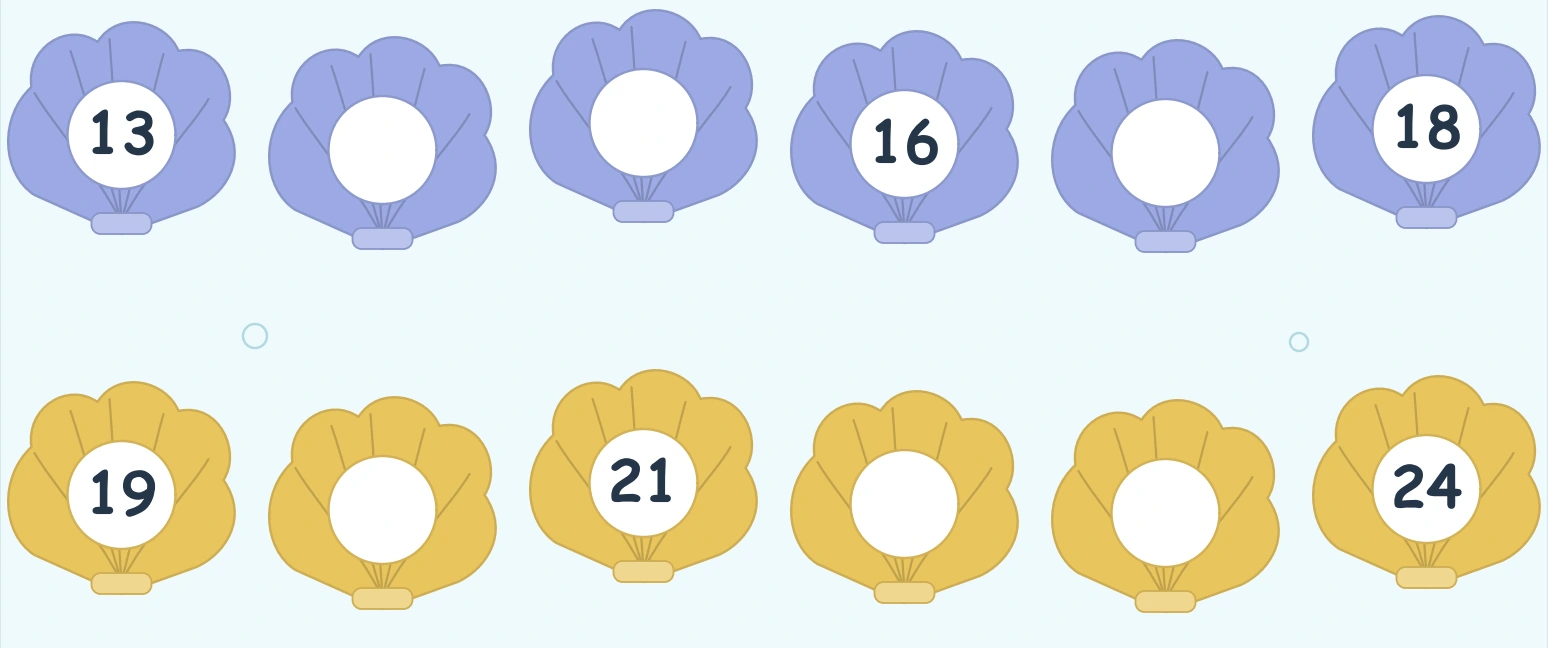
The purple Ocean Missing Numbers row begins at printed 13, leaves two gaps, then shows 16, another gap and 18. Count fourteen, fifteen, sixteen to test the pair after 13. Later, 17 fits between 16 and 18. These are two different bridge lengths in one row, so avoid applying a rule such as “every blank has one missing number beside it” without inspecting the actual spacing.
The yellow Ocean Missing Numbers row reads 19, empty, 21, empty, empty, 24. It needs 20, then 22 and 23. Starting at 21 gives a short path to the final printed 24. A learner can compare how many positions must be visited before reaching the checking shore. This concerns the sequence of labels, not adding together the printed numerals as an arithmetic sum.
Adult Ocean Missing Numbers check list
The eleven Ocean Missing Numbers answers, read by row, are 3 and 4; 7, 9 and 12; 14, 15 and 17; then 20, 22 and 23. Keep this Ocean Missing Numbers check list for reviewing an attempted bridge. It need not be read out before the child has inspected the neighbors. If the result differs, return to one relevant printed clue and let the learner test the local sequence.
Five Ocean Missing Numbers gains hidden in a short bridge
Ocean Missing Numbers turns a neighbor into evidence
A visible 5 can confirm the route through 3 and 4. The learner begins to use information around a blank rather than choosing a familiar numeral merely because it looks plausible. This gives an explanation a specific reference point another listener can inspect.
Ocean Missing Numbers gives counting on a clear job
Restarting from a known shore can shorten the path to a missing value. Keep a full count available when it is needed. The useful development is choosing a dependable starting point, not being forced to abandon a strategy that currently makes sense.
Ocean Missing Numbers keeps two consecutive labels distinct
Paired openings require two positions to receive two different values in order. Reaching the next supplied numeral checks both decisions together. This gives a child practice holding a short sequence in mind while a finger or card preserves its place.
Ocean Missing Numbers supports spoken mathematical explanation
Before, between and after describe relationships the child can point to. An adult can lend those words without requiring a memorized full sentence. The explanation grows from a visible shell run and remains useful even when writing is not the child's chosen response.
Ocean Missing Numbers allows reasoning and recording to cooperate
A number can be identified aloud, selected from a card or written in its center. These response choices let an adult notice the mathematical decision separately from fine-motor effort. A two-digit label still belongs in one shell, with its digit order preserved.
Four Ocean Missing Numbers extensions for a bridge builder
1. An Ocean Missing Numbers arrival check
Choose a short incomplete run and let one partner speak while another points. Pause when the finger reaches the next given numeral and compare the spoken value with it. If they disagree, restart from a dependable shore. Exchange the roles so the observer also gets to navigate, with no speed target and no need to complete a whole row.
2. Move an Ocean Missing Numbers answer before writing
An adult writes the candidate numerals on separate loose cards. The learner places them beside the intended shell centers and reads the local run aloud. Swapping two cards makes an order change easy to test. Transfer the labels into the printed spaces only if writing is useful today; the checking conversation can be the complete activity.
3. Invent a smaller Ocean Missing Numbers crossing
Make an adult-written card run within a familiar range, hide one or two middle cards and ask another person to reconstruct the bridge. The learner can choose the hidden positions after seeing an example. Keep the extra range manageable rather than automatically stretching beyond twenty-four. Its purpose is transferring the neighbor strategy to a fresh, short problem.
4. Record an Ocean Missing Numbers navigator's clue
Ask the child which printed number helped most and let an adult record the answer on a plain card. Reopen that note during a later shell visit. The learner can demonstrate the remembered clue or choose another starting shore. A brief return with a specific question makes regular practice more purposeful than repeatedly asking how many blanks are still unfinished.
Use Ocean Missing Numbers as a classroom listening task
At a small-group Ocean Missing Numbers table, offer a pointing role, a speaking role and a checking role. Give everyone access to the printed sheet. After one bridge, change the jobs and let each learner name a useful clue. An adult may write a dictated answer for a child whose reasoning is clear but whose numeral formation still needs support.
Ocean Missing Numbers corrections can remain local. If a child jumps over empty centers, model one careful touch per position. If adjacent gaps get matching labels, say the connecting run together. Keep both shores visible while repairing the bridge. A short successful check is a reasonable finish; more shells can wait until interest and hand comfort return.
Print Ocean Missing Numbers and choose a suitable response
The free Ocean Missing Numbers file is the original PDF. A clean premium copy is available through eligible active membership, removing the printed website identity, domain references and watermark branding. That member file has no embedded advertisements. Select US Letter portrait when printing, inspect the page boundary in the preview and keep every shell visible rather than enlarging the picture until a row clips.
For other entry points, explore a close look at five before longer sequences, simple pathways for a steadier pencil start and more tracing routes with changes of direction. Further family ideas are available through NAEYC's mathematics articles for families and the PBS Family Math counting discussion. A navigator can stop once the bridge reaches a trustworthy shore.
Popular Worksheets
Printable resources families and teachers are downloading now.
 Free
 Free
 Free
 Free