
Vehicle Number Choice: 4 Brilliant Traffic Count Stops
A counting finger needs a route when the vehicles do not all share one line. Vehicle Number Choice turns buses, boats, a plane, engines and trucks into five short journeys, each ending at a matching numeral. Children inspect a picture group, visit every complete vehicle once, and circle one of three possible answers. The totals range from one airplane to ten trucks. Before starting a longer group, agree on where the finger will begin and where it will go next. A simple route can keep a busy transport scene from becoming a repeated or unfinished count.
🚌 Vehicle Number Choice plans the first bus journey

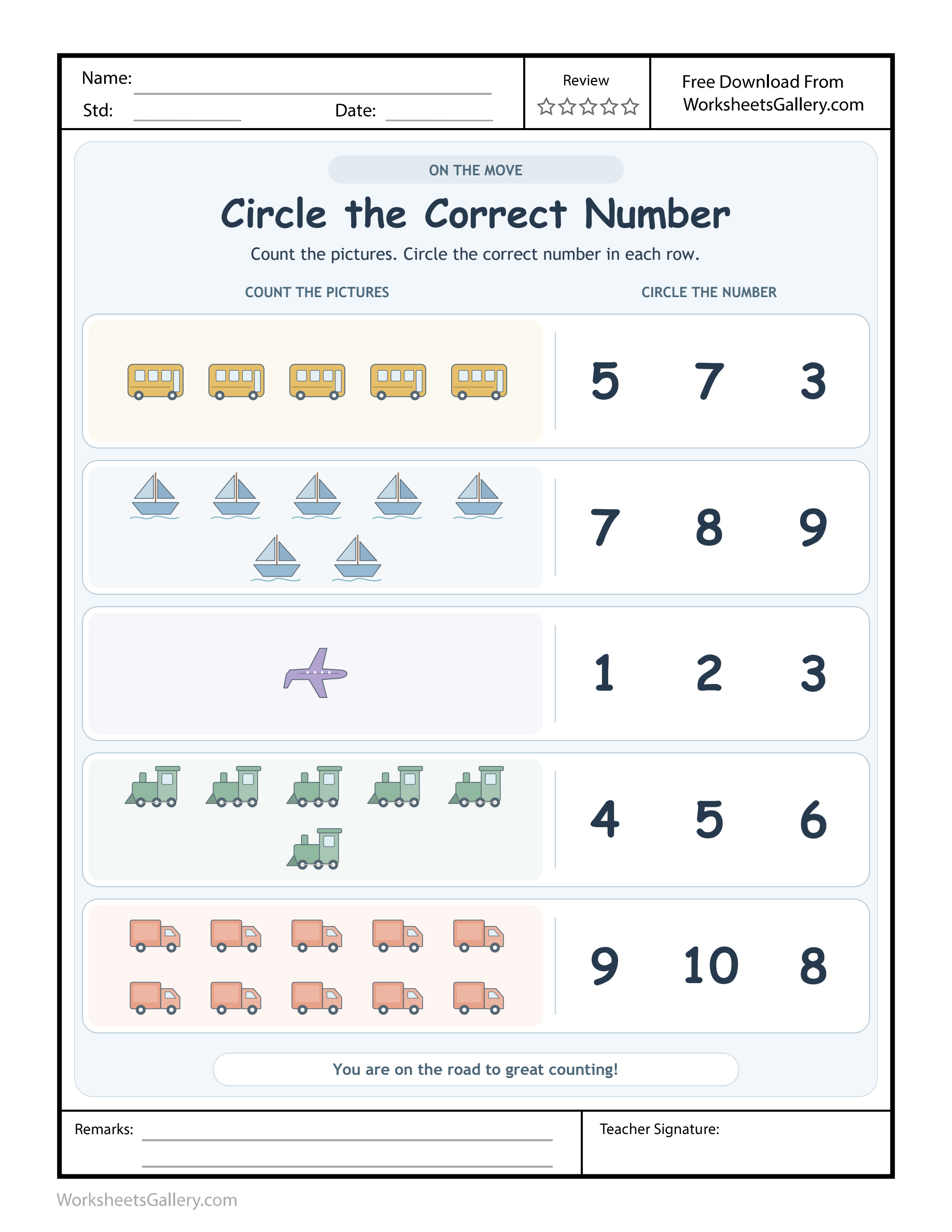
Five buses line up beside 5, 7 and 3. Start at the left bus and move steadily across, giving each complete vehicle one number name. Vehicle Number Choice begins with a single line that makes the route easy to see. Once the child reaches five, keep that total while finding its numeral at the left of the choices.
The buses have several windows and wheels, but they remain five vehicles. Vehicle Number Choice is about those complete pictures rather than the small features within them. Point near a bus body if the learner's finger begins following windows instead. The question “Which vehicle did that number name?” can clarify what each touch represents.
Vehicle Number Choice offers different route lengths
The one-plane problem can suit a beginning counter, while the ten-truck group requires a longer scan. Vehicle Number Choice can be explored across roughly ages three to six with support fitted to experience. A child who enjoys naming vehicles may still need an adult pointer to coordinate the count, and an older learner may use one tricky group for review.
Readiness is not an all-or-nothing requirement for the whole sheet. Vehicle Number Choice allows pointing, oral answers or supported circling for selected problems. If following a route is the main focus today, an adult can read the numeral choices afterward. If the route is secure, let the child take responsibility for finding the matching symbol too.
A home Vehicle Number Choice route with Jae
Jae reaches the lower sailboats and then points back at an upper boat he has already counted. His mother asks him to show where he finished the first line. They plan a left-to-right trip across the upper five, then return to the first lower boat for six and seven. Vehicle Number Choice gives the return movement a clear job.
At home, place the page on a stable surface and let the child trace a route with a hovering finger before counting. Vehicle Number Choice does not require drawing arrows on the worksheet. Once the route is understood, touch each vehicle, name the total and select its numeral. A pencil can wait until the learner has made the mathematical decision.
If the child forgets the total while scanning the answers, repeat a short phrase such as “seven boats.” Vehicle Number Choice keeps the pictures available for another look. A recount can follow the same planned route, letting the learner test whether the finger and spoken sequence remain coordinated rather than beginning a completely different trip each time.
A Vehicle Number Choice route card
- Find the group boundary. Count only the vehicles in the current problem.
- Choose the starting picture. A consistent leftmost beginning is easy to share.
- Continue through lower pictures. Keep the same counting sequence after changing lines.
- Stop at the last vehicle. State its count word as the complete group quantity.
- Locate and circle the numeral. Keep the three alternatives distinct while recording the answer.
Vehicle Number Choice gives every group a fresh count. After seven boats, the single airplane is one, not the eighth vehicle in a running whole-page tally. State the new vehicle name before beginning another problem so the learner knows which collection the question concerns.
Vehicle Number Choice checks the transport log
The verified quantities are 5 buses, 7 sailboats, 1 airplane, 6 train engines and 10 trucks. Use this Vehicle Number Choice log after the learner has inspected a group. The sheet asks for counted quantities, without a written addition task, tracing sequence or request to name the numbers in ascending order.
| Transport group | Choices in order | Route to inspect |
|---|---|---|
| Buses: 5 | 5, 7, 3 | One line of five. |
| Sailboats: 7 | 7, 8, 9 | Five above two. |
| Airplane: 1 | 1, 2, 3 | One complete aircraft. |
| Engines: 6 | 4, 5, 6 | Five above one. |
| Trucks: 10 | 9, 10, 8 | Two lines of five. |
The choices change position across Vehicle Number Choice. A left answer fits buses, boats and the plane, but the engine total is on the right and the truck total is in the middle. Counting evidence remains necessary even when the same pencil location happened to work several times before.
Vehicle Number Choice lands at one airplane

One aircraft sits in the third picture group with 1, 2 and 3 beside it. The wings and tail belong to that single plane. Vehicle Number Choice can give a learner a reassuring short turn between longer collections, especially when the boat route required support or a restart.
Accept immediate recognition of one if the child can indicate the complete aircraft. Vehicle Number Choice does not need extra invented steps to make the small group harder. Ask for a clear selection of 1 and a comfortable mark, then let the child decide whether to attempt another route or close the transport log for now.
Five observations from Vehicle Number Choice
Vehicle Number Choice gives scanning a plan
A chosen route tells the eyes and finger which picture comes next. This can reduce accidental returns to vehicles already visited. Observe the movement itself, especially at the change to a lower line, before interpreting an extra or missing counting word.
Vehicle Number Choice joins one object with one word
Every complete bus or boat receives a single number name. The pace of speech should follow the pointing movement rather than race ahead. An adult can move the pointer while the child names numbers, then exchange roles to inspect the coordination from another angle.
Vehicle Number Choice uses quantity language
“Six engines” names a complete collection. Saying the vehicle noun with the total can make the result easier to discuss and remember. A learner may communicate through a familiar language or a pointing gesture while the adult models the relevant number phrase.
Vehicle Number Choice makes numeral recognition functional
The symbol 10 represents the ten trucks already counted. A child who has the quantity but needs help recognizing the numeral can hear all choices read aloud. Keep that assistance distinct from supplying the quantity so the learner's counting work remains visible.
Vehicle Number Choice gives the pencil a clear destination
Circling one intended numeral asks for controlled movement and a deliberate stop. A slightly irregular shape can still communicate the answer. If marking takes too much effort, accept the child's pointed choice first and practice a larger loop on another piece of paper.
Vehicle Number Choice at a classroom transport table
Offer a navigator role and a number-reporter role. The navigator points through a group while the reporter names the sequence and final quantity. Switch for the next problem. Vehicle Number Choice lets each learner attend to a useful job without assuming that the child holding the pencil did all the counting independently.
Ask a learner to describe the route before a second attempt on the engines or trucks. Vehicle Number Choice can show whether a lower picture was missed, a previously counted one was revisited or a numeral was misidentified afterward. Keep notes on those specific actions, and let a quiet learner demonstrate with a pointer rather than compete with a partner's spoken speed.
- Leave both levels of a staggered group visible.
- Use a pointer that does not hide the next vehicle.
- State when a new transport group begins.
- Allow the final total to be repeated before numeral selection.
- Offer an individual turn after a shared demonstration.
- End with a route the learner can explain.
Four Vehicle Number Choice depot games
1. Vehicle Number Choice fills five bus bays
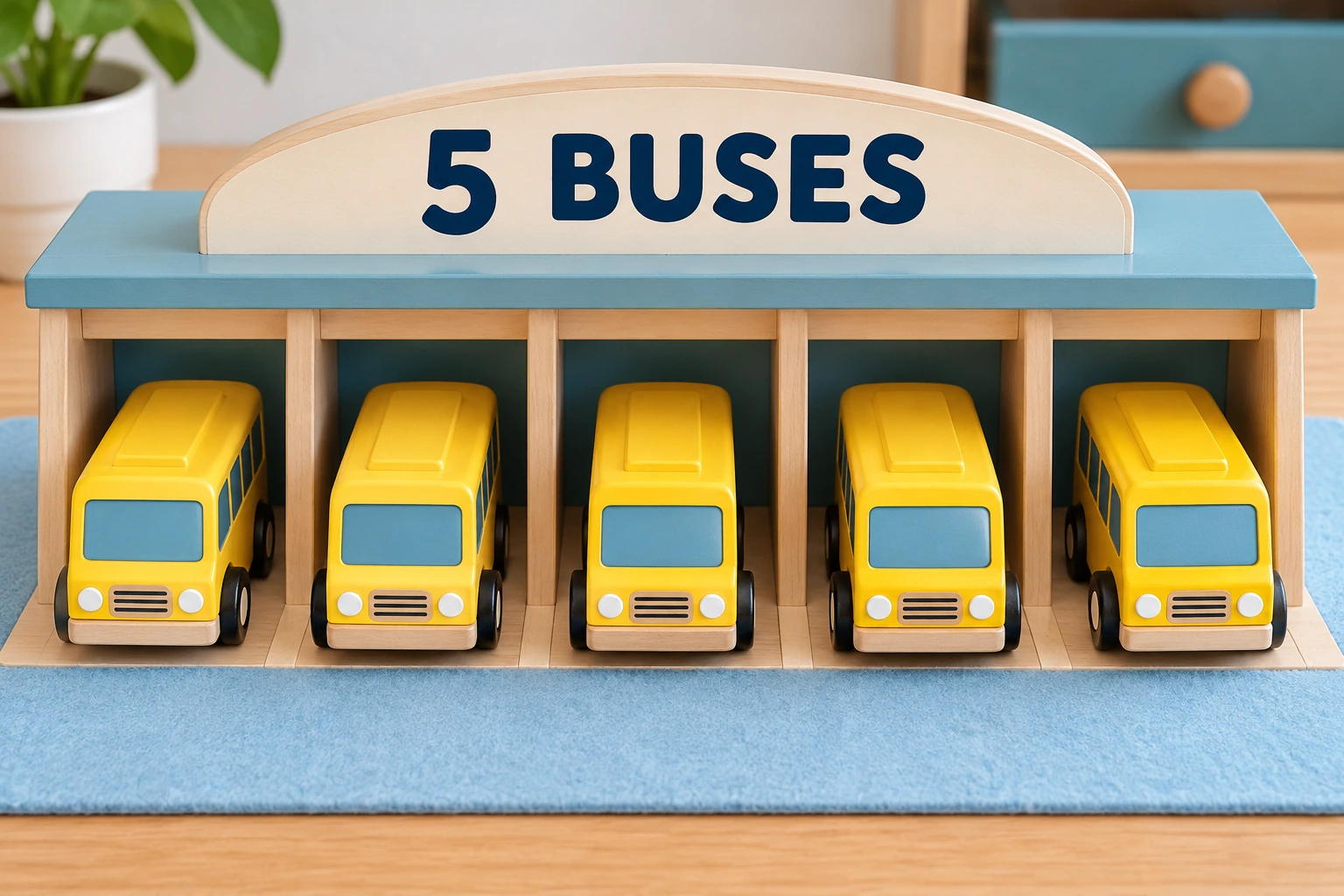
Park five toy buses in separate bays beneath a 5 BUSES sign. Ask the child to plan a visiting route and count each bus once. Move the buses out of their bays without adding vehicles and check the total again. The organized depot is a starting aid, while the later arrangement invites another deliberate look.
2. Vehicle Number Choice guides seven boats
Make seven boat cards in a five-and-two arrangement. A toy harbor guide follows the learner's directions through both lines. Stop before the lower pair and ask where the trip continues. The child controls the route, then an adult supplies the number words on another turn so both roles remain available.
3. Vehicle Number Choice visits one airfield
Place one plane card on a pretend runway and offer cards 1, 2 and 3. Let the child explain how many complete aircraft are present despite the visible wings. Move the plane card to another part of the runway and ask again. Location changes without adding another plane.
4. Vehicle Number Choice audits a truck depot
Arrange ten truck cards as two equal lines. Ask the learner to name a route before the count and place a 10 label after checking. A partner can inspect whether every truck received one visit. If the count differs, compare routes and repair the report before changing the label.
Vehicle Number Choice returns through the trucks

The upper five trucks and lower five trucks form one ten-vehicle collection. Vehicle Number Choice offers 9, 10 and 8. Ask the child to continue from the upper line to the lower line without restarting at one. An adult can gesture toward the next uncounted truck while leaving the final total for the learner to determine.
If the child counts wheels, name trucks as the current unit. If the child points twice at a vehicle, retrace the planned route slowly. Vehicle Number Choice supports a practical repair when the adult can identify the movement that produced the result. Inspect the route before asking for another total.
Keep Vehicle Number Choice visits comfortable
Use one selected journey during transport play instead of making every return a full-page exercise. Vehicle Number Choice can become familiar through a repeated strategy: plan, visit, report and select. A learner who asks for another look is using the visible evidence, and that action can be acknowledged specifically.
When frustration rises, pause at a completed small group. Vehicle Number Choice will still offer longer routes on another day. “You knew where the next truck was” names progress more clearly than a general demand to be faster or neater. Invite the child to choose the first route next time, preserving a little control over the session.
Follow-up tools after Vehicle Number Choice
For a separate writing model, use the numeral-one tracing task after the plane, six-writing guidance after the engines, or the ten formation worksheet after the trucks. Pick the task linked to the observed need rather than adding all three to the same sitting.
Adults can look through PBS's mathematics resources for four-year-olds and NAEYC's maths ideas for family learning. A suitable play invitation can accompany Vehicle Number Choice while keeping the learner's own explanation at the center of the activity.
Print the Vehicle Number Choice page
The original free PDF preserves the uploaded worksheet with its website marks. Eligible active members can access the clean premium Vehicle Number Choice edition after signing in. That printable removes website-name lettering and watermark branding; advertisements are not inserted into its activity areas. Save the selected file, then open the print preview to confirm the edition and layout.
Use US Letter paper and make sure every vehicle group and answer choice fits within the printable area. Adjust fitting when a printer would clip the border, and inspect a first copy of Vehicle Number Choice before preparing more. A consistent route gives the first bus and final truck an equally clear place in the count.
Popular Worksheets
Printable resources families and teachers are downloading now.
 Free
 Free
 Free
 Free