
Space Missing Numbers: 6 Powerful Mission Checkpoints
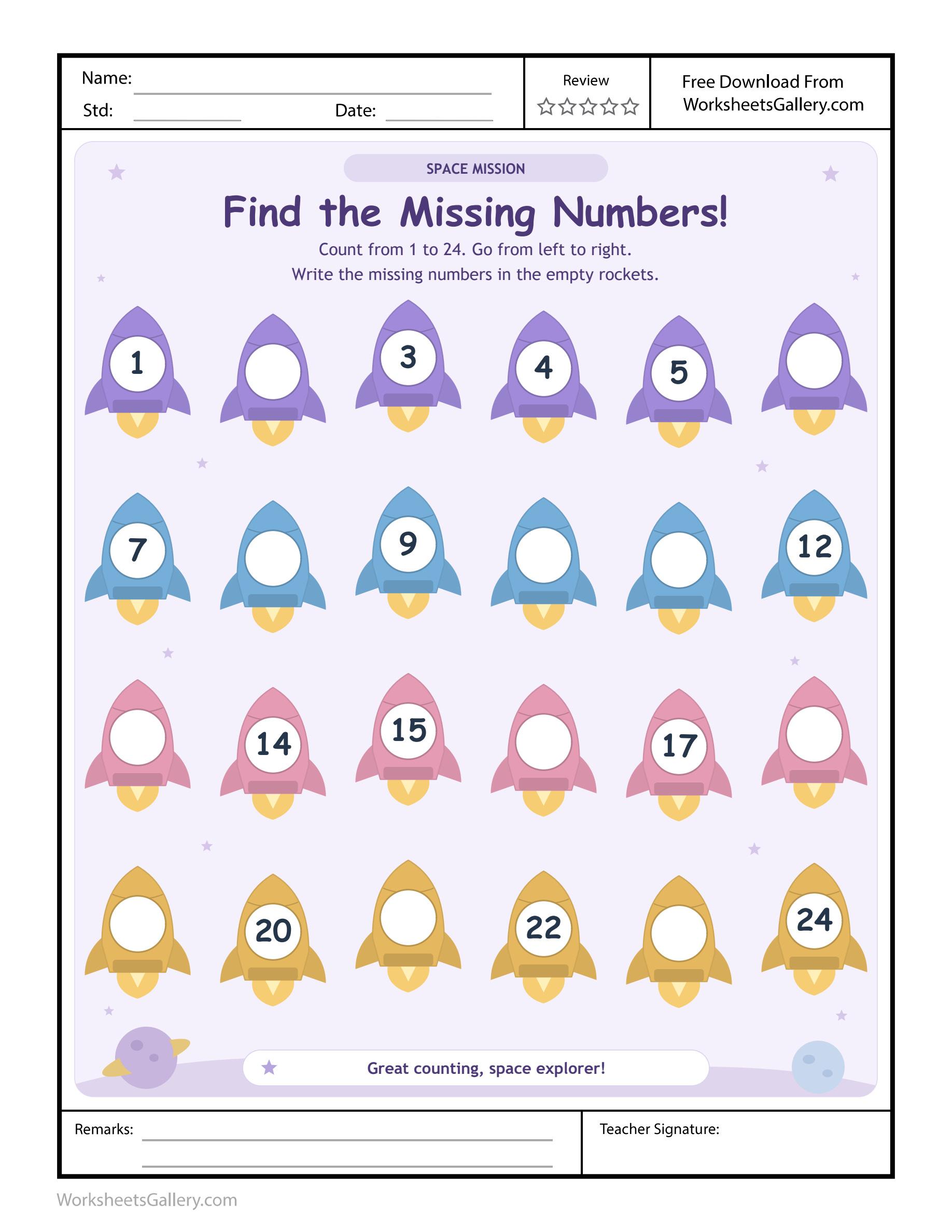
Mission control has a counting job before any pretend launch begins. Space Missing Numbers sends the rockets along an increasing route, using printed checkpoints to recover the labels that have disappeared. The sequence moves from one to twenty-four, so a countdown would take the crew in the wrong direction. A child can inspect one window, explain a short stretch aloud and test whether it reaches the next known number. The rocket setting makes the route memorable while leaving the mathematical job clear: every position needs its own correct place in the forward count.
🚀 Space Missing Numbers begins with a forward mission brief

Read the Space Missing Numbers direction with the learner: count from 1 to 24, moving across a row before returning to the next row's left edge. Four groups of six rockets provide twenty-four positions. Eleven windows are waiting for written numerals and thirteen are already labeled. Stars, planets and the rocket flames belong to the scene; the main windows carry the numerical route.
The purple Space Missing Numbers row shows 1, a gap, 3, 4, 5 and another gap. Its missing entries are 2 and 6. A child who recognizes 5 can use it as a checkpoint for the row ending. A child who prefers to start at 1 can do that too. Keep attention on a dependable route rather than demanding the shortest possible method immediately.
Space Missing Numbers suits many learners around ages four to six who are ready to work beyond the earliest number sequence. A younger child might take a short spoken turn with substantial adult guidance. Readiness depends on the learner's current counting and numeral knowledge, not a claim that every child of a certain age can complete all twenty-four positions independently.
A Space Missing Numbers checkpoint crosses into two digits

The blue Space Missing Numbers rockets give 7, empty, 9, two empty windows and 12. Recover 8 after 7. Then count onward from the printed 9: ten, eleven, twelve. The arrival at 12 checks the paired middle answers. Repeating 10 twice would fill both windows but fail that connecting run, so read the whole short section after writing.
Two digits in one Space Missing Numbers window represent one number. A learner may know that ten follows nine yet need help placing its 1 and 0 together. Compare an adult-written 10 card with the window before asking for a pencil response. This keeps mathematical reasoning separate from the physical demands of fitting and ordering two written digits in a small space.
Space Missing Numbers asks for a restart, not a countdown
The Space Missing Numbers picture may remind a child of a launch countdown. Acknowledge that association, then point back to the actual forward instruction. Say the local sequence from 9 to 12 while visiting each window. Keep pretend countdown play as a different activity; do not reverse the answers or encourage counting backward across this printed route.
Seven Space Missing Numbers tools for a thoughtful crew
Space Missing Numbers makes a checkpoint useful
A known printed value offers a place to restart. The learner can count onward through a short uncertain section instead of facing the entire mission at once. An adult should still allow a complete count when that is the strategy the child currently trusts.
Space Missing Numbers lets arrival test a plan
Reaching printed 12 after filling 10 and 11 checks more than one choice. The child can compare a spoken arrival with visible evidence. A mismatch becomes a reason to inspect the intervening windows rather than an instruction to guess another isolated answer.
Space Missing Numbers gives each window one value
Touching or pointing to a whole rocket window keeps the numerical sequence aligned with its positions. A blank window still receives its spoken number. This discourages skipping an empty space while continuing to say only the labels that happen to be visible.
Space Missing Numbers connects a spoken teen to its numeral
The child can say sixteen, choose a 16 card and then decide whether to write it. Those responses are related but not identical tasks. Keeping the choice visible helps an adult distinguish uncertainty about the sequence from difficulty forming or arranging the digits.
Space Missing Numbers requires attention at a row return
After a row's final rocket, the next value belongs at the following row's left edge. A broad pointing movement can show this change. The count continues even though the eye travels back, giving visual tracking a precise role in the mission.
Space Missing Numbers gives a partner something to hear
A short spoken explanation can identify the checkpoint that supported an answer. The listener can follow the same windows and test the reasoning. Mathematical language grows from a shared route rather than from reciting a sentence that the learner does not yet understand.
Space Missing Numbers can preserve a remembered strategy
An adult note such as “counted from nine to check twelve” records an observable action. On another day, the learner can revisit that action with less support or explain why a different checkpoint helps. Regular practice then has continuity beyond a tally of completed spaces.
Inspect the Space Missing Numbers pink and gold sectors

The pink Space Missing Numbers row spans 13 through 18. It supplies 14, 15 and 17, leaving 13, 16 and 18 missing. The first window needs a value before printed 14. If the learner is unsure, trace the route forward from the previous row's 12 rather than expecting independent backward counting. That earlier endpoint can supply a useful starting clue.

The final Space Missing Numbers sector gives 20, 22 and 24 in the second, fourth and sixth windows. It needs 19, 21 and 23 in the intervening positions. During Space Missing Numbers, a child can test the opening by reading seventeen, eighteen, nineteen, twenty from a reliable earlier point. The worksheet does not ask for addition of the visible labels or for a count of rocket parts.
Adult Space Missing Numbers mission check
The missing Space Missing Numbers labels, grouped by source row, are 2 and 6; 8, 10 and 11; 13, 16 and 18; then 19, 21 and 23. Keep the list for checking an attempt, with the printed clues available to the child. Giving all answers before the learner explores would replace the mission's reasoning with copying.
Amira opens a Space Missing Numbers control desk
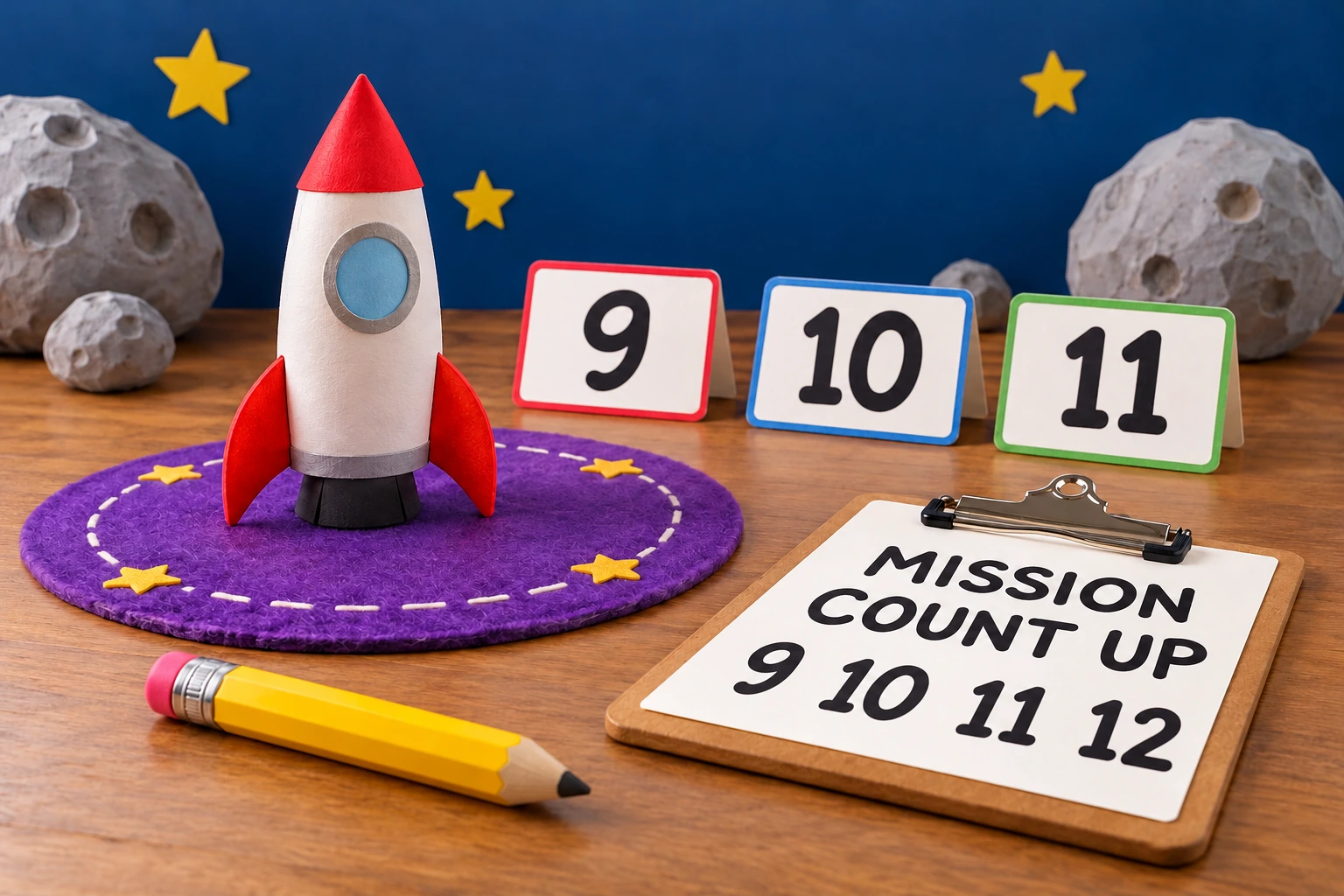
Amira and her older brother inspect checkpoint cards labeled 9, 10 and 11 beside a paper rocket. Their Space Missing Numbers mission note says COUNT UP and carries 9 through 12. He reads the note while she points to its ascending labels. They then return to the actual blue rocket row and use its 9 and 12 to discuss the two empty windows.
For home Space Missing Numbers use, choose one sector, read its direction and give the learner a speaking turn before a writing turn. Amira can dictate an imaginary mission report while her brother records the longer words elsewhere. Her own task remains a selected number or explanation. The story offers a purpose without requiring a beginner to write a report and eleven answers in one sitting.
If Amira becomes frustrated after a digit reversal, Space Missing Numbers can continue through a spoken check or a moveable numeral card. Her brother names the useful decision she made and separates it from the mark that needs attention. A sound mission plan can be clear before its handwriting is controlled. Finish the current checkpoint and save another for later.
Six Space Missing Numbers activities beyond the printed mission
1. A Space Missing Numbers radio check
One crew member speaks a short forward sequence while another points to the matching windows. Pause at a printed checkpoint and compare its value with the spoken arrival. Swap the two roles. The useful challenge is coordinating the route, not speaking quickly or completing a full sector before another learner gets a turn.
2. Move Space Missing Numbers cards into a short flight path
An adult prepares a familiar run of numbered cards and removes one middle card. The child chooses its replacement and explains which neighbor helped. Let the learner remove a card for the adult on a later turn. Keep this extra route short enough to inspect; it is a transfer game rather than an additional twenty-four-item assignment.
3. Give Space Missing Numbers a two-digit planning pad
Offer a broad scrap of paper for a spoken answer such as 10 or 16. The learner can inspect an adult model, arrange its digits and compare the result with the intended value. Returning to the smaller window is optional. The pad targets recording after the numerical choice, so a handwriting difficulty does not hide the child's correct reasoning.
4. An adult takes a Space Missing Numbers wrong turn
Deliberately repeat one number in an adult-spoken short run and invite the child to stop the mission when it stops matching the windows. Return to a given checkpoint to repair it together. Make the error playful and transparent. The child is testing a route, not being tricked into accepting an adult's authority over the printed evidence.
5. Sketch a Space Missing Numbers checkpoint report
Let the learner draw a rocket and dictate how one missing label was recovered. An adult records the explanation and reads it back. The child may add the selected Space Missing Numbers numeral beside the drawing. Their imaginative report can become a reminder for another visit without requiring independent spelling of space vocabulary or formal written mathematical sentences.
6. Return to a Space Missing Numbers saved checkpoint
Keep one note about a strategy that worked and reopen it during a later short session. Ask which printed number would support the same kind of check today. The learner may explain, point or write. A remembered starting clue gives repeated practice a changing question instead of making every return another demand to fill more rocket windows.
Run a Space Missing Numbers classroom control table
Use Space Missing Numbers with a navigator, radio speaker and recorder in a small group. Begin with a selected row, explain that the route increases, then rotate responsibilities. A teacher can observe whether a child tracks empty windows, continues across a decade or needs a model for a written teen number. Different responses can contribute to the same shared mission.
| Mission-control signal | Next check to offer |
|---|---|
| The child starts a launch countdown. | Read COUNT UP and point from 9 toward 12. |
| One answer occupies two windows. | Keep both digits together inside one number position. |
| The new row begins again at one. | Connect the previous endpoint with the next rocket. |
Choose the Space Missing Numbers correction that matches the observed difficulty. A counting cue will not by itself solve cramped numeral writing, and a neater pencil mark will not repair a broken spoken sequence. Keep the next Space Missing Numbers action small, make room for an oral success and pause when attention or hand comfort fades.
Print the Space Missing Numbers control sheet
The original Space Missing Numbers PDF is offered free. Members with eligible active access can obtain a clean Space Missing Numbers edition: domain lettering, website-name printing and watermark branding are removed, and its pages have no embedded adverts. Use portrait US Letter paper, checking the entire border and all rocket windows before printing.
Other practice options include a smaller number-five writing and picture task, broad beginner paths before narrow numeral work and additional tracing routes to inspect deliberately. Adults can explore PBS Family Math's number-sense video and NAEYC's home mathematics resources. The crew can return tomorrow with one trustworthy checkpoint already remembered.
Popular Worksheets
Printable resources families and teachers are downloading now.
 Free
 Free
 Free
 Free