
Sweet Missing Numbers: 5 Brilliant Cupcake Label Games
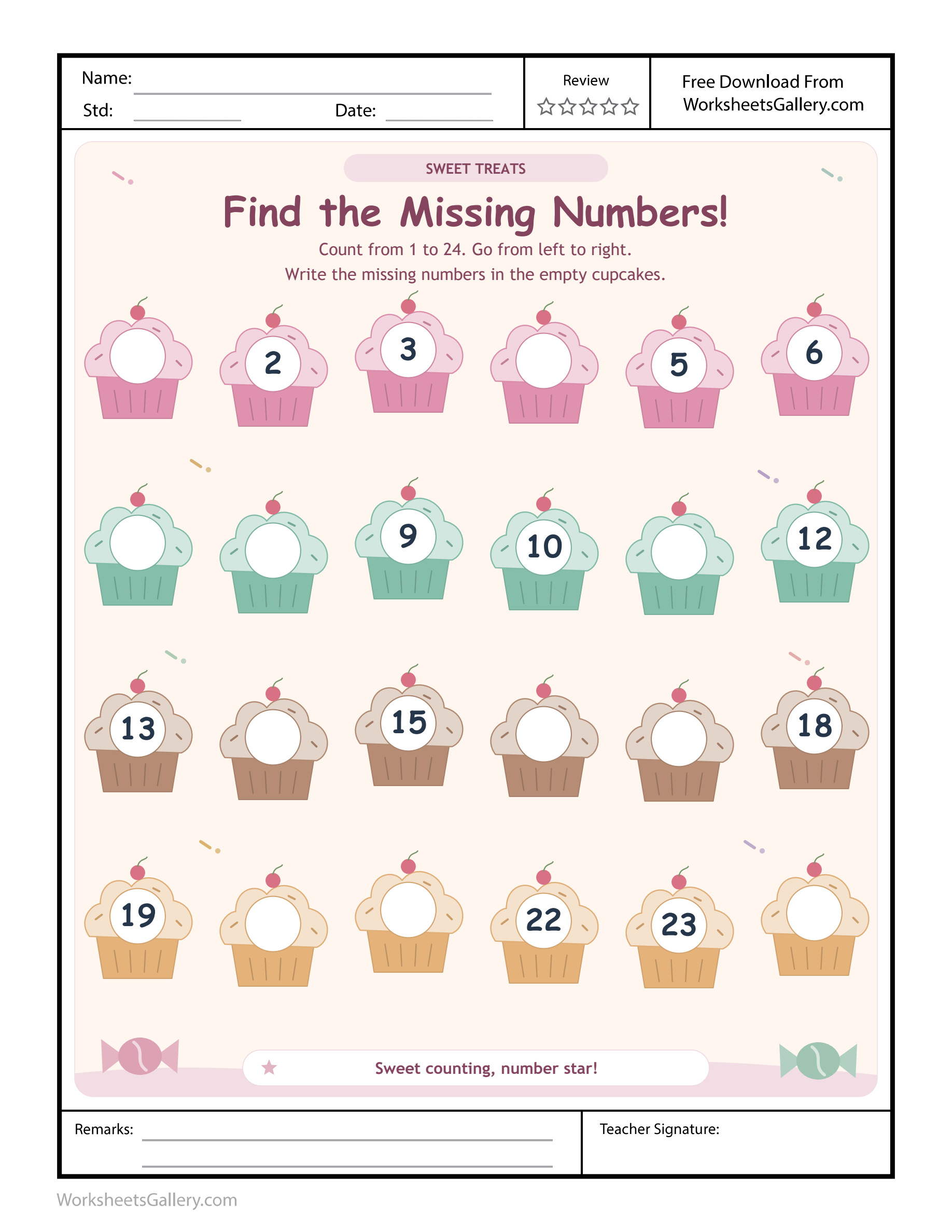
Where does a number display begin when its first label is missing? Sweet Missing Numbers gives that question a cupcake setting, with an empty opening position and an unwritten final one. The printed instruction supplies both endpoints: count from one to twenty-four. Children can use that range alongside the visible neighboring labels, rather than waiting for a clue on both sides of every gap. A pretend bakery makes the task inviting, but no real treats are required. One carefully explained label can be enough to complete a useful visit to the display.
🧁 Read the Sweet Missing Numbers range before choosing a label

The instruction on Sweet Missing Numbers names the counting range and asks for missing numerals inside the empty cupcakes. There are four rows, six cupcake positions per row and eleven gaps altogether. Thirteen numerals are already shown. The Sweet Missing Numbers task concerns those main centers; cherries, sprinkles and wrapped candies do not add extra positions to the ordered sequence.
Sweet Missing Numbers requires the count to continue when the row color changes. After the last pink cupcake, return to the mint row's left edge and continue with 7. The physical return does not restart the count. This distinction matters because a child can know many number names while still losing the route when the eye moves between differently colored rows.
For Sweet Missing Numbers readiness, look beyond a birthday. Many children around four to six will find a supported entry point if they are extending number order toward twenty-four. Others may need a shorter familiar sequence first. A spoken answer, a chosen numeral card and a written response place different demands on the learner, so offer the response that makes their current reasoning visible.
Sweet Missing Numbers has a first cupcake without a left neighbor

The pink Sweet Missing Numbers row starts with an empty center before the printed 2. Its first answer is 1 because this activity explicitly begins there. The child does not have to invent an unseen earlier cupcake. Read the instruction again if necessary, then point through one, two, three. Another gap between printed 3 and 5 needs 4, making a different kind of clue available within the same row.
A Sweet Missing Numbers learner may copy 2 into the empty opening on Sweet Missing Numbers simply because it is nearby. Test that choice aloud. Would two, two, three follow the instruction to count from one? The conversation can stay gentle and factual. An adult can write a Sweet Missing Numbers candidate on a removable card so the child can change it without repeatedly erasing the printed center.
The Sweet Missing Numbers final cupcake has no following clue

Sweet Missing Numbers ends its orange row with a gap after printed 23. The stated range confirms 24 as the last label. Earlier in that row, printed 19 is followed by two gaps before 22, requiring 20 and 21. The child therefore meets a paired middle repair and an endpoint repair in one short section, each with its own useful evidence.
Do not turn Sweet Missing Numbers into an independent backward-counting test when that is not the learner's goal. Starting from a dependable earlier value and moving forward can also establish a missing opening or ending. A child might read nineteen, twenty, twenty-one, twenty-two, twenty-three, twenty-four while pointing through the entire orange display. That complete check connects the endpoint with its route.
A Sweet Missing Numbers reference for the adult
| Display row | Missing labels from left to right |
|---|---|
| Pink: 1 to 6 | 1, 4 |
| Mint: 7 to 12 | 7, 8, 11 |
| Chocolate: 13 to 18 | 14, 16, 17 |
| Orange: 19 to 24 | 20, 21, 24 |
Use this Sweet Missing Numbers reference after a child has tried a selected section. If the labels differ, find a relevant printed clue together and reread the short run. The aim is an answer supported by the display. Simply copying the check table would fill the centers while removing the reasoning that makes the worksheet useful.
Six Sweet Missing Numbers skills beyond a filled display
Sweet Missing Numbers uses a stated boundary
The instruction identifies 1 and 24 as the limits. A learner can use information outside an individual gap to decide its value, especially where a visible neighbor is available on only one side.
Sweet Missing Numbers links a label to its position
An empty cupcake still occupies a place. Pointing through it while saying its number preserves the sequence, helping distinguish an absent written label from an absent object in the display.
Sweet Missing Numbers connects adjacent choices
Paired gaps require two consecutive values in order. Checking a complete run encourages the child to test their relationship rather than treating every empty center as an unrelated invitation to guess.
Sweet Missing Numbers makes an explanation shareable
A gesture toward the instruction or a printed neighbor can show why an answer belongs. Adult language can support that explanation without requiring the learner to memorize a complete formal sentence.
Sweet Missing Numbers separates knowing from forming
A child can identify twenty-one before being comfortable arranging its digits on paper. Oral choices and numeral cards help an adult observe the mathematical decision separately from fine-motor control.
Sweet Missing Numbers gives another visit a focus
A note about using the final 24 boundary or testing a paired gap supplies a remembered strategy. The next session can revisit that strategy instead of measuring success only by completed spaces.
Explore the Sweet Missing Numbers middle shelves

The mint Sweet Missing Numbers row opens with two empty centers before 9. It follows the previous row's 6, so those openings need 7 and 8. A later gap between 10 and 12 needs 11. Let the child read the Sweet Missing Numbers six-position run after placing the labels. The same answer cannot fill both opening centers because their consecutive positions require different values.

The chocolate Sweet Missing Numbers row shows 13, a gap, 15, two gaps and 18. Recover 14 in the single opening, then 16 and 17 in the pair. Counting on from 15 offers a short check: sixteen, seventeen, eighteen. This is a sequencing task, not a request to add 15 and 18 or count the cherries above the cupcakes.
If Sweet Missing Numbers labels become cramped, use a broad practice card for a chosen two-digit answer before returning to the small center. Keep both digits together as one numeral. A learner who says sixteen correctly but writes its digits in reverse needs a different next step from someone who cannot yet establish which value follows fifteen.
Ezra's Sweet Missing Numbers bakery desk at home

Ezra and his grandmother set felt cupcakes beside tags reading FIRST 1 and LAST 24. Those labels remind them of the Sweet Missing Numbers boundaries. She reads the instruction while he points to the first empty cupcake. He explains that it must be one, then chooses whether to write that answer or place a prepared card nearby. The props make a pretend display without using actual food as a reward.
During a home Sweet Missing Numbers turn, begin with an endpoint, read one connected row and invite a check before recording. Ezra can dictate a shopkeeper's message while his grandmother writes its longer words separately. His own contribution might remain one number label. Sharing an imaginative purpose does not require a beginner to complete a full written menu and eleven missing answers together.
When Ezra becomes disappointed by a reversed numeral, his grandmother points to the Sweet Missing Numbers choice he reasoned out correctly. They compare a fresh large card with an adult model and leave the crowded mark alone for the moment. Preserve the reasoning while giving the hand more room. A small success can close the shop for today.
A Sweet Missing Numbers display in a classroom
For a small-group Sweet Missing Numbers station, let one learner read or hear the count range, another locate an endpoint and another record an agreed label. Rotate the jobs after a short section. An adult can observe whether a child used the instruction, a neighbor or a full count. Those strategies reveal more than comparing the number of centers different children filled.
Common Sweet Missing Numbers difficulties include beginning with 2, stopping the display at 23, restarting when the color changes and copying a nearby label into a gap. Return to the evidence relevant to the error. A broad pointing return clarifies row movement; a reread of the stated range clarifies an endpoint. Keep corrections specific rather than adding every possible cue at once.
Five Sweet Missing Numbers games for another display day
1. Sweet Missing Numbers first-and-last tag search
An adult offers a small set of readable numeral cards and asks which belong at the display's beginning and ending. Keep the worksheet direction visible. Let the child explain the choices by pointing to the range, then locate the matching positions. The task is recognizing the stated boundaries, so a pencil response is optional.
2. A Sweet Missing Numbers shopkeeper reads the shelf
One partner points along a chosen cupcake row while another speaks every value, including those not printed. Switch jobs after the row. Pause at a supplied numeral to test whether the spoken route matches. The game gives a listener access to the learner's plan without asking for faster counting or identical handwriting from both participants.
3. Repair Sweet Missing Numbers with moveable labels
Place adult-written candidate cards beside a short incomplete run. The learner can rearrange them, read the sequence and test the result against a visible clue. Removable labels keep revision straightforward. Transfer an agreed value into a cupcake only if the child wants the additional writing task; the explanation may already show the intended understanding.
4. Invent a tiny Sweet Missing Numbers display
Use a familiar, short card sequence and tell a partner its starting and ending numbers. Remove one endpoint and ask the partner to restore it from the announced range. Let the learner take the announcing role too. This extra game transfers the boundary idea without demanding a newly extended range or another long twenty-four-position exercise.
5. Keep a Sweet Missing Numbers shop note
Ask the child to dictate how a first or final label was recovered, and record that explanation beside a cupcake sketch. On a later visit, read it back and invite a demonstration. A brief remembered question supports regular practice while leaving the child a choice about writing. The next shop day can inspect one idea instead of reopening every unfinished space.
Print Sweet Missing Numbers with a readable display boundary
The original Sweet Missing Numbers worksheet is free to download. Its clean premium version is supplied through eligible active membership, without printed website-name branding, domain lettering or watermark wording; the PDF includes no embedded advertisements. Select portrait US Letter paper and inspect the complete border in the printing preview. Avoid enlarging the design until the first or last cupcake falls outside the printable area.
For related choices, consider a focused visit to five before longer number routes, an introductory collection of pencil paths or a further selection of controlled tracing movements. Families can also explore NAEYC's everyday mathematics ideas and PBS Family Math's counting resource. A carefully chosen endpoint can be a satisfying place to stop.
Popular Worksheets
Printable resources families and teachers are downloading now.
 Free
 Free
 Free
 Free