
Jungle Missing Numbers: 4 Wonderful Paw Trail Repairs
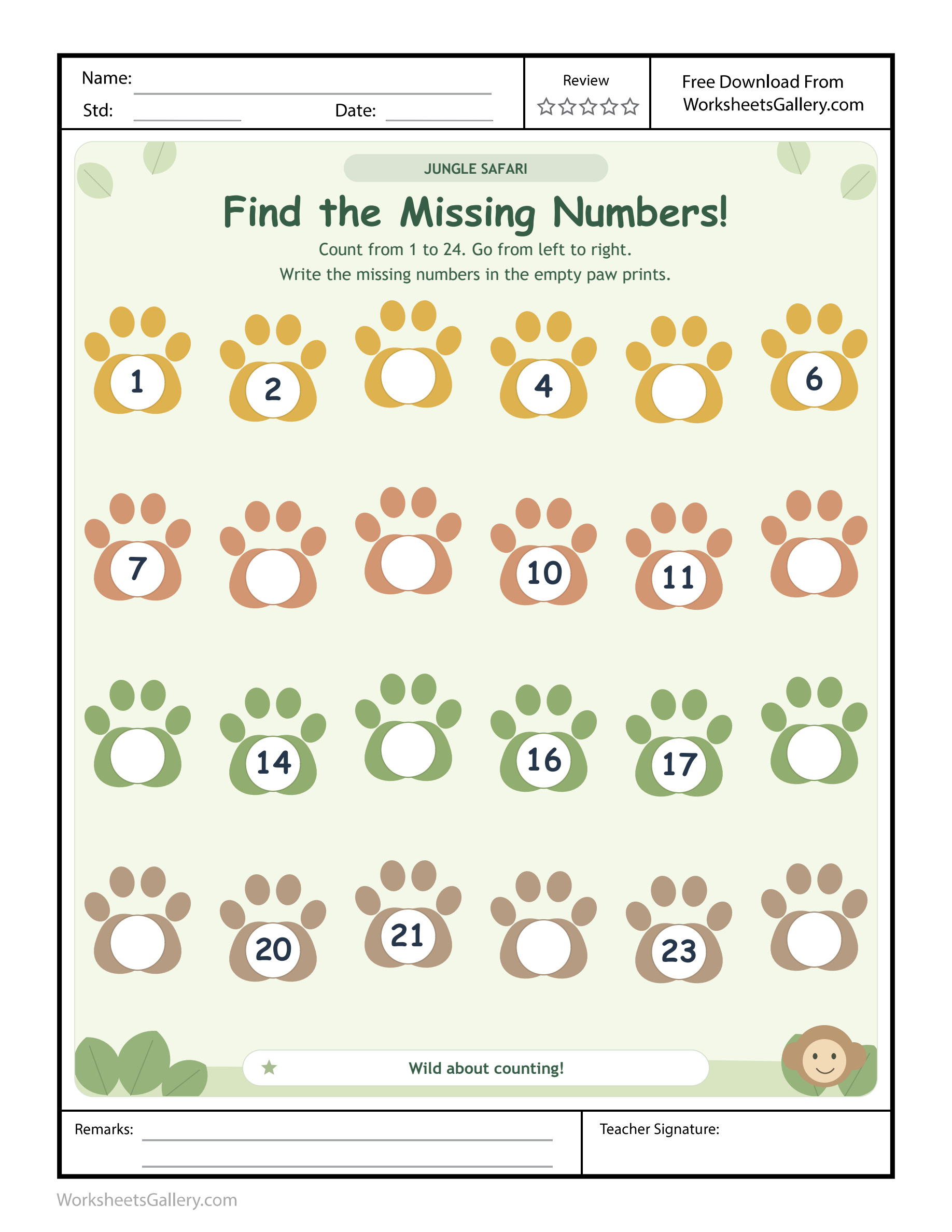
A trail can disappear from view without the number sequence stopping. Jungle Missing Numbers makes that idea concrete where one paw-print row ends in a gap and the next begins with another. Children need to carry the count across the return to the left, using printed clues before and after the turn. The leafy setting invites an explorer's explanation, but the main task stays focused on the twenty-four paw positions. A learner can point, speak, select a number card or write, giving an adult several ways to see how the route is understood.
🐾 Find the Jungle Missing Numbers turn between twelve and thirteen

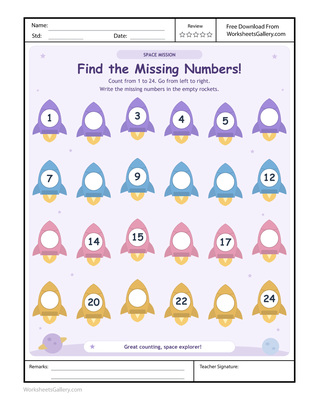
The second Jungle Missing Numbers row shows 7, two gaps, 10, 11 and a final empty center. That last space needs 12. The first two gaps need 8 and 9, so the complete row runs continuously from seven through twelve. Do not stop the Jungle Missing Numbers count at printed 11 merely because the next center contains no visible numeral to read.

The following Jungle Missing Numbers row begins with a gap before printed 14. Its opening needs 13. Together, those two row-edge gaps form the connected stretch eleven, twelve, thirteen, fourteen. Point from 11 to the final orange center, return to the first green center and continue to 14. The finger moves back across the page while the numbers continue forward.
A child may know twelve and thirteen separately yet lose them during this Jungle Missing Numbers return. Make the movement broad and unhurried. A plain paper strip can mark the current row while leaving the relevant neighboring clue available. There is no requirement to infer a vertical column rule, because the printed instruction directs a left-to-right count through successive rows.
Walk the Jungle Missing Numbers route with a small group
At a classroom trail desk, Jungle Missing Numbers can be a shared navigation problem before it becomes a writing task. Let one child guide the pointer and another speak the values. A third learner may check arrival at a supplied numeral. Rotate those jobs after a short run, giving the group a common purpose while allowing different levels of numeral-writing confidence.
- Read the Jungle Missing Numbers direction and locate the main row of paw centers.
- Choose a known starting value, then visit every following position, including each gap.
- Show the leftward return when a row ends, carrying the spoken count to the next row.
- Check a visible numeral before recording agreed answers in the empty centers.
For many learners aged four to six, Jungle Missing Numbers offers practice with an increasingly familiar sequence extending into the twenties. Some learners will need a shorter supported run, even if they are older. A younger participant might join by pointing while an adult counts. Choose the Jungle Missing Numbers entry point from observed readiness rather than requiring every child to complete all eleven gaps independently.
What counts as one Jungle Missing Numbers position?
Each main Jungle Missing Numbers paw has one central writing area. Its toes do not stand for extra numerical steps. The sheet contains twenty-four main positions in four rows of six, with thirteen given numerals and eleven gaps. Leaves and the small monkey decorate the scene. Counting those details would answer a different question from the number-order task shown on the sheet.
The first Jungle Missing Numbers row gives 1, 2, a gap, 4, another gap and 6, so its missing entries are 3 and 5. Use this short opening if the larger row return feels unfamiliar. A learner can demonstrate one number per paw before attempting the more demanding transition between two empty row-edge centers. Changing the starting section is support, not a failure to use the worksheet correctly.
Mina keeps a Jungle Missing Numbers explorer's log at home
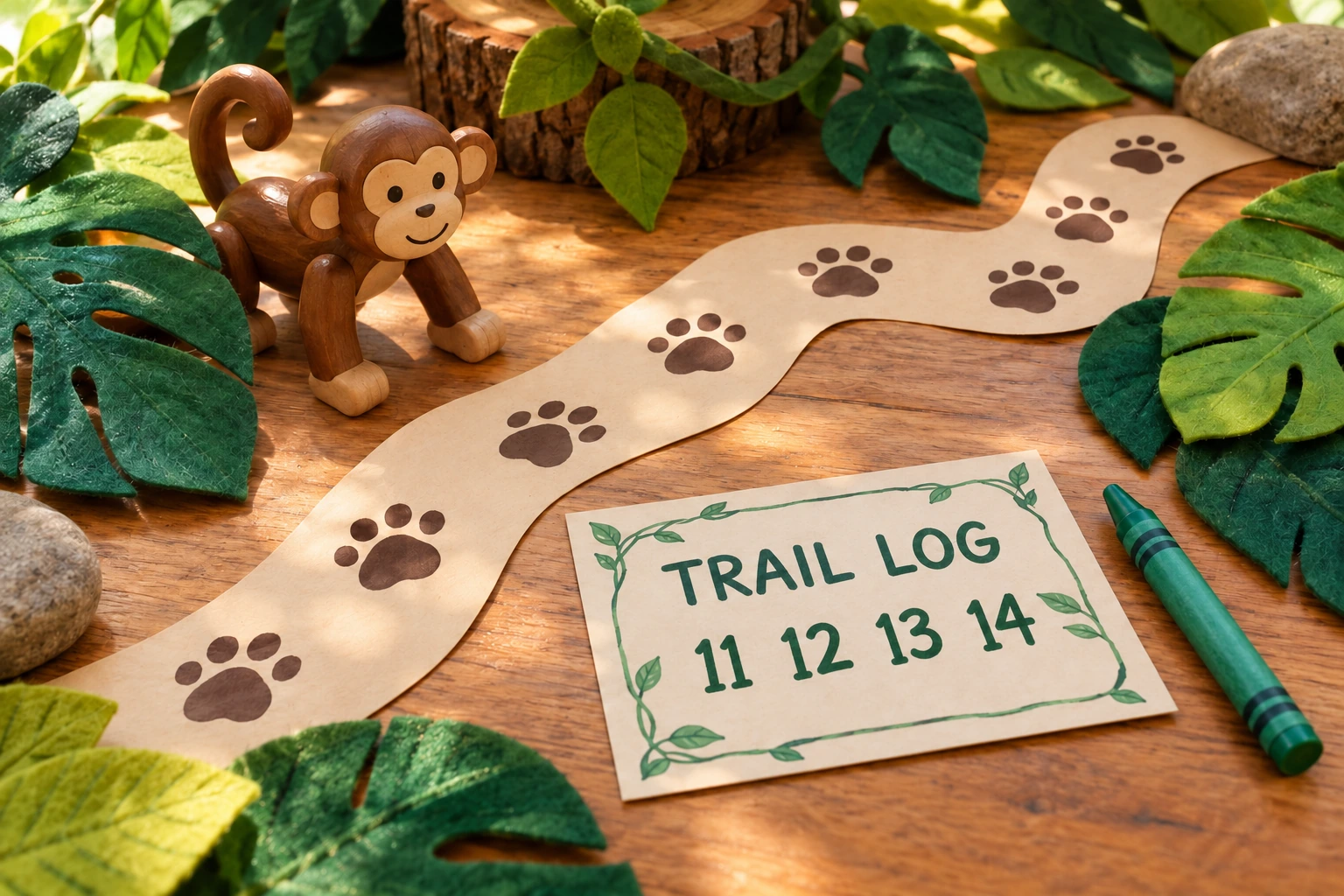
Mina and her grandfather place a wooden monkey beside a log card reading TRAIL LOG, with 11, 12, 13 and 14 below it. The Jungle Missing Numbers sheet supplies the real paw-print route. They read the card's ascending run, then locate the corresponding positions across the orange-to-green return. Mina points out that twelve belongs at one row's ending and thirteen at the next row's beginning.
For a home Jungle Missing Numbers visit, start with that single turn rather than the entire page. Her grandfather reads the direction and models the return once. Mina then chooses the pointing or speaking role, using a printed clue to check the result. She may write the two answers, choose adult-made numeral cards or explain the same route without a pencil.
The Jungle Missing Numbers story can continue through a dictated expedition note. Mina imagines where the monkey goes next, while her grandfather records the longer sentence elsewhere. Keep this creative message separate from the actual numbered exercise. A winding invented jungle path is not a replacement diagram telling the child to change the worksheet's left-to-right order.
Five Jungle Missing Numbers abilities to watch at a turn
Jungle Missing Numbers keeps an absent label in the sequence
A learner who touches the empty final paw and says twelve preserves its place even though its numeral is not printed. That response shows something a completed-looking page might conceal: the child is following the route rather than reading only the labels already present.
Jungle Missing Numbers coordinates two kinds of movement
The eye and finger return left while the numerical sequence increases. Making that distinction visible can explain why a child loses the count at a row boundary. In Jungle Missing Numbers, a broad gesture may support the transition more directly than another reminder to write carefully.
Jungle Missing Numbers uses an arriving clue to check a route
Printed 14 confirms the spoken run through the preceding 12 and 13. The learner can test the connected stretch against information on the sheet. If the arrival differs, the useful question concerns where the route changed, rather than which isolated answer should be guessed next.
Jungle Missing Numbers lets reasoning precede recording
An oral choice or moveable card can show a correct value before handwriting keeps both digits in order. A child who knows thirteen but reverses its written digits needs support with representation. That is different from not yet knowing which number comes before fourteen.
Jungle Missing Numbers gives an explanation a listener
An explorer can tell a partner where to move and which known value supports the turn. Before, after and next describe visible relationships. The adult can lend those words while accepting a clear gesture, allowing mathematical communication to develop without demanding a formal memorized account.
Check the Jungle Missing Numbers closing track

The final Jungle Missing Numbers row has a gap before 20, printed 21, another gap, printed 23 and an empty ending. It needs 19, 22 and 24. The previous row also ends with missing 18 after printed 17, giving another return where two adjacent values cross a boundary. Count seventeen, eighteen, nineteen, twenty while deliberately showing the move from the green row to the brown one.
| Jungle track section | Missing entries in row order |
|---|---|
| Gold paws, 1–6 | 3, 5 |
| Orange paws, 7–12 | 8, 9, 12 |
| Green paws, 13–18 | 13, 15, 18 |
| Brown paws, 19–24 | 19, 22, 24 |
This Jungle Missing Numbers check table supports an adult's review after an attempt. Read a local route before supplying a correction from the list. The last value can be confirmed from the stated endpoint of twenty-four, even though there is no later printed paw to check against. Different gaps may call for different evidence. A flexible explanation matters more than applying one shortcut everywhere.
Four Jungle Missing Numbers trail-repair games
1. A Jungle Missing Numbers guide talks through the return
One person gives the spoken count while another points across a selected row ending and next-row beginning. Pause at the arriving printed clue, compare its value and exchange roles. The child can describe the return in their own words. This Jungle Missing Numbers game keeps the count connected, so a slow accurate route is more useful than a fast uninterrupted recital.
2. Put Jungle Missing Numbers cards on a folded trail
An adult arranges a short familiar sequence across two small paper rows and removes the last card above and first card below. Let the learner restore them while explaining the return. Choose a range the child can already inspect. This extra card game isolates the boundary idea without extending the count beyond twenty-four or requiring another long page of writing.
3. A Jungle Missing Numbers listener catches a restart
Ask an adult to make an obvious playful mistake by restarting at one after a row turn. The learner can stop the expedition and use a known printed clue to repair the spoken route. Avoid making the error mysterious or insisting on a verbal correction alone. Pointing to the appropriate next paw can show exactly what the child noticed.
4. Save a Jungle Missing Numbers turning-point note
Invite the learner to dictate how a row-edge gap was found, then record the explanation beside a simple paw sketch. Read that note during another brief visit and ask for a demonstration. The child may point, speak or choose a card before deciding whether to write. A remembered turn gives recurring practice a purpose beyond returning to the page's unfinished spaces.
Keep Jungle Missing Numbers practice curious and comfortable
Jungle Missing Numbers errors can come from several sources. A child who counts toes needs the main center identified; one who jumps down a column needs the reading direction shown; one who repeats twelve in the next row needs the continuous run tested. Select the Jungle Missing Numbers cue that matches what happened. Giving every possible explanation at once can obscure the useful next action.
If the learner knows a Jungle Missing Numbers answer but becomes upset while writing it, offer a broader card or let a spoken explanation finish the turn. Name the strategy that worked, such as finding fourteen to check the return. Keep the successful route available when the pencil pauses. An expedition can end with one understood boundary and resume with another on a later day.
For regular Jungle Missing Numbers visits, note a specific observation instead of awarding a score for every filled paw. The child might remember the return gesture, need less help recognizing a teen numeral or choose a checking clue independently. Let that evidence guide the next short task. Interest can survive an unfinished sheet when the learner knows what has already become clearer.
Download Jungle Missing Numbers for a supported expedition
Select the original Jungle Missing Numbers PDF for the free worksheet. A clean Jungle Missing Numbers counterpart is available with eligible active membership: the website's printed name, domain lettering and watermark branding are removed, and the PDF has no embedded adverts. For printing, use US Letter portrait and inspect the surrounding border. Keep the first and last paw positions within the preview rather than scaling the artwork until an edge is lost.
Other routes include a smaller five-focused number and picture activity, early pencil pathways with room to follow a line and more varied tracing movements for another session. Adult support ideas appear in PBS Family Math's look at counting and number sense and NAEYC's family mathematics resource pages. A clear turning point is a good place to pause an explorer's log.
Popular Worksheets
Printable resources families and teachers are downloading now.
 Free
 Free
 Free
 Free