
Ocean Count Match: 4 Wonderful Ways to Hold a Total
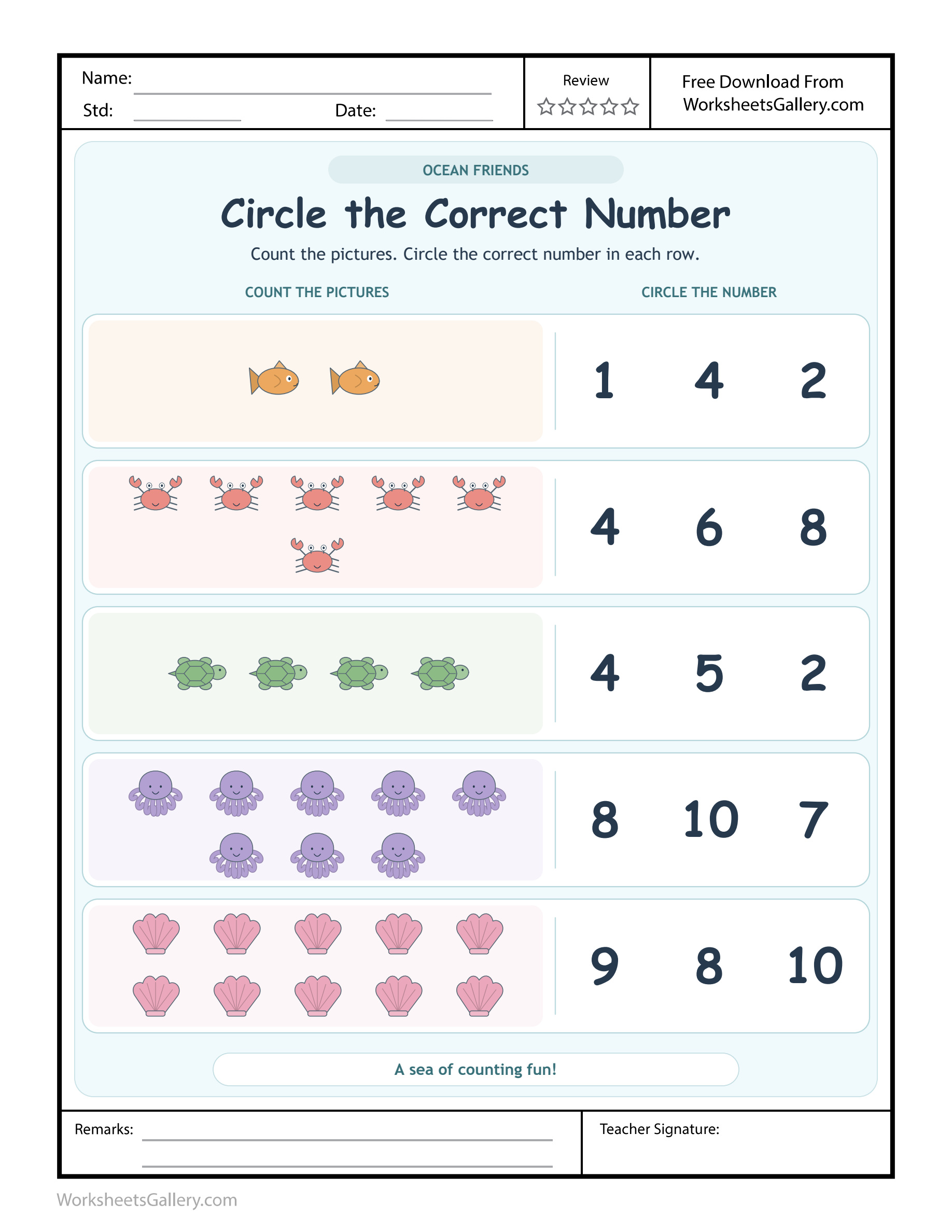
Six crabs have been counted, yet the answer seems to vanish during the glance toward the numerals. Ocean Count Match gives that familiar moment a practical focus: keep the total while finding its written partner. Five sea-themed picture groups each offer three possible numbers. Children count fish, crabs, turtles, jellyfish and shells, then circle a matching numeral. The largest collection reaches ten. Try a short spoken phrase such as “six crabs” before moving right, and let the pictures remain available whenever the learner wants to check the count again.
🌊 The Ocean Count Match field guide
There are five independent problems on this one-page sheet. Ocean Count Match begins with two fish and finishes with ten shells, but the intermediate totals do not form an increasing number sequence. Every new group needs its own count. The learner chooses from three numerals beside that group and circles one; there are no numeral-writing lines to complete.
| Sea group | Offered numerals | Whole-group quantity |
|---|---|---|
| Fish | 1, 4, 2 | 2 |
| Crabs | 4, 6, 8 | 6 |
| Turtles | 4, 5, 2 | 4 |
| Jellyfish | 8, 10, 7 | 8 |
| Shells | 9, 8, 10 | 10 |
Keep this Ocean Count Match guide for an adult's later check. Reading the answers out before the child explores the pictures removes the central decision. Instead, begin with a group the learner can count and ask for the quantity in a short phrase. A response such as “four turtles” keeps the number attached to the objects it describes.
Ocean Count Match puts a pause between jobs
Counting and locating a numeral are connected, but they involve different actions. On Ocean Count Match, the pointing finger can remain near the last counted picture while the learner repeats the total. Only then does attention move to the three options. The final spoken word represents the entire group, not just the animal under the finger at that moment.

The crab group contains five on the upper line and one underneath. Once all six have been visited, say “six crabs” rather than continuing with seven while scanning the answer area. Ocean Count Match asks for the finished quantity, not the next number after counting. If the total slips away, the pictures are still there for a calm recount.
Seven things to observe with Ocean Count Match
Ocean Count Match separates reciting from counting
A child may know a string of number names while pointing at a different pace. Watching the crab route shows whether each animal receives one word. Match the pace to the finger instead of asking the child to recite farther into the sequence.
Ocean Count Match makes the total explicit
“How many altogether?” asks the child to use the final counting word as a group quantity. Accept a quiet repetition of six. An immediate restart is not a failure; it tells the adult that using the final word deserves another supported opportunity.
Ocean Count Match gives memory a short task
The learner carries one known total across a small visual gap. A spoken label can support that handoff. Keep the task brief and visible; there is no need to hide the pictures or add a long delay simply to make remembering more difficult.
Ocean Count Match links symbols with quantities
Choosing 8 for the jellyfish gives the written symbol a concrete meaning. If the learner can count but cannot recognize 8, read the options aloud neutrally. The child can then decide which named option matches, while numeral recognition remains a separate skill to revisit.
Ocean Count Match organizes visual attention
The lower crab and the lower jellyfish pictures belong to their respective groups. A deliberate scan includes them before moving to the numerals. A pointer can support that route without covering the animals still waiting to be counted.
Ocean Count Match offers a manageable pencil action
One circle records the learner's chosen numeral. A broad, slightly uneven loop is enough if the intended choice is clear. For a child concentrating hard on the count, allow pointing first and handle the circling afterward, keeping motor demands from obscuring the answer.
Ocean Count Match invites useful maths language
Naming a group with its total connects words such as fish and shells with a quantity. A child can speak in a familiar home language or indicate the matching numeral. Listen to the mathematical relationship rather than requiring a particular sentence pattern.
Ocean Count Match readiness before a long dive
Preschoolers beginning to count small collections may enjoy the two fish and four turtles with an adult. The groups of eight and ten can suit a more experienced counter. Ocean Count Match is generally useful across ages three to six when assistance reflects current experience. Start where the child can coordinate a few touches and number names.
Choose a short visit if the learner is tired. Ocean Count Match does not require five correct circles in one sitting to provide information. If counting is secure but circling is awkward, let the child use a finger to select. If the number names are uncertain, demonstrate the smallest group together before introducing the longer crab route.
A home conversation with Ocean Count Match
Malik counts the crabs with his grandmother and reaches six. When he looks right, he points to 8. She asks what he counted rather than telling him which symbol to circle. Malik repeats “six crabs,” looks across again and locates 6. Their Ocean Count Match turn shows that remembering the total and recognizing the symbol can be supported together.
At home, place the paper where both people can see the picture side and the answer side. Ocean Count Match needs only a comfortable pencil and a clear surface. Let the child choose fish or turtles to begin. Touch the animals, state the total, find the symbol and mark the choice. Pause after one success to ask what made remembering easier.
An adult can model uncertainty honestly: “I need to check whether I included the one below.” Ocean Count Match makes the evidence available to both partners. Take another look together instead of presenting recounting as a punishment. The child is learning a strategy for recovering a quantity, not trying to avoid ever needing help.
Ocean Count Match as a classroom handoff
Use a counter and a recorder in a small pair. The counter names the total while the recorder finds that numeral in the same row. Before circling, both inspect the pictures. Exchange jobs for the next Ocean Count Match problem, allowing each learner a turn with the mathematical decision as well as the pencil.
For assessment through observation, ask a learner to repeat the total before scanning the numerals. Note whether that prompt changes the response. Ocean Count Match can reveal a lost total, an incomplete picture scan or uncertain symbol recognition. Record the specific support used, since those situations call for different next activities rather than one general “counting practice” label.
- Keep one whole sea group visible during its turn.
- Ask partners to listen before suggesting an alternative total.
- Choose a pointing route that includes lower pictures.
- Read unfamiliar numeral options without emphasizing the answer.
- Allow a recount when the remembered quantity is uncertain.
- Stop after an explanation the learner can give comfortably.
Ocean Count Match reaches the ten shells

The final group contains two lines of five shells. A child may notice the arrangement, but counting each shell remains welcome. Ocean Count Match presents 9, 8 and 10 in that order. The correct total is the rightmost option, showing why neither the first nor the middle position can be chosen automatically.
The numeral 10 contains two digits, yet it names one total here. On Ocean Count Match, the child circles 10 as a whole option. If the learner circles 1 or 0 separately, point out the spacing between the three choices and read each complete numeral. Avoid introducing place-value explanations before the child needs that separate lesson.
Four Ocean Count Match activities with a remembered total
1. Ocean Count Match gives a crab report
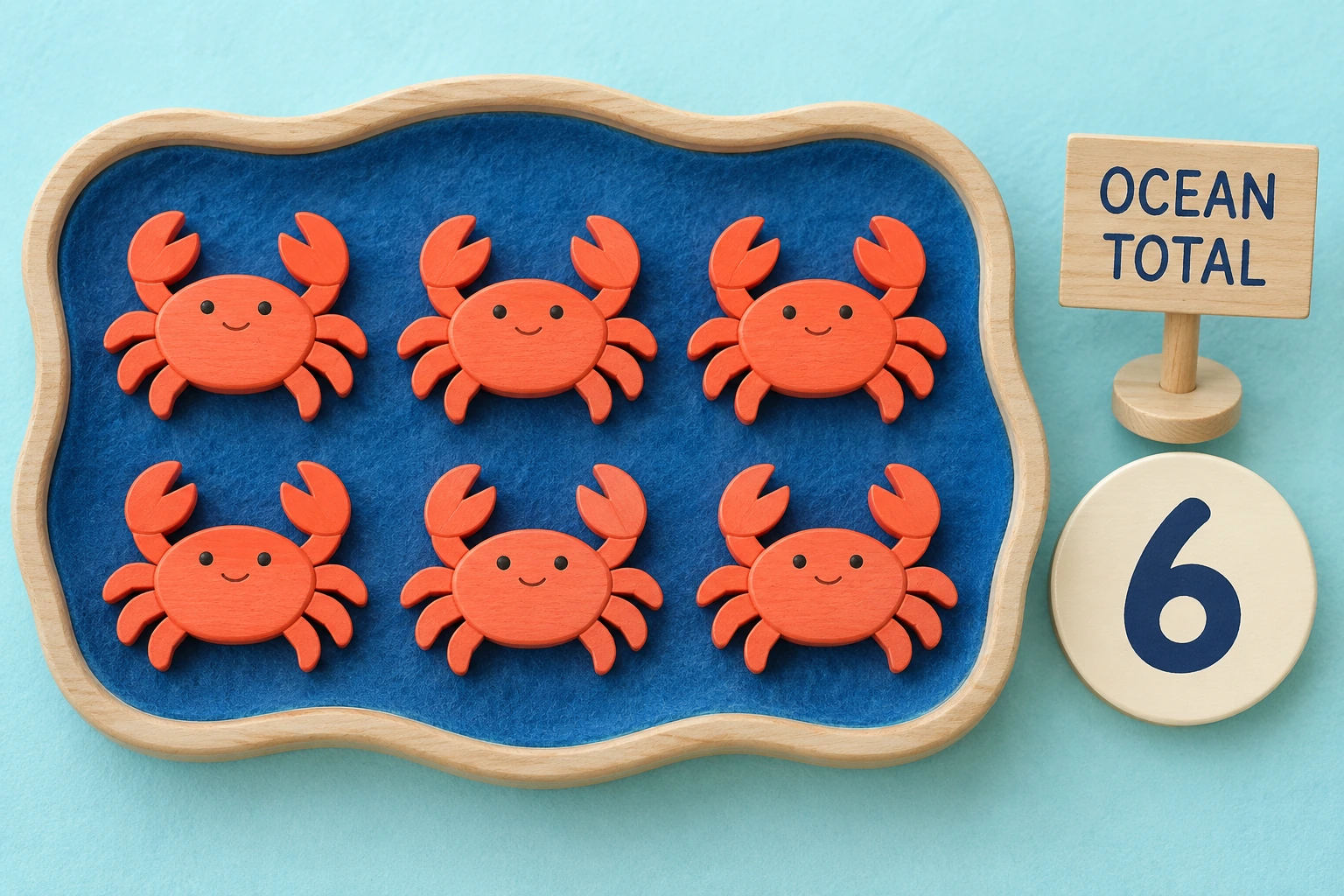
Arrange six crab props as two rows of three. The learner counts, turns toward a partner and reports “six crabs.” The partner selects a 6 card, and they both verify the group. This example rearranges six from the worksheet's five-and-one layout, so the quantity must be checked rather than copied from a familiar shape.
2. Ocean Count Match whispers to a turtle
A toy turtle waits beside cards 2, 4 and 5. Let the child count four visible counters, whisper the total to the turtle and choose its card. Keep the counters available throughout. The pretend listener gives the repeated total a playful purpose without asking the child to memorize an unseen collection.
3. Ocean Count Match carries a shell message
Place a small shell group on one end of a table and numeral cards nearby at the other. The learner counts, says the total and moves a finger toward the matching card. Keep the distance short. If the quantity is forgotten, return to the same group and try another clear message rather than increasing the distance.
4. Ocean Count Match checks a diver's note
An adult writes 8 on a scrap and places it beside a group of six counters, calling it a diver's uncertain note. Invite the child to inspect both and suggest a repair. Let the learner write, dictate or select 6. The activity treats verification as useful work rather than a contest to catch mistakes quickly.
Repair an Ocean Count Match mix-up
If counting continues into crab legs or jellyfish tentacles, name the complete pictured animal as the unit. If the child stops at the upper line, trace toward the lower pictures without announcing their total. Ocean Count Match offers distinct places to investigate these errors; an adult can make the next cue match the observed action.
If the child repeats a total accurately but points at another numeral, read the three symbols aloud. Ocean Count Match can then continue as a supported selection task. A remembered quantity and a recognized numeral are two useful observations. Keep both visible in your notes instead of treating an incorrect circle as a complete account of the learner's understanding.
Another brief Ocean Count Match visit
Return to one familiar group during a calm part of the day. Ask the child to choose a phrase for remembering its total, perhaps “ten shells altogether.” Ocean Count Match can become a comfortable routine when the learner controls a small part of the session. Praise the use of a helpful phrase or a successful recount, with no comparison to a faster partner.
For a written numeral model, try the separate six tracing resource. The eight-writing worksheet and focused ten practice offer other tasks after counting is understood. Select the model related to the learner's actual uncertainty rather than assigning every linked page.
Ocean Count Match resources and printable editions
Browse PBS's maths page for families with four-year-olds or the NAEYC family mathematics library for wider play ideas. Choose a short activity that fits the child's interests. These adult resources can accompany an Ocean Count Match conversation without becoming another requirement for the learner.
The free Ocean Count Match sample preserves the uploaded worksheet, including its original website branding. Members with eligible active access can choose a clean premium PDF instead: website marks and watermark branding are removed, and the worksheet has no inserted ads. Sign in, choose the edition you want, and save it before opening the printing controls.
Print Ocean Count Match on US Letter paper after checking its one-page preview. Confirm that the shells and all three final choices remain inside the printable area; use fitting if your printer clips an edge. Keep the total, then find its symbol. That small sequence is enough to give the next sea group a clear purpose.
Popular Worksheets
Printable resources families and teachers are downloading now.
 Free
 Free
 Free
 Free