
Space Count Check: 4 Powerful Mission Number Games
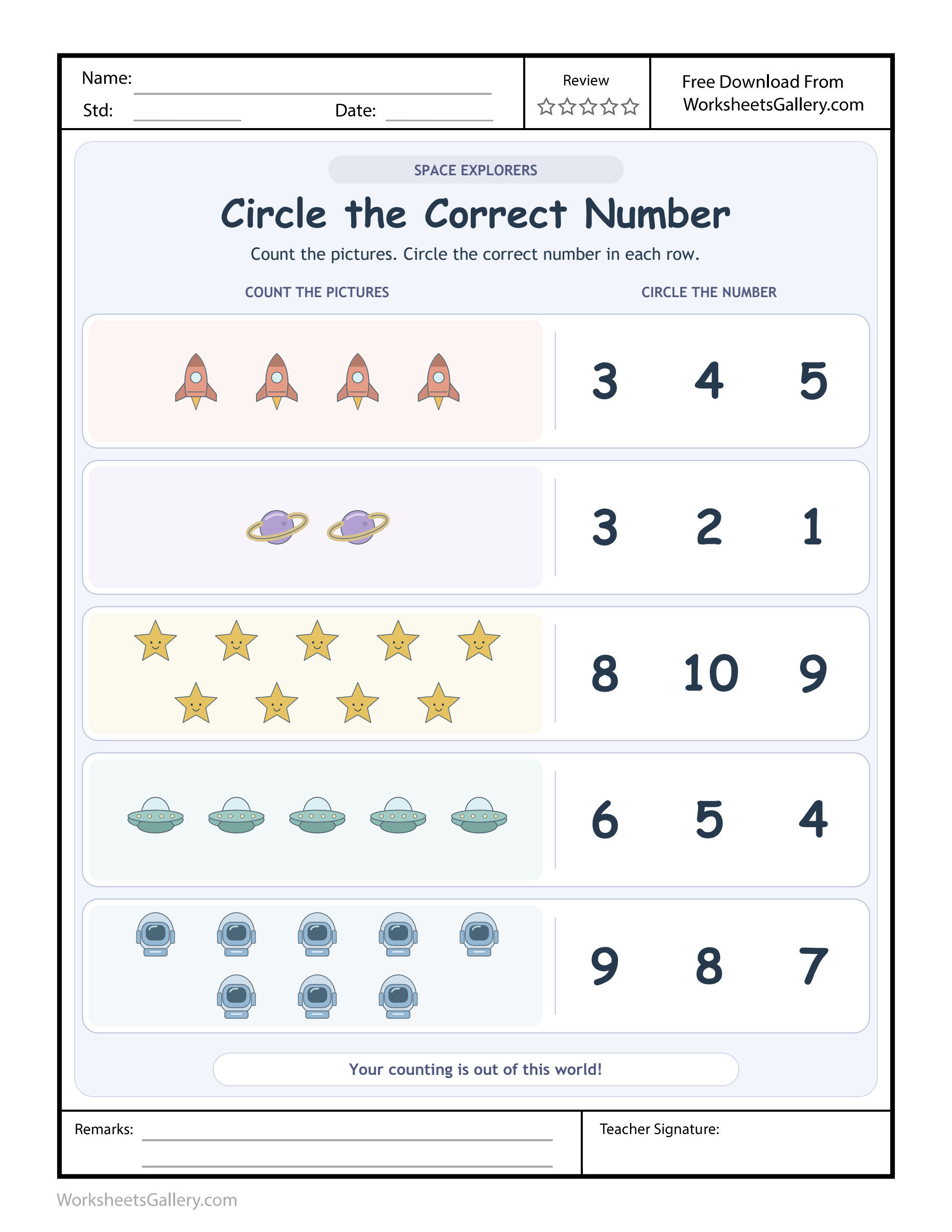
The middle answer works twice, and then the stars ask for another look. Space Count Check invites children to use the pictured quantity as their evidence instead of choosing a familiar answer position. Five groups of rockets, planets, stars, flying saucers and helmets each have three numeral options. Four correct choices happen to be in the middle on this sheet; the nine-star group is different. Count each collection on its own, hold the result, and find the matching numeral wherever it appears. A checked answer gives the pretend mission a dependable report.
🚀 Space Count Check launches with four rockets

Four rockets appear beside 3, 4 and 5. Touch one whole craft for each counting word, then ask which numeral describes the collection. Space Count Check begins with a middle answer, but that location is a consequence of this particular choice order. The useful reason for selecting 4 is the four visible rockets.
The rocket's window, nose and flame are parts of its drawing. Space Count Check counts the complete craft rather than its details. Let the learner explain what received each touch before marking the numeral. If the child recognizes four at a glance, a pointing check can confirm the quantity without requiring unnecessary repeated counting.
Two Space Count Check planets keep the same answer location

The second group has two ringed planets and the options 3, 2 and 1. The middle choice works again. Space Count Check offers a reason to ask for an explanation even after a correct circle: did the learner count two planets, recognize the quantity immediately, or simply repeat the previous pencil position?
Suri tells her brother, “It's the middle one.” He asks how many planets she sees. She points to both and says two, making the answer meaningful. When they reach the stars on Space Count Check, that same question will matter again. Their conversation treats a correct guess as a starting point for checking rather than as proof of a particular strategy.
Space Count Check asks the stars for evidence

Five stars sit on the upper line and four on the lower one, giving nine altogether. The options are 8, 10 and 9. On Space Count Check, circling the middle choice here would record ten. Let the learner count all nine, repeat the total and find 9 at the right. The completed picture count supplies a reason to change position.
If Suri chooses ten automatically, her brother can ask her to show the star that received the tenth count. Space Count Check makes the evidence available for inspection. If there is no tenth star, they recount the complete group together and find its matching numeral. Avoid turning the moment into a trick: the adult's job is to make checking useful and comfortable.
Space Count Check keeps five mission reports separate
The verified quantities are 4 rockets, 2 planets, 9 stars, 5 flying saucers and 8 helmets. Each group begins its own count. Space Count Check does not ask the learner to total every space picture on the page, solve written additions or fill a number sequence.
| Mission report | Choices shown | Evidence-based selection |
|---|---|---|
| Rockets | 3 / 4 / 5 | 4 in the middle |
| Planets | 3 / 2 / 1 | 2 in the middle |
| Stars | 8 / 10 / 9 | 9 on the right |
| Flying saucers | 6 / 5 / 4 | 5 in the middle |
| Helmets | 9 / 8 / 7 | 8 in the middle |
Keep the table as an adult reference until the learner has considered the pictures. On Space Count Check, knowing the response locations in advance would remove the central task. Ask for a quantity statement such as “nine stars” rather than instructions about where a pencil should go.
Space Count Check at a home mission desk
Lay the paper flat with a pencil and a visible number reference nearby. Invite the child to choose a short group, count or recognize its quantity, name the total and inspect all three alternatives. Space Count Check works as a small conversation; completing just rockets and planets can be enough for one rested session.
An adult can record a dictated selection when drawing a circle is demanding. In Space Count Check, that preserves the mathematical decision while supporting the motor action. Ask the learner to point at the exact numeral intended before writing. Keep the other options readable so the child can revisit the choice if a later recount suggests a revision.
- Identify the complete objects in the chosen group.
- Visit every picture, including those below the first line.
- State the finished quantity before scanning the alternatives.
- Find the numeral with that value, regardless of position.
- Make one clear circle and explain the evidence used.
Space Count Check in a classroom control room
Give partners the roles of observer and mission reporter. The observer checks the picture group while the reporter states the quantity and proposes a numeral. Switch after a brief turn. Space Count Check allows a teacher to ask each child for evidence without relying on the classmate who usually speaks first.
During individual observation, offer the star group after the learner has completed another row. Ask how the selection was made. Space Count Check can reveal a repeated-position strategy, an omitted lower star or uncertain recognition of 9. Those are different needs, so write a descriptive note about the actual action and support rather than only recording whether the circle was correct.
Five worthwhile Space Count Check observations
Space Count Check values a reason
The learner can connect a numeral to the objects that justify it. A pointing route can serve as the explanation when a longer spoken sentence is difficult. Listen for the relationship between the quantity and symbol instead of requiring a particular phrase from every child.
Space Count Check supports one-to-one counting
Each rocket or star needs one number name. A finger that jumps back to an earlier picture may explain an extra count. Guide the route gently, preserving the child's role in naming the sequence and deciding the finished total.
Space Count Check asks for flexible attention
The correct answer may occupy another location from the previous response. A child must inspect the new choices instead of repeating the last movement. The star example makes this demand visible within the familiar task, without adding complicated new instructions.
Space Count Check connects symbols and language
“Eight helmets” attaches a spoken number to a named collection, while 8 records the same quantity in print. If the numeral is unfamiliar, read the options without highlighting one. This support leaves the child responsible for matching the remembered total.
Space Count Check gives marking a purpose
Circling the chosen answer combines visual selection with a small planned hand movement. A clear oval communicates the decision even when it is uneven. An adult can separate selecting from marking to observe number understanding before adding a demand for pencil precision.
Space Count Check inspects five saucers

Five flying-saucer pictures form a single line beside 6, 5 and 4. Space Count Check returns to a middle response here, but the evidence is still the counted group. Invite the learner to explain the five craft before circling. Lights and windows belong to each saucer and are not additional spacecraft.
The page uses imaginary space pictures for a counting task, not a description of actual space travel or planetary science. Space Count Check can welcome a short pretend mission story while keeping the mathematical question specific. If storytelling starts to overwhelm the count, give the toy reporter a single group to describe before adding another mission detail.
Four Space Count Check mission games

1. Space Count Check rearranges nine stars
Place nine star tokens in three lines of three and label the group 9 STARS. Count them, then rearrange the same tokens as five and four. Ask whether a star was added or removed before recounting. The illustration offers a clear alternate arrangement, while the worksheet keeps its original unanswered choice.
2. Space Count Check moves the answer cards
Count a small group of rocket cards and offer three separate numeral cards. After a choice, shuffle only the numeral positions and ask the child to find the matching value again. Keep the pictured collection unchanged. Explain what moved so the activity invites a new look rather than surprising the learner with hidden changes.
3. Space Count Check requests a helmet report
Arrange eight helmet drawings and let a toy commander request the quantity. The child counts, states the total and dictates a short report. An adult can record 8 while the learner points back to the entire group. A report that names the collection gives the final count a practical pretend-play purpose.
4. Space Count Check repairs a mission label
Put a 5 card beside four visible rocket counters and call the label provisional. Ask the learner to inspect it and choose a replacement if needed. Let the child decide how to demonstrate the mismatch. The game celebrates comparing evidence with a label, not catching an adult's mistake as quickly as possible.
Space Count Check includes the lower helmets

Five helmets appear above three more. A count that stops at five has missed part of the collection. Space Count Check offers 9, 8 and 7, with the correct 8 in the center. Ask the child to include the lower pictures and then state the complete total before looking at the options again.
If both 8 and 9 are circled, ask which quantity the child intends to report. If 9 is named but its symbol is confused with another, use a separate numeral reference. Space Count Check can preserve a correct picture count while providing help with recognition. Check what the child meant before interpreting the mark.
Space Count Check readiness and a calm return
Small groups such as two planets can suit early counters with support, while nine stars requires a more sustained route. Across approximately ages three to six, match the selected problems to the learner's experience. Space Count Check can involve adult pointing, spoken choices or independent circling without treating every response method as the same skill.
For a later visit, ask the child to choose one mission report worth checking again. Space Count Check need not become a daily challenge to finish faster. Name a specific strategy: the learner included the lower stars or searched for a value after the cards moved. A revised answer can be a well-checked answer. Stop while the child can still describe what happened.
Further practice alongside Space Count Check
For numeral formation, the nine-writing page can follow the star count. The one-to-ten tracing resource changes the response type, while the dice-based number game offers another small-quantity setting. Choose one relevant task after observing whether counting, numeral recognition or writing needs attention.
For adult background and play ideas, explore NAEYC's maths articles for families and the PBS family maths page for age four. These resources can inform a small next activity without making another assignment necessary to use Space Count Check.
Choose a Space Count Check PDF edition
The original free download retains the uploaded worksheet's website marks. A clean premium Space Count Check PDF is provided through the existing membership download area for eligible active members. Its activity page contains no website branding, no watermark marks and no inserted advertising. Access the member edition after signing in, then save whichever PDF you intend to print.
Check the US Letter print preview for all five groups and complete answer options. Fit Space Count Check within the printer's margins if necessary, then inspect a single trial sheet. Let the first mission report come from the pictures. The matching numeral can be found after the child knows which quantity the report needs to carry.
Popular Worksheets
Printable resources families and teachers are downloading now.
 Free
 Free
 Free
 Free