
Garden Picture Count: 6 Powerful Whole-Object Games
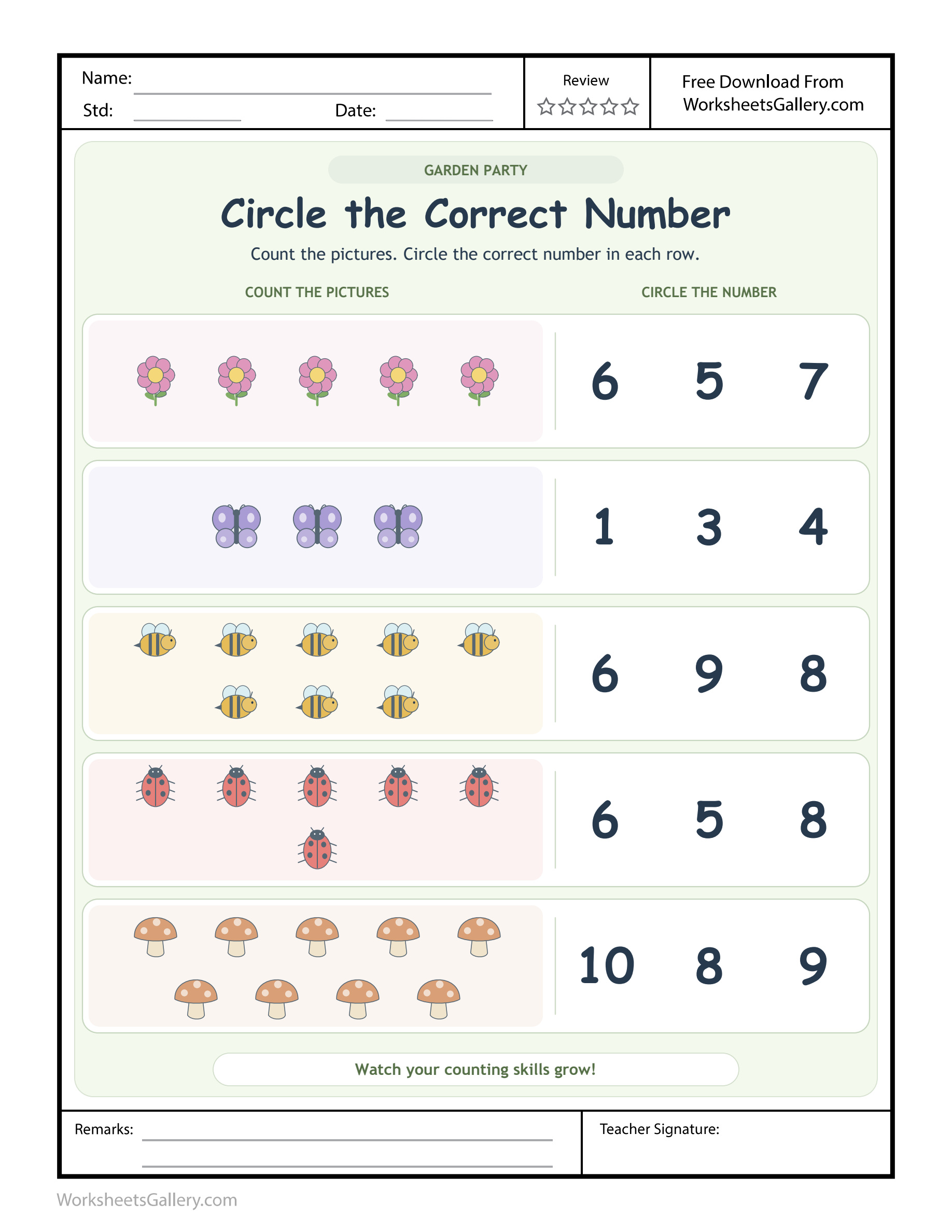
Before counting, decide what one thing is. A butterfly has several wings, and a flower has several petals, but Garden Picture Count asks for complete pictured objects. Children inspect five garden groups, find the quantity of each, and circle a numeral from three choices. The page offers a useful conversation about what belongs inside an object and what counts as another member of a group. Begin with a flower or butterfly the learner can describe. Once the counting unit is agreed, a pointing finger can follow the whole group with much less confusion.
🌼 Garden Picture Count names the unit first
Ask “What are we counting here?” before asking “How many?” On Garden Picture Count, the answer might be flowers, butterflies, bees, ladybugs or mushrooms. The noun sets the task. A petal is visible, but it is not another flower. A bee stripe can be interesting without becoming another bee in the count.

Five flower pictures begin the sheet, alongside 6, 5 and 7. Garden Picture Count requires five complete flowers, even though many more petals are visible. Invite the child to touch a blossom center once, then move to the next flower. This is one practical pointing choice, not a demand to ignore the attractive artwork or stop talking about its details.
Who can explore Garden Picture Count comfortably
Preschool and kindergarten children, often between three and six, can use selected parts with different levels of help. Garden Picture Count includes groups reaching nine, so the entire sheet may be too much for a learner just beginning to coordinate counting words with objects. The three butterflies offer a shorter starting collection than the bees or mushrooms.
An interested younger learner can name pictures and point while an adult models a count. A more experienced child may explain why petals are excluded. Garden Picture Count is a counting-and-choice page, with no required tracing or written number formation. Let a spoken or pointed answer come before pencil work when controlling a circle would distract from deciding the unit.
Five useful Garden Picture Count outcomes
Garden Picture Count clarifies a shared question
Agreeing to count butterflies makes the adult's question and the child's action match. Without that agreement, counting wings can be a reasonable response to a different imagined question. Naming the unit gives both people a clearer way to discuss an unexpected answer.
Garden Picture Count supports selective looking
The learner notices the entire insect while leaving spots or stripes inside it. This is purposeful visual discrimination within a simple activity. An adult can guide a finger toward the body if repeated touches keep landing on separate decorative details.
Garden Picture Count joins pointing with number names
Each complete garden picture receives one word in the count. Slowing a finger can help a child whose spoken number sequence races ahead. Watch which objects are actually visited before deciding that a wrong total reflects unfamiliar number names.
Garden Picture Count links a collection to its numeral
After reaching eight bees, the child searches for 8 among the options. A visible numeral card can assist recognition while the learner still decides the quantity. Knowing how many and recognizing the written symbol are related achievements that deserve separate attention.
Garden Picture Count makes communication and movement purposeful
Explaining “I counted the whole ladybugs” gives language a practical role. Circling the selected numeral then records that decision through a controlled curved movement. A child can communicate the idea by pointing when a full explanation or pencil response is not yet comfortable.
Garden Picture Count at a classroom nature desk
Place the page beside large paper flowers and a number strip. Before anyone counts, let the group describe what one flower includes. Garden Picture Count then becomes a clear application of that discussion: point once at each flower picture, retain the total and find its numeral. Do not add the loose paper props to the printed collection.
For a paired classroom turn, one child states the unit and another counts. Swap those roles on the next group. Garden Picture Count allows a teacher to hear whether partners agree on “bees” rather than “wings.” If their totals differ, ask them to demonstrate their routes before inviting the faster child to announce an answer for everyone.
- Say the object name before starting the count.
- Leave the full group visible, including pictures placed underneath.
- Ask for one touch per complete object.
- Read unfamiliar numeral options in an even voice.
- Accept a pointing explanation of what was counted.
- Separate the recording turn from the initial thinking turn.
- Record whether the learner needed help choosing the unit.
A Garden Picture Count conversation about wings
Iona points to butterfly wings and says six. Her father asks her to show one butterfly, letting her trace its outline in the air. Together they name the whole creature before trying again. On Garden Picture Count, her six was information about what she had been attending to, giving the adult a specific starting point for support.

Three butterflies appear beside 1, 3 and 4. Pointing at the center of each body makes the intended three units clearer. Garden Picture Count does not require a child to name insect body parts. Keep the discussion on complete pictures, and return to the original question once both people are using the same counting unit.
At home, choose one garden group after a short picture-book conversation or during a calm table activity. Let the child explain what they intend to count, then watch the route. Garden Picture Count can occupy a few focused minutes with a comfortable pencil nearby. Stop after an understood decision instead of stretching the session until every group has an adult-supplied answer.
Garden Picture Count checks five garden collections
The quantities are 5 flowers, 3 butterflies, 8 bees, 6 ladybugs and 9 mushrooms. Their choices appear in different orders, so the same answer location is not a reliable strategy. Use this Garden Picture Count reference after the learner's attempt, focusing on the particular group that needs inspection.
| Counted unit | Details inside it | Numeral to verify |
|---|---|---|
| Whole flowers | Petals and leaves | 5 |
| Whole butterflies | Wings and markings | 3 |
| Whole bees | Wings and stripes | 8 |
| Whole ladybugs | Spots and legs | 6 |
| Whole mushrooms | Cap spots and stems | 9 |
Garden Picture Count continues below the bees

Five bees sit above three more. A child who counts only the upper line may know exactly how to count five objects but still need a route through the whole area. Garden Picture Count offers a reason to look underneath before moving toward 6, 9 or 8. After all eight bees have been visited, locate the rightmost 8.
Count the complete bee, not each stripe or each wing. Garden Picture Count brings those details into the same visual field, so a clear unit and a complete scan both matter. You can support one while observing the other: move a pointer yourself while the child supplies number names, or name the objects while the learner controls the pointing.
Six Garden Picture Count games with whole objects
1. Garden Picture Count opens a flower stall
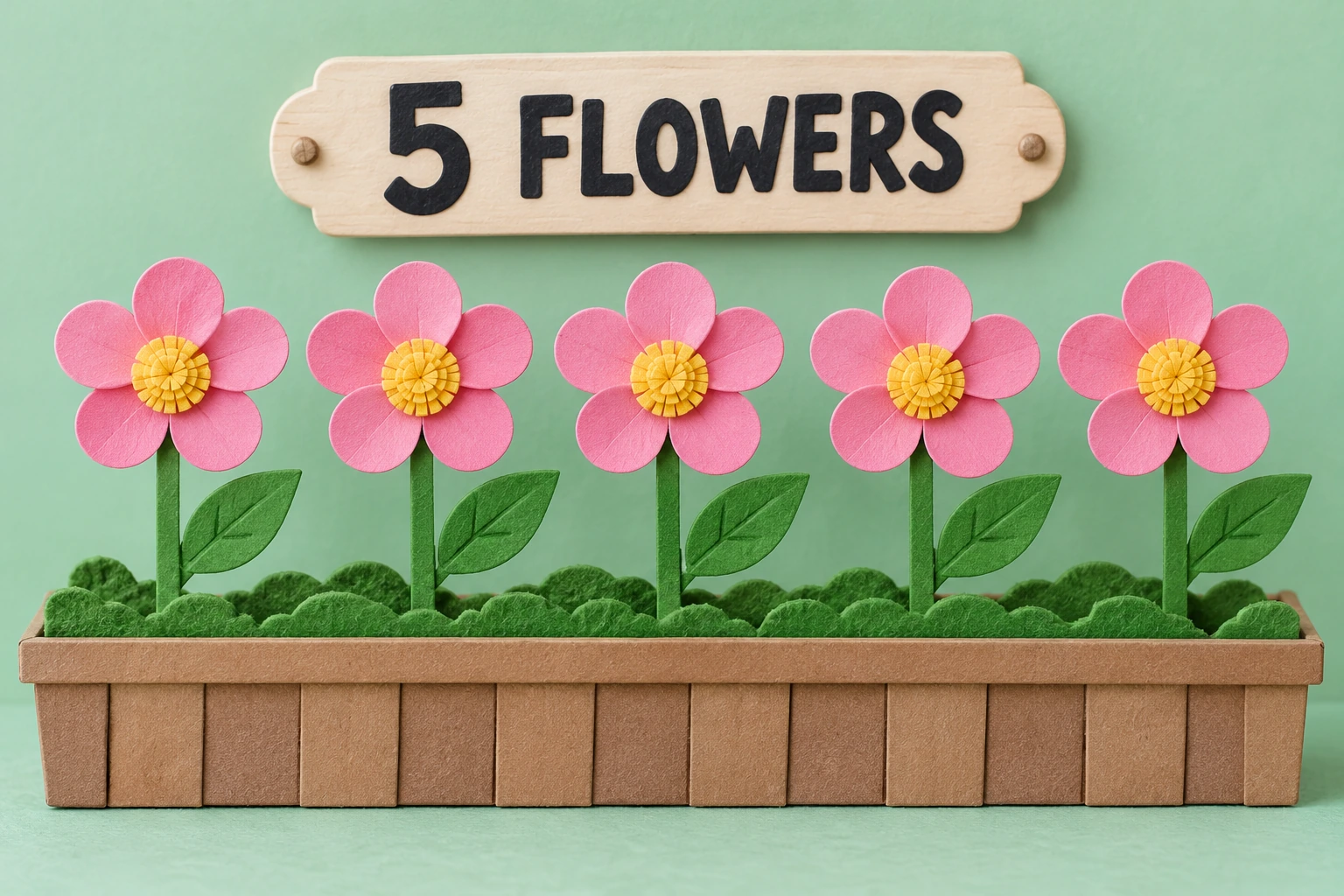
Arrange five handmade flowers in a little planter and write 5 FLOWERS on a sign. Ask the learner what the label counts. Let the child point at each whole flower, then describe one flower's petals separately. The two questions can coexist, provided everyone knows which unit the current question uses.
2. Garden Picture Count makes butterfly tickets
Set out three paper butterflies and give a toy visitor one ticket for each butterfly visited. Compare tickets with complete insect pictures afterward. Wings do not receive separate tickets in this game. Change the visitor role so the child can ask an adult to demonstrate a matching one-to-one route.
3. Garden Picture Count changes a bee arrangement
Move eight bee cards from five-and-three into a single line without adding any. Invite a fresh count and compare the final quantity. This play task shows the same collection in a different arrangement; it does not require the learner to write an addition equation or explain a formal rule about number conservation.
4. Garden Picture Count repairs a spot report
Use two large paper ladybugs with several spots each. An adult pretends that every spot is another ladybug. Ask the child to show what one whole ladybug looks like and correct the report. Keep the group small so attention can stay on the unit rather than a difficult counting sequence.
5. Garden Picture Count labels a paper patch
Put nine mushroom drawings in a pretend garden patch and offer numeral cards 8, 9 and 10. The child chooses a label after checking complete mushrooms. Use craft pictures for this tabletop game, with caps and stems remaining parts of each drawing. The sign names a quantity, not a real-world plant identification.
6. Garden Picture Count lets the child ask
The learner chooses a small garden collection and tells an adult exactly what to count. The adult follows that instruction and explains the unit used. Reverse the roles after a successful example. Asking a clear question gives the child another way to show understanding without completing an additional printed row.
Garden Picture Count inspects the ladybugs

The ladybug group has five upper pictures and one lower picture, giving six. Garden Picture Count offers 6, 5 and 8. A choice of 5 may reflect a missed lower insect; a much larger spoken total may reflect spot counting. Ask the learner to demonstrate before choosing which repair to model.
When a child changes an answer, acknowledge the useful observation: “You noticed another whole ladybug below.” Garden Picture Count can support a calm correction because the evidence remains visible. We can agree on the question and take another look. That tone is more helpful than treating the decorative details as something the child should never have noticed.
A comfortable Garden Picture Count habit
Revisit a single group on another day and begin by asking its noun. The child may choose flowers for a familiar success or bees for another challenge. Garden Picture Count does not need repeated full-page completion to make the routine worthwhile. A remembered strategy such as touching each insect's body can be named and celebrated specifically.
For separate numeral-writing practice, try the resource for forming eight, nine tracing practice or the six tracing page. These change the response from selecting a numeral to practicing its written shape, so choose one when that is the learner's next need.
Garden Picture Count downloads and adult reading
The NAEYC collection of family maths articles offers broader ideas to explore. The PBS maths resources for age-four families provide another starting place. Use a relevant idea alongside Garden Picture Count while keeping the child's current question small and clear.
Download the original free sample to keep the uploaded branded edition. For a no-watermark Garden Picture Count worksheet, sign in with an eligible active membership and select the clean premium PDF. The premium activity has no website-name lettering or inserted advertisements. Save the edition you selected, then check its print settings before using paper.
The file is a single US Letter page. Review the Garden Picture Count print preview for intact borders and complete garden groups, fitting the page to your printer's available area when required. Test one sheet before making further copies. Agree on one whole object, then count the group. That question can guide the first flower and every later garden decision.
Popular Worksheets
Printable resources families and teachers are downloading now.
 Free
 Free
 Free
 Free