
School Supply Count: 5 Brilliant Art-Table Number Tasks
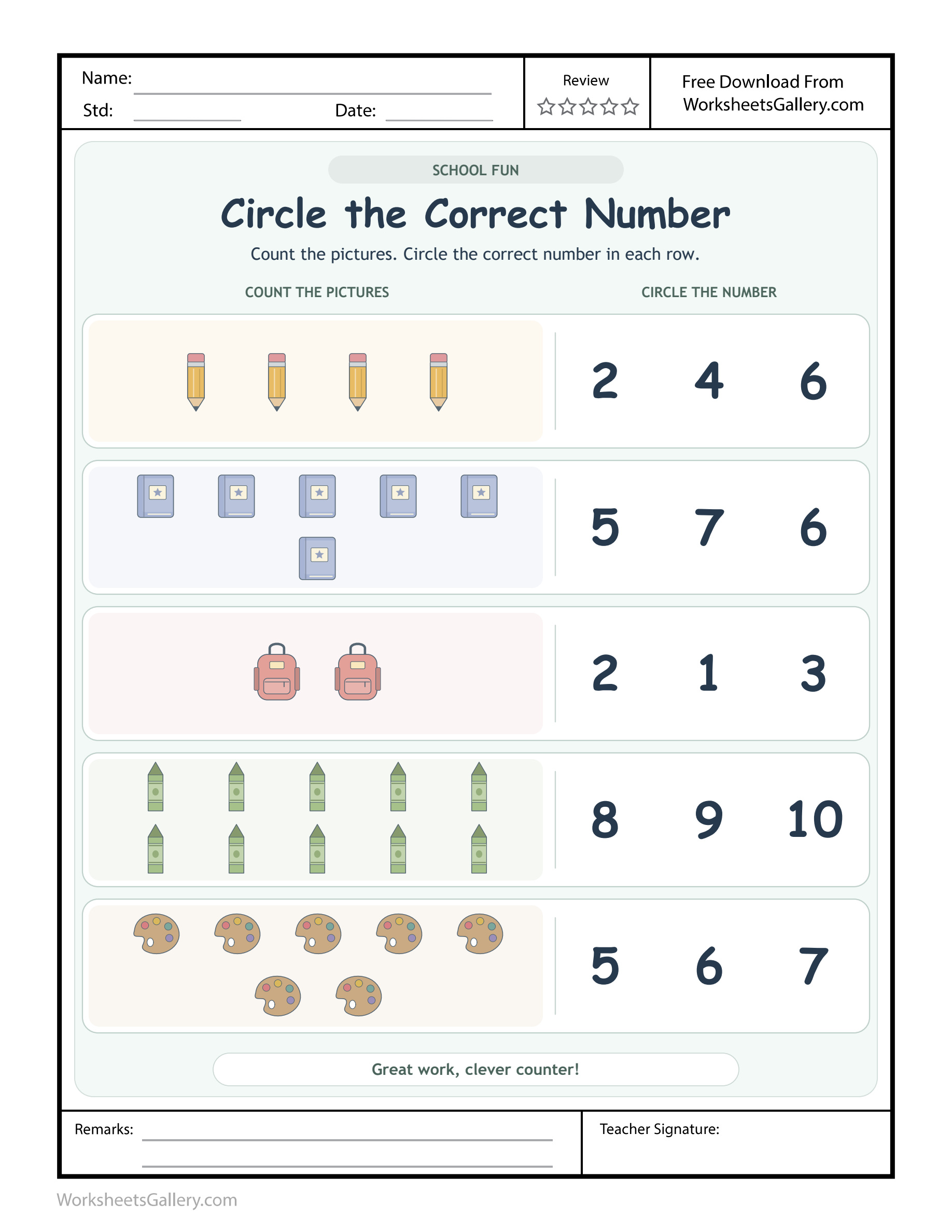
The art table needs a useful inventory: how many complete supplies are actually shown? School Supply Count gives children five picture groups to inspect before choosing a numeral for each. Pencils, books, backpacks, crayons and paint palettes provide familiar objects, but their covers, wrappers and colored details are not extra supplies. Children count the whole items and circle one of three possible answers. Treat the page as a small stock-check conversation rather than a race to fill it. A clear report such as “seven palettes” can connect the pictures, the counted quantity and the written numeral.
🎨 School Supply Count makes an inventory useful
Rui studies the palette pictures while his teacher asks how many complete palettes a pretend art table has. He begins naming paint spots. She asks him to show one whole palette, then another. School Supply Count gives them a practical reason to clarify the unit: the inventory needs the number of palettes, not a count of the little colors painted on them.
After agreeing on the item, Rui can point through all seven and select 7. School Supply Count does not require a written stock list or complete sentences from the learner. A spoken total and a clear numeral choice are enough. An adult may record a dictated answer while keeping the mathematical decision with the child.
Read the School Supply Count stock card
The adult reference is 4 pencils, 6 books, 2 backpacks, 10 crayons and 7 palettes. These are separate collections, not a running tally of every supply on the sheet. School Supply Count begins a new count when the pictured item changes, with one numeral chosen for each bordered group.
| Inventory item | Three choices | Quantity to report |
|---|---|---|
| Pencils | 2 / 4 / 6 | 4 |
| Books | 5 / 7 / 6 | 6 |
| Backpacks | 2 / 1 / 3 | 2 |
| Crayons | 8 / 9 / 10 | 10 |
| Paint palettes | 5 / 6 / 7 | 7 |
Keep the stock card for checking a learner's attempt. School Supply Count asks the child to inspect the picture evidence before receiving an answer. A numeral's position varies among the choices, and quantities rise and fall between problems. The page is not a number-order exercise, a tracing task or a set of written addition equations.
School Supply Count finds the sixth book

Five books appear above a sixth book. School Supply Count offers 5, 7 and 6, with 6 at the right. A learner who stops at the upper line may have counted those five accurately but missed the lower member of the group. Ask where the route finished before supplying another total.
Each book also has a cover star. Counting those stars could happen to produce the same quantity, so a correct answer alone does not identify the unit the child used. School Supply Count offers an opportunity to ask “What did each touch count?” The learner's demonstration can reveal a useful distinction that a circle by itself leaves hidden.
A classroom School Supply Count check-in
At a small-group table, give one learner the supply-namer role and another the counting role. The first names complete books or palettes; the second visits each picture and reports the quantity. Rotate before a different School Supply Count problem. Both children should experience naming the unit and selecting a numeral, rather than one doing all the thinking.
For an individual turn, ask the learner to explain a selected response without another child prompting first. School Supply Count can show whether a number was recognized, a lower picture was included or an object detail was counted instead. Record the actual support used. A guided six-book count is useful information even when the learner is not yet ready to handle the ten crayons alone.
- Identify the complete supply item before naming any numbers.
- Make every picture in the current group available for inspection.
- Coordinate a single counting word with each visited item.
- Ask for the finished group quantity before choosing a symbol.
- Keep unfamiliar numeral choices readable and distinct.
- Separate a child's pointed selection from the pencil recording when needed.
School Supply Count at a home art corner
Choose a clear table surface, a comfortable pencil and a number reference if useful. Begin with the two backpacks or four pencils for a shorter task. School Supply Count can be explored through one careful inventory report before introducing the longer collections. Real art supplies nearby are props for a separate conversation, not extra objects to add to the printed count.
An adult can model the sequence on a small group: name the item, point and count, say the total, then find its numeral. Let the child take the next turn. School Supply Count needs only a brief routine, with enough thinking time between stages. Read the three numerals aloud without emphasizing the answer if symbol recognition is the uncertain part.
If Rui tells a family member “seven palettes,” ask him to show which pictures the report includes. School Supply Count can then connect classroom talk with home play without requiring another completed sheet. The explanation might be a pointing route, a selected numeral card or a short phrase in the language the child uses most comfortably.
School Supply Count checks all ten crayons

Two equal lines of five crayons form one ten-crayon collection. School Supply Count offers 8, 9 and 10. The learner may count every picture or notice an arrangement and verify it, provided the final report includes all ten. The lower line continues the same group rather than starting a separate answer.
A crayon's wrapper and point remain parts of that one crayon. School Supply Count names complete supplies as its units. When choosing 10, circle the two-digit numeral as a single option, using the spacing between the alternatives as a visual guide. An uncertain loop can be repaired after the intended answer is understood.
Five gains from School Supply Count inventory work
School Supply Count clarifies what a quantity describes
A stock report needs a noun as well as a number. Naming palettes instead of paint spots makes the mathematical question specific. The learner connects a total with a defined collection rather than attaching a number to any attractive detail on the page.
School Supply Count organizes a visual route
The lower book and lower palettes need attention before the learner moves toward the numerals. A deliberate pointing plan makes those visits observable. An adult can guide the route while leaving the count words and quantity decision to the child.
School Supply Count connects spoken and printed number
Saying six books and finding 6 gives the written symbol a useful function. If the child can count six but needs a numeral model, provide one without changing the group. The distinction helps an adult choose a follow-up directed at recognition rather than repeating an already secure count.
School Supply Count gives hand control a reason
A circle records an inventory choice through a planned curved movement. The mark does not need to be perfectly round to be clear. Let pointing establish the decision first when pencil control is absorbing more effort than the counting task.
School Supply Count makes explanations useful
A partner needs to know whether a report included the lower pictures or counted complete palettes. The learner can explain through words and gestures. Listening to that explanation supports language practice and gives the adult evidence that a finished numeral alone cannot supply.
School Supply Count names the complete palette

Five palettes sit above two more, alongside 5, 6 and 7. School Supply Count asks for seven whole palettes. Colored spots, thumb holes and outer curves are details of each item. Ask the child to indicate one complete palette before beginning if the colors are attracting separate number names.
The alternate play scene below places seven palettes as four and three. School Supply Count keeps the printed arrangement unchanged, while the supporting example invites a fresh count of the same quantity in another layout. Comparing the two groups is optional; the learner can first become comfortable with either route on its own.
Five School Supply Count art-table games
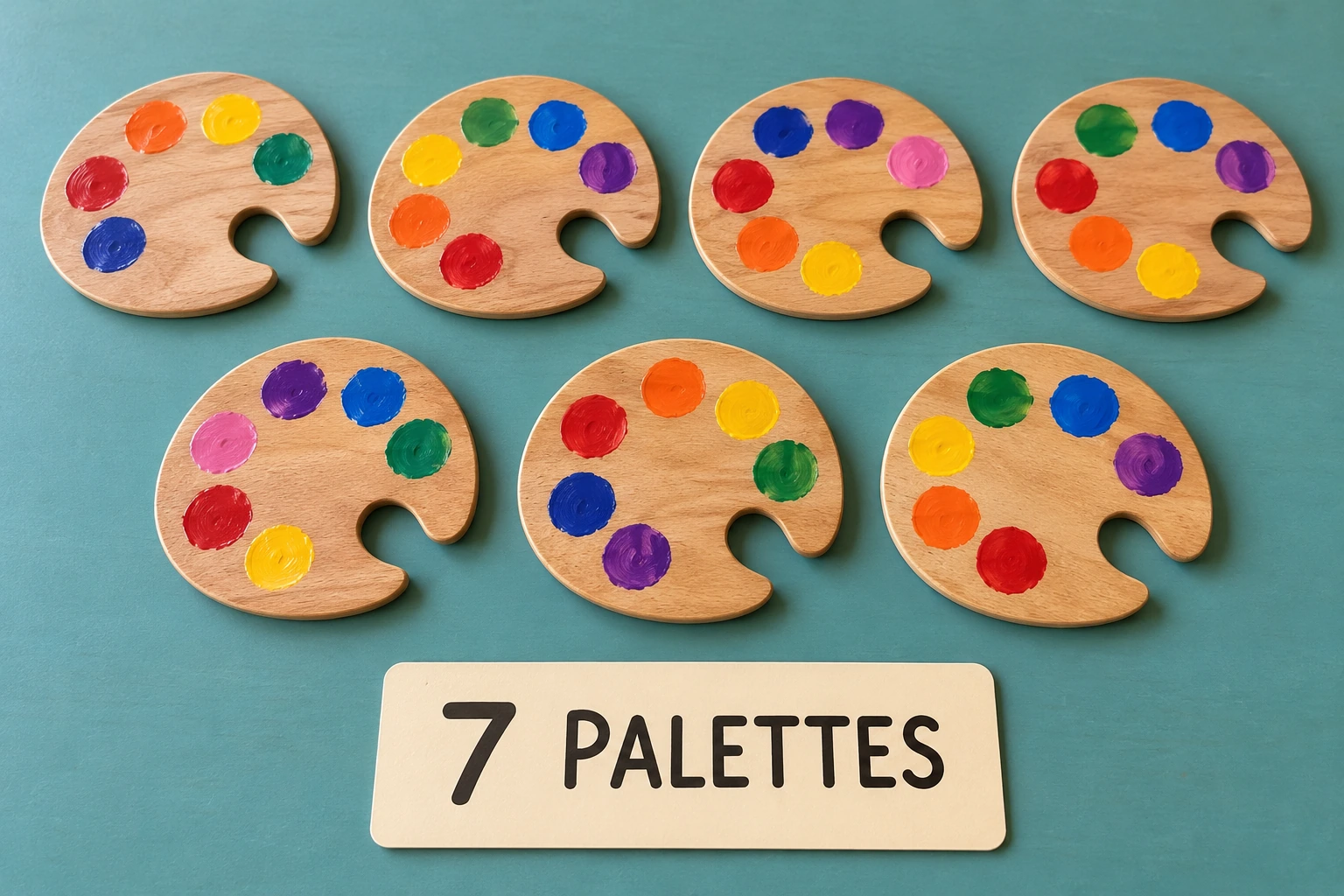
1. School Supply Count labels seven palettes
Arrange seven palette props with a readable 7 PALETTES card beside them. Let the child check the label by pointing at each whole item. Then point at a paint spot and ask whether it is another palette. The question makes the unit explicit without requiring the child to count all the decorative colors.
2. School Supply Count opens a pencil desk
Offer four pencil cards and numeral cards 2, 4 and 6. A toy classroom helper needs the correct stock label. The learner counts the complete pencils and selects the value before arranging a pretend desk. Move only the pencil spacing on another turn and ask whether the label still describes the collection.
3. School Supply Count sends two backpacks
Place two backpack drawings beside a pretend classroom door. The child reports the number of bags and chooses its numeral. A partner checks that pockets and handles were treated as parts of their bags. The small collection offers a confident turn before a longer crayon or palette inventory.
4. School Supply Count checks a book shelf
Arrange six book cards with five together and one slightly below. Ask a learner to explain a route before counting, then attach a quantity label. A toy librarian can inspect whether every book received a visit. Swap the inspecting role so the child can check an adult's route as well as perform one.
5. School Supply Count dictates a crayon report
Prepare ten crayon cards in two lines of five. After counting, the child dictates a short stock note for an adult to record. The learner selects a 10 card to confirm the written quantity. This gives the counted total a pretend communication purpose without adding a requirement to handwrite an unfamiliar numeral.
Repair a School Supply Count report thoughtfully
If a child answers five for the books, ask to see the completed route and direct attention toward the lower picture if needed. If palette details receive individual taps, restate the item being inventoried. School Supply Count lets those observed actions guide the repair, so the child receives a useful cue instead of a general demand for more effort.
When the spoken quantity is accurate but the selected symbol differs, read the options in an even voice. When a mark touches two numerals, ask which was intended. School Supply Count can preserve correct reasoning while addressing recognition or recording. An inventory can be checked and revised. A changed answer does not make the whole page unsuccessful.
School Supply Count readiness and repeat visits
Learners around three to six may explore these tasks with varying levels of support. Two backpacks can be approachable before ten crayons, and interest in art supplies can provide a reason to begin. School Supply Count suits children starting to coordinate counting words with picture touches and link known totals to numerals; no independent written report is required.
Return to one supply group during a calm play session, letting the learner choose a familiar item. School Supply Count can become a short regular habit through a shared strategy rather than repeated full-page completion. Name the progress specifically: the child counted the extra book, kept seven as the total or checked a proposed stock label.
If attention or hand comfort fades, pause with a completed small report. School Supply Count offers further groups for another day. Count complete supplies before writing the inventory value. That simple purpose can remain familiar even when the child changes response method or needs a different amount of adult help.
Further resources after School Supply Count
For a separate numeral model, use seven formation practice after the palettes, the ten tracing resource after the crayons, or a six-writing model after the books. Select one task that responds to the learner's actual next question, keeping formation distinct from deciding a pictured quantity.
For adult ideas beyond the page, browse the family mathematics article collection at NAEYC and PBS's maths guidance area for age-four families. Bring a manageable play invitation alongside School Supply Count without making it an extra task the child must complete before enjoying the worksheet.
Save the School Supply Count printable edition
The original free sample preserves the website marks on the uploaded source. An eligible active membership provides access to the clean premium School Supply Count PDF through the premium download. After signing in, members can save an edition without website-name or watermark branding and without advertisements added to the activity page. Select and save the file you intend to print.
Inspect the one-page US Letter preview before printing School Supply Count. Confirm that the final palettes and their answer options remain within the printer margins, using fitting when necessary. Check a first paper copy before preparing a class set. A clear group, an agreed item and one checked numeral are enough to start the art-table inventory.
Popular Worksheets
Printable resources families and teachers are downloading now.
 Free
 Free
 Free
 Free