
Fruit Number Choice: 5 Brilliant Market Counting Games
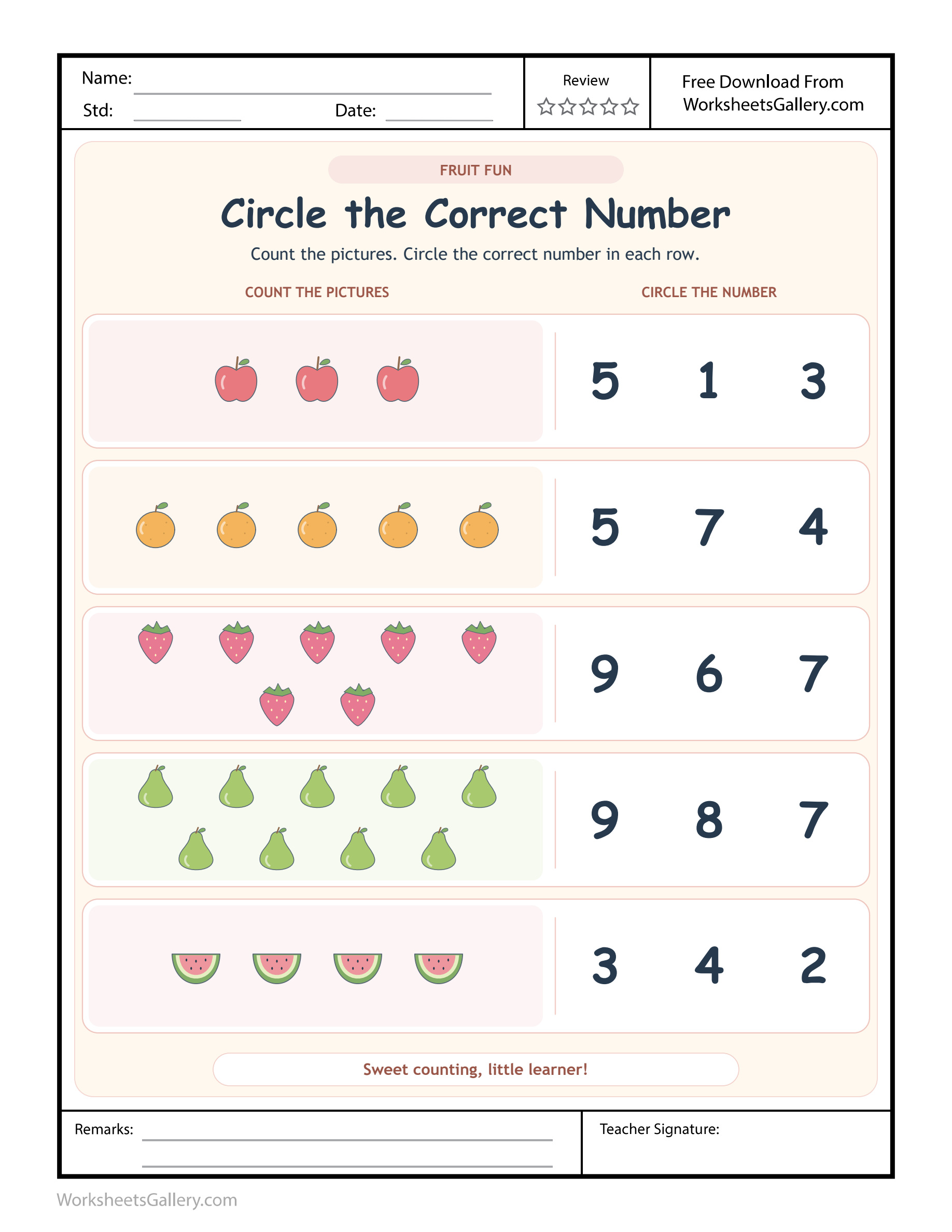
Three apples are waiting on the stall, but the first printed answer is five. That little mismatch makes Fruit Number Choice a useful invitation to count before choosing. Children inspect five fruit groups and circle the numeral that describes each group. The pictures include straight lines and groups that continue underneath, so the route matters as much as the spoken counting words. Keep the pencil nearby for the final decision. A finger, a quiet pause and one clearly remembered total can do most of the thinking before a circle appears.
🍎 Fruit Number Choice begins at the fruit stall
Pia notices the large 5 beside the apples and begins saying “five.” Her uncle gently covers the answer area with scrap paper, leaving all three apples visible. She touches the fruit and counts three. When he uncovers the numerals, she finds 3 at the far right. Fruit Number Choice has given them a clear reason to let the pictures speak before the possible answers.

Use that cover briefly rather than turning it into a rule for every learner. A child who counts confidently may not need it. Fruit Number Choice simply offers an opportunity to observe whether a numeral is influencing the count. Ask “How many apples did your finger visit?” and allow the child to show the route instead of supplying a correction immediately.
A small routine for Fruit Number Choice
- Name the group. Agree that the first problem concerns complete apples.
- Visit each picture. Pair one spoken number with one fruit.
- Keep the total. Repeat the last count word as the quantity.
- Inspect the alternatives. Locate that numeral among the three choices.
- Circle once. Mark the chosen numeral while leaving the others readable.
Fruit Number Choice separates counting objects from recognizing written numerals. A child may count seven strawberries accurately yet hesitate over the symbol 7. Read the three choices aloud without pointing to the correct one, then let the learner select. Another child may recognize every numeral but need help keeping track of the berries. Respond to the difficulty you actually see.
This is a picture-counting and selection task. Fruit Number Choice does not ask for missing number sequences, sums or traced numeral strokes. Each bordered row stands on its own. The count resets for the next type of fruit, and the totals do not have to increase as the child works downward.
Inspect the five Fruit Number Choice orders
The quantities, from top to bottom, are 3 apples, 5 oranges, 7 strawberries, 9 pears and 4 watermelon slices. Keep this adult reference available for checking after an attempt. On Fruit Number Choice, a watermelon slice is one pictured item; its seeds do not add more slices to the group.
| Fruit order | Choices as printed | Count to confirm |
|---|---|---|
| Apples | 5 / 1 / 3 | 3 |
| Oranges | 5 / 7 / 4 | 5 |
| Strawberries | 9 / 6 / 7 | 7 |
| Pears | 9 / 8 / 7 | 9 |
| Watermelon slices | 3 / 4 / 2 | 4 |
The answer changes location across Fruit Number Choice. Apples use the rightmost option, oranges the leftmost and watermelon slices the middle. A familiar position is therefore a poor substitute for counting. After an answer, ask the child to connect the chosen numeral back to its fruit group with a pointing gesture.
Fruit Number Choice follows the lower strawberries

Five strawberries appear on the upper line and two below. A learner who stops at five has counted part of the group accurately but has not yet visited every berry. Fruit Number Choice lets an adult acknowledge that partial success: “Your first line was careful; show me what is underneath.” Continue the counting route to six and seven.
Keep the group boundary visible when using a cover. Fruit Number Choice needs both strawberry lines available together. Covering the lower pair accidentally changes the evidence the learner can inspect. If visual tracking is difficult, an adult can move a pointer while the child supplies the number names, then exchange those roles on another small group.
Six observations from a Fruit Number Choice session
Fruit Number Choice encourages deliberate attention
The first apple example gives a reason to pause before reacting to a prominent numeral. Notice whether the learner studies the pictures or reaches toward an answer immediately. A short, attentive look can be a useful success even before the full task is completed.
Fruit Number Choice connects touches and words
Each fruit receives one counting word. A child who speaks faster than the pointing finger can slow both together. This coordination gives an adult something concrete to support, rather than repeatedly asking for the count to be “more careful” without showing what that means.
Fruit Number Choice gives the final word a job
After saying nine, ask how many pears there are altogether. Repeating nine as the total connects the counting sequence with the size of the group. Leave the pictures available for checking; the activity does not require the learner to remember an unseen collection.
Fruit Number Choice makes symbols purposeful
The written 4 stands for the four watermelon slices. Choosing it is a practical use of numeral recognition rather than an isolated naming drill. A reference numeral card can support recognition while the learner remains responsible for deciding the quantity.
Fruit Number Choice offers controlled pencil work
Circling one option calls for planning a small curved movement and stopping around the intended numeral. An imperfect oval can communicate a correct choice. If pencil control is demanding today, let the child point first and practice a larger circle elsewhere.
Fruit Number Choice invites an explanation
“I counted these two as well” can explain why seven replaced five in the strawberry row. The learner may show that explanation with a finger instead of a sentence. Respond to the reasoning, giving the child a chance to lead the checking conversation.
Use Fruit Number Choice in a home market
Set out the sheet and three pretend fruit pieces on a clear table. Let the child count the props before examining the apple row. On Fruit Number Choice, the props are preparation rather than extra fruit to include in the printed count. Move them aside before checking the worksheet itself, so the two collections remain distinct.
When Pia is ready to circle, her uncle asks her to say “three apples” once more. She keeps that total while scanning the choices. Fruit Number Choice can be explored one order at a time; there is no need to complete all five in a single sitting. Finish with a row she can explain rather than waiting until concentration has disappeared.
Fruit Number Choice at the classroom produce desk
Offer a counter role and an order-checker role. The counter points and names the total; the checker inspects the same fruit group before agreeing. Swap roles for the next problem. Fruit Number Choice provides a shared object for discussion, but the teacher should also hear each learner make a choice without another child's answer arriving first.
Record the kind of cue used: a cover over numerals, a pointer across the pictures or a spoken reading of the options. On Fruit Number Choice, these cues address different demands. A completed circle alone does not reveal whether the learner counted independently, recognized the numeral independently or needed support with both.
Five market games beyond Fruit Number Choice
1. Fruit Number Choice with a delayed price board
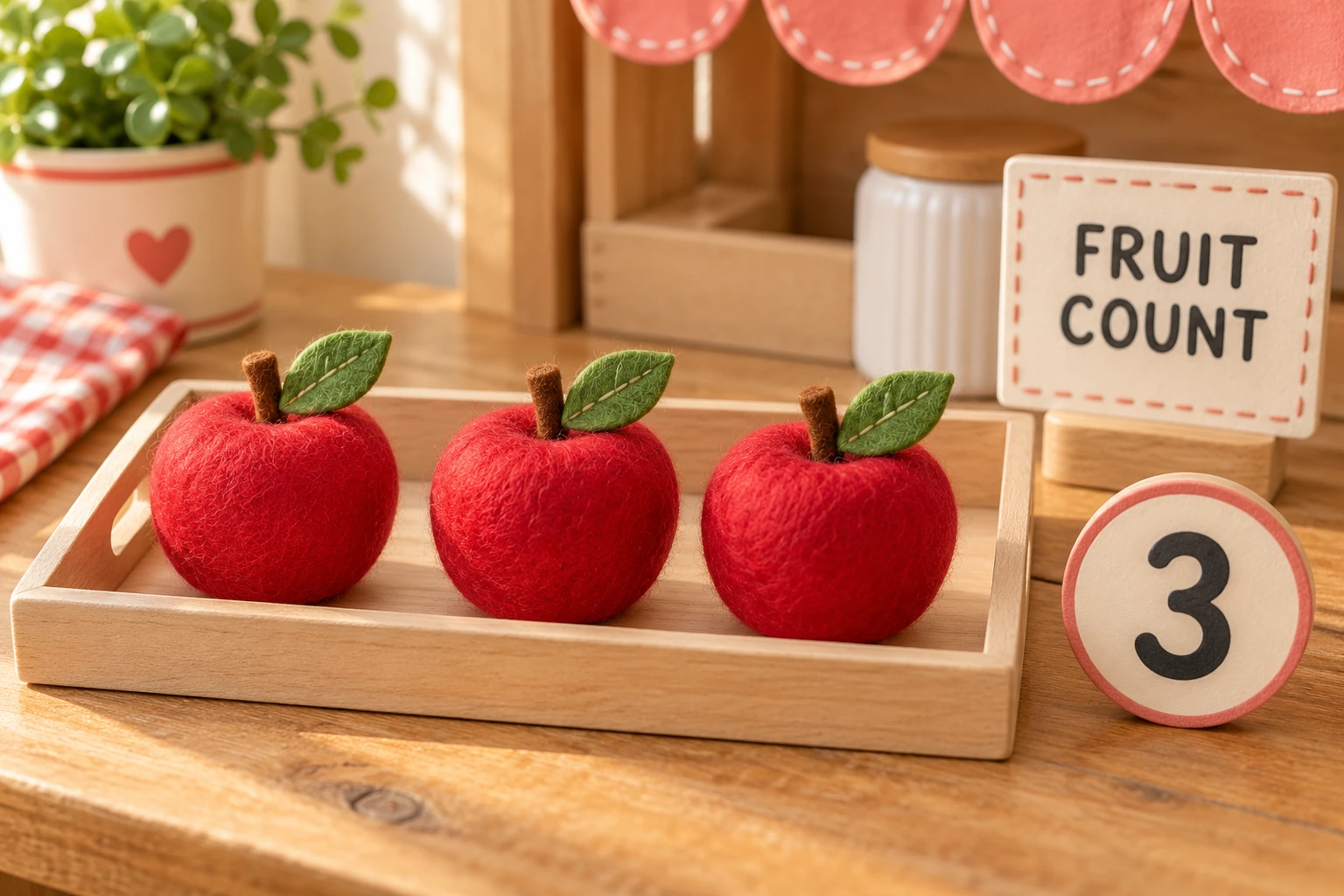
Arrange three pretend apples and keep cards 1, 3 and 5 face down. Ask for the quantity before revealing the cards. The child then finds the total already counted. Explain that these cards label quantities, not prices, so the pretend stall stays focused on how many apples are present.
2. Fruit Number Choice as a whispered order
One partner counts four paper watermelon slices and whispers the total to another. The receiver selects a numeral card, then both inspect the collection together. Reverse the jobs with a different small group. This gives the final count a short journey from one person to another without a long memory demand.
3. Fruit Number Choice with an honest delivery
Ask for five pretend oranges from a small visible supply. The learner moves each selected orange into a tray and checks the delivered group. Compare the result with the worksheet's orange order afterward. Keep the task about one delivered collection rather than adding the remaining fruit into its total.
4. Fruit Number Choice changes the berry layout
Make seven berry counters, first arranged as five and two, then as a single line. Recount both arrangements together. Let the child explain whether any berries were added or removed. Return to the printed strawberry group only if the learner wants to compare the two ways of organizing it.
5. Fruit Number Choice sends a market receipt
The child chooses one finished row and dictates a small receipt such as “4 slices.” An adult can write it while the learner checks the numeral against the pictures. Give the receipt to a toy shopper. The written quantity now serves a purpose beyond gaining an adult's approval.
Fruit Number Choice repairs a nearly right count

The pears have five pictures above four. If the learner selects 8, first check for a skipped pear or a repeated touch. Fruit Number Choice provides a fixed collection that can be inspected again. Avoid assuming that every incorrect circle means the child does not recognize the numeral; the counting route may explain the result.
If two answers are circled, ask which one describes the finished count. If leaves or seeds attract extra taps, agree on complete fruit as the unit. Fruit Number Choice can feel manageable when corrections concern a specific action. “Let's include this pear” offers a clearer next step than a general request to start everything over.
Readiness and another visit to Fruit Number Choice
Children often explore this kind of task between ages three and six, with help suited to their counting experience. The seven- and nine-item groups may need more support than the apples. Fruit Number Choice suits a child ready to coordinate pointing with counting and begin linking small totals to numerals. Readiness matters more than completing the page at a particular age.
Revisit one order during a relaxed routine, perhaps before pretend-shop play. Fruit Number Choice does not need a timer or a daily score. Let the learner choose a familiar group before trying a harder one. Praise a concrete strategy, such as remembering the total while looking right, and keep the next visit short enough to feel inviting.
Related practice after Fruit Number Choice
For writing the apple total separately, open the numeral three tracing page. A learner ready for a different number-selection activity can try the one-to-six dice game. Later, fruit picture addition introduces a different mathematical task; finish counting single groups comfortably before combining them.
Adults can browse NAEYC's family maths collection and PBS KIDS for Parents maths ideas for age four. Choose a manageable play idea alongside Fruit Number Choice rather than making the linked resources another set of assignments.
Save the Fruit Number Choice printable
Select the original free sample for the uploaded edition with its existing website marks. Eligible active members can use the clean premium PDF of Fruit Number Choice. Its website lettering is removed, giving members a no-watermark worksheet without inserted advertisements. Sign in for the member edition, save your chosen file, and open it before printing.
Use US Letter paper and check that every fruit group fits inside the printer preview. Apply page fitting if the border would be clipped. Print a trial copy of Fruit Number Choice before preparing more sheets. Let the count come first, with a clear circle recording the decision only after the child has inspected the fruit.
Popular Worksheets
Printable resources families and teachers are downloading now.
 Free
 Free
 Free
 Free