AI vs Traditional Learning: 5 Smart Worksheet Decisions
A fluent draft and a familiar worksheet both need adult judgement. Five decisions keep purpose, accuracy, access and conversation at the centre of early education.
A polished activity can still ask the wrong question. Whether an adult drafts an idea with an AI tool or chooses a printable, the learning purpose needs to survive the attractive presentation. For preschool and kindergarten children, that purpose might be counting whole objects, noticing a letter or explaining a picture. This guide offers five decisions for parents and teachers weighing digital preparation against paper practice. It includes three existing worksheet examples, checks and ways to bring an activity back into conversation and play. Begin with what the child needs to do, then choose the material that supports it.

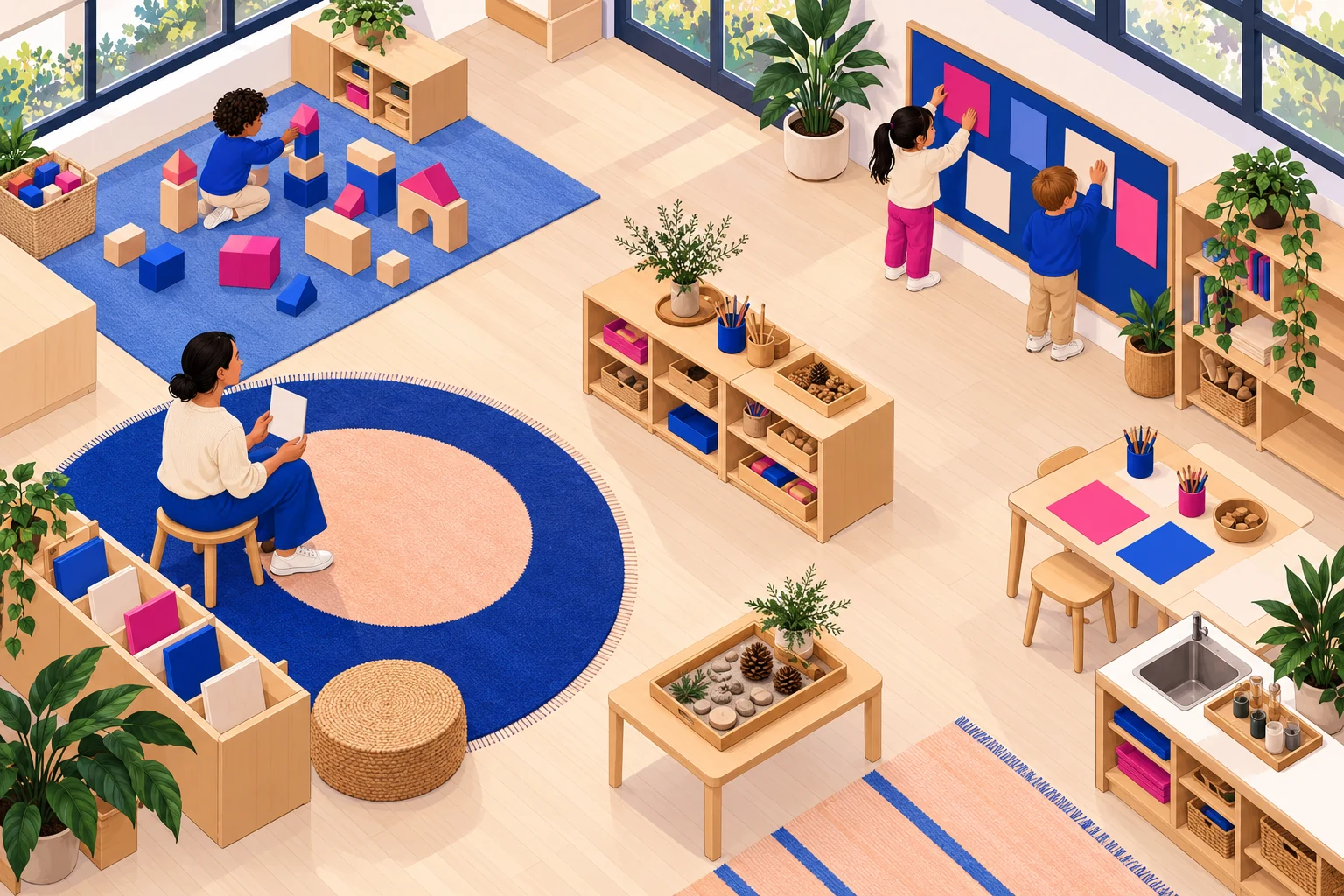
Open space separates an adult’s preparation desk from the child’s hands-on play, without showing a young child using a chatbot.
🧭 Keep the learning question ahead of the tool
“AI” covers many kinds of systems, including tools that draft text, pictures or suggestions. A printed worksheet is a physical format; its content could come from many processes. These are not equivalent categories in a simple contest. An adult might use a digital tool during preparation and still choose paper for the child’s learning activity. Another might prepare everything by hand and offer a poorly matched task.
Traditional early learning also includes shared stories, pretend play, outdoor exploration, conversation and real objects. It is much broader than rows of tracing. A useful comparison therefore asks what the learner experiences: Do they make a decision, test an idea, handle a material, ask for help or explain what happened? A device-free page can support those experiences, but its presence alone does not establish quality.
These decisions concern adult selection and preparation. They are not instructions to give a young child independent conversations with a general-purpose chatbot. Provider requirements, school policies and the child’s context must be checked before choosing any digital service.
The current guidance behind these learning decisions
UNESCO’s guidance on generative AI in education, published in 2023 with its information page updated in January 2026, emphasises human agency, age appropriateness and validation. The implication for an adult preparing learning materials is straightforward: a plausible draft still needs knowledgeable review before it becomes a child’s task.
UNICEF’s December 2025 guidance on AI and children includes safety, privacy, fairness, inclusion and children’s development among its requirements. Those principles inform the questions below. Neither source establishes that every printable is better than every digital experience, or that these five decisions form a tested learning programme. The practical examples are adaptations for families and early educators.
Decision 1: state one learning purpose you can observe
Compare “make something educational about rockets” with “help a child count three complete rocket pictures once each.” The second describes an action an adult can notice. It also exposes an easy error: counting windows, fins or flames as separate rockets. Before selecting an activity, say what counts as one successful attempt, and decide what support is welcome.
For a concrete learning example, open Number 3 Worksheet: 4 Brilliant Rocket Mission Wins. Its three-rocket collection sits alongside numeral practice and other sections. Choose the picture count if quantity is today’s purpose. A learner can point while an adult says the counting words; tracing every 3 is not a prerequisite for discussing how many rockets there are.
An AI tool may offer several story contexts for the same purpose, but the adult still needs to inspect whether the instructions preserve it. “Count down from three” describes a launch routine; it does not establish the number of rockets. Keep a short purpose note beside any proposed learning material so a cheerful theme does not quietly change the task.
Decision 2: check the learning content before the layout
Count every picture yourself. Read every instruction aloud. Compare a letter model with the form your setting teaches. Look for ambiguous units, missing examples, mixed tasks and answer cues that make the intended challenge pointless. These checks apply to any source, including a familiar printed page. A neat layout and fluent explanation are not evidence that its learning content is correct.
Test the material as a learner might encounter it. If a page asks for an estimate beside a clearly printed answer, the adult needs a different invitation or a removable cover. If a proposed phonics task relies on a misleading picture name, change the cue rather than expecting the child to guess what the adult meant.
Adult review is part of preparing the learning experience. When a claim is outside your knowledge, check an appropriate authoritative source or ask a qualified colleague. An automated response approving another automated response does not supply an independent check. Keep the uncertain material out of the activity until the relevant point is resolved.

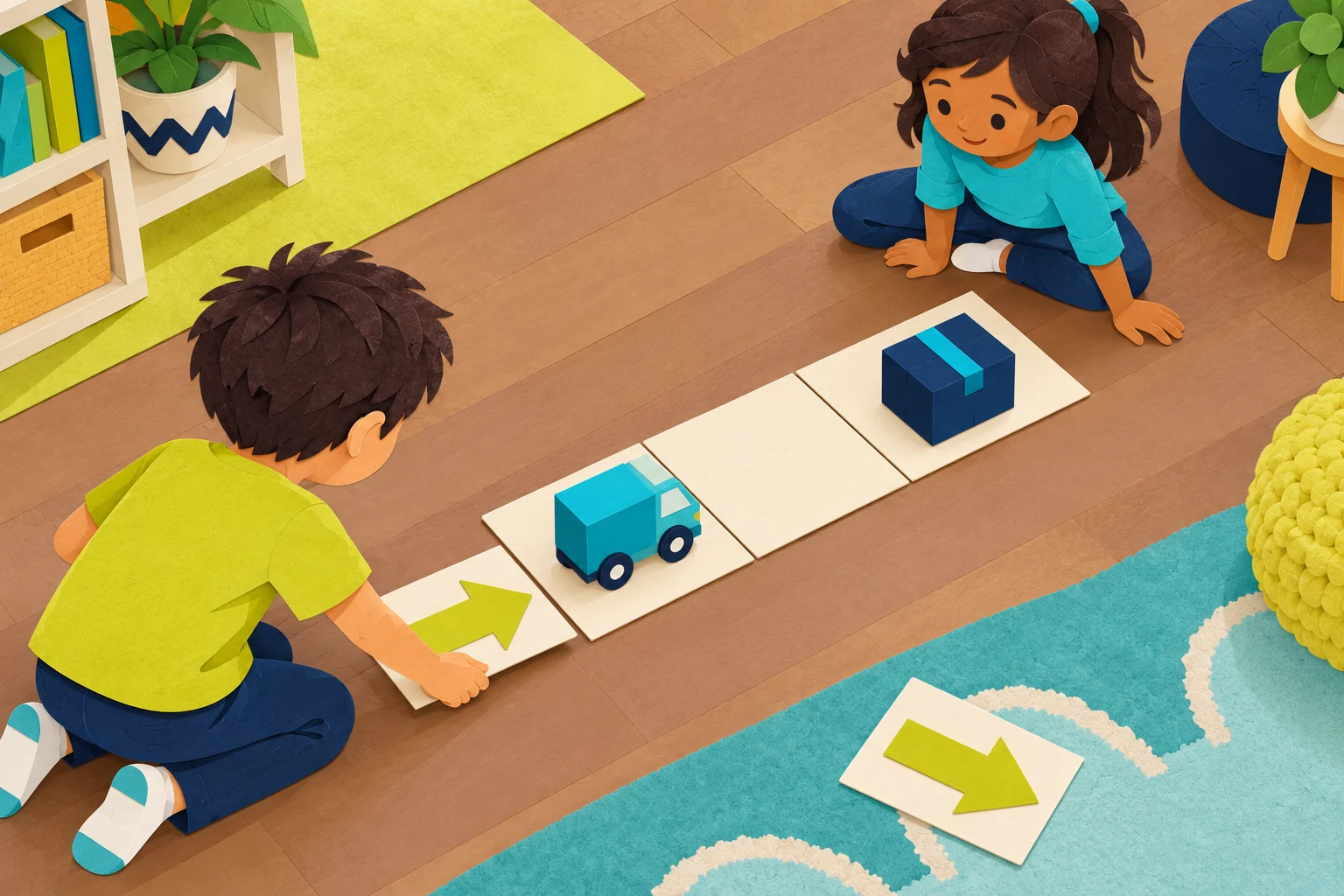
Four whole picture objects and four real blocks offer a straightforward quantity comparison before a material is used.
Decision 3: choose a learning format the child can use
Paper offers a stable surface that can remain beside real objects while a child points, marks or explains. It can be useful where a device is unavailable, distracting or unnecessary for the purpose. It also has limits: faint print, crowded spaces, small targets and an uncomfortable tool can obstruct participation. A paper learning task is not automatically accessible just because it is familiar to an adult.
Consider Mm Worksheet: 5 Brilliant Moon Peak Journal Missions as a learning example. The printed uppercase and lowercase models, tracing sections and moon picture cue are already visible for inspection. A child might compare M with m, follow one model with a finger, or dictate something about the moon. Choose which of those actions matters today. Letter recognition and handwriting should not be treated as interchangeable evidence.
Some learners need other formats or support, including accessible digital materials, larger print, verbal responses or adapted tools. Preserve the learning purpose while changing the route into it. Consult the family and teaching team about supports already in use rather than presenting either paper or technology as a universal solution.
Decision 4: protect the relationship around learning
An activity should leave an adult able to notice the child. Watch the pointing route, listen to an explanation and ask whether a pause would help. A worksheet can hold a shared focus while the adult responds. If the adult concentrates entirely on correcting marks or entering results into a device, the visible task may obscure the child’s actual learning experience.
Use Chick Coloring: 5 Brilliant Moves for Happy Artists when a familiar outline would invite a colour conversation. It includes a large chick and a smaller finished reference. An adult can ask whether the artist wants to follow a colour or invent another choice, then wait. Blank paper provides another route if the outline becomes restrictive. The aim here is an art decision and a conversation, not proof that a particular medium changes emotional development.
Keep encouragement attached to something observed. “You tested the crayon before choosing it” describes a decision. “This proves you are ready for harder learning” goes beyond that evidence. A child may also choose to stop, watch or return later; those responses help the adult judge the next invitation.
Decision 5: use technology only where it adds learning value
For adult preparation, a drafting tool might suggest alternative wording, a list of questions or several story themes. Treat those as candidates to inspect. Remove unnecessary steps, check every example and adapt the language to the actual group. Time saved in drafting is useful only if the final learning activity remains accurate and manageable.
Describe a generic need when seeking ideas. A request such as “suggest a short counting story for three large toy animals” does not need a child’s name, photograph, school record or private information. Follow the service’s rules and your setting’s privacy procedures. Avoid uploading identifiable work or sensitive records merely to make a generic learning prompt feel more specific.
Finally, ask whether the tool is needed at all. One familiar page, a few large blocks and a thoughtful adult question may be enough. Choosing a simpler preparation method is a practical decision, just as choosing an accessible digital format can be. The learning purpose supplies the reason; novelty does not need to supply one.
What paper can offer, and what the adult still supplies
| A possible advantage | A practical limitation | The adult’s learning decision |
|---|---|---|
| A stable picture collection | Pictures may invite counting parts | Identify the whole unit before counting |
| A visible letter model | The form may differ from local instruction | Check the model and choose one purpose |
| A shared drawing surface | A fixed outline may narrow choices | Offer blank paper alongside it |
| No device needed during use | Print may be faint or cramped | Test one copy and adjust access |
| A record that can be revisited | Completed marks hide how they were made | Listen and observe during learning |
Six useful contributions of a well-chosen worksheet
- A common learning reference. Adult and child can point to the same feature during learning, reducing the need to hold a complex instruction in memory.
- A visible learning example. A checked model offers something to compare with, while leaving the adult responsible for explaining its purpose.
- A pauseable learning task. Paper can be set aside and revisited without a running activity moving on. The child can help decide where to resume.
- A bridge to objects. A printed collection can sit beside large toys, linking a representation with a hands-on learning check.
- A space for a response. Marks, pointing and dictated comments can make an idea visible. The response does not have to be independent handwriting.
- A prompt for reflection. Returning to an attempt gives a child and adult something specific to discuss, without treating one page as a full learning assessment.
Try a five-minute learning-material check
- Write the learning purpose. Use an observable action, such as pointing to three complete pictures, rather than a broad promise of improved ability.
- Inspect one learning example. Check the count, word, model or instruction against the intended task. Resolve uncertainty before use.
- Test the learning material. Print one copy or inspect the accessible format you plan to use. Look at the material from the child’s position.
- Prepare a real-world learning connection. Put large objects, blank paper or a familiar book within reach. Keep loose pieces age appropriate and supervise their use.
- Plan one learning question. Ask about an action or idea you can actually observe, then allow a response in words, gestures or pointing.
The time label is a planning suggestion, not a guarantee. Some learning material needs longer checking, especially when its facts or models are unfamiliar. It is reasonable to use a trusted resource already understood rather than rushing to repair a new draft.
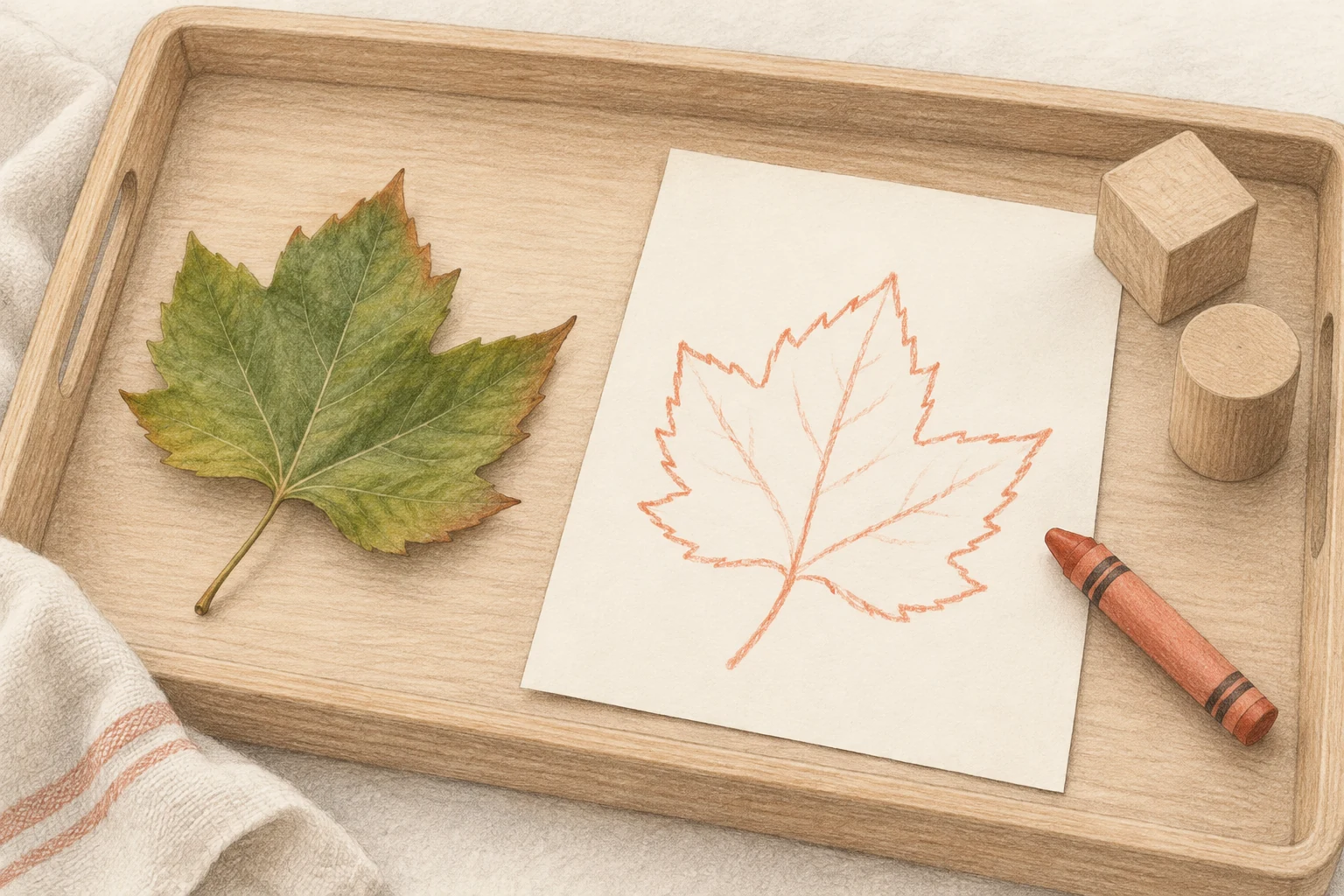
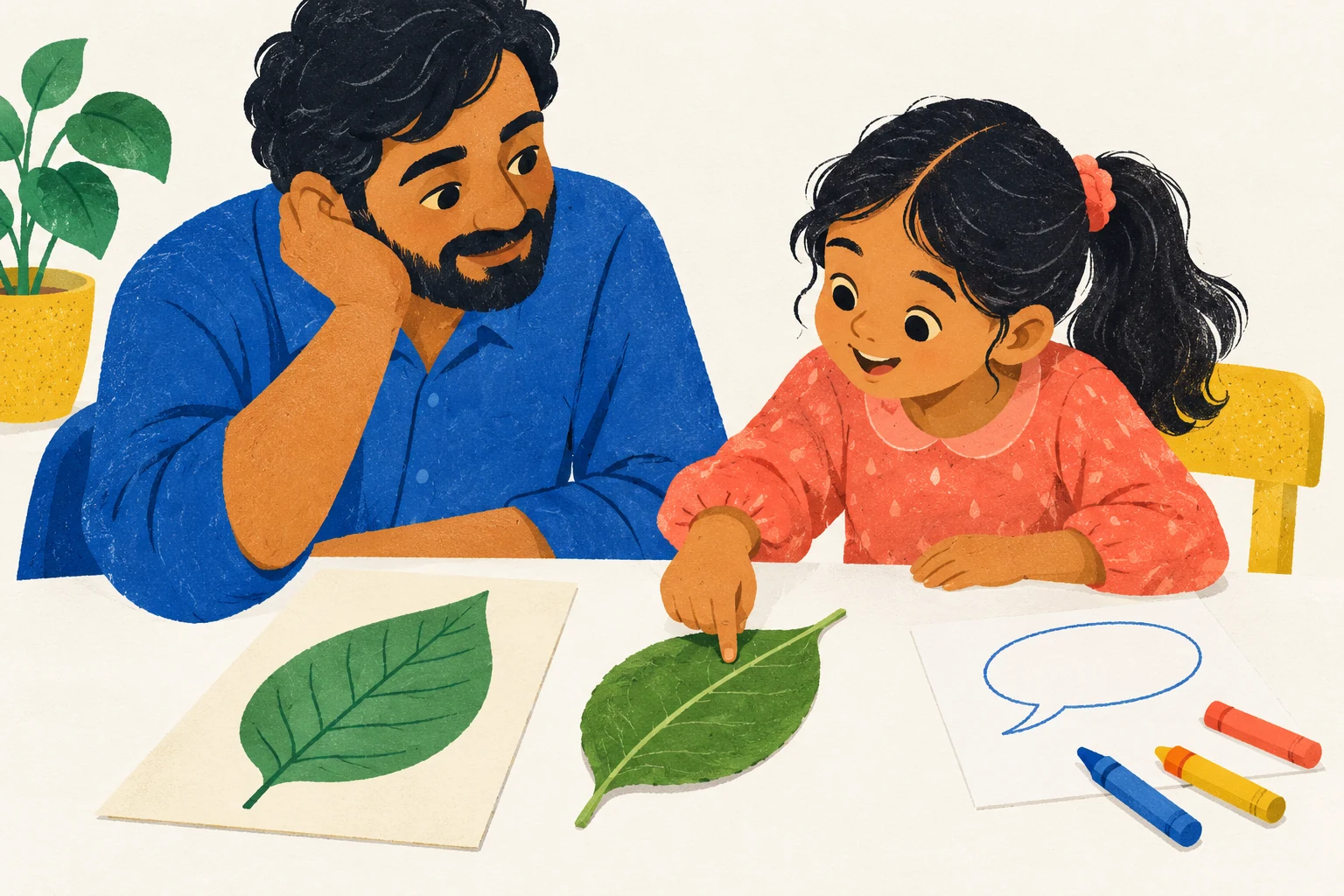
The real leaf and its sketch invite a conversation about which details a representation shows and which remain to be noticed.
Two learning choices an adult might face
A parent: the colourful page asks too much
Imagine a parent finding an attractive activity that combines counting, spelling, drawing and a long story. The child is currently interested in three toy rockets. The parent sets the complicated page aside, opens the existing rocket resource and supports one picture count. In this hypothetical learning scene, the useful choice concerns scope. It does not establish that the rejected material’s preparation method caused the mismatch.
A teacher: the draft needs a better question
Picture a teacher reviewing several suggested questions for the moon letter page. One asks children to read a sentence containing correspondences they have not been taught. The teacher replaces it with a familiar letter comparison and offers oral moon talk separately. The learning invitation now matches current instruction. This example illustrates adult review, without claiming that a tool diagnosed the group or measured individual progress.
Four ways to extend learning beyond a completed page
- Explain a deliberate mismatch. An adult places two large blocks beside a three-picture collection and asks what should change. Check together without making the learner guess a hidden rule.
- Become the instruction reader. The child tells the adult how to begin a familiar task, using gestures or words. Follow the directions and ask for clarification respectfully.
- Make a real-object companion. Pair a simple sketch with an observed safe leaf, toy or household object. Discuss one feature the picture shows and one it leaves out.
- Save an explanation. With the child’s agreement, an adult writes a brief comment about their idea beside the paper. Keep it locally according to the family’s or setting’s normal practice.
Bring the learning decision back to the child
The three linked pages list ages three to six and currently offer free watermarked single-page samples, with clean PDFs requiring active membership. Check those panels before downloading. Their value lies in how they fit a chosen purpose, rather than in a claim that every child should complete them.
“Show me what you were thinking” leaves room for a child’s explanation to matter. Whether preparation involved a digital draft, a pencil or an existing resource, the adult can remain curious and responsible. Keep learning accurate, manageable and connected to real experiences; let the next choice follow what you notice together.