
Mm Worksheet: 5 Brilliant Moon Peak Journal Missions
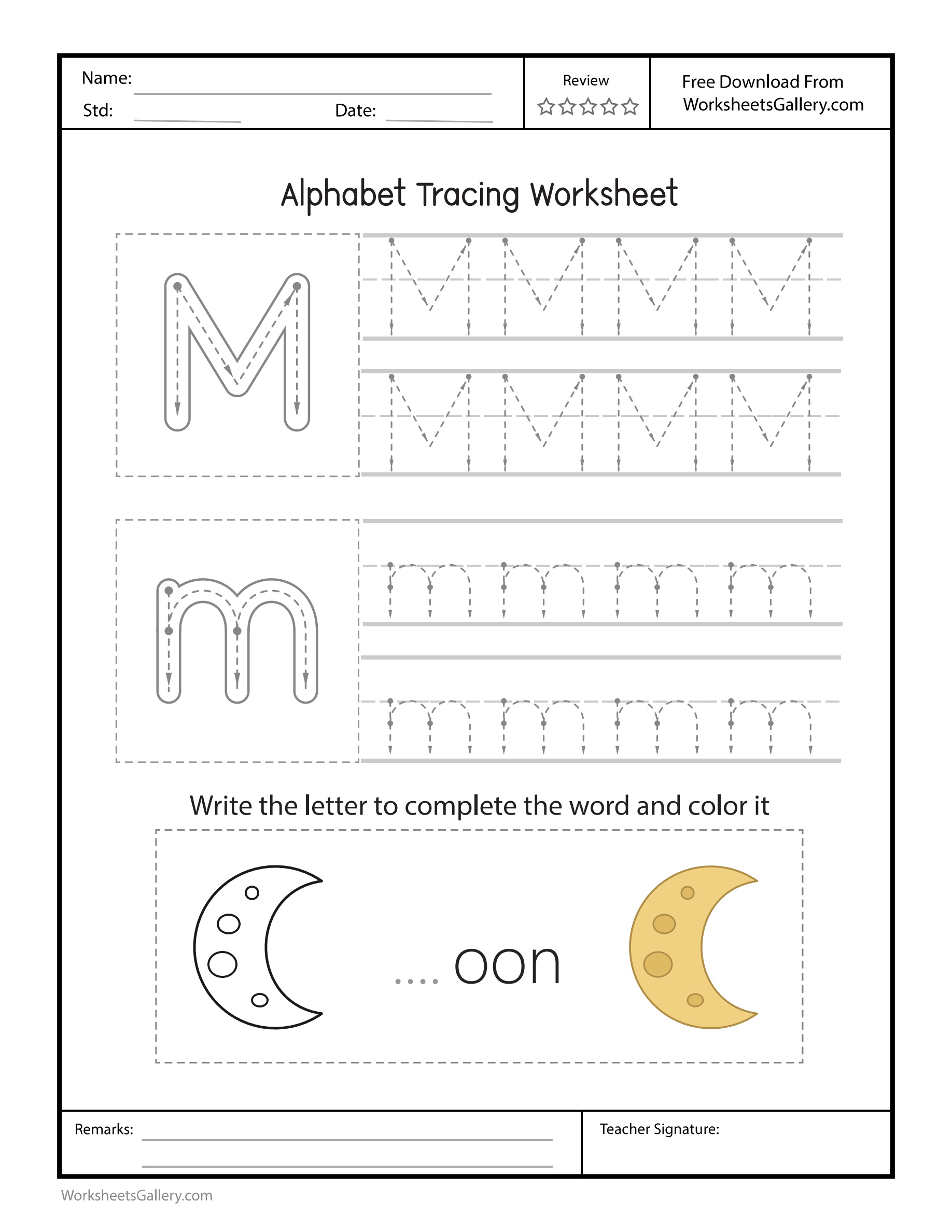
The Mm moon activity belongs to the complete A–Z letter-pair collection. One $4 purchase supplies all 26 clean tracing pages in a single alphabetically ordered PDF, including this moon peak journal lesson.
A moon journal can begin with one small letter instead of a whole written sky report. The Mm Worksheet leaves the first m missing from moon and supplies two case models for finding it. Capital M uses tall sides and inner diagonals, while lowercase m moves through two humps. Those routes give a child something specific to inspect before choosing a tracing example. Intended for learners around three to six years old, the page can combine picture conversation, broad rehearsal and a short writing contribution, with the journal story making the initial useful.
The Mm Worksheet journal begins with a picture word
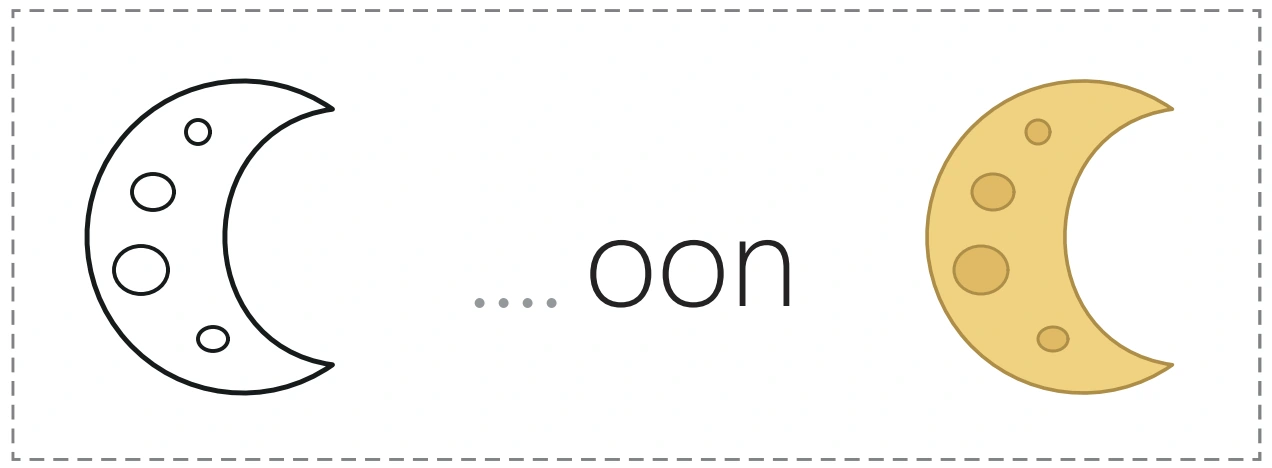
The Mm Worksheet moon appears as an outline and a colored companion beside its incomplete word. An adult can name the Mm Worksheet moon and point to the initial space, leaving the already printed letters in place. Lowercase m supplies the beginning. Read the finished word together without asking the child to independently explain the vowel spelling or copy a whole observation sentence.
For Mm Worksheet sound talk, listen to the first /m/ in moon and distinguish it from naming the letter M. The crescent illustration provides the picture clue, not a diagram of the letter's shape. A child may color it imaginatively while still identifying the written initial correctly. The page is about letter formation and word beginnings, not a test about the Moon's changing appearance.
Follow two Mm Worksheet humps and stop after them
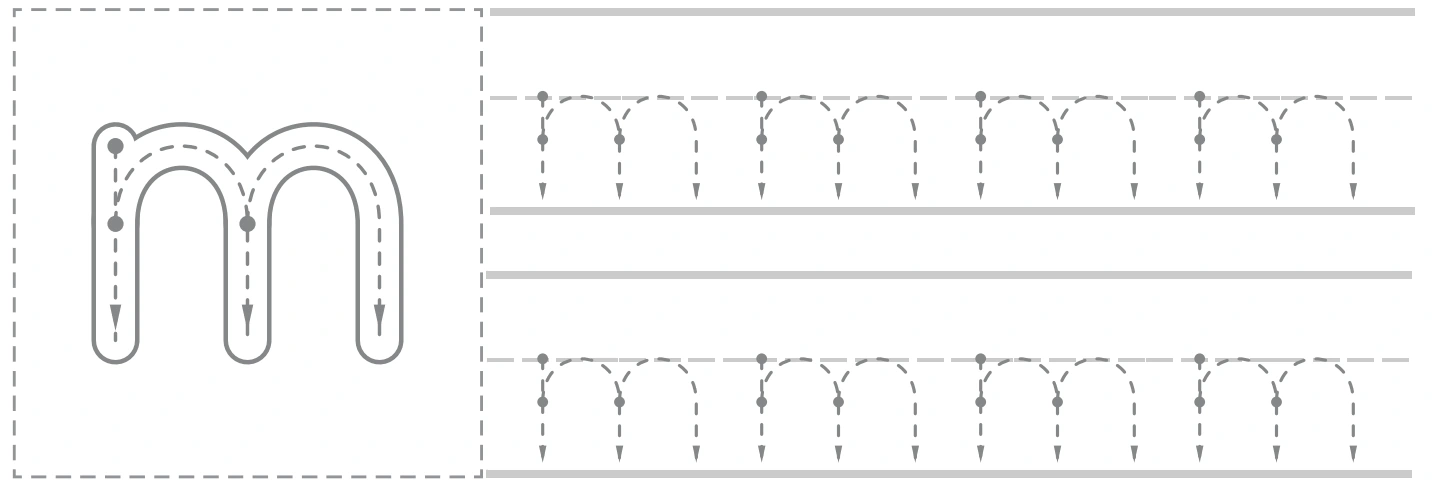
Lowercase m on the Mm Worksheet combines its stem with two rounded humps. Locate each rise on the large guide and follow the Mm Worksheet route with a finger. The repetition inside one letter deserves a clear finish. A child who continues adding more humps may need to inspect where the source ends rather than complete another full small-letter row.
The Mm Worksheet offers eight small m examples across two rows. Choose one and compare its parts before starting another. Ask whether both humps are present and whether an additional one was added. A larger card can make those distinctions easier to inspect. The learner's understanding may be clearer in a broad finger movement than in a tightly controlled pencil attempt.
Capital Mm Worksheet routes change the inner shape
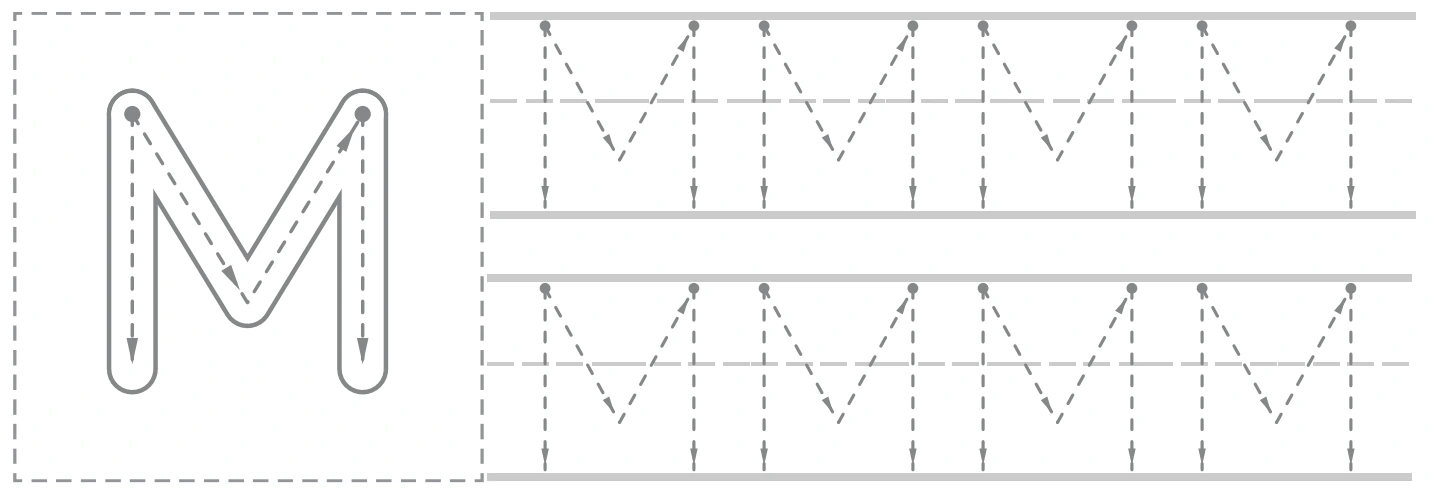
The Mm Worksheet capital M is not made by stretching the small rounded form. Its outer sides stand tall while the inner diagonals dip between them. Point to that difference and use the source arrows to rehearse the route. A learner can match M with m by name before confidently producing both patterns with the hand.
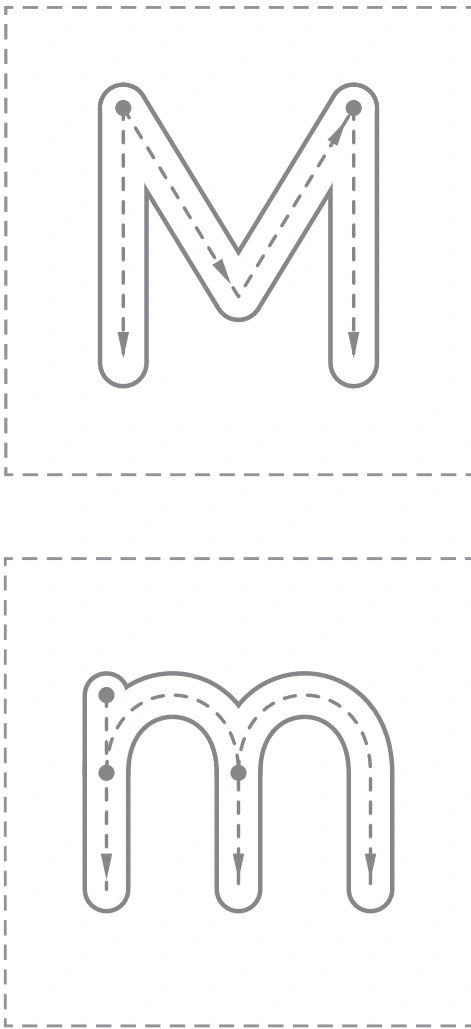
The large Mm Worksheet guides make a side-by-side comparison possible without shrinking the details. Capital M has angled inner portions; lowercase m has rounded humps in its lower writing space. Keep the actual models visible when another book uses a different font. The purpose is to understand this supplied pair and its routes, not to copy every typeface a child has encountered.
Eight capital examples complete the Mm Worksheet set of sixteen small tracing opportunities. Treat those as choices across visits. A child may try one capital, one small form and the moon initial, then finish with coloring. If the next model is being followed without looking at its features, pause and ask what the learner wants to check before continuing.
Inez opens the Mm Worksheet window journal

Inez and her mother put a blank notebook beside a paper window frame for Mm Worksheet play. The pictured moon becomes the subject of a pretend sky report. Inez points to the initial space and asks for the small model. Her mother reads the word, then lets Inez rehearse two broad humps on a loose page before choosing a smaller contribution for the label.
Their Mm Worksheet conversation does not require a real night-sky observation. They can describe the worksheet's crescent or invent a window scene together. If Inez wants a longer report, her mother records what she says on another line. The independent writing job remains a recognizable m, while the child retains ownership of the idea being communicated.
For a home Mm Worksheet visit, choose a moment when the child is comfortable using paper and a writing tool. Name the picture, inspect the two humps and try one route. An imagined window journal can supply a fresh purpose without adding complicated materials. Stop after the selected job if the hand or attention is no longer ready for another precise movement.
Six Mm Worksheet observations for a journal margin
Mm Worksheet repetition happens inside one form
Two humps belong to the small letter, but an unlimited chain does not. Locating the source ending lets a learner plan a stop. An adult can discuss that finish before requesting another small copy, making the repeated movement more deliberate rather than merely longer.
Mm Worksheet partners contrast angles and curves
The two cases share a name while asking for different inner paths. A point or card match can show recognition without a pencil. That keeps a successful visual connection separate from the harder motor task of reproducing both shapes at the printed size.
Mm Worksheet height changes the available space
The capital's tall sides and lowercase humps occupy different ruled areas. Compare those actual references instead of judging every form by the same height expectation. A broad rehearsal is a useful support when the intended relationship is understood but small marks remain difficult.
An Mm Worksheet initial can finish a meaningful word
Adding m gives the moon label its beginning. Adult reading connects the child's mark with the picture and journal story. The rest of the spelling can remain supplied, allowing a useful writing contribution without turning the activity into an independent reading or spelling test.
Mm Worksheet speech can describe a sequence
A learner may say first hump, next hump and stop, or show those parts through gestures. Such an explanation tells an adult which route the child intends. It can be informative even when the pencil does not yet produce that route smoothly in a small space.
Mm Worksheet revisits can use a visible comparison
Save a loose-card attempt and compare another later. Notice two clearer humps, a remembered ending or a capital inner angle that reaches its intended place. Those observations provide a practical next step without treating finished-row totals as a guarantee of broader literacy progress.
Five moon-journal missions after the Mm Worksheet
1. Count the Mm Worksheet humps with a gesture
Look at one small model and move a finger over each hump, ending where the source finishes. Then make a broad version on spare paper. The counting language organizes parts of the letter rather than turning the moon picture into a quantity exercise. Return to the printed form if a chain of extra humps begins to grow.
2. An angled Mm Worksheet paper ridge
Fold or arrange plain paper strips to explore the capital's tall sides and dipping inner diagonals. Keep the source guide nearby and compare the shape with the small letter's rounded version. The paper model is a construction experiment, not another printed worksheet answer. Moving the pieces gives the learner a reversible way to inspect the capital structure.
3. Find m in an Mm Worksheet-style moon label
An adult writes moon on a loose journal card and reads it aloud. Ask a learner to locate its beginning and compare that letter with the small model. The child does not need to read the word independently. Looking for the initial inside a spoken label gives the form a job within a familiar message.
4. Make a picture report beside the Mm Worksheet
Let the child draw a real remembered or imagined window view on a blank page, then choose an m contribution near the picture. State clearly whether the scene is observed or pretend. The adult can record a dictated description if wanted, while the child's letter connects the shared report with moon without requiring an entire written sentence.
5. Inspect a missing Mm Worksheet hump
An adult makes a large small-letter example with only one rounded rise. Invite the learner to compare it with the source and identify what differs. Make a new m together and compare it with a correctly completed model afterward. Alternating complete and altered examples makes the decision depend on looking rather than assuming every adult card needs a correction.
The Mm Worksheet journal in a classroom
Partners can alternate between explaining the two humps and making a broad or small attempt at an Mm Worksheet station. Another learner may choose the capital's inner angles instead. An adult notes the particular feature being explored and the support that helped. That record respects different goals instead of ranking everyone by the number of models completed in the same period.
| The route needs checking | Use this comparison |
|---|---|
| The small form has one hump. | Locate both rounded rises in the model. |
| The small form keeps repeating. | Find where the source's second hump finishes. |
| The capital is copied as large round humps. | Compare M's angled inner portions. |
Mm Worksheet feedback can stay focused on one feature. A deliberate finish belongs to the letter plan. Across the three-to-six age range, writers may need different movement sizes and amounts of adult help. Offer a loose card, a finger rehearsal or a pause before another row. The journal should provide a reason to write, not a reason to ignore a tired hand.
A return to the Mm Worksheet can begin with a new picture report or a capital construction rather than the first unfilled space. Choose one task that the learner understands and let coloring be another option. The window journal can hold a small contribution today and another later. Short practice remains purposeful when attention stays with the actual letter feature.
Print an Mm Worksheet journal visit
The Mm Worksheet free edition is the original sample. A separate clean premium PDF is available through eligible active membership; it removes the website's page branding, domain and watermark text and contains no embedded adverts. The complete related alphabet collection costs $4 for one purchased PDF containing all 26 clean sheets, offering another route to the full set.
Use portrait US Letter output for the Mm Worksheet and inspect both the border and the light hump guides on a test print. Keep blank paper beside the Mm Worksheet for larger routes or a picture report. Other visits can use a concise pencil-path warm-up, more varied directional lines or a number label with picture support. Further adult ideas are available through NAEYC's family writing guidance and Reading Rockets' letter-knowledge collection.
Popular Worksheets
Printable resources families and teachers are downloading now.
 Free
 Free
 Free
 Free