Attention: 6 Essential Ways to Support Focus and Memory
Look beyond minutes on a timer. Explore six practical supports for following directions, using reminders and returning to learning, with three existing printables.
Before asking a child to concentrate for longer, watch what happens when the activity changes. They may lose a spoken instruction but remember every detail of a building plan. Attention involves selecting what matters, staying with it and shifting when a situation calls for something different. For parents and teachers of children around three to six, those distinctions make support more practical. This guide offers six ways to arrange a clearer learning experience, using existing worksheets selectively alongside objects, movement and conversation. The aim is useful participation, with room to pause and return, rather than a competition in sitting still.
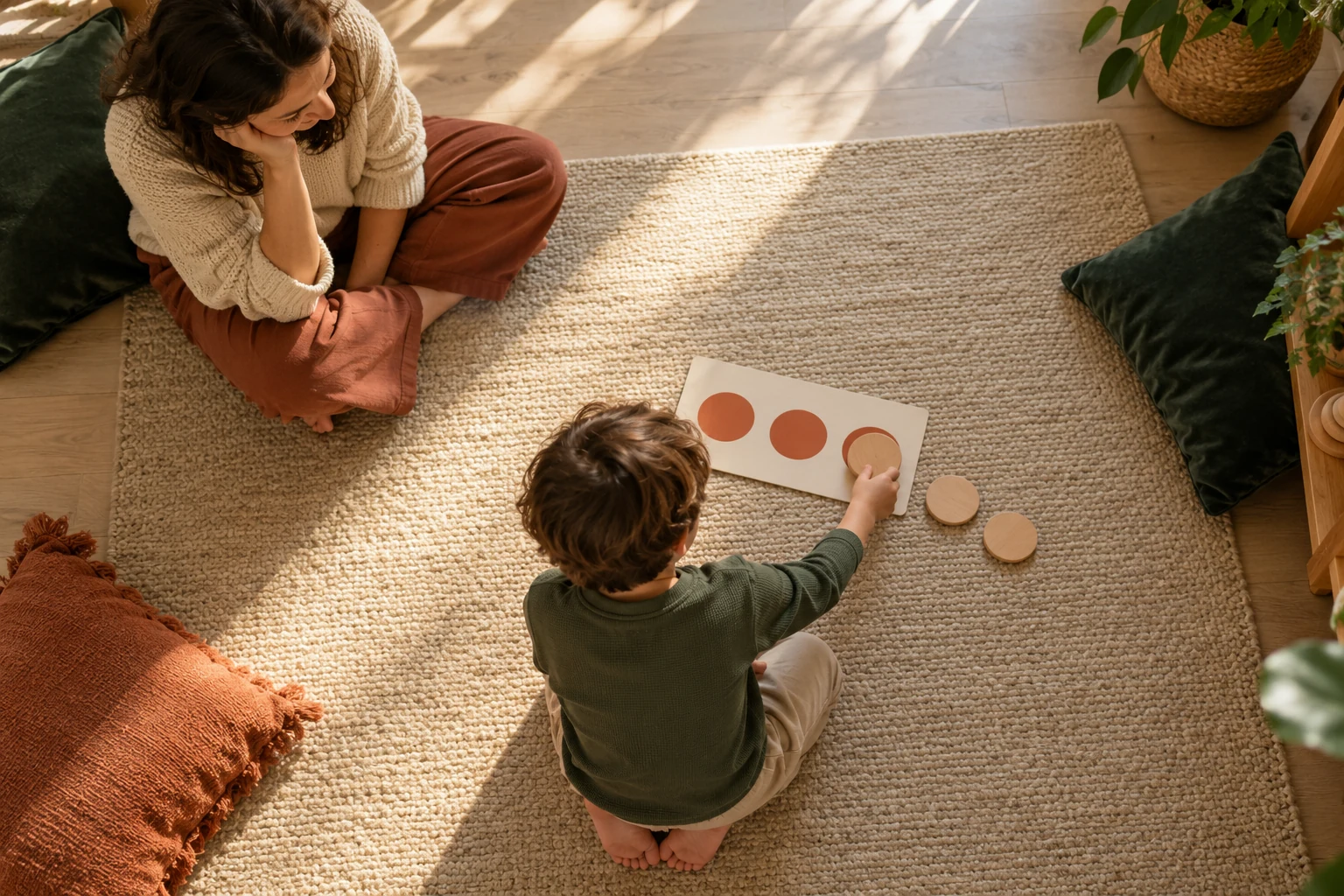
The overhead scene keeps materials within reach while an adult remains available without directing the child's hand.
🧭 What better attention support can make possible
- A clearer starting action: the learner can find the relevant picture or model without searching through several unrelated demands.
- More available ideas: a visible reminder can reduce how much instruction must be held in mind at once.
- More informative practice: adults can distinguish a counting difficulty from losing a place on the page.
- More comfortable participation: suitable tools and a usable position leave fewer practical obstacles between the child and the task.
- More meaningful feedback: observations describe a strategy the learner can recognise and try again.
- Better shared planning: families and educators can compare specific examples across settings instead of exchanging an attention label.
These are aims for everyday support. No printable can guarantee stronger memory, an increased intelligence score or treatment of a developmental condition.
Attention and memory do different jobs
Imagine hearing, “Find the rockets, count them and write the number.” Selecting the rocket group calls for attention. Keeping the steps available while acting uses working memory. Understanding quantity and forming a numeral involve further learning. A stumble at the final step does not reveal which earlier demand was difficult.
Working memory refers to holding and using information briefly. It differs from remembering a familiar story over many days. A child may recall dinosaur names easily and still need a picture cue for a new classroom routine.
Attention is also allowed to move
Looking toward an unexpected sound is not automatically a failure. For shifting attention, the useful question may be whether the child can return with an appropriate cue. Equally, a fixed gaze does not prove that an instruction was understood.
Avoid calculating a compulsory attention span from age alone. Activity, familiarity, interest, language, health and available support all affect what adults observe. Use a child’s actual experience to plan manageable attention practice, without treating a timer result as a developmental diagnosis.
First collect an attention snapshot, not a score
Choose an ordinary activity and write down the instruction, what the child did and what helped. “Found the rocket group after I pointed to its border” is more useful than “Poor focus.” For a balanced attention snapshot, include moments that went smoothly, so the record shows capabilities as well as obstacles.
Ask what caught the child’s attention. A gesture toward a noisy door or a question about an unfamiliar word may suggest a practical change. Do not insist that children explain a difficulty they cannot yet describe.
| What an adult observes | A possible demand to investigate | One useful adjustment |
|---|---|---|
| Begins a different section | Finding the relevant place | Point to one selected area |
| Starts correctly but loses a step | Holding an instruction in mind | Leave a simple reminder visible |
| Counts an object twice | Tracking the counted items | Move a matching object aside |
| Speaks an idea but avoids small marks | Managing the response tool | Offer a broader mark or adult scribing |
| Looks away when movement begins nearby | Selecting relevant information | Change position and offer a return cue |
Several explanations can fit the same observation. Attention support starts with a reasonable experiment, not certainty about the cause.
Support 1: give attention a visible destination
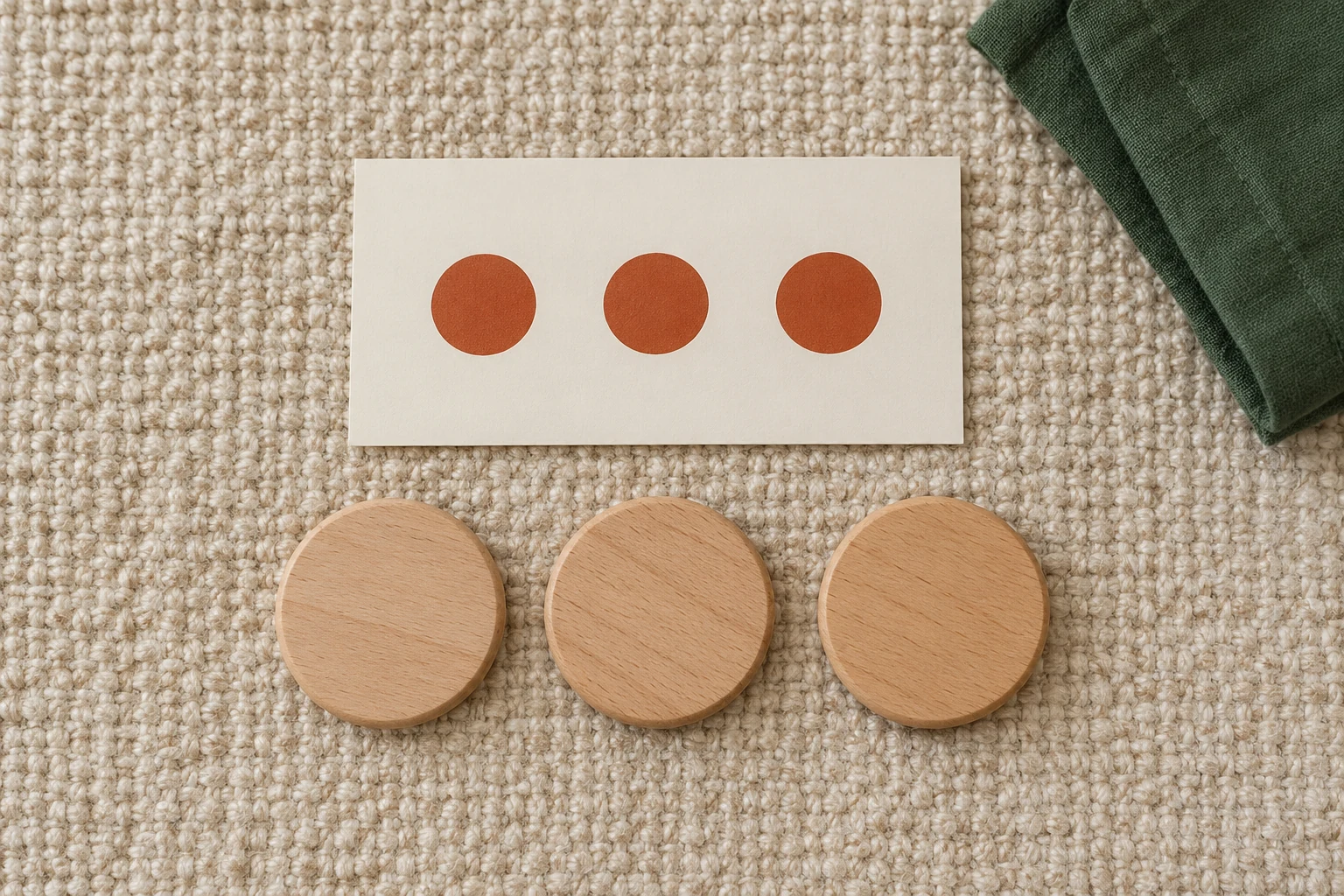
The homemade dot card and large objects demonstrate a support; they are not additional sheets supplied with the rocket printable.
Try Number 3 Worksheet: 4 Brilliant Rocket Mission Wins when a three-object collection suits the learner. Select only the top group: two rockets above and one below. Ask the child to find where the count will begin, then point through all three complete spacecraft.
Keep a separate card or plain paper over other sections if that makes the chosen area easier to locate. Explain what remains available later. For this attention activity, the lower counting group, numeral search and tracing remain separate tasks; completing them all is unnecessary for this observation.
A destination gives attention useful information
Saying “Pay attention” again gives little information about where to look or what to do. “We are checking these three rockets” identifies the current job. Give the learner a moment to act before adding another instruction.
The homemade three-dot card in the photograph demonstrates a simple visual cue. It is not another page supplied with the rocket download. Choose large, safe objects if adding a hands-on match, and stay with the child.
Support 2: free attention with a visible memory reminder
Offer one instruction initially, then add another only when the child can manage the sequence comfortably. This is a teaching decision, not a universal rule about how many steps a particular age should remember.
For example, place three large counters near the selected rocket group and say, “Move one for each rocket.” Once that makes sense, introduce a simple checking action. Keep the selected picture visible rather than hiding it to create an unnecessary memory test.
Attention can return through a consistent cue
If the child loses their place, point to the current object and briefly restate the action. A personal cue agreed with the learner may be more helpful than calling across the room. Avoid public reminders that turn attention support into a performance for classmates.
At home, a drawing of a cup beside the sink might remind a child of a familiar routine. At school, a picture of the current activity can serve a similar purpose. Such reminders support participation; they are not evidence that independent memory has already developed.
Support 3: reduce competing demands on attention
Choose a workable place with enough light, stable materials and access to the adult’s explanation. Try moving away from a busy doorway or putting unused supplies aside. Ask whether the change helps rather than assuming that an entirely bare room suits every learner.
Some children participate better with an appropriate standing position or another agreed arrangement. Keep existing individual supports available and coordinate changes with the educator. Attention should not depend on maintaining one prescribed posture.
Make attention cues accessible
Say the child’s name or use a familiar agreed cue before an instruction, without demanding eye contact. Use language they understand and give processing time. Demonstrate an action alongside words when useful.
Check that the learner can see the page and hear the explanation. Moving closer to a model may change participation, but it does not identify a vision or hearing condition. Share persistent concerns with the relevant professional rather than drawing conclusions from a single activity.
Support 4: pair attention with a movement purpose
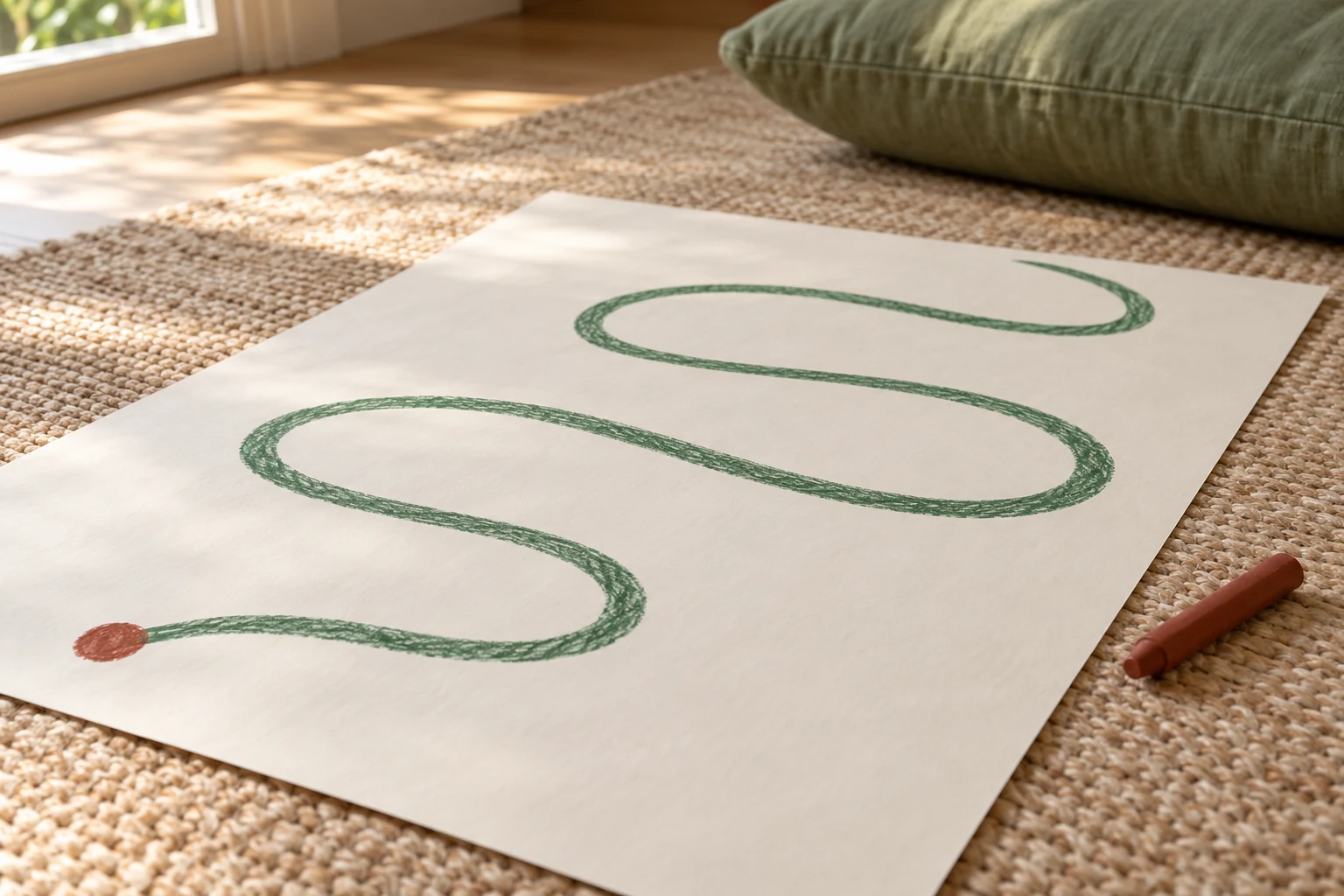
The homemade line illustrates following a selected direction; speed and line accuracy alone do not identify an attention difficulty.
Select one route from Trace 5 Essential Lines and Curves: Fun Paths for Little Hands (Ages 3-5). Locate its starting point together and follow it with a finger before introducing a suitable crayon. A larger homemade curve on plain paper can make the direction easier to explore when small movements are not yet comfortable.
Keep the purpose clear: finding a start and following a path. A quick journey is not necessarily a better one, and a mark outside the printed route does not by itself establish an attention difficulty.
Practise attention beyond the page
Try a familiar movement game in a safe clear space. Begin with one action to copy, then build a sequence only as the child is ready. For shared attention practice, let them lead a turn so the adult also has to notice and remember.
The Harvard executive-function activities guide describes age-related games and supported practice. Published in 2014, it is established guidance, not new evidence for a particular worksheet programme. Play can offer practice; improvement in one game does not guarantee broad changes in memory or learning.
Support 5: bring attention back to a saved idea
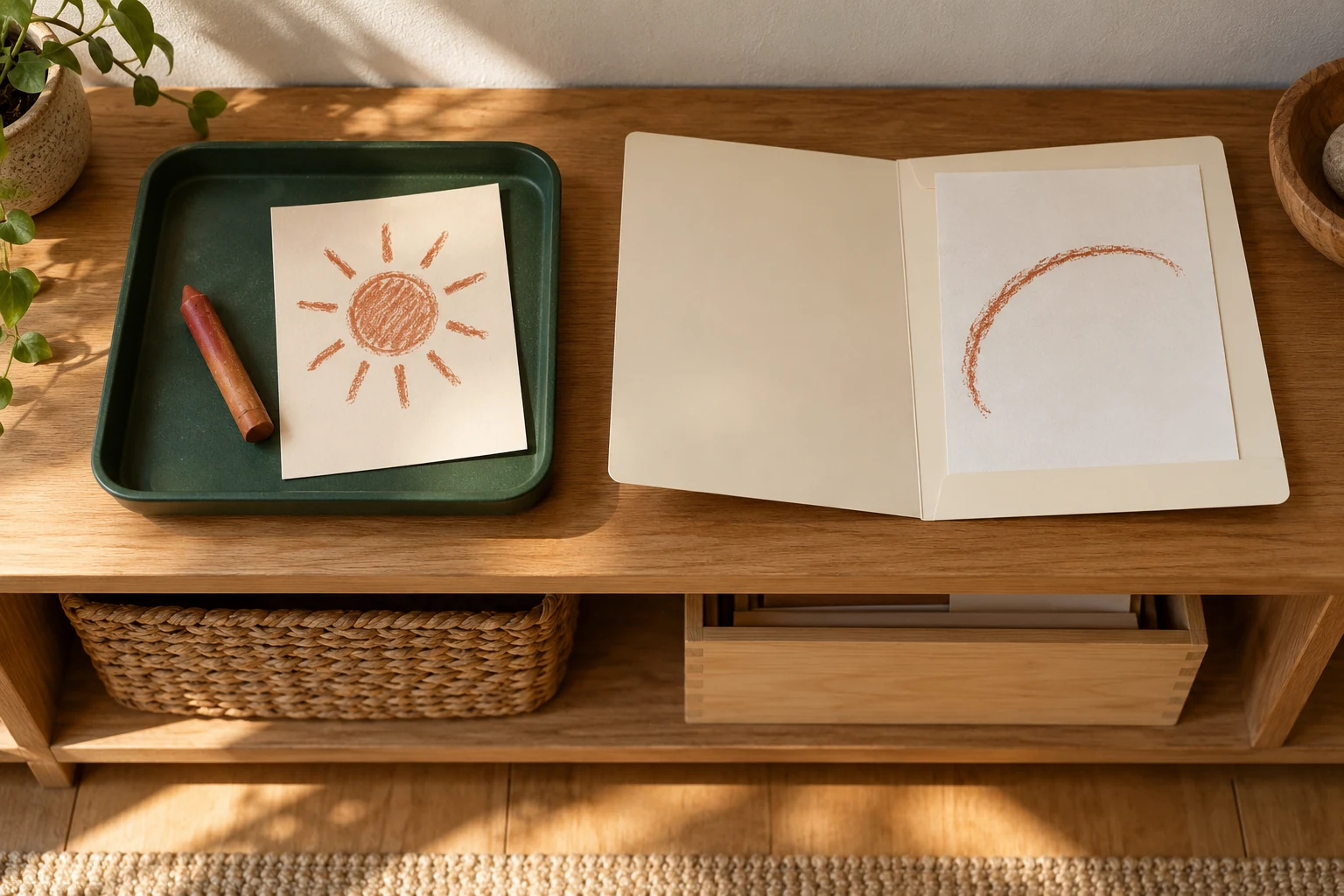
The drawing and open folder represent supported recall of a playful plan, without scoring memory or reproducing a worksheet.
Use the sun picture from Ss Worksheet: 5 Brilliant Sun Bend Activities as a conversation prompt: what might a pretend traveller need on a bright day? An adult can record the child’s suggestion separately. Save a chosen drawing and later ask what it was going to communicate.
The letter models and tracing belong to letter instruction when appropriate. The sun picture does not turn the resource into a memory assessment or a weather-safety curriculum. For attention to the saved plan, use the part that serves the current purpose and acknowledge any adult support.
Give attention somewhere familiar to return
Leave a simple clue with saved work, such as a drawing of the intended next action. On returning, invite the child to inspect the clue rather than testing them without warning. Remembering with support is a useful route back into participation.
Ask an open but manageable question: “What were we making for our traveller?” Accept a gesture, a few words or a new idea. If the plan has changed, discuss that change. Attention support does not require freezing a playful project exactly as it was.
Support 6: support attention within everyday needs
Consider whether the activity follows a tiring transition, missed rest, discomfort or an unusually noisy part of the day. Offer an appropriate break and return opportunity. Avoid making attention practice an extra demand when ordinary needs are unmet.
Agree on a small current purpose and a reasonable ending. A child might check one selected collection, put the materials away with help, and return another day. Do not withhold rest or familiar supports until an arbitrary amount of paper is completed.
When attention concerns need a wider conversation
In St. Louis Children’s Hospital’s August 2026 guidance on learning concerns, a paediatrician recommends gathering specific examples and considering several possible contributors. A difficulty with focus alone does not identify its cause.
If attention difficulties persist, interfere with daily participation or appear across settings, discuss them with the child’s educator and primary-care clinician. Bring descriptive examples and note changes in sleep, comfort or enjoyment. Classroom support can be explored while questions are being investigated; a worksheet score should not decide whether a child deserves help.
A short attention routine adults can repeat thoughtfully
- Choose one purpose. Decide whether today’s task concerns a quantity, route, spoken direction or remembered plan.
- Prepare access. Select a relevant section, a usable position and familiar language before inviting participation.
- Show the first action. Keep the explanation brief enough for this learner and offer a visible cue where needed.
- Watch the response. Allow time, then provide the smallest useful clarification without rushing to a label.
- Save an observation. Record what the child managed and which support mattered, then plan a suitable return.
All three recommended pages currently provide free watermarked single-page PDF samples, with clean files requiring membership. The rocket and sun pages list ages three to six; the tracing page lists three to five. Preview the actual content and match it to current teaching rather than assigning a page solely by age.
Two hypothetical attention stories with different explanations
The home attention example: an instruction becomes visible
Imagine a child forgetting a spoken request to choose materials for a picture message. The parent places the available paper and crayons in one tray and shows the first action. The child begins describing the picture. The change suggests that the invitation became easier to use; it does not prove that attention or memory has permanently improved.
The classroom attention example: a cue replaces a warning
Picture a learner looking toward children passing the door during a small-group count. The teacher changes the group’s position and quietly points to the last checked object. The learner resumes. In this hypothetical scene, the adult has useful information about the environment and the cue. They have no basis for diagnosing the child from that moment.
Four ways to extend attention practice through everyday play
Invite attention through a sound-to-action exchange: agree on one gentle sound and one movement, rehearse together and swap the leader. Keep volume comfortable and avoid startling the child.
Make a picture-plan errand with one familiar destination inside the room. A homemade drawing reminds the learner what to carry; it stays available during the journey.
Build attention with a story-detail return. After a shared picture book, revisit one illustration and invite a remembered or newly noticed detail, without marking answers.
Offer a route-and-rest turn. Follow one homemade curve, choose a comfortable pause, then decide together whether another turn would be welcome. Attention practice can include recognising a stopping point.
Make attention support feel like assistance
Children notice whether an adult approaches them as a partner or a problem. Try “I can show you where we were” when a place is lost. Keep the next useful action easier to find than the next correction. Attention develops within everyday learning and relationships; the adult’s immediate contribution is to make participation understandable, supported and worth returning to.