Thinking: 8 Brilliant Problem-Solving Games for Kids
Give a child's idea something to test. Eight practical games invite predictions, comparisons and revised plans, using selected real printables and homemade props.
Suppose a toy van cannot cross a gap between two blocks. One child moves the supports; another looks for a longer piece of card. Both are doing more than guessing the adult’s preferred answer. Thinking becomes visible when children can show an idea, try it and notice the result. These eight games give parents and teachers of children around three to six practical invitations to reason through everyday problems. Selected printable pictures provide useful starting points, while homemade props make ideas movable. Begin with a question worth investigating, and keep the child’s explanation at the centre of the activity.
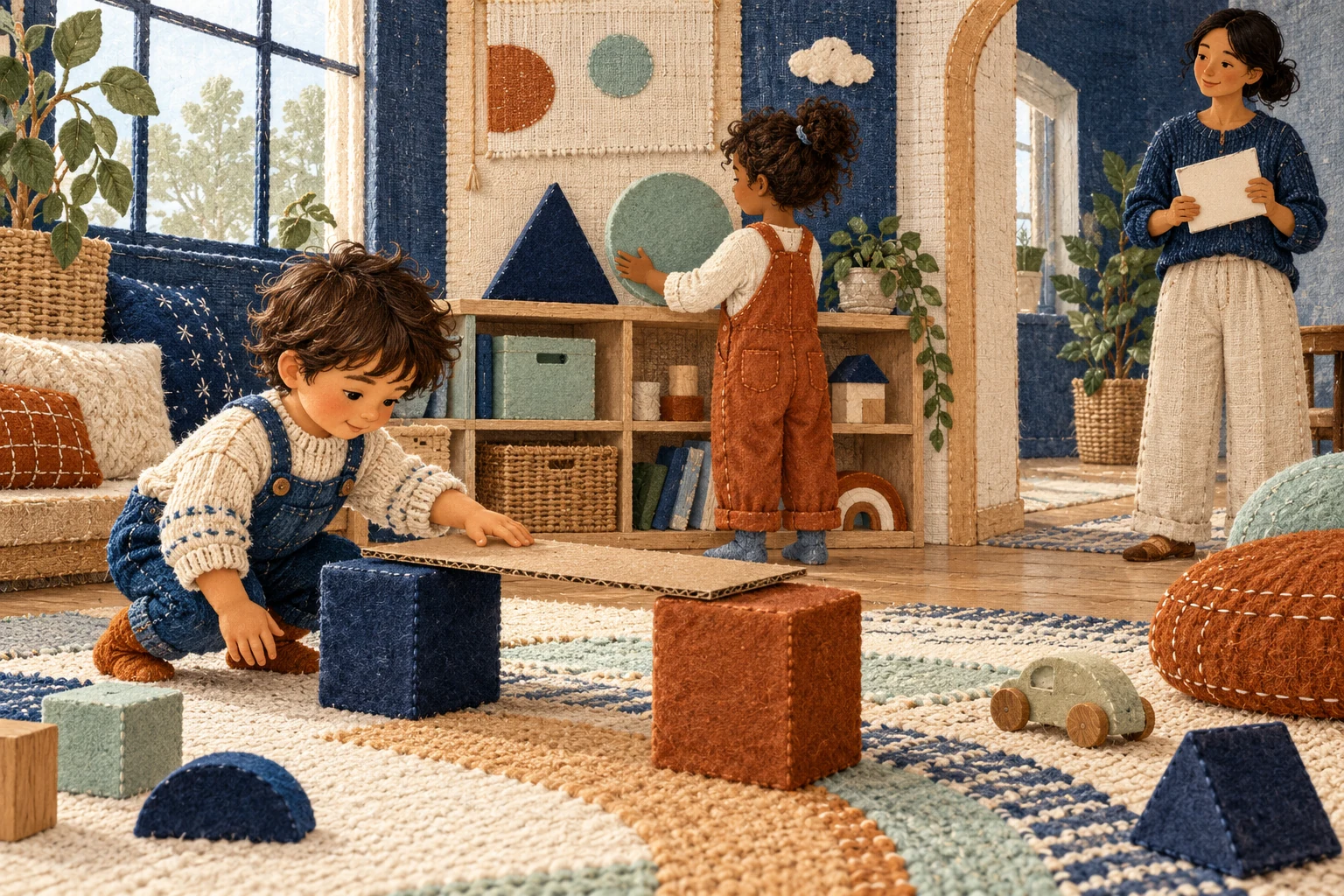
The separate positions leave room for building, comparing and adult observation without a shared worksheet table.
🧩 Set up a thinking space before introducing a game
Gather a few large, safe materials and a clear working area. Stay nearby, especially with tools or objects that could become unsafe. Choose a problem small enough to explore together: reaching across a pretend gap, finding enough places for picture guests, or checking whether a count still matches.
Make the thinking conditions clear: tell the child what can be changed. If a cardboard bridge must connect two fixed banks, explain that condition. If the banks may move, say so. Thinking is easier to discuss when the rules are honest and visible.
Leave space for thinking between questions
Ask one useful question and wait. Thinking may involve moving objects before explaining. Gestures, demonstrations and familiar-language responses can reveal an idea that a polished sentence would hide.
NAEYC’s family guidance on stretching children’s thinking, published in spring 2024, recommends open questions, processing time and attentive responses. Those principles inform the conversations here; the games are original practical examples, not a validated test or a promised boost to intelligence.
Game 1 — Bridge thinking: change one feature
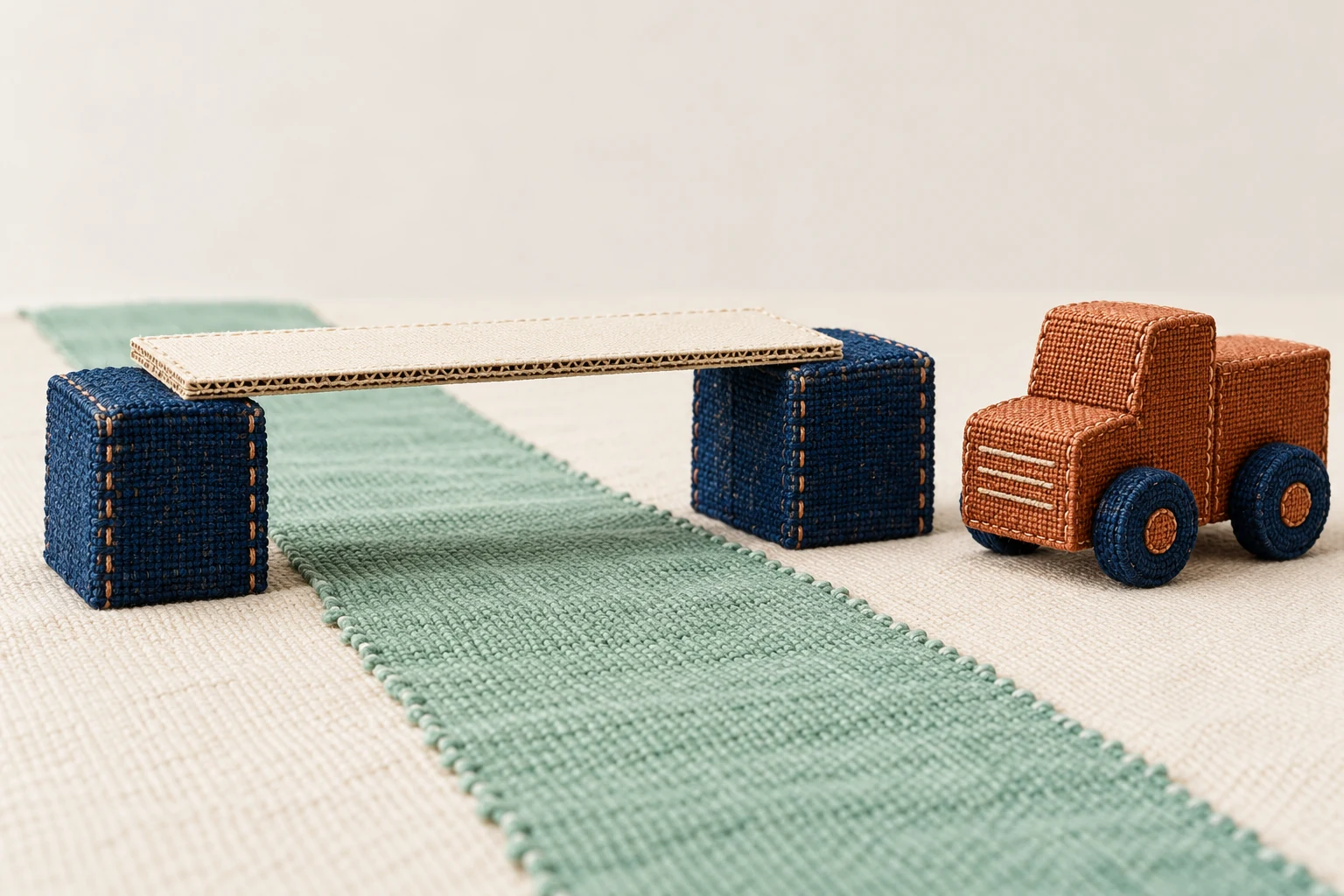
The fabric strip represents an imaginary gap; this supervised toy-scale construction is not intended to carry a child.
Place two broad blocks a short distance apart on the floor, with a flat card available as a bridge. Ask whether a suitable toy can cross. Let the child choose the first arrangement, then test it gently with adult supervision.
During this thinking game, if the card bends or falls, describe what happened without grading the builder. Ask which feature they want to change: the gap, the card or the support position. Keep the construction low and never invite a child to stand on it.
Notice what the test adds to thinking
An early prediction is an idea to investigate. After a change, compare the result with the earlier attempt. If several features changed at once, acknowledge that it is harder to tell which one mattered.
Critical thinking includes revising an explanation when evidence changes. It does not require defending the first idea forever. An adult can model this by saying, “My card was too short for that gap; I’m choosing another.”
Game 2 — Picnic thinking: make enough places
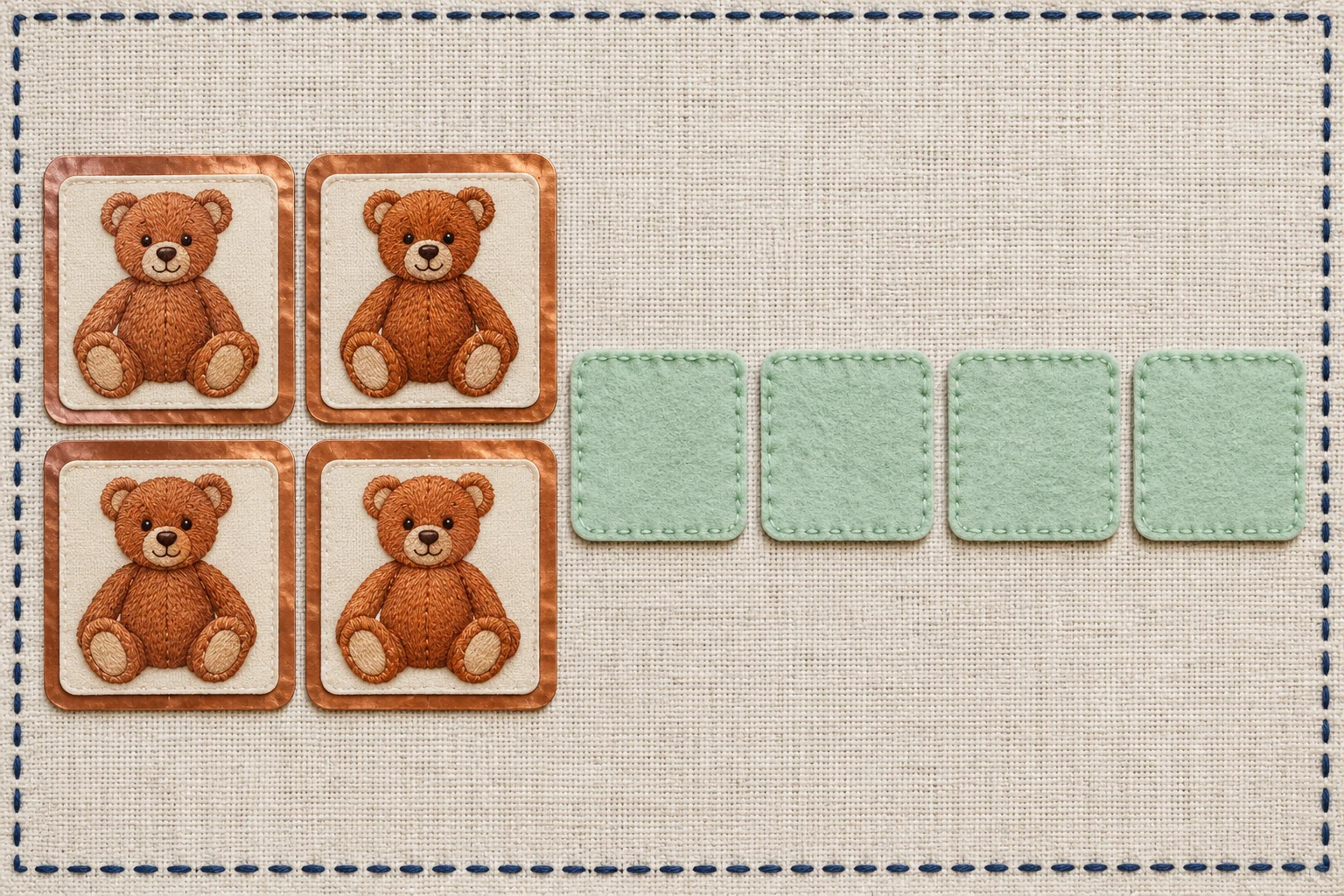
These generic homemade props extend a selected four-object collection without adding the other worksheet groups to its count.
Use the top group in Number 4 Worksheet: 5 Wonderful Teddy Picnic Tasks as four pretend guests. Its four teddy pictures form two rows of two. Invite the child to prepare one large homemade mat or paper plate for each pictured bear, using pointing and one-to-one matching.
Extend the thinking by asking how a partner could check the plan. A learner might point from each bear to a mat, count both groups or move four large toy guests onto their places. Explain the method they chose rather than requiring a single arrangement.
Keep the thinking problem separate from handwriting
The page also contains numeral tracing, a symbol search, colouring and another counting group. They are separate tasks, not extra picnic guests. Select the top collection for this invitation.
If four is not suitable yet, begin with fewer homemade guests. Choosing an accessible amount preserves the thinking purpose. Writing a numeral can wait for another teaching moment when the learner has appropriate support.
Game 3 — Flexible thinking: describe a different group
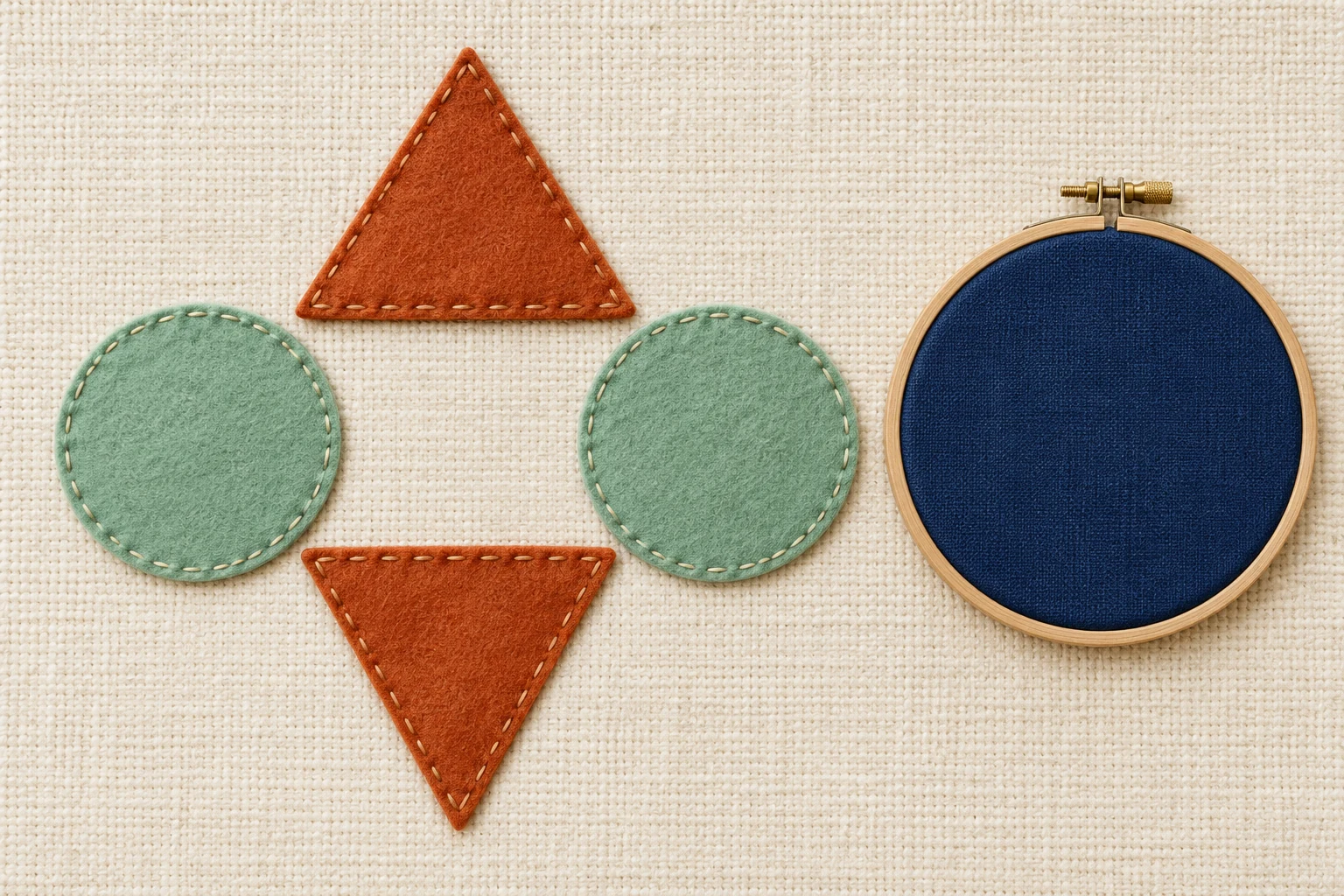
The shapes allow discussion of a stated feature; the hoop is an optional grouping boundary rather than a hidden answer.
Offer several large shapes with visible differences, such as two circles and two triangles in different colours. Ask the learner to make a group and explain what belongs. Accept a demonstration when the sorting word is unfamiliar.
Then invite another possible group. Sorting by shape and sorting by colour answer different questions. For flexible thinking, neither arrangement needs to be called wrong if it follows the stated rule consistently.
Make the rule available to thinking
An adult can model one example first, then let the child propose another. If an object seems not to fit, ask which feature the learner was considering before correcting it. Perhaps their rule concerns something the adult overlooked.
Use a drawn loop or tray to make a group’s boundary visible. Avoid secretly changing the rule and treating confusion as failure. Flexible thinking involves understanding a change, not guessing an adult’s concealed intention.
Game 4 — Design thinking: compare what changed

These homemade cards illustrate a separate extension; the linked worksheet has a fuller house scene and coloured guide.
Explore Color the house: 5 Amazing Steps for Creative Learning! with a child for whom its picture is suitable. The large house scene includes a roof, door, windows, two trees and a sun, with a smaller coloured guide below. Invite the learner to begin their thinking with a visible detail and describe where it is.
On separate paper, sketch two very simple house designs with one deliberate difference, such as adding a door. Ask what changed and how someone could show it. These homemade comparison cards are an extension, not extra pages inside the download.
Careful thinking separates observation from opinion
“This picture has a door” can be checked against the drawing. “I like that door colour” expresses a preference. Both have a place, but they answer different questions.
Thinking becomes more precise when adults keep that distinction clear. A colouring choice need not match the guide unless copying its colours is the agreed purpose. Explain which invitation is in use before assessing a response.
Game 5 — Number thinking: does rearranging change the amount?
For a child ready to work with six, Number 6 Worksheet: 4 Powerful Duck Pond Successes offers a top collection of six ducks in two rows of three. Count that group together, then match it with six large counters on a separate mat.
Spread the same counters farther apart while the child watches. Ask what changed and how they could check their thinking about the amount. They may recount, pair the counters with the ducks or move them back into a familiar arrangement.
Thinking needs a fair comparison
Do not add or remove a counter secretly and call the result a spacing experiment. If you later change the amount openly, name the new question. The learner needs access to the information being discussed.
The lower duck group is another task. Keep it outside the selected count, and use smaller homemade collections if six is currently too demanding. The aim is reasoning about a suitable set, not reaching a larger number quickly.
Game 6 — Story thinking: offer a plausible next event
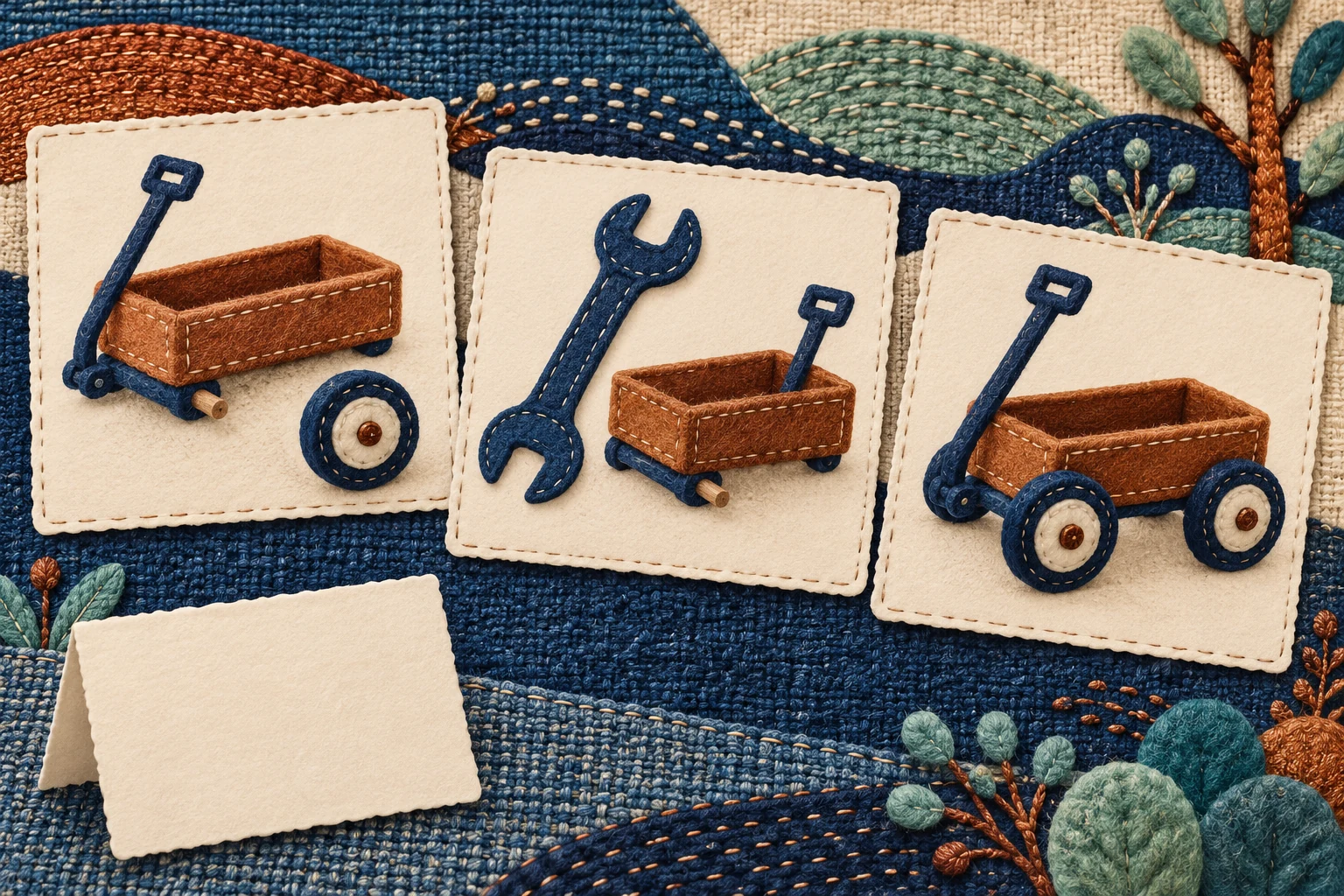
The cards support conversation about a pretend repair, while adults handle real tools and repairs.
Draw a simple pretend problem on large cards: a wagon has a loose wheel, someone finds an appropriate tool, and the wagon is usable again. Invite the child to arrange or narrate the pictures. Thinking here stays with pictures; an adult handles real repairs; this is a picture story.
Ask what detail supports the proposed sequence. There may be several coherent stories. A child could decide the tool belongs to another character or invent a reason the wagon must wait.
Separate imaginative thinking from a factual claim
Make room for invention without pretending every explanation is supported by the picture. “The wagon flies away” can be an entertaining fantasy; it is not evidence that real wagons fly. Ask whether the child is telling an invented adventure or describing the pictured repair.
Adding that distinction keeps critical thinking friendly. It allows creative stories and careful observation to coexist instead of making imagination something adults must correct out of the activity.
Game 7 — Partner thinking: send a usable instruction
Place two familiar large objects in a simple arrangement. One learner describes or demonstrates how a partner could build something similar with another set. Begin with a visible model; hiding it is an optional later change, not a compulsory memory test.
Compare the results to make the shared thinking visible. If “put it there” was unclear, discuss what extra information would help. Pointing, position words or a sketch can make the message easier to use.
Share the work of thinking
Swap roles so one child is not always the instructor. An adult may scribe, translate familiar-language ideas or simplify the materials. Record which support was provided rather than treating all products as independent work.
Keep the exchange cooperative. A missing detail is information about a message, not a reason to tease a partner. The problem belongs to the shared task, and both learners can help improve the communication.
Game 8 — Planning thinking: choose and revisit a method
Invite the child to choose one earlier game and explain an intended first move. Record the thinking in a quick sketch or dictated sentence. After trying it, ask what they would keep or change next time.
A learner may decide the original method worked well. Revision is useful when the result suggests a reason, not a requirement to invent a new answer every turn. Notice when a child can explain why they kept an approach.
Adult thinking can remain curious and specific
NAEYC’s discussion of questions in STEAM explorations distinguishes invitations to share ideas from prompts that ask children to observe or investigate. An adult can combine the two: invite a proposal, then help the child find something they can check.
These games apply that broad teaching principle. They do not measure a fixed thinking ability or establish how a child will reason in every subject. Knowledge, language, experience and access influence what a learner can demonstrate.
A thinking conversation has several possible next moves
| The child’s contribution | A useful adult response | What remains open |
|---|---|---|
| Offers a prediction | Ask what they expect to notice | The result of a fair test |
| Shows an unexpected grouping | Ask which feature connects it | Other coherent grouping rules |
| Changes an explanation | Ask which detail changed the idea | Whether another test is worthwhile |
| Cannot explain verbally | Invite a gesture, model or sketch | The meaning of the demonstration |
| Becomes frustrated | Pause and offer help or a return | When the learner is ready to continue |
Use the table as conversation support, not a scoring rubric. A thoughtful response can be quiet, brief or practical. Fast talking is not a reliable measure of thinking quality.
Five gains worth noticing in thinking games
- Reasons become visible: learners connect an answer with an object, feature or observed event.
- Alternatives become discussable: a child can consider more than one grouping, design or story.
- Testing gains a purpose: an action answers a question instead of merely completing an adult’s sequence.
- Communication becomes usable: explanations can be checked and clarified with a partner.
- Revision feels legitimate: changing a plan can be a sensible response to what happened.
These are observable opportunities for thinking practice. They should not become a checklist for ranking children or promising guaranteed academic gains.
Prepare a thinking invitation in four small decisions
- Name the problem: choose one question that fits the learner’s current experience.
- Select the evidence: provide the relevant picture, objects or safe test conditions.
- Agree on help: decide what the adult will demonstrate or record while leaving room for the child’s idea.
- Choose an ending: stop after a useful attempt and save one question only if the learner wants a return.
The two number pages currently list ages three to six and offer free watermarked single-page PDF samples, with clean files requiring membership. The house page lists ages four to six and a free watermarked single-page PDF. Inspect each preview before printing; the title does not mean every suggested prop or game is included.
Two hypothetical thinking moments, at home and at school
At home: thinking through a crossing
Imagine a child’s short bridge card falling between the supports. The parent offers another safe piece while keeping the gap the same. The child compares the reach and chooses the longer span. This hypothetical scene makes one reason discussable. It is not a report that the child independently understands structural engineering.
At school: two ways of thinking coexist
Picture one learner grouping shapes by colour while another proposes grouping them by edges. The teacher asks each to demonstrate a rule, then provides time for both arrangements. The group can compare two consistent methods. In this hypothetical classroom, the conversation reveals thinking without turning different approaches into a contest.
Four extensions when the thinking question still interests them
Create a materials messenger role: the child requests a suitable piece for a partner’s design and explains the feature needed.
Open a because gallery with one adult-scribed explanation beside a chosen construction, available for the child to revise.
Invent a different-ending theatre using large picture props. Compare what each ending changes for the characters.
Try a same-rule collection walk inside a familiar room. Find safe objects sharing one stated feature, with an adult handling anything unsuitable.
Keep thinking safe enough for an unfinished idea
An answer offered hesitantly may contain a worthwhile observation. Say “Show me the part that gave you that idea” and make room for a response. When a test disappoints, a pause can be more useful than another demand. Protect the learner’s right to reconsider. Thinking grows more visible when adults welcome reasons, offer appropriate help and let an honest question remain open long enough to explore.