Emotions: 7 Powerful Ways to Help Children Feel Safe
A difficult feeling does not need an instant lesson. Seven supportive approaches connect safe limits, calm-time play, unfinished work and later repair.
A torn drawing can feel enormous to the child holding it. The adult sees a sheet of paper; the learner may see a lost plan, an unfair moment or something they cannot yet explain. Emotions belong in early learning because frustration, anger and disappointment often arrive during ordinary play and practice. This guide offers seven supportive approaches for parents and teachers of children around three to six. Existing printables appear as optional invitations for calmer moments, alongside conversation and repair. Start by noticing what support is needed now, and leave the teaching conversation until the child can take part.

The adult remains nearby without demanding contact, a smile or immediate participation in an activity.
🌿 Begin with the emotions moment you are actually in
During intense distress, the next useful action may be ensuring safety and staying available. Later, a child might be ready to describe what happened, choose a comfortable activity or practise another way to ask for help. Those are different moments, with different demands.
The CDC’s April 2026 guidance on noticing and naming emotions advises making people safe and waiting until adult and child are calm before emotion coaching. It also distinguishes accepting emotions from allowing hurtful behaviour. That early-years guidance provides context for the practical learning invitations below; none is a treatment programme.
Emotions do not come with a compulsory explanation
A child may not know why their emotions feel overwhelming. Avoid repeatedly asking for a reason while they are struggling to respond. Watch what happened beforehand and offer a brief, tentative observation later.
Children can experience several emotions together. Anger about a change may sit alongside sadness about something lost. The adult does not have to find one perfect word before offering appropriate support.
Approach 1 — Prepare your own response to strong emotions
Notice the moments when your voice becomes faster or your body tenses. Plan a short phrase that keeps your response clear, such as “I am here, and we will make this safe.” A familiar sentence may be easier to use than inventing a long explanation under pressure.
If you need another adult’s help, arrange a safe handover. Taking space for yourself must not leave a young child without appropriate supervision. Classroom teams can decide in advance who stays with the group and who supports an individual learner.
A grown-up can repair their response to emotions too
If you spoke harshly, acknowledge it when things are calmer. Name what you will do differently without asking the child to reassure you. Managing adult emotions remains the adult’s responsibility.
Keep the explanation proportionate: “My voice was too loud. I will speak more gently.” A child should not become responsible for preventing an adult’s anger or protecting an adult from embarrassment.
Approach 2 — Keep emotions welcome and boundaries clear
Describe the action that must stop in brief, concrete language. “Blocks stay on the floor” gives more usable information than a judgement about the child’s character. Move other people or unsafe materials away when needed, following the setting’s safeguarding procedures.
Offer a manageable safe alternative when the learner can use it: setting an object down, moving with an adult to a quieter place, or asking for help. Avoid turning the boundary into a debate while someone could be hurt.
Explain a limit without labelling emotions as bad
An angry feeling does not make a child bad. Equally, acknowledging anger does not require letting them hurt someone. Keep the feeling and the action distinct in the later conversation.
Do not use a worksheet as a consequence for strong emotions. Writing lines or completing a colouring page should not become the price of being welcomed back. A learning resource has a different purpose from a safety boundary.
Approach 3 — Explore emotions in stories
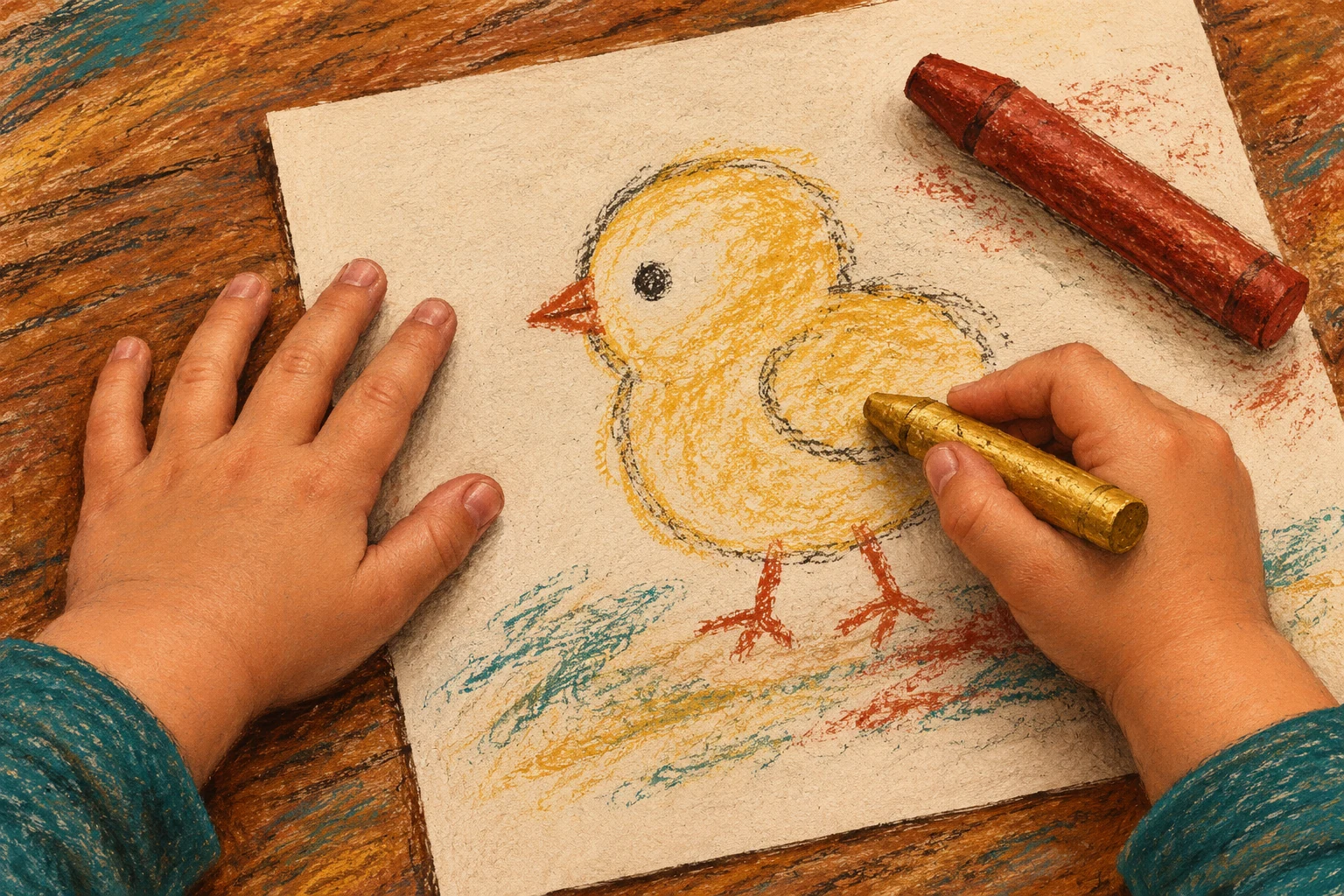
The generic coloured drawing is a conversation example rather than the linked printable's exact artwork or an assessment of feelings.
In a calm moment, Chick Coloring: 5 Brilliant Moves for Happy Artists can start a pretend story about a chick whose plan changes. The actual printable has a large outline and a smaller finished yellow-and-orange reference. Let the child choose whether to colour a detail or simply talk about the character.
An adult might invent a chick waiting for a friend and ask what it could do next. Keep the story fictional unless the child chooses to connect it with their own experience. A picture character is not a diagnostic window into a learner’s emotions.
A drawing does not define a child's emotions
Ask about a mark without assigning it a psychological meaning. A red patch may simply be a favourite colour. A smiling chick does not prove the child is happy, and an unfinished picture does not establish distress.
The illustration here shows a generic coloured chick drawing rather than the download’s precise artwork. Use the preview to see what is included. Colouring is an optional creative activity; it should never be advertised as a guaranteed way to settle emotions.
Approach 4 — Make space for emotions easy to find

The open doorway and ordinary materials illustrate an accessible supervised space, without a timer, ranking chart or compulsory return condition.
Prepare an available comfortable area during an ordinary part of the day. Show where a child can sit with an adult nearby, choose a familiar book or pause without an audience. Keep it supervised and accessible, with no locked door or requirement to earn a return.
A home may have room for a cushion beside a shelf; a classroom may need another arrangement. Ask which parts feel comfortable to the child. An adult’s idea of a soothing space will not suit every learner.
Space for emotions should not become exclusion
Explain the invitation before it is needed. Avoid presenting it as a place where troublesome children are sent until they look cheerful. Keep existing individual supports available and coordinate changes with the educator or relevant professional.
Some children prefer quiet company; others may welcome familiar comforting contact. Offer rather than insist, and respect the child’s response. Safety and appropriate supervision still guide the adult’s decisions.
Approach 5 — Build a vocabulary for emotions without a quiz
Use ordinary stories, daily events and your own modest examples to introduce words such as disappointed, relieved, worried or proud. Offer a possible word tentatively and accept a correction. The child has information about their experience that an adult cannot see.
NAEYC’s guidance on teaching emotional intelligence describes adult modelling and a richer vocabulary for emotions. Its 2017 classroom discussion is an established teaching resource, rather than new evidence for the worksheet activities in this article.
Keep an emotions check-in personal and optional
Invite a private word, gesture or adult-supported message. A child should not have to disclose personal emotions to the whole class to join a lesson. Avoid a public chart ranking whose emotions are most acceptable.
During a story, ask how a character’s situation might have changed. Different interpretations can be explored against the picture or events. A discussion about fictional emotions gives children room to contribute without being asked to reveal a private family experience.
Approach 6 — Respect emotions around unfinished activities

The larger homemade curve and saved paper illustrate optional pre-writing practice, not a breathing chart or a measure of emotional control.
For a child who is calm and interested in making marks, choose one suitable path from Trace 5 Essential Lines and Curves: Fun Paths for Little Hands (Ages 3-5). Locate the starting dot together and offer finger movement or a usable crayon. A larger homemade curve may be more appropriate than a small printed route.
If emotions become difficult, stop adding demands. Save the page with the learner’s agreement and describe what remains available later. Tracing does not need to be completed before the child can rest, receive comfort or join another appropriate activity.
Make room for emotions without recording a verdict
Write a private adult note if useful: what the activity required, where participation changed and which support was offered. Avoid labelling the child from a single response or displaying an unfinished page as evidence of poor behaviour.
When returning, ask whether the learner wants help, a different scale or another reasonable activity. The original path is a pre-writing resource, not a breathing chart or emotional-regulation assessment. Any larger route or reminder drawing is a homemade addition.
Approach 7 — Move from emotions to repair when ready

The small rebuilt construction suggests one possible response; other people can choose whether shared rebuilding is welcome.
After everyone is safe and able to participate, discuss what needs attention: a fallen construction, a hurt partner or a resource that became unavailable. An adult may need to check another child’s wellbeing first. Repair should respond to the actual event.
Help the learner choose a possible action, such as rebuilding with permission, replacing a torn shared card with adult help, or asking how the other person would like to continue. A forced hug or immediate apology is not the only possible response.
Rehearse a conversation about emotions separately
In a later calm play session, Number 2 Worksheet: 6 Powerful Games for Happy Sailors offers a top pair of boats that can prompt a pretend conversation about two sailors wanting a shared dock. Use large homemade props and model a usable request or a turn arrangement.
This optional emotions story uses a printable containing number models, tracing and separate lower activities; it is not a conflict-resolution pack. Keep the boat pair distinct from other pictures. The invented dock story rehearses language without reenacting a real disagreement or putting either child on trial.
Match the learning invitation to the emotions moment
| The situation | An adult can offer | Save for later |
|---|---|---|
| Someone could be hurt | Immediate safety support and clear limits | A detailed account of the disagreement |
| The child cannot engage yet | Appropriate supervision, space and calm availability | Questions requiring an explanation |
| The learner wants quiet company | A familiar book, conversation or no activity | Any optional printable invitation |
| The child is ready to reflect | A brief discussion and a possible repair | Demands for a perfect account |
| A calm practice opportunity arises | A pretend story or chosen creative task | Judgements about the child’s character |
The table is a planning aid for emotions support, not a timed sequence. Emotions do not settle according to a classroom countdown. If a child remains distressed, reassess the support and seek help where needed rather than moving them through stages mechanically.
Six useful aims for supporting emotions during learning
- Safety stays visible: the adult identifies an immediate boundary without shaming the feeling.
- Help becomes easier to request: the learner practises a phrase, gesture or familiar signal before a difficult moment.
- Vocabulary becomes more specific: stories can introduce words beyond a simple happy-or-sad choice.
- Creative work retains its purpose: drawing and tracing remain learning invitations rather than punishments.
- Relationships have a route to repair: a practical next action can address what happened when people are ready.
- Adults share useful information: a clear description supports coordinated planning at home and school.
These are practical aims for emotions support, not promises that a child will stop having angry emotions or that one activity will change behaviour permanently.
Two hypothetical emotions stories with room for support
At home: emotions come before the drawing
Imagine a child becoming upset when a chick picture tears. The parent puts the crayons safely aside and stays nearby. Later, the child chooses to tape the page with adult help and add a separate drawing. This hypothetical example concerns a supported return, not proof that colouring cured distress. The adult would still offer care if the child never wanted to finish.
At school: emotions and readiness shape repair
Picture a disagreement about blocks leaving one learner angry and another worried about a fallen arch. Adults make the area safe and support both children. Later, they ask whether rebuilding together is welcome, accepting another suitable repair if it is not. In this hypothetical classroom, emotions are acknowledged without making the hurt child responsible for comforting the person who knocked the structure.
Plan a calm-time emotions activity in five decisions
- Choose the emotions moment: wait until the learner can take part and check that they want an invitation.
- Select one purpose: a fictional story, chosen marks or practising a help request is enough.
- Inspect the page: offer only a suitable section and explain any homemade props separately.
- Keep an exit available: agree that the activity can pause without losing adult care or ordinary support.
- Notice participation: record an idea or chosen action if useful, without scoring private emotions.
The three linked resources currently list ages three to six for the chick and boat pages, and three to five for the tracing page. Each offers a free watermarked single-page PDF sample; clean files require membership. Preview before printing and check access again if it has changed.
Four gentle extensions for talking about emotions
Make a character-help envelope. An adult records a suggested way a fictional character could ask for assistance; the child can add a chosen picture.
Use a puppet misunderstanding in calm play. Two puppets want the same prop, and the learner offers words or a gesture that might clarify their plans.
Create a save-and-return bookmark with a simple adult-drawn cue for an unfinished project. The learner chooses whether to use it later.
Offer a kindness planning turn: decide how to welcome a new pretend classmate or make room in a game. Keep the invitation concrete without requiring personal disclosure.
When emotions need more support than a learning activity
If distress is frequent, intense, persistent or affecting daily relationships, play or learning, discuss specific observations with the child’s educator and a qualified child-health professional. Seek urgent local help if anyone is in immediate danger. Do not rely on printable activities to manage an unsafe situation.
Support for emotions can include understanding communication, sensory, developmental or health needs; adults should avoid diagnosing those needs from a colouring choice. A child can need additional help and still deserve ordinary kindness and access to learning.
Leave the door open after difficult emotions
Try “We can work out the next part when you are ready.” Keep care available through the unfinished moment. A calm-time activity may give a story somewhere to go, but the relationship carries the more important message: strong emotions can be met with support, safe limits and another opportunity to learn.