Motivation: 7 Powerful Ways to Renew a Child's Interest
Explore seven practical adjustments to a learning invitation, with existing dog, number and tracing worksheets that can support purposeful play.
A child abandons a counting page, then spends an afternoon arranging animals into an elaborate zoo. Has the interest in learning disappeared, or is this particular invitation missing something? Motivation is easier to understand when adults look at the task, the setting and the child’s response together. This guide explores seven practical adjustments for parents and teachers of children roughly three to six. Existing printables can supply a picture, model or manageable challenge, while play and conversation give them a purpose. Begin with curiosity about what is getting in the way, rather than a label about the learner.

The separate positions allow a storyteller, audience member and supporting adult to contribute without gathering around one worksheet.
🔍 Investigate motivation before increasing the pressure
Interest can fall for several reasons: an instruction is hard to understand, a task repeats something already familiar, a new skill needs more teaching, or the child wants company. Tiredness, discomfort and events outside the activity may also matter. An adult cannot identify the cause of reduced motivation from refusal alone.
Motivation is not a fixed supply of enthusiasm. A child can dislike a particular worksheet and remain curious about numbers, stories or making things. Finishing quietly is not the only sign of engagement, and moving away does not automatically mean laziness.
The Harvard Center on the Developing Child’s motivation guidance discusses curiosity, appropriate challenge, interaction and agency. Published in 2019, it provides an established starting point, rather than proof that one new printable will restore interest. The suggestions below are practical adaptations for ordinary learning situations.
A motivation notebook can begin with three details
For a motivation observation, record the invitation, the response and the available support. For example: “Asked to write nine; pushed the pencil away; counted fish willingly when allowed to point.” That is more useful than “No motivation today.” It distinguishes a writing demand from a counting opportunity.
Include what interested the child elsewhere. Perhaps they explained a pretend pet’s needs or checked where a toy road should go. Ask which part of an activity they might change, accepting gestures and familiar-language responses.
Keep notes brief and private. Their purpose is to help adults plan motivation support, not to produce a daily motivation rating or a public chart comparing children. Look for patterns across occasions before drawing conclusions.
Motivation adjustment 1: make the request understandable
Sit near the child and explain the immediate task in familiar words. Show one example when useful. A page with tracing, searching and counting can contain several different instructions; “Do this sheet” may leave the learner guessing where to start.
Ask the child to show the first action rather than repeat a long instruction word for word. If they choose a different action, check whether the purpose was clear before assuming that motivation is the problem.
Support motivation with a clear beginning
You might cover unrelated sections temporarily or point to one picture group. This reduces competing information without necessarily changing the skill being taught. Check whether the child can now participate, then decide if the concept itself needs a different demonstration.
Motivation can be affected by language and access. A familiar phrase, visible model, stable paper or usable tool may be more relevant than a brighter design. Coordinate individual supports with the child’s educator where appropriate.
Motivation adjustment 2: connect with a real interest
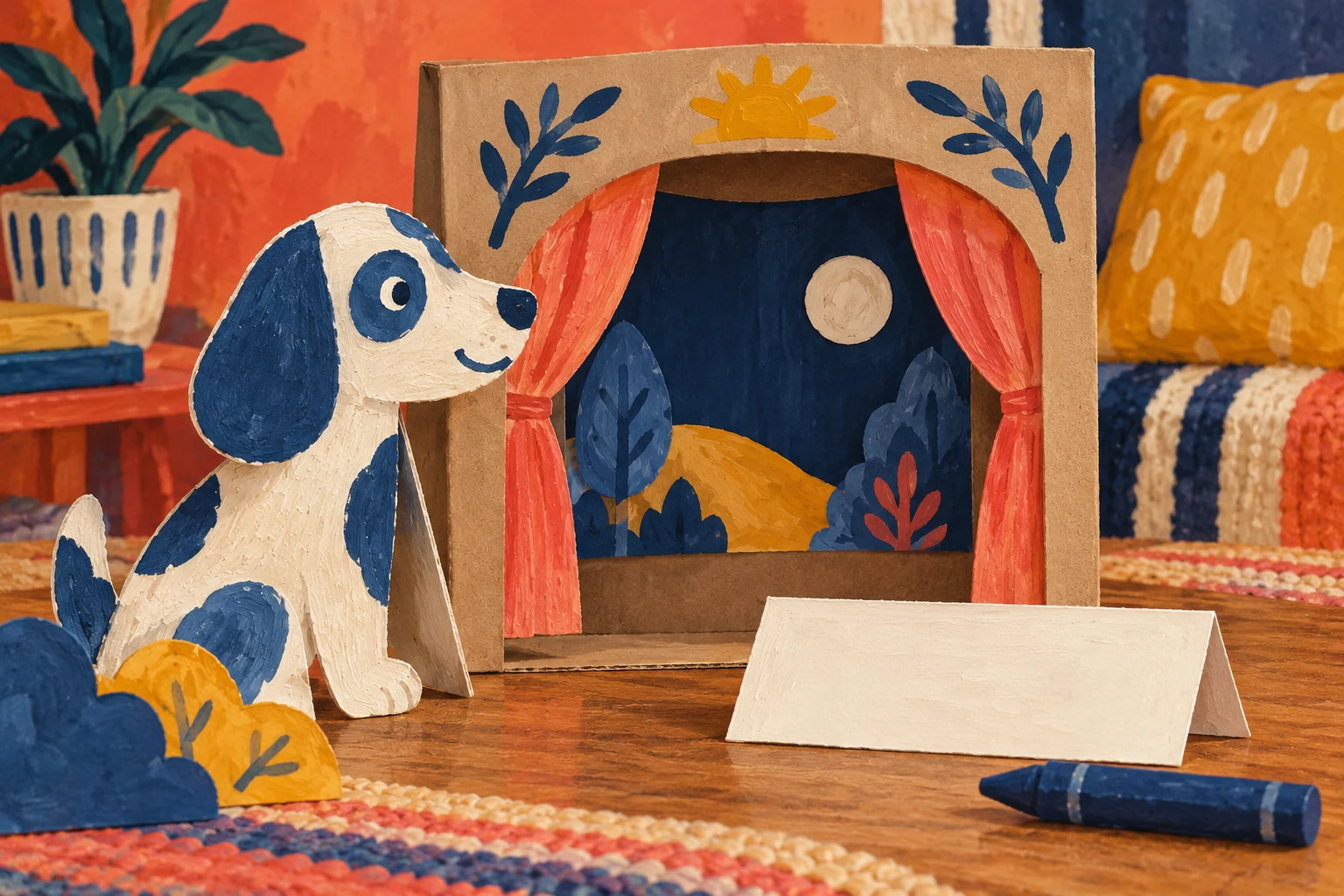
These homemade theatre props illustrate an extension; they are not additional pages included with the linked dog worksheet.
For a child absorbed in animal stories, Dd Worksheet: 5 Powerful Dog Door Discoveries offers a dog picture alongside D/d models and tracing. Let the picture prompt a message for a pretend kennel or a short story about a dog needing a home. Adults can scribe the message on separate paper.
The picture-word activity and letter rows are available when they match current teaching; they do not have to become the price of joining the story. Motivation often has a more useful starting point when the child recognises why an action matters.
Follow motivation without disguising the task
Explain the actual purpose. If the lesson involves a taught letter form, say so and provide that model. If the activity is oral storytelling, do not secretly judge handwriting while the child is inventing dialogue.
Interest can invite motivation without guaranteeing cooperation. A child who enjoys dogs may still prefer playing with a toy to colouring a picture. Notice that response and consider whether another format would serve the learning purpose better.
Motivation adjustment 3: change the challenge thoughtfully
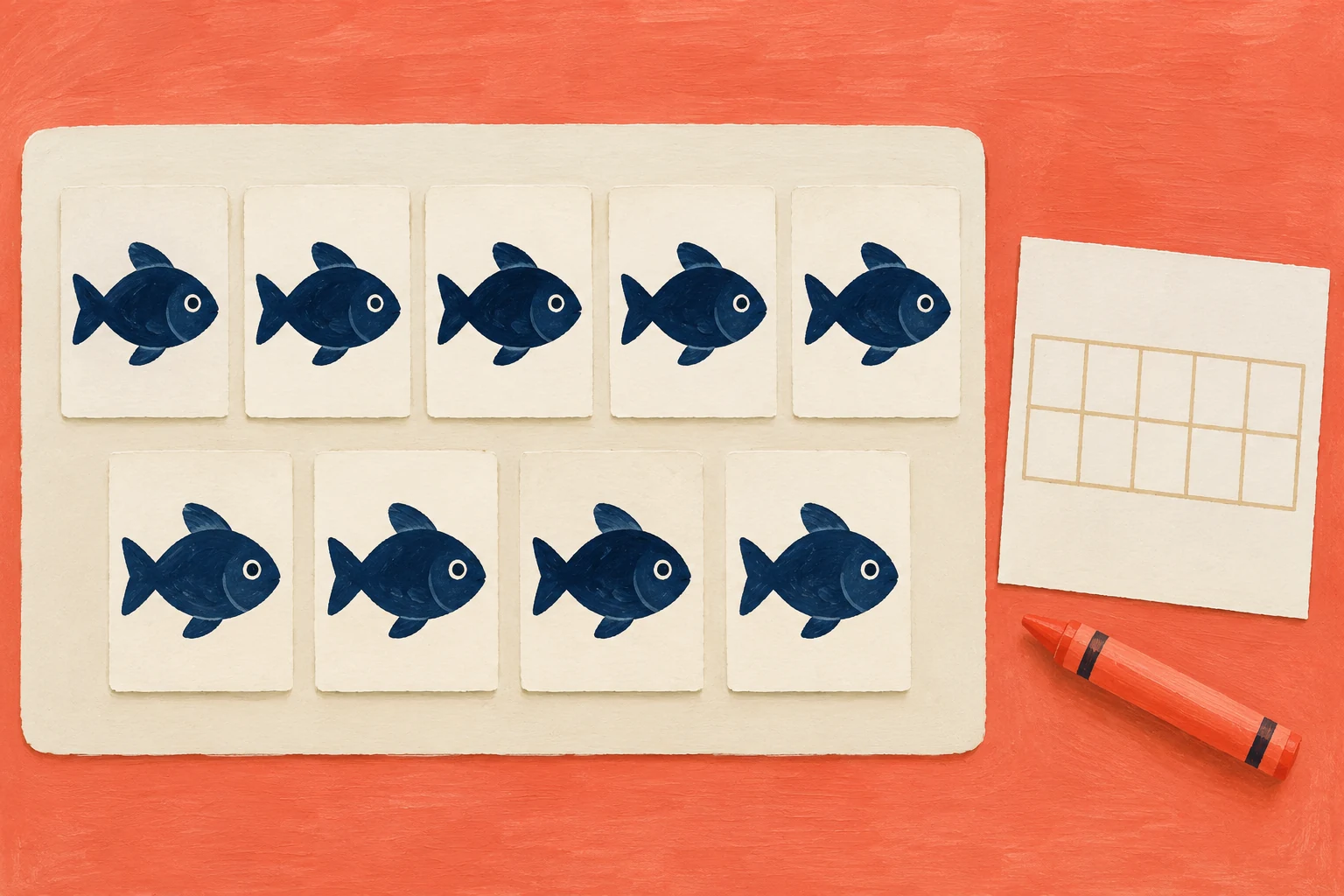
The nine illustrated fish support the example of rearranging a known amount; the separate empty grid is a homemade recording prop.
Repeated practice can feel uninteresting when a skill is secure. An unfamiliar task can be discouraging when too many new demands arrive together. Look at what the child can currently demonstrate before choosing what to add or remove.
For a learner ready for a nine-object collection, Number 9 Worksheet: 4 Brilliant Fish Survey Adventures provides a top group of nine fish arranged as five and four. Invite a count or a comparison with nine large counters. The lower group is a separate exercise; do not combine every fish across the page into one total.
Motivation needs a workable level of difficulty
If nine is not an appropriate starting point, use a smaller collection of familiar objects instead. The worksheet’s three-to-six age label does not mean every child in that range should tackle all its tasks. Counting and writing the numeral can also require different support.
For a confident counter, ask how they checked that none was missed, or invite another arrangement of the same nine counters. Motivation can come from a worthwhile question rather than an endless increase in the number of rows.
Motivation adjustment 4: offer another way to participate
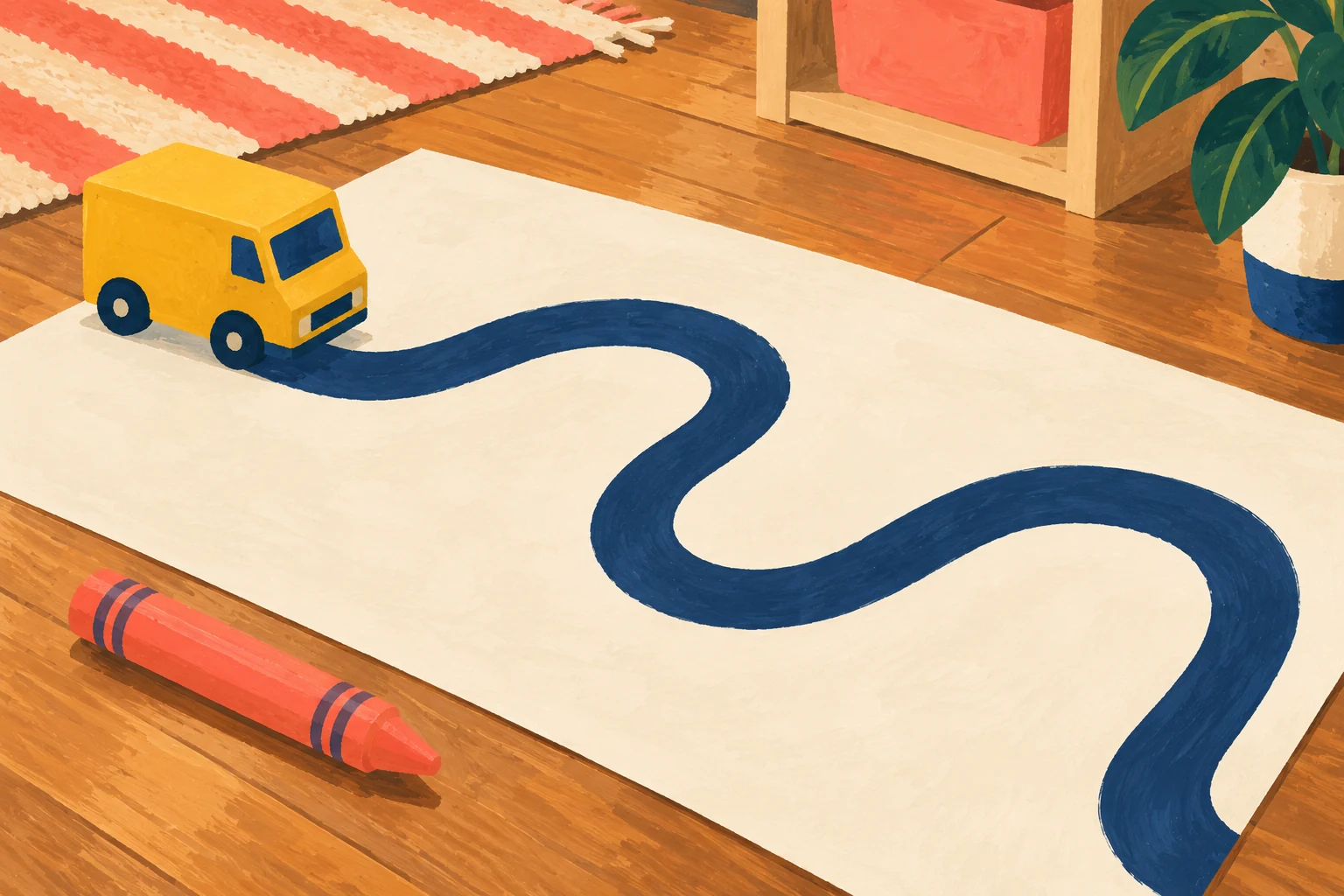
The large homemade road extends a selected tracing path and is not a road pack supplied by the printable.
A child interested in routes but reluctant to make small marks might begin with Trace 5 Essential Lines and Curves: Fun Paths for Little Hands (Ages 3-5). Select one curve for finger movement, then draw a larger road on plain paper for a broad toy vehicle. Let the child describe where the delivery is going.
This changes the scale and response, not the printable into a ready-made road pack. The original page contains varied tracing paths with starting points. Any delivery cards and larger routes are homemade additions.
Look beyond motivation to the specific skill
Motivation to tell a story does not establish a particular level of pencil control. Likewise, difficulty with a crayon does not prove a child lacks an idea about direction. Be precise about what you are noticing.
Offer movement, speaking, pointing or making where they serve the purpose. If the goal is specifically a writing movement, keep an appropriate marking opportunity available with support, rather than claiming a spoken response demonstrates the same skill.
Motivation adjustment 5: leave a meaningful decision
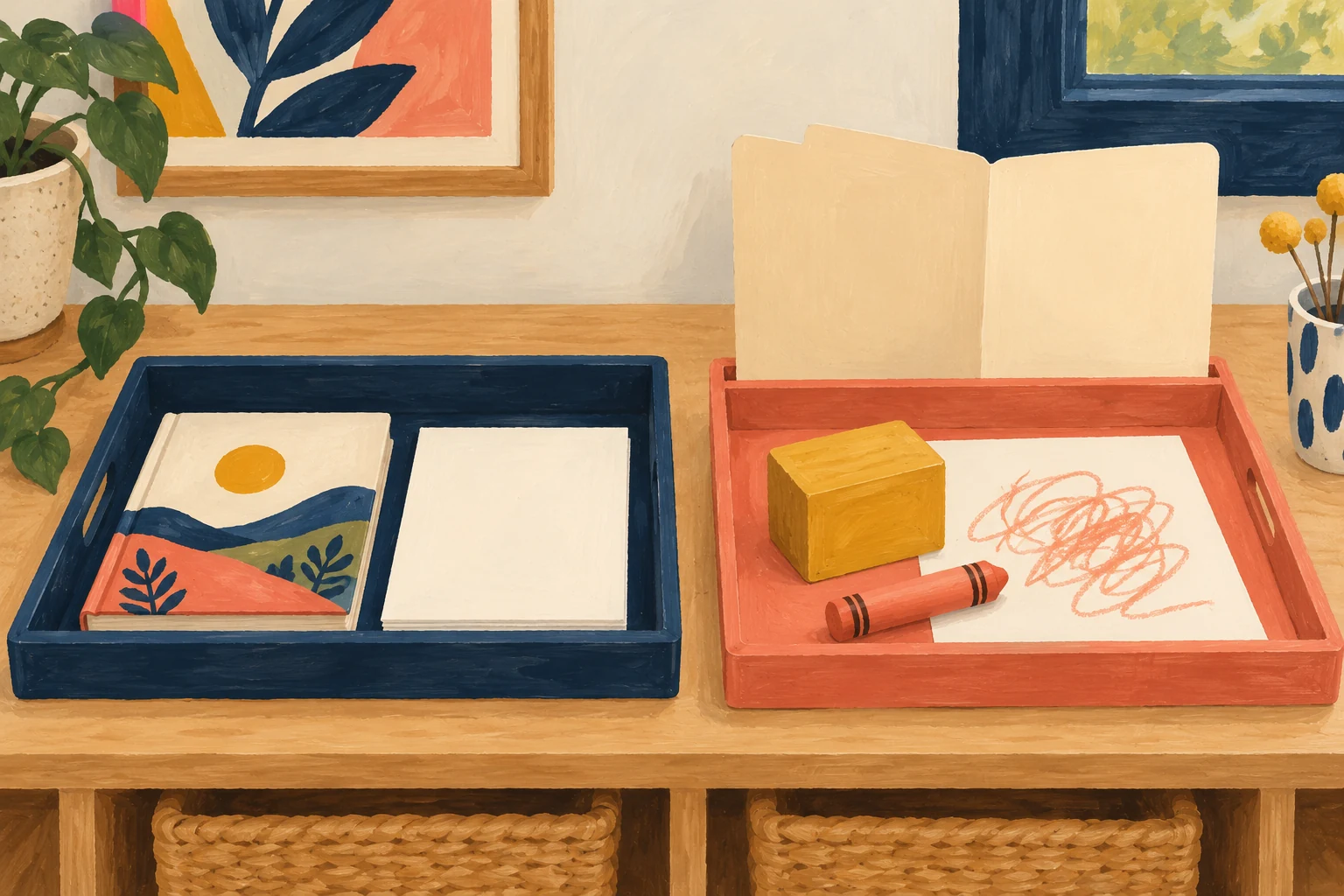
A book, making materials and an unfinished drawing represent different possible ways to continue an idea.
Invite a choice between two available approaches: telling the story before drawing, or drawing one detail before dictating. At home, a learner may also choose another reasonable time. In class, explain which parts of a planned activity are flexible and which purpose remains shared.
Motivation can suffer when a supposed choice has only one acceptable answer. Avoid asking an open question and then rejecting every response until the child agrees with an adult’s hidden plan.
Make a choice relevant to motivation
Let the selected option affect what happens. If the child chooses a larger space, make that space available. If the options are not workable, offer two different ones honestly.
The NAEYC guidance on teaching to enhance development and learning describes planned environments that combine adult support with children’s agency, interests and language. Those broad principles support thoughtful flexibility; they do not require adults to turn every routine into unlimited negotiation.
Motivation adjustment 6: make connection part of the activity
For motivation, an invitation to count for a partner or explain a picture to a listening adult can feel different from being handed paper alone. Join a brief exchange, then watch whether the child wants to continue independently or needs further support.
Use clear roles. One child can arrange objects while another checks a selected collection, with the adult helping both participate. Do not let a fluent partner answer every question or make a quieter child responsible for keeping the group entertained.
Motivation is more than earning a reaction
Offer a specific response to an idea or strategy: “I could follow your count because you moved each object aside.” Leave space for the child to notice the result too. Constant applause can interrupt a conversation that already has its own purpose.
If an agreed reward or support plan is already in use, coordinate any changes with the relevant adults. This article does not propose abruptly withdrawing established supports or treating all external encouragement as harmful.
Motivation adjustment 7: build a reasonable ending and return
To support motivation, tell the child what a manageable stopping point looks like, such as checking one collection together. Save an unfinished page if the learner wants to return. A clear ending can make a task easier to approach than an open-ended demand to keep working.
Consider whether the moment calls for food, rest, movement or company instead of another learning prompt. Motivation does not override ordinary needs. Avoid using exhaustion as an opportunity to test persistence.
Share patterns when motivation changes persist
Talk with the educator about specific observations across settings. Ask which activities still invite interest and what support has been useful. A sudden or sustained loss of enjoyment across play, relationships and daily life deserves attention beyond changing worksheets; consult an appropriate child-health professional when concerned.
Keep the conversation descriptive and free of diagnoses made from internet checklists. The aim is to understand the child’s experience and arrange support, not to assign a permanent identity from a difficult week.
A quick map from observation to a motivation experiment
| What you notice | Change one part | Look for |
|---|---|---|
| The child asks what to do repeatedly | Model one immediate action | A clearer start or a more specific question |
| Familiar rows are dismissed quickly | Add a meaningful checking question | A reason to explain the method |
| Ideas are lively but small marks are avoided | Offer a larger response or scribing | Participation without confusing the skills |
| Work begins only when an adult stays | Plan a short shared role | What kind of connection makes entry easier |
| Interest fades after a demanding day | Choose another suitable moment | Whether the response changes with the context |
Treat the result as information. Motivation is not proved or disproved by whether a single adjustment works immediately. Retain what helps and reconsider the rest.
Five useful gains from investigating motivation
- Better task matching: adults can separate familiar skills from demands that still need teaching.
- More accurate observations: a child’s idea is less likely to be hidden by an unnecessary writing or language requirement.
- Purposeful practice: a count, route or mark contributes to something the child understands.
- Clearer adult coordination: families and teachers can share an example instead of exchanging general labels.
- More workable routines: a defined beginning, support and stopping point make the invitation easier to understand.
These are practical aims for motivation support, not promised improvements in academic performance or behaviour.
Two hypothetical motivation investigations
At home: motivation appears in another format
Imagine a child declining a dog-themed writing activity but enthusiastically explaining where a pretend puppy should sleep. The parent writes down the dictated message and asks whether the child wants to add a picture. They do. The observation concerns storytelling and chosen marks, not independent sentence writing. Motivation was easier to see once the activity made room for the child’s existing idea.
At school: a checking question invites motivation
Picture a child quickly finishing a familiar count and pushing further rows away. The teacher offers a suitable new collection and asks how a partner could check it. The child moves counters into two groups and explains their method. This hypothetical example shows a reason to investigate the challenge level; it does not establish that boredom explains every refusal.
Try a four-part motivation review
- Describe: name the precise moment interest changed and what the activity required.
- Ask: invite the child’s view and compare observations with another adult where useful.
- Adjust: change one manageable feature, keeping the teaching purpose clear.
- Review: note what changed in participation, questions or comfort, then decide whether to repeat, adapt or stop.
All three linked resources currently offer free watermarked, single-page PDF samples, with clean files requiring membership. Check their previews and access panels before printing. A selective part of a page can be enough for one useful motivation experiment.
Four extensions that give motivation a fresh purpose
Set up a question envelope: an adult records one question the child wants to investigate and offers appropriate materials later.
Connect motivation to a delivery role for an invented shop or theatre. Counting objects or adding a mark now serves an actual pretend request.
Try a teach-the-adult turn. The child demonstrates a familiar action and the adult asks one honest clarification, avoiding deliberate incompetence or a trick.
Keep a save-one-idea folder as a motivation resource for a drawing or dictated plan the child chooses. Reopen it when the idea becomes useful again, rather than as compulsory evidence of completion.
Keep motivation connected to a learner’s experience
A new app, more colourful worksheet or faster sequence of rewards cannot tell an adult why an invitation is not working. Observation and conversation still matter. Say, “Let’s find out which part would make this clearer.” Keep curiosity about the child alongside curiosity about the topic. Motivation support becomes more practical when adults are willing to change the invitation and give the child a genuine way to participate.