Estimation: 5 Powerful Games for Confident Math Talk
A prediction is more interesting when a child can explain its clue. Try five small-group number games, then check the amounts with three existing worksheets.
“Maybe six?” can be the start of a worthwhile mathematical conversation. Estimation gives a child permission to offer an approximate amount, explain a clue and revise an idea after checking. These five games bring that conversation into ordinary family learning, with existing number worksheets available for the counting that follows. They suit supported preschool and kindergarten exploration, especially when children can already count a small collection with help. You will need a few large objects, paper and a willingness to wonder together. Nobody earns a prize for guessing fastest; the interesting part is discovering why an amount seemed reasonable.
🔎 Make estimation a conversation before a worksheet task
Imagine a child seeing a loose group of counters and saying “about five.” They have not necessarily counted five separate objects. They might be comparing the group with five fingers, recognising a familiar arrangement, or simply trying a number they know. Ask what they noticed, then check together. That sequence makes estimation visible: predict, explain, count, compare.
Approximate and exact answers serve different purposes. “About six blocks” is useful when wondering what is in a small basket. “Six blocks” reports a checked count. If a child already knows a tiny group instantly, welcome that recognition; do not insist they pretend to guess. If they start counting immediately, let them finish and describe the exact amount. Estimation is another mathematical tool, not a ban on counting.
Keep the starting collection within a range the child can count with support. Three or four objects may be plenty for one learner; another may enjoy comparing collections up to eight. These are activity choices, not age deadlines or measures of mathematical ability.
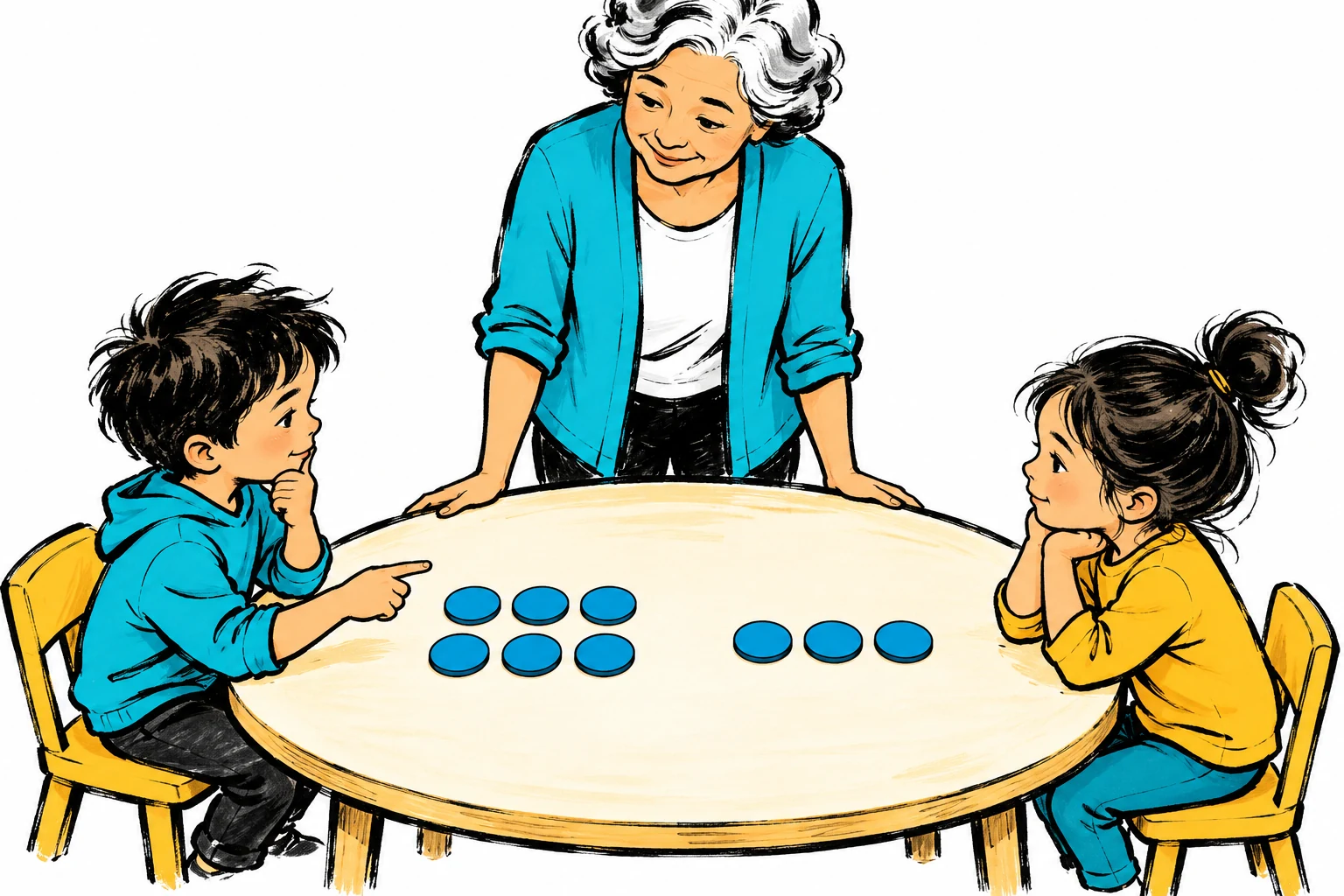
The family looks between a six-counter collection and a three-counter reference; the adult leaves space for the children to explain their ideas.
Why estimation belongs in today’s home learning
Recent early-math discussion places children’s reasoning alongside their answers. In a February 2026 Erikson Institute article about mathematical mistakes, educators encourage adults to inspect children’s thinking and make room for revising ideas. For estimation, that means responding to an unexpectedly large prediction with curiosity and a manageable check. It does not mean leaving a counting error unexplored.
The Illinois Early Learning Project’s mathematics guidance includes estimating small sets and comparing quantities. Those established preschool standards offer a useful foundation, while the games here are practical family adaptations. There is no claim that playing them guarantees a score increase. A better immediate question is whether your child can show you a clue, join a count, or explain something they noticed afterward.
Set up one estimation round in four steps
- Choose a collection for estimation. Start with a few large, similar objects, spread so each is visible. Use age-appropriate materials under adult supervision and avoid small counters around children who mouth objects.
- Invite an estimation answer. Ask, “About how many do you think?” Leave the collection visible and allow thinking time. A pointing response or “more than three” can begin the conversation.
- Check the estimation together. Count each whole object once, moving or pointing to it. Say the total after the count. There is no countdown, timer or need to hide the objects suddenly.
- Compare estimation with the count. Return to the child’s prediction. Was the checked amount more, fewer or the same? Ask which visible clue might help on another estimation round, then offer a turn or stop.
An adult can record the prediction and checked amount on separate scraps. Writing a numeral is optional for the child. A spoken explanation deserves as much attention as a written answer. Keep handwriting demands out of the way when the purpose is thinking about quantity.
Game one: borrow a small group as an estimation clue
Place three large counters in a short reference row. Count that row together so its amount is known. Beside it, arrange five similar counters loosely. For estimation, ask whether the second collection seems smaller, about the same, or larger than three, before inviting a possible number. The known group gives estimation a concrete anchor instead of asking for a number from nowhere.
If a child says “three” for both, do not announce that the second group should obviously look larger. Invite them to count it or match one counter from each collection. They may discover leftovers, then revise their prediction. Keep the pieces the same size for this first comparison, so size differences do not distract from number.
Once the child wants another round, alter only the second collection. A nearby amount is enough; there is no need to jump to a jar of hundreds. Let the child arrange the next collection for you. Explain your own estimation clue aloud, and let the count settle the exact amount.

Similar counters keep the comparison about number; a row of three provides a visible anchor for considering the separate five-counter collection.
Game two: use turtle pictures after a prediction
Open Number 5 Worksheet: 6 Brilliant Turtle Trail Wins. The top collection contains five whole turtles arranged as three above and two below; a large 5 and the word “five” appear beside them. The page also includes numeral tracing, a search activity, a colouring turtle and a separate lower count-and-write collection. These details make it useful for checking quantity, but the visible numeral already supplies the answer.
For a fresh estimation invitation, prepare the page before showing it. Rest loose opaque paper over the numeral and the other answer cues, leaving only the top picture collection visible. Keep the worksheet’s branding intact and remove the loose cover after checking. If the child has already seen the answer, use a new group of real objects for estimation and reserve the turtle page for exact counting.
Ask for an approximate amount, then count whole turtles together. Do not count heads and shells as separate items. The three-and-two arrangement may become the clue a child describes afterward. There is no requirement to finish the tracing rows before the estimation conversation is complete.
Game three: spread six ducks without adding any
Use Number 6 Worksheet: 4 Powerful Duck Pond Successes to check a collection of six ducks, arranged in two rows of three at the top. As on the turtle page, a large numeral and additional activities reveal the intended amount. Estimation must come before those cues are shown, or take place with a separate collection. The lower count-and-write panel is another six-duck group, not an instruction to combine every duck on the sheet into one total.
After counting a selected picture group, set out six large blocks to represent it. Move the same blocks farther apart while the child watches. Ask what changed and whether the amount might have changed. Check the estimation by counting again if they wish. A child may initially judge the wider arrangement to contain more; the check gives that idea something observable to work with.
This estimation game introduces a useful caution: space and quantity can look related without being the same. Avoid treating a changed answer as failure. Say exactly what you did—moved the blocks without adding or removing any—and offer another arrangement only if the learner remains interested.
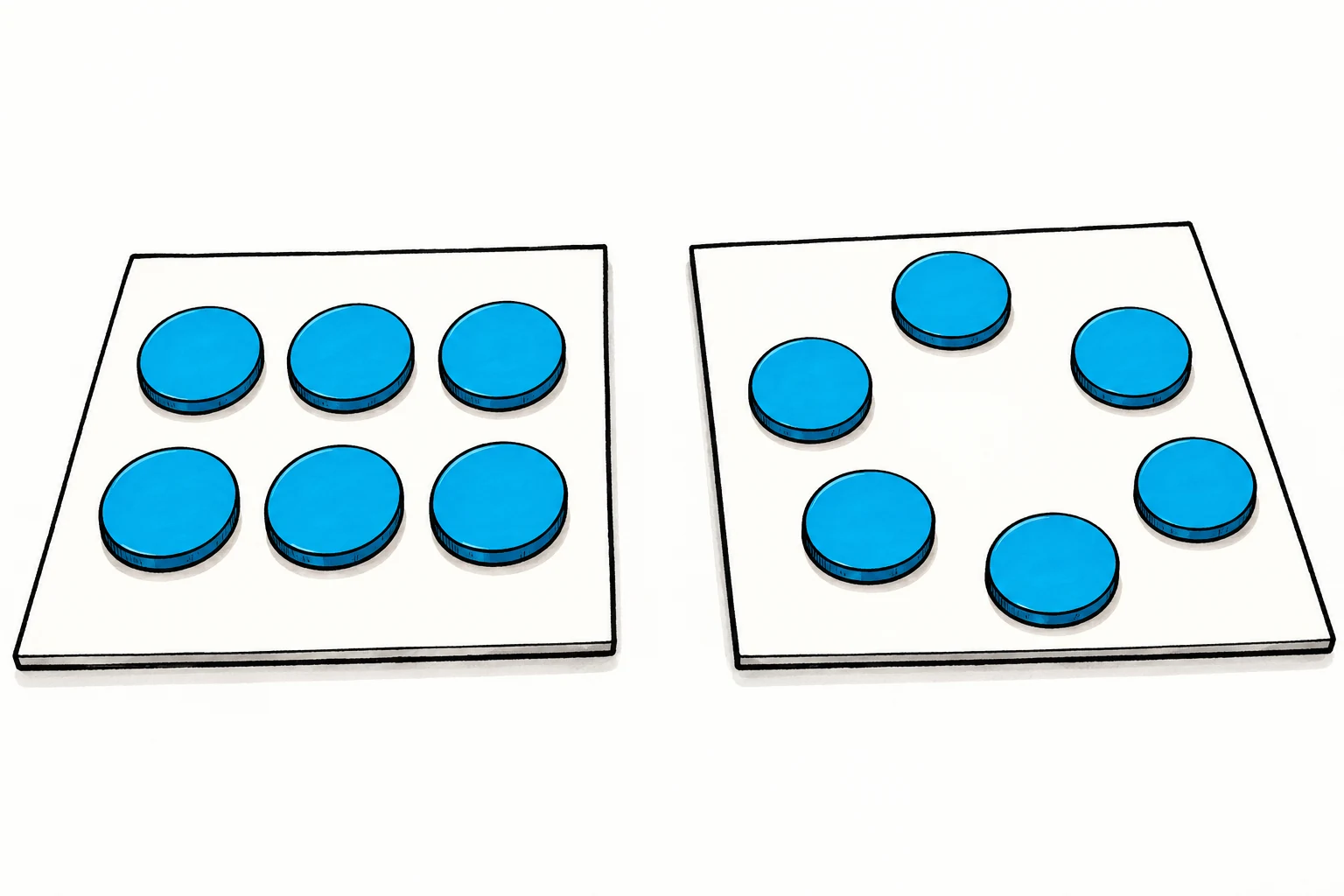
Both mats contain six whole counters. The contrasting arrangements invite a prediction, a careful count and a discussion of what changed.
Game four: an ice cream shop with a useful check
Number 8 Worksheet: 6 Wonderful Ice Cream Shop Games has eight complete ice cream cones in two rows of four, along with the numeral 8, tracing and other practice. For this estimation invitation, the counted unit is a whole cone illustration, not its scoop and cone counted separately. Use the selected picture group to verify an amount after a loose-object prediction, or cover the answer cues before presenting the group.
For this estimation game, pretend you run a small shop with a tray of large paper cone cards you have drawn yourself. Begin with an amount your child can check comfortably; eight is an option, not the compulsory starting point. Predict about how many orders the tray could fill if each pretend order receives one card. Then hand out the cards one at a time and count what you used.
Return to the downloaded page for a clear eight-picture example if appropriate. A smaller collection of real objects is a better estimation task than pushing a child beyond a count they can follow. The roleplay supplies a reason to check; it does not need real food, purchases or a race against another player.
Game five: let estimation guide the tidy-up plan
At the end of play, choose one small, visible collection of large blocks. Ask about how many pieces need returning to a basket. Listen to the child’s estimation before moving anything. Then count as the blocks go in, one at a time. During estimation checks, keep the basket open so a child can check which pieces have already been counted.
Suppose the prediction was five and the count is seven. Say both amounts calmly. You can show five fingers and point out that the checked collection had more, or arrange the blocks for another look. Avoid demanding a subtraction sentence unless the child already enjoys that representation; comparison is enough for the estimation purpose.
The following day, choose a different small collection. Repeating the same exact pile after its total is known becomes recall rather than a new prediction. Familiar household materials keep the routine easy to revisit, while changing the amount preserves a reason to look, think and check.
When an estimation answer surprises you
| What the child does | What it may tell you | A useful next move |
|---|---|---|
| Calls a small group “a hundred” | A large number word may be exciting or familiar | Count a smaller collection together; offer a known group for comparison |
| Counts before predicting | Exact counting is the strategy they chose | Accept the count and explain when an approximate answer can be useful |
| Chooses the wider group as larger | Spacing may be the visible clue | Move the same pieces together and apart, then check |
| Copies the printed numeral | The answer cue is available | Use loose objects for the next estimation invitation |
| Revises before counting | A new clue has changed the idea | Ask what they noticed; keep both predictions if they want |
One response does not tell you everything about a learner. A tired child may offer a favourite number; a quiet child may understand a comparison without explaining it aloud. Choose a smaller amount, model one round, or leave the activity for another time. Estimation should give you information for the next invitation, not a label to attach to the child.
Five things an estimation conversation can reveal
- How a child uses a reference. An estimation reference such as a known group of three may help them judge another group as larger. Watch whether they look back at the reference before responding.
- What they count as one. Whole ducks and whole cones make the unit visible. Pointing to each complete illustration can clarify a count without requiring written work.
- Which comparison words are useful. In estimation, more, fewer and the same let a learner describe the checked amount relative to a prediction. Model the word with the objects in view.
- How they respond to new information. Changing a prediction after noticing another clue is worth discussing. An estimation answer is allowed to develop.
- Where counting support is needed. Skipping a piece or counting it twice suggests a practical adjustment to the estimation check, such as moving objects into a counted row. It is a reason to support the check.
Two everyday settings for a thoughtful estimation round
A family table: “I saw a group like my fingers”
Imagine a five-year-old predicting about five blocks because the collection looks like one hand’s fingers. A parent counts seven and asks which part looked familiar. The child points to five close blocks and then two farther away. That explains the prediction. For another look at the estimation clue, bring the outlying pieces closer and count again together. In this hypothetical scene, estimation uncovers the visual clue the child used; it also gives the parent a concrete reason to discuss the whole collection.
A classroom: two predictions, one shared count
Picture a teacher adapting the home estimation game for a small kindergarten group. Two children predict six and eight for a collection. The teacher records both without names beside them, asks each child for a clue, and supports a shared count of seven. The group discusses how the collection falls between the predictions. There is no closest-answer prize. Offer a private pointing or partner response to anyone uncomfortable speaking in a group. This is an illustrative situation, not a report of classroom results.
Four estimation invitations for another day
- Photograph an estimation collection. With adult help, photograph a small group of large toys. Use the photo for estimation, then count the original toys. Keep the whole collection visible and avoid including identifiable people.
- Run a pretend delivery desk. Prepare several large paper parcels, invite an estimation, then count each delivery. Let the child choose the next manageable collection.
- Compare two possibilities. After a prediction, ask whether another amount would also seem reasonable and why. Check the estimation with objects rather than debating who sounds most certain.
- Dictate a tiny estimation diary. An adult writes one prediction, its checked amount and the child’s clue. Revisit the note when a different collection prompts a similar idea.
Finish with a clue worth remembering
The three linked number pages currently list ages three to six and offer single-page PDFs: a free watermarked sample or a clean file with active membership. Read the access details before downloading, and inspect the preview rather than assuming every section belongs in today’s activity. For estimation practice, keep loose covers removable and avoid marking over branding or answer cues permanently.
“You changed your idea after looking again” is a useful response when it describes what happened. Praise need not depend on a prediction matching the count. In estimation, a learner can be uncertain and still have a valuable clue. End after a shared discovery, let the child choose whether to keep the note, and leave another small collection for a day when curiosity returns.