Dice Play: 4 Smart Games for Happy Family Learning
Three existing worksheets become four cooperative family games. Choose the matching number cube, share useful roles, and turn repeated results into something worth discussing.
A four appears again, and the family has a decision: celebrate another match, change roles, or stop while the game still feels inviting. Dice play contains more than a race to fill every circle. For children around four to six, a numbered cube and a shared worksheet can support conversations about symbols, quantities, turns, and unexpected results. These four cooperative games use existing Worksheets Gallery resources, with practical suggestions for choosing a page, adapting the challenge, and keeping parents, teachers, and young learners involved without making speed the goal.
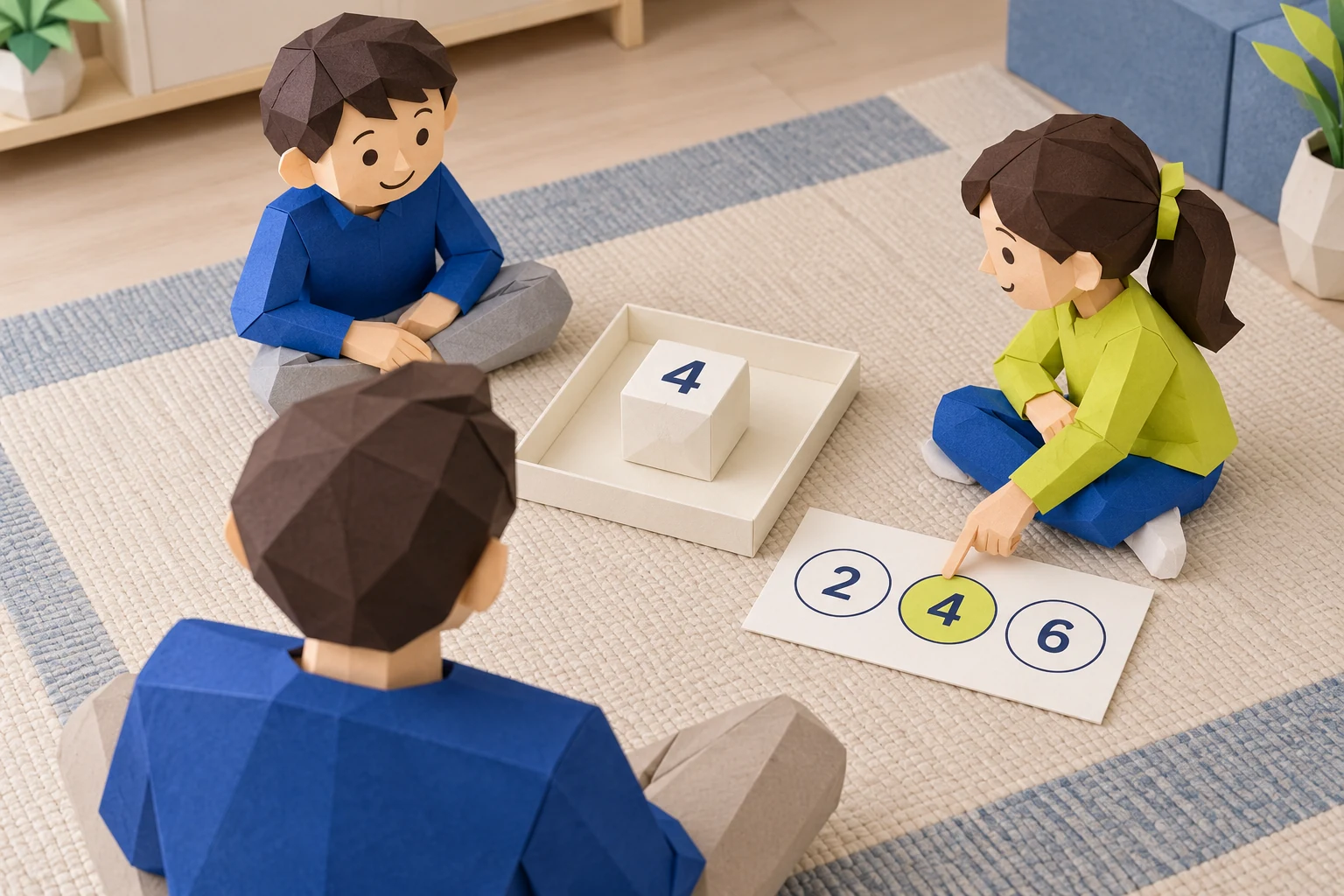
The parent sits in the foreground with two children across the mat. A visible four on the cube matches the coloured circle, illustrating a shared dice decision.
Choose a real worksheet for your dice session
Start with a page whose numbers the learner is ready to explore. Each resource below contains numbered circles and a printable cube net. Open its preview before downloading, then choose the game format that suits your family.
First matches / 1–6
Number 1 to 6 Dice Game: Fun & Challenging Math Practice!
Use this dice worksheet for a shared search: roll its numbered cube, name the result, and colour one available circle carrying that numeral. A roll of four selects one circle labelled 4; it does not ask for four circles to be coloured.
For a learner who needs quantity support, build the rolled amount with large counters before finding the printed number. Keep counting available rather than demanding instant recognition.
A different number set / 4–9
Amazing Number 4 to 9 Dice Game: Fun & Skill Building!
Choose this page when the learner is ready to find numerals through nine. Assemble its custom cube with faces 4, 5, 6, 7, 8, and 9. A standard one-to-six die has no face for seven, eight, or nine.
Before dice play, invite the child to inspect the cube's faces. Keep the page facing one way when comparing six and nine, and demonstrate how rotating the paper changes their appearance.
An optional next step / 0, 2, 4, 6, 8, 10
Amazing Even Number Dice Game: 7 Brilliant Steps for Fun Math!
This dice resource uses a custom even-number cube, including zero. Try it when these quantities and numerals are accessible with support. Make pairs with large counters if the child is interested in why the numbers belong together.
A zero result still has a matching circle. Show an empty counter group, then find 0 on the page. There is no need to introduce a formal even-number rule during the first game.
The pages currently offer a watermarked free sample and a clean PDF requiring active membership. Check the access option shown on the worksheet page. These blog games are optional variations on the printed activities.
What does one dice turn actually show?
A learner might recognise a printed 5 without being ready to collect five objects, or count five dots without finding the numeral. Dice play lets an adult notice those different actions and choose a useful connection between them.
The printed cubes recommended here carry numerals. If you substitute a dotted die for the one-to-six page, the task changes: the learner first interprets or counts the dots, then finds the corresponding symbol. Explain that extra step.
Cambridge NRICH's early-years dice activity connects rolling with counting, matching amounts and numerals, and describing results. Our cooperative variations keep those connections available while letting families choose the challenge.
Prepare a dice turn that everyone understands
- Choose a dice worksheet and its matching cube. Check the printed face values together before beginning.
- Prepare the materials. An adult can cut and assemble the net in advance. Keep a rolling tray and chunky colouring tools nearby.
- Demonstrate one complete turn. Roll, read the upper face, locate the numeral, and mark one matching circle.
- Agree on repeats. Use another uncoloured match if available. If none remains, record the result separately and pass the cube.
- Choose a short stopping point. For example, take four turns each, then decide together whether another round would be enjoyable.
Use age-appropriate dice and large materials. Keep dice preparation separate from the number task if cutting or folding would use up the learner's interest before play begins.
Four cooperative ways to use the dice worksheets
Use one variation at a time. The page can stay familiar while the shared job changes. None of these dice games requires the sheet to be finished in one sitting.
1. Give the page a shared mission
Put one dice worksheet between the players and choose a small collective aim, such as finding three different numerals during a short round. Everyone contributes to the same page, taking turns to roll and mark.
If the same number appears repeatedly, the team still records valid matches. Reaching the chosen aim is possible, not promised. At the stopping point, discuss which values appeared and leave any unfinished aim available for another day.
This dice variation works well when a child dislikes having a page compared with a sibling's. The conversation can focus on how the team found a match and what helped someone join in.
2. Pass the roles as well as the cube
Give players three jobs: roller, number finder, and checker. With two people, combine rolling and checking. After a complete dice turn, swap jobs so the adult also has to follow the child's explanation.
The checker asks for a reason: “Show me how this circle matches.” They can point between the cube and page or build the amount with counters. Checking is a shared investigation, not permission for one player to correct everyone else.
Keep the dice result visible until all three jobs finish. A child should not have to remember an earlier face while someone has already rolled again.
3. Build the amount before marking it
After a dice roll, arrange that many large counters in a clear row or small group. Invite a partner to check by touching each item once. Then find one matching numeral circle on the worksheet.
For a four, the quantity is four counters and the record is one circle labelled 4. Say both parts aloud so the learner can distinguish an amount from the place where a result is recorded.
Choose values the child can manage comfortably. The even-number dice page can include an empty group for zero, while its larger values may need more adult modelling or a later session.
4. Become the cube curator
Before rolling, inspect the custom dice and nominate a possible result. Ask the child to find the face that supports their choice. Then propose a number missing from that cube and investigate whether it could appear.
On the four-to-nine cube, eight is possible and two is absent. On the even-number cube, zero is possible and five is absent. Looking at all faces supplies the evidence; a few rolls alone cannot reveal every possible result.
The curator can explain the dice choice to the next player. This creates a practical reason to read the face set, rather than treating a higher number range as automatically better.

The upward-facing eight matches the card. Visible four and five on the side faces show that the dice cube carries a custom set of numerals.
Two dice sessions with different turning points
At home: another four is still a turn
Imagine Leena rolling four twice while her brother hopes for six. Their parent points to another uncoloured 4 and invites Leena to mark it. The repeated result counts as part of the game.
After their agreed dice turns, they compare what actually appeared. Six has not arrived, so they leave its circles for another session. The parent describes the pattern without promising that six must come next.
In class: the equipment needs changing
Consider a group using the four-to-nine page with a regular dotted die. A learner asks how anyone will roll eight. The teacher checks the equipment with the group and replaces it with the worksheet's numbered cube.
The children become dice curators before the next round. Their question exposes a mismatch between the resource and tool, giving the teacher a clear adjustment to model before sending the activity home.
Six things families can notice during dice play
- Symbol recognition: The dice player finds the same numeral in different positions on the page.
- Quantity connections: A spoken number, a counter group, and a written numeral can describe one amount.
- Careful recording: One result leads to one agreed mark, even when a value repeats.
- Mathematical explanations: A player points out the evidence for a match or a possible result.
- Shared responsibility: Rolling, finding, and checking give different people meaningful roles.
- Flexible participation: Pointing, counting, speaking, and asking for a model can all contribute to a turn.
Stanford DREME's discussion of caregivers as maths teaching partners emphasises giving families usable materials and practical guidance. A demonstrated dice turn and one clear variation can make a take-home page easier to use.
Keep a dice pause small and useful
| You notice | Try | Then look for |
|---|---|---|
| The child colours several circles after a four. | Model one result and one matching numeral circle. | Whether the recording rule is clear. |
| Searching the full page feels crowded. | Inspect a smaller area together. | A match the learner can locate. |
| No uncoloured match remains. | Note the result separately, then pass the cube. | A turn that follows the agreed repeat rule. |
Short dice sessions need not contain every face value or equal numbers of results. Repeats are possible, and missing numbers are not guaranteed to appear on the next roll. An unfinished page can still hold worthwhile decisions.
Four extensions after the crayons rest
- Make a sound group. Tap a drum once for each unit in the rolled amount, with a partner keeping count.
- Build a tiny display. Arrange large blocks to show one result, then invite someone to check the amount.
- Explain a missing face. Record a spoken message telling a family member which numbers the chosen cube can show.
- Invent a repeat response. Agree on a gesture for a repeated value and keep using the same recording rule.
Keep the dice set and quantities manageable. Add a new job because the learner is interested, rather than adding several new rules to every turn.
Finish with a reason to return
After the dice game, ask which part the learner would explain to someone else: assembling a cube, finding a numeral, checking counters, or choosing what happens after a repeat. That answer can guide the next invitation.
During dice play, an adult can model uncertainty comfortably: “I have not found that circle yet. Let's look together.” Leave room for the child to offer the next step. A shared discovery is worth keeping even when the page stays unfinished.
Save the worksheet and its matching dice equipment together. Next time, the family can begin with a familiar turn and choose one small change, carrying the learning forward at a pace everyone can join.