Directions: 4 Creative Games for Confident Explorers
Inside, beside, above and below gain meaning through shared objects. Four invitations connect real movement with rocket, boat and tracing worksheets.
“Beside which box?” is a useful question. A child who asks it has noticed that a direction needs a reference point. In nursery and kindergarten learning, words such as inside, below, across, and beside become clearer when children can move something and inspect the result. These four invitations connect spoken directions with familiar worksheet pictures, finger journeys, and real objects. Parents and teachers can start with one visible relationship, leave time for a response, and let the learner give an instruction in return. The aim is shared meaning rather than a faster sequence of commands.
First, make the directions clear enough to follow
An instruction combines an action with information about where it happens. “Put the boat beside the box” names the object, the movement, and the reference. “Put it there” may work when a gesture supplies the missing information, but it is harder to interpret when the speaker points somewhere else or the listener cannot see.
Keep directions connected to a stable scene. Decide which box you mean, place it where both people can inspect it, and use a single boat. Show the relationship once if the words are unfamiliar. Then invite the child to move or point. Their response gives you something concrete to discuss.
| Directions to begin with | A visible demonstration | A question to check meaning |
|---|---|---|
| Put the rabbit inside the box. | Place the rabbit within the box's edges. | Where is the rabbit now? |
| Put the boat beside the box. | Leave the boat outside, next to the box. | Is it inside or beside? |
| Point below the two top pictures. | Show the lower picture on an upright page. | Which picture did you find? |
| Move a finger across the path. | Follow the supplied route together. | Where did the journey finish? |
Avoid turning directions into a guessing contest. Name the landmark again, offer a gesture, or reduce the number of objects when the intended place is unclear. The language can become more detailed after the first relationship makes sense.
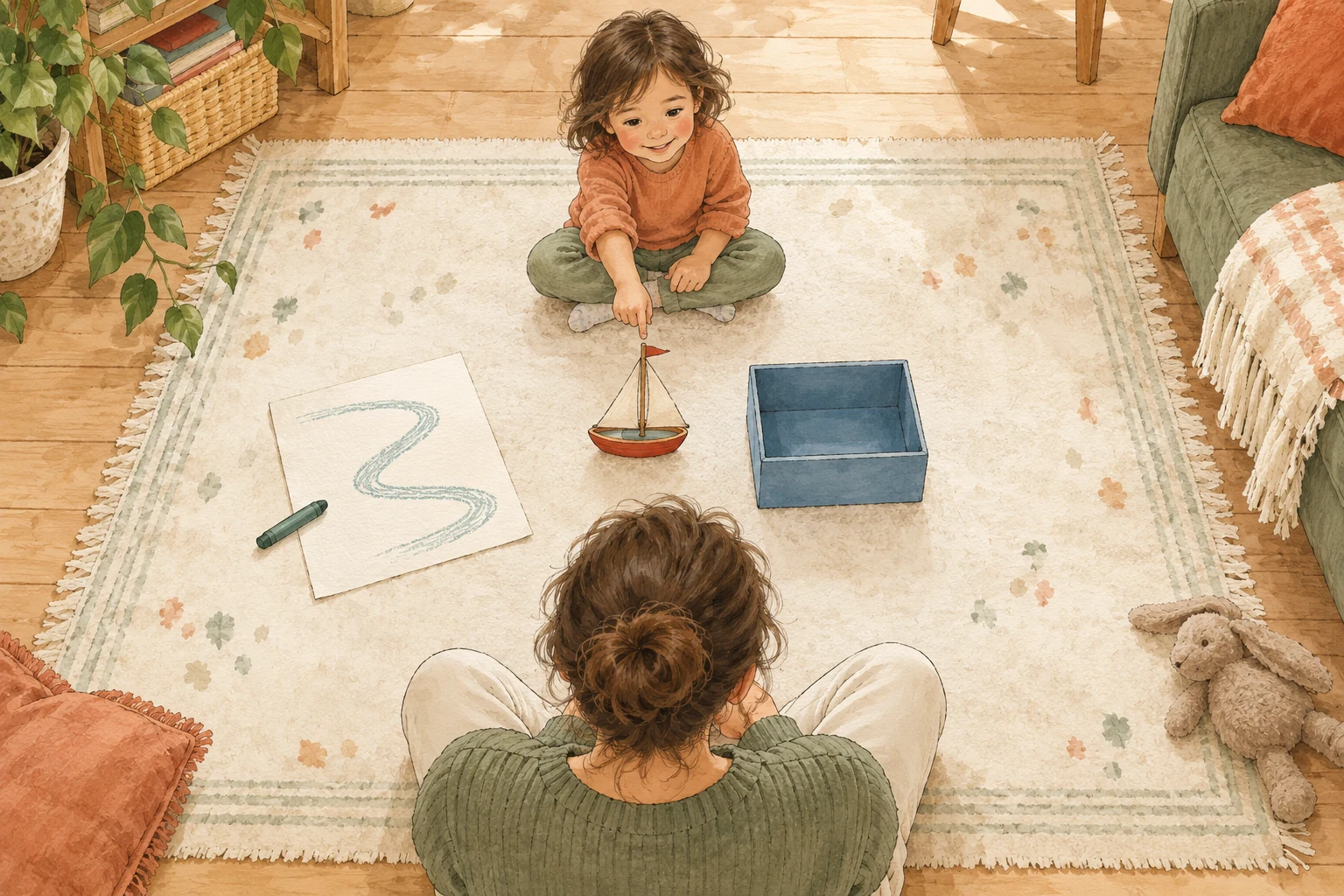
The parent and child share directions around a boat, an open box and a broad drawn path. These are separate activity props.
Four directions invitations, from objects to print
Directions invitation 1: build a scene the child can change
Place a toy animal and an open box on a mat. Try “inside,” then move the toy outside and describe the new relationship. Next, invite the child to choose a position and show you. The adult can follow their gesture while supplying the word.
For these directions, use a toy that can genuinely fit inside the container. A rabbit balanced on its rim shows a different relationship from a rabbit sitting within it. Pause to inspect those details together. Once the first word is familiar, compare inside with beside instead of introducing many new terms at once.
Offer a turn as the speaker too. A learner who says “Rabbit in” has contributed an understandable message. Expand it naturally: “The rabbit is inside the box.” You can repeat the longer version without asking for a rehearsed sentence before continuing the game.
Directions invitation 2: look above and below a printed group
Use Number 3 Worksheet: 4 Brilliant Rocket Mission Wins to explore the arrangement of its three rockets. The page shows two rockets above a third. Keep the paper upright and ask the child to point to the rocket below the two others. There is a visible reference for the directions, and the learner can answer without writing.
Then switch roles: the child chooses a rocket and tells the adult where to look. “The bottom one” is a useful beginning. You can add “below the pair” while pointing to the relevant group. Count all three complete rockets separately if you want to discuss quantity; position and counting are different questions.
These directions concern the worksheet's pictured arrangement. Do not rotate the page midway and expect the same top-and-bottom clue to stay true. If you deliberately turn it, announce the change and look again together.
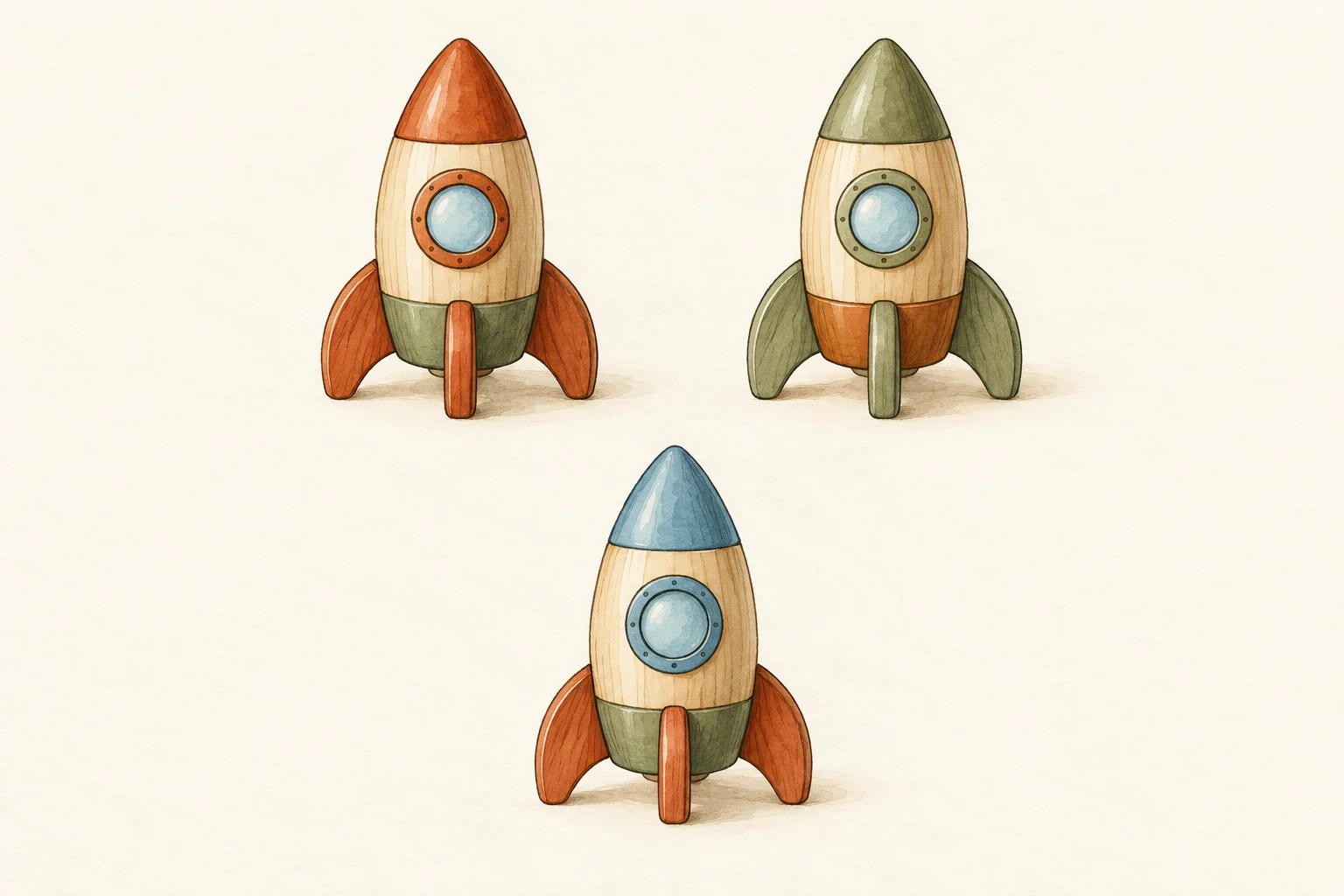
Three separate toy rockets demonstrate the relationship without reproducing the worksheet.
Invitation 3: travel along a visible route
Trace 5 Essential Lines and Curves: Fun Paths for Little Hands (Ages 3-5) offers straight, slanted, horizontal, and curved tracing paths. Choose one route and locate its starting cue. Before offering a pencil, describe the movement while the child follows it with a finger. Use the model's intended path rather than inventing a different route across several rows.
Keep directions brief enough to connect with that movement. You might say “start here” with a clear point, then describe travelling down or across the chosen line. The starting position and supplied route matter more than producing a long sentence about every turn.
A learner can direct your finger instead. Wait at a place they indicate and ask where to continue. This makes directions useful for a shared action, while an adult handles the smaller movement if that is currently easier. Return to an optional traced attempt after the route has been explored.

This large demonstration path is a separate prop for finger movement.
Invitation 4: turn a picture relationship into a prop scene
Open Number 2 Worksheet: 6 Powerful Games for Happy Sailors and locate its two complete sailboats beside one another. Invite the child to point to one boat, then the other. Recreate that side-by-side arrangement using two large toy boats or simple paper drawings on separate cards.
Give directions such as “put your boat beside mine,” keeping both on the same surface. Then let the child move one boat and explain the new arrangement. A hand gesture can show the intended relation. Notice whether you are discussing the boats' positions, their quantity, or the numeral 2, and keep each question clear.
The worksheet provides the reference picture; the movable boats are extra materials you prepare. Its printed boats remain whole objects even though their sails contain several coloured parts. A new position does not change the number of boats.
What can these directions conversations offer?
- Words attached to visible relationships. Moving an object gives inside or beside a situation the child can inspect, rather than a definition to memorise.
- A reason to name a landmark. Directions become clearer when the speaker identifies the box, path, or picture that matters.
- Practice linking print with real space. A paper arrangement can be recreated with props while the learner compares what stayed the same.
- A turn in each communication role. Children can give directions as well as follow them, using gestures, words, or both.
- Useful questions when meaning is uncertain. Asking which object or which place can keep a shared activity going without random guessing.
NAEYC's January 2026 article on spatial thinking connects spatial words with books, movement, and manipulatives. These worksheet invitations apply that broad principle to small scenes adults can set up at home or in class. They are practical suggestions rather than a tested programme or a timetable for mastery.
Keep directions accessible across different responses
Children may understand a relationship before they can explain it in a long sentence. Make pointing available. Let a child move a large prop or ask an adult to move it. Use a familiar home-language word when it communicates the intended relationship, then connect it with another word your setting is using.
Be careful with left-and-right directions when you face one another. Your left may appear on the other person's right. Beginning beside the child can reduce that extra demand. You can spend plenty of time with inside, beside, above, and below before adding viewpoint changes.
Directions also depend on what the learner can notice in the scene. A busy tabletop with several similar containers may make “the box” uncertain. Clear away the extra objects, name one reference, and show it if needed. Offer support as part of the interaction rather than withholding a clue to make the task harder.
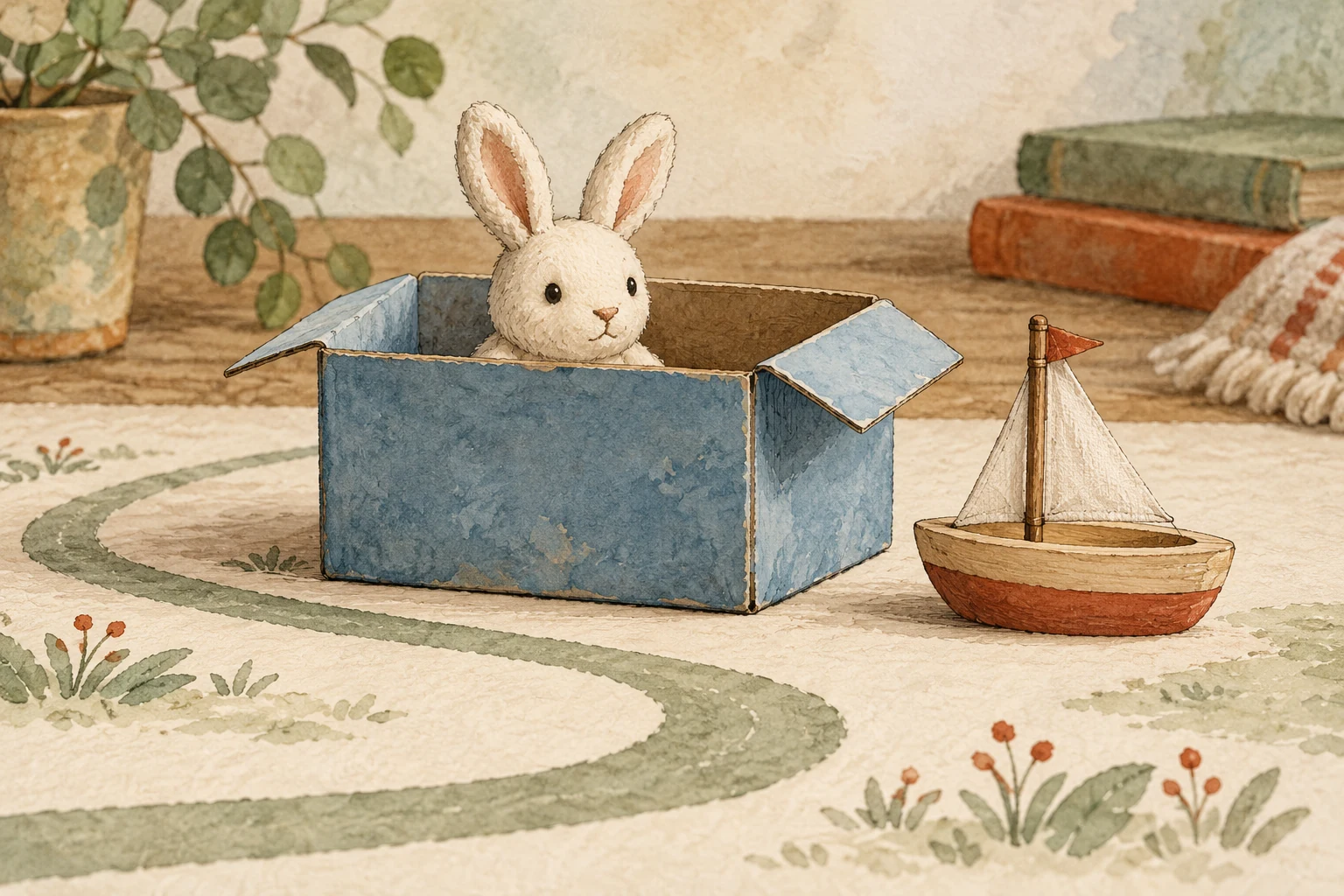
The low view makes two different relationships visible. A broad path in the foreground suggests another directions invitation.
Try a five-move directions routine
- Choose one relationship and two familiar objects.
- Name both objects before giving the first instruction.
- Pair new directions with a clear demonstration or gesture.
- Wait for the child to point, move, or request help.
- Exchange roles so the learner can direct one adult action.
After this directions routine, return the objects to a simple starting scene. A fresh turn should not depend on remembering an unexplained earlier arrangement. If the child wants to continue, repeat the relationship with a different familiar toy before adding another step to the instruction.
At home, the box gives “beside” a meaning
Imagine Esha putting a toy boat inside a blue box when her aunt meant beside it. Instead of repeating the same directions more loudly, her aunt moves the boat outside and says, “Now it is beside the box.” Esha points to the gap between them.
They exchange roles. Esha puts a rabbit inside the box and asks her aunt to find it. The next directions turn grows from the child-created scene. Her aunt can say “inside” while they look at the same position, then let Esha move the rabbit again.
The useful observation is the relationship Esha showed and the support that helped. Their play can stop there. A short shared discovery does not need to become a worksheet completion session or a sequence of increasingly complicated requests.
In class, change the directions before blaming the listener
In a separate imagined classroom scene, two learners sit on opposite sides of a table. The teacher asks one to put a picture “on the left.” Each child points to a different side from their own view. The disagreement reveals an extra perspective demand.
The teacher moves beside the learners, names the page's top edge, and changes the directions to “point below the two rockets.” They now share a stable reference. Later, the children can explore how a viewpoint changes a clue, when that is an appropriate new challenge.
The teacher records which reference and response method made the activity understandable. Correcting the setup is an instructional decision. It avoids treating an ambiguous adult message as evidence that a child was not paying attention.
Four extensions for directions beyond the page
🧺 Put an object away with directions
Use directions during an ordinary tidy-up: one book beside another, or crayons inside a basket. Show the destination before adding a second job. The relationship has a practical purpose, and the child can inspect the finished arrangement.
🐰 Let a toy offer directions
A toy rabbit can ask to sit beside a box or inside it. Invite the learner to choose the next position. Keep the toy's directions simple, and let a gesture carry the message when words are still emerging.
🖼 Describe a drawing with directions
One child points to a detail in their own picture while another asks about its position. Directions may concern a sun above a house or a path beside a pond. The artist decides which detail to discuss; the drawing need not fit an adult's template.
📖 Add directions and movement to a story
Pause at a spatial word in a well-known book and show the relationship with a prop. Then return to the story. A brief directions moment can support the meaning without interrupting every sentence for a question.
Leave the last directions turn to the child
In a Fall 2026 NAEYC reflection on guided play, a teacher describes adjusting support around individual learners. For this activity, the practical lesson is to watch the response and adapt the cue, the materials, or the number of steps. Shared objects can support different levels of help.
Before printing, inspect the three linked resources and their access choices. The rocket and boat pages list ages three to six; the tracing page lists three to five. Each currently offers a watermarked free one-page PDF and a clean member-file option. Choose the task that fits the learner, then leave space for their directions to guide something you do.
A clearer message can open another try. Celebrate a useful question, an accurate point, or a relationship the child has shown. Directions become meaningful when people can use them to understand one another.