Choice: 5 Powerful Ways to Support Happy Learners
Two workable options can make a short practice session more participatory. Explore tools, starting points, support and three existing worksheets.
“The yellow one,” says a child, reaching past the pencil an adult has already placed on the table. That small choice can be the beginning of useful learning. For parents of three-to-six-year-olds, worksheet practice often includes decisions about materials, starting points and how much support to offer. This guide explores five places where children can have a real say while adults keep a clear learning purpose. You will find specific printable suggestions, ordinary home and classroom examples, and ways to respond when deciding feels harder than the activity itself.
A choice needs room to change what happens
If both answers lead to the adult's preferred result regardless of the child's response, the invitation is confusing. A meaningful choice changes something the child can notice: which picture to discuss, which suitable tool to hold, or whether to watch a demonstration before trying. The adult must be ready to follow through on either option.
Consider the learning purpose first. Looking closely at a picture can happen through pointing or talking. Practising a pencil movement eventually needs a mark-making tool. Offering finger tracing before pencil tracing may provide an entry point, but those actions give different information. Describe the purpose honestly rather than treating every route as interchangeable.
In its family guidance, NAEYC explains offering options within limits: present acceptable alternatives and be clear when a decision is already fixed. Applied to a worksheet, that principle might mean letting the child select a starting picture while you keep scissors out of an activity that does not require cutting.
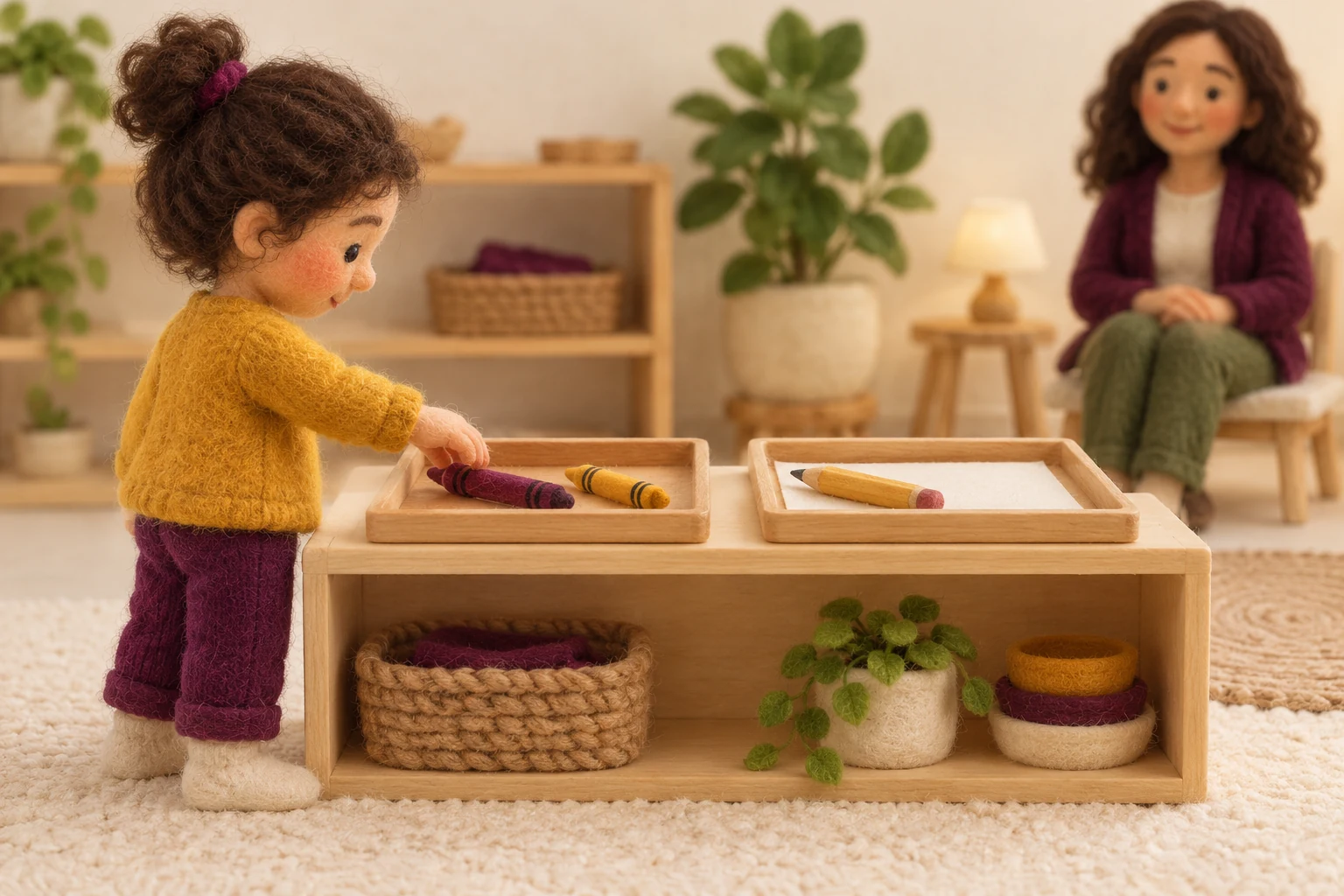
Two trays hold different mark-making tools. The parent leaves space for the child to look, select and begin.
① Material choice: make both tools workable
Offer two tools that suit the page and the learner. A broad crayon and a coloured pencil may both work for a large colouring space. A tiny word gap may need a finer point. Check whether the tool can produce a visible mark without excessive pressure before offering it as an equally practical option.
For Chick Coloring: 5 Brilliant Moves for Happy Artists, show the large chick outline and its small yellow-and-orange reference. A child might select a yellow crayon or a yellow coloured pencil for the body. If you are exploring different colours instead, say that clearly. Matching the reference and inventing a new bird are different invitations; either can be worthwhile when the purpose is understood.
Keep the unselected tool nearby without repeatedly recommending it. One genuine choice is enough to begin. If the point breaks or the mark is hard to see, show the problem and offer a replacement. Changing an unsuitable tool is sensible problem-solving, not evidence that the child chose badly.
② Starting-point choice: find two honest doors
A page may contain several tasks, but presenting every section at once can make the invitation unwieldy. Select two possible beginnings. Both should connect with the day's purpose, and each should be small enough for a child to understand before committing.
Open Trace 5 Essential Lines and Curves: Fun Paths for Little Hands (Ages 3-5) and inspect the different line and curve rows together. Offer a choice between a horizontal route and a curved route when either movement fits your plan. Point to the actual starting cues. The adult should not quietly require the curved row first after the child has selected the straight one.
Here, choice changes the order; it does not change the printed path. A child still needs to see where a selected route begins. Covering other rows with loose paper can reduce visual distraction, provided that cover does not hide the model or become another compulsory task. Begin with one visible example and review what happened before adding more.
③ Support choice: show me or try beside me
Some children want to watch a movement before they attempt it. Others want an adult close by while they explore. Ask which kind of support would be useful, then demonstrate what those options mean. “I can show one on my paper, or I can sit beside you while you start.”
Use Ii Worksheet: 4 Brilliant Igloo Dot Expeditions to compare the barred capital I with the lowercase i and its detached dot. A support choice might be watching the adult make a large i on scrap paper or first locating the stem and dot on the printed model. Neither route requires filling every small tracing example immediately.
Avoid moving the child's hand as an assumed form of help. Show the movement on your own surface and allow space to respond. If the learner asks you to write the missing initial in the igloo word, clarify who will make that mark. An adult-written letter can support shared reading, but it is not a sample of the child's independent writing.
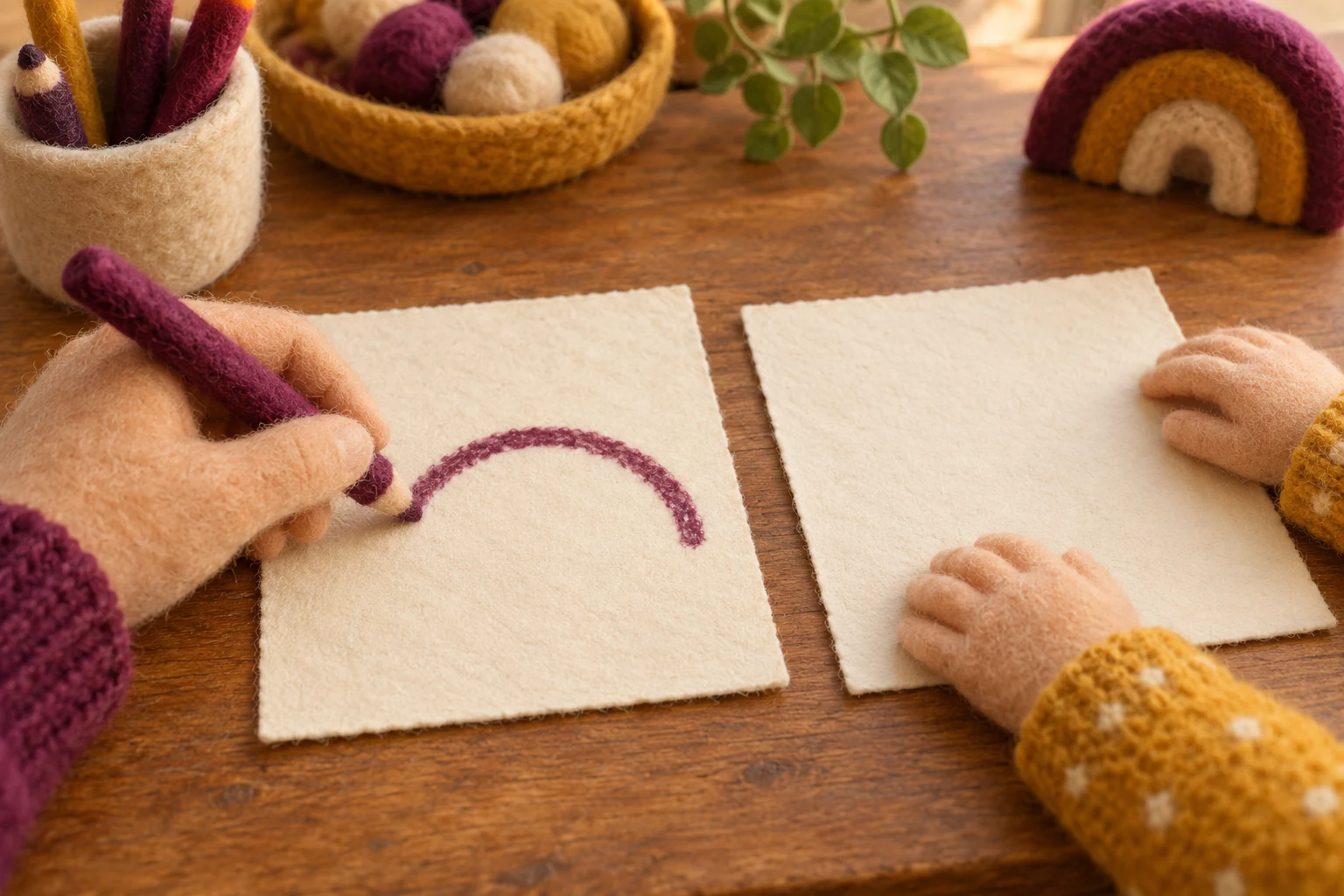
Separate papers leave the child room for their own attempt.
④ Response choice: point, tell or demonstrate
Before adding more pencil work, decide what you need to find out. If the question concerns recognition, pointing can be informative. If the question concerns formation, a child needs an opportunity to make the shape. An answer format should match the question rather than merely make the activity appear finished.
With the igloo page, a child can point to lowercase i or name it. That choice offers two ways to show recognition. Later, invite a large i on loose paper if you want to observe formation. Keep those observations separate: knowing which letter is requested and producing its movements are related, but distinct, achievements.
A child may use a gesture, home language or familiar communication aid to express a choice. Place the two actual options where they can be seen. Confirm the selection in ordinary words and proceed. Requiring an elaborate sentence before handing over a tool adds a language demand that may have little to do with today's activity.
⑤ Review choice: identify what deserves another look
After a short attempt, invite the child to select one feature for a closer look. “Shall we look at the beginning of your line or the end?” The question makes a small review manageable. Keep both possibilities respectful; avoid presenting a successful mark beside a deliberately embarrassing label for an unfinished one.
This choice concerns attention, not a grade. Describe what is visible: the curved line stayed near the guide, or the dot sits above the short stem. Let the child show what they noticed, including something different from your observation. An unexpected comment can reveal the feature that mattered to them.
Agree on the next action together where possible. It could be another example, an adult model, or putting the sheet away for another occasion. A review choice does not create an obligation to repeat indefinitely. Leave enough time for the learner to use the information rather than ending with a long list of corrections.
A choice map for a short practice session
| Decision | A workable choice | What stays clear |
|---|---|---|
| Material choice | Two suitable yellow tools for a large space | The mark should remain visible |
| Starting choice | A straight row or a curved row | Each route has its own starting cue |
| Support choice | An adult model or nearby company | The child makes their own attempt |
| Response choice | Pointing or naming for recognition | Writing requires a separate observation |
| Review choice | Look at the beginning or the ending | Discussion describes a visible feature |
Seven useful things to notice during choice
- Purposeful participation. Reaching for a selected tool is a visible contribution to the activity. Notice the action itself without promising that every decision will create enthusiasm.
- Comparing features. A child can inspect a thick tip and a narrow tip before selecting one. The comparison gives practical language a concrete reference.
- Communicating a preference. Pointing, speaking or using an established aid can make a choice understandable. Adults can respond without demanding the same communication form from everyone.
- Following a short plan. Selecting one row and then finding its starting cue connects a decision with an immediate action. Keep the sequence short enough to remember.
- Requesting assistance. A learner can distinguish wanting a model from wanting company. Those requests tell an adult what support to try next.
- Reconsidering a decision. Discovering that a crayon hides a tiny guide gives a reason to change tools. A revised choice can reflect useful observation.
- Sharing responsibility. Adults prepare workable limits; children contribute within them. Neither person needs to control every detail of the worksheet session.
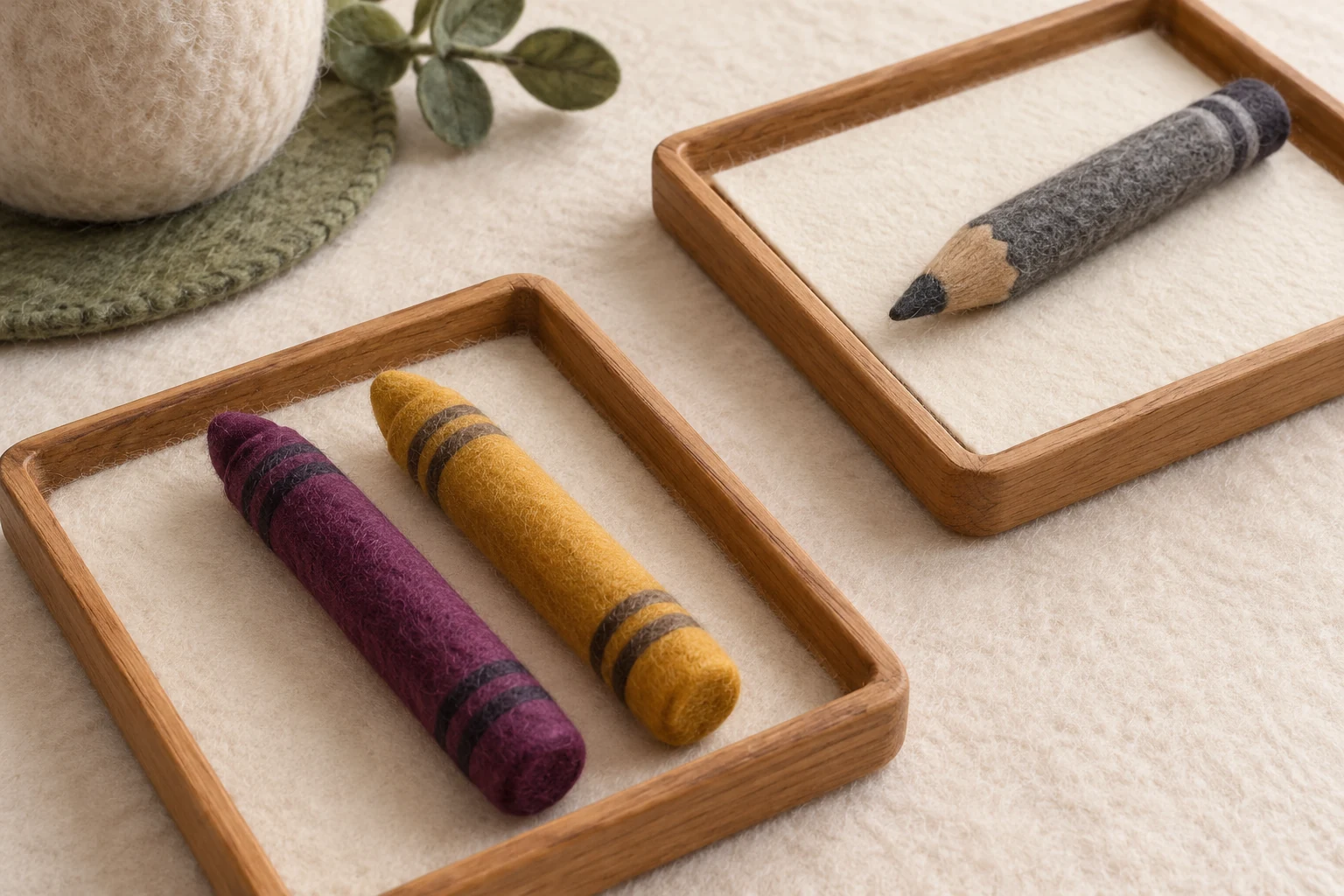
Separate trays make two sets of materials easy to compare. These props illustrate an invitation rather than a printable worksheet.
Set up one choice before adding another
- Name the learning purpose. Decide whether you are exploring a picture, recognising a form or practising a movement. Choose a suitable page and inspect its model before presenting options.
- Prepare two real alternatives. Test the materials, clear a comfortable surface and remove items that are unavailable. Keep a choice small enough to show with objects or a brief phrase.
- Ask once, then pause. Give the child time to look between the alternatives. Avoid filling the silence with extra suggestions, a countdown or a sales pitch for your favourite option.
- Confirm and act. Name the selected option and make it available. Carry through the choice before introducing another question, so the child can connect their response with what happens.
- Observe the fit. Watch whether the tool, task and support work together. If there is a difficulty, describe it and offer a concrete adjustment rather than labelling the decision a failure.
The University of Virginia's ECE Resource Hub offers a short guide to meaningful options, including keeping options limited and pausing for a response. Try that pause during an ordinary invitation. A child who is still looking has not necessarily ignored the question; more adult talk may obscure the alternatives you just showed.
A kitchen-table choice after a busy afternoon
Imagine Nila arriving home with little interest in another instruction. Her father lays out the chick page and two suitable yellow tools. He asks for a material choice, then waits while she tests both on scrap paper. She chooses the crayon and colours a small part of the body.
He notices her looking at the orange reference feet. Instead of moving on to a new worksheet, he asks what she has spotted. Nila points, and they compare the feet with the large outline. The original choice opened a brief conversation; it did not guarantee a finished picture, and completion was never promised.
Later, her father records a simple observation for himself: the broad crayon was easy to see, and picture comparison held her attention. That is enough to guide another invitation. This imagined home example illustrates a possible exchange, not a report of a particular child's progress.
At a classroom table, the same options need not suit everyone
Picture a teacher welcoming three children to a short line activity. One child wants a visible model, another begins with a finger, and the third reaches for a pencil. The teacher keeps the shared movement purpose while arranging support individually. She does not ask the entire group to copy the first child's choice.
A child who cannot yet select from spoken options sees the two routes indicated directly on the page. Another requests both. The teacher explains the current limit: one route first, with a review afterwards. That boundary remains predictable without making the slower decision-maker wait through public comparison.
When discussing practice with families, describe the actual choice and the child's action. “He selected the curved row and watched one model” gives more usable information than “He was good today.” This classroom scene is another illustrative example; children may respond differently on another day.
When neither choice fits
Declining both alternatives is information. Check whether the activity is comfortable, the materials are usable and the question makes sense. A thirsty child, a crowded table or an unfamiliar word can interfere with an otherwise reasonable choice. Changing the setup may be more useful than repeating the same question louder.
If a child asks you to decide, offer a simple starting suggestion and stay open to revision. Choosing together counts as participation. Some moments call for fewer decisions. For a fixed safety limit, use a clear statement; do not wrap it in a choice you cannot honour. For optional practice, a pause or another time may be appropriate.
Keep access clear before printing. The three linked pages offer a watermarked free sample; their clean files require active membership. They are single-page resources with different tasks and age guidance. The separate trays in these illustrations are activity props, not extra downloadable pages or a new printable pack.
Four playful ways to extend a choice
A puppet's choice
Let a puppet offer two suitable picture-talk beginnings. The child makes a choice for the puppet, then explains or demonstrates it. Swap roles so the adult also practises accepting an option without changing the rules halfway through.
Tool detective choice
Make a small test patch on scrap paper with two suitable tools. Compare visibility, thickness and comfort. Choose one for a particular space, then check whether it works there. Keep the experiment separate from judging the child's grip or speed.
Announce a route choice
Invite the child to announce or point to the line row they intend to explore. After the attempt, look back at that plan. A changed choice can prompt a useful explanation: perhaps the curved route looked more interesting once it was uncovered.
Offer a partner a choice
Each partner prepares two acceptable ways to share a picture: describing one detail or pointing while the other names it. Honour the partner's selection. This tiny exchange gives the child experience offering a choice as well as receiving one.
Keep each choice believable
Children do not need a decision at every turn. They need adults who mean the options they offer. Start with one choice that you can comfortably honour, connect it with a suitable worksheet and watch what follows. A small decision deserves a real response. If today's invitation falls flat, adjust the materials or the timing. Tomorrow's short practice can begin with something you learned together.