Independent Thinking: 7 Powerful Habits for the AI Era
An instant answer can wait while a child inspects, asks and explains. Seven practical habits keep young learners involved in finding things out.
“How could we find out?” can be a more useful starting point than producing an instant answer. A child wondering about a leaf, a pictured collection or a pretend building has an opportunity to inspect something, ask another person and explain a reason. Independent thinking begins in these small exchanges, well before children need their own technology. For parents and teachers of children around four to seven, this guide offers seven habits that keep the learner’s contribution visible. Three existing worksheets provide concrete pictures to investigate. Ordinary objects, books, conversation and adult support do the rest of the work.
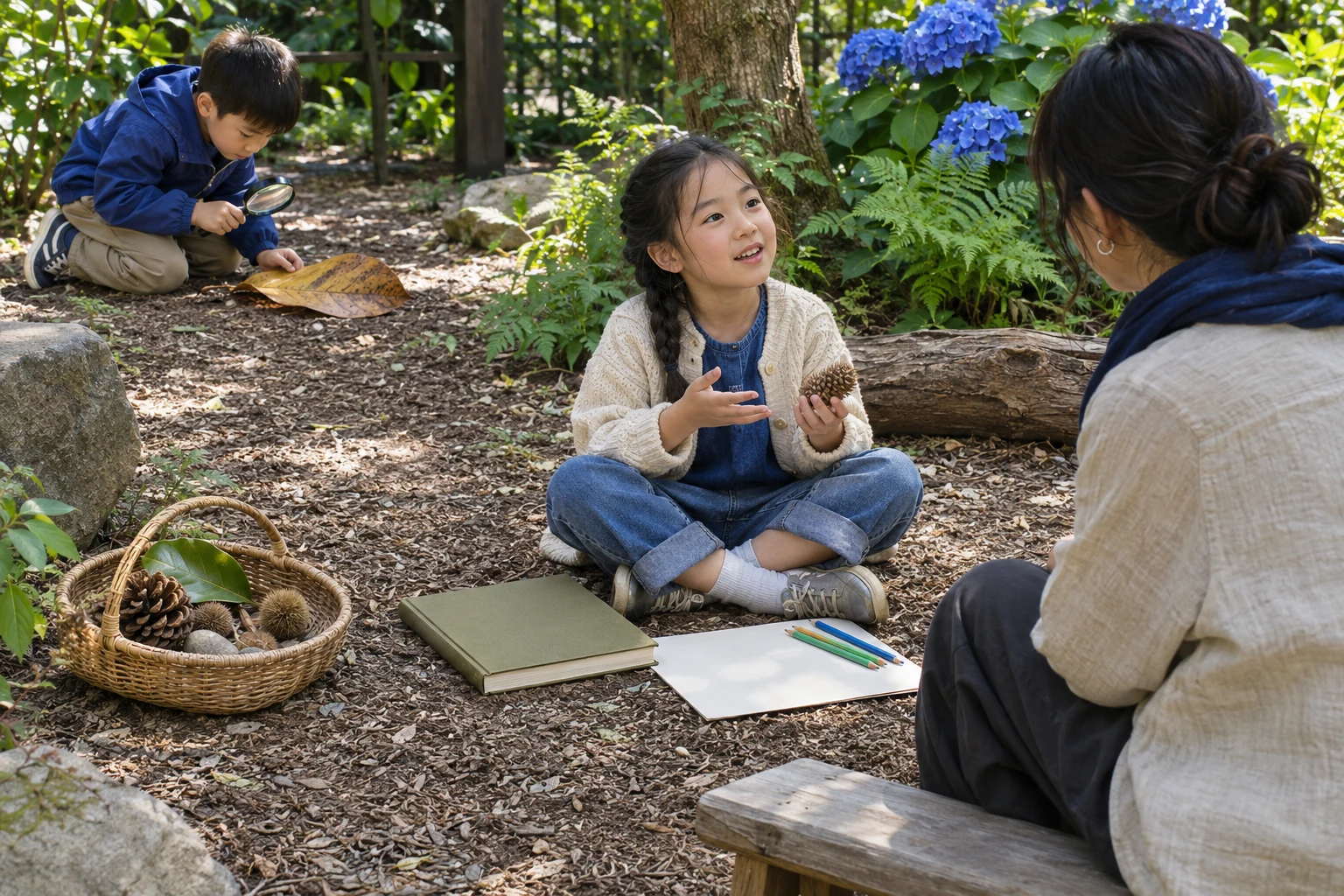
The different positions leave room for individual investigation and adult support, with a closed book and drawing paper nearby.
🌱 Independent thinking still makes room for help
A child can ask a question independently and need an adult to read a source, hold materials steady or explain an unfamiliar word. Independence concerns the learner’s active contribution, not the removal of appropriate teaching or accessibility support.
UNICEF Innocenti’s work on preparing children for an AI world identifies critical thinking, creativity, safety awareness and understanding rights among relevant competencies. Its project considers children across settings and ages; it does not establish that a particular preschool worksheet prevents over-reliance on technology.
Keep the purpose of the activity visible
If today’s purpose is for a learner to propose a way to count, make room for that proposal before demonstrating a method. If a new concept needs direct explanation, provide it. Withholding an answer to a question the child cannot reasonably investigate is not automatically better teaching.
Adults can use digital tools appropriately in their own work while protecting the child’s opportunity to observe, decide and explain. These activities are designed to work without a device. They are not an argument that every technology use is harmful or that children should investigate online material without supervision.
Habit 1 — Give a question somewhere to stay

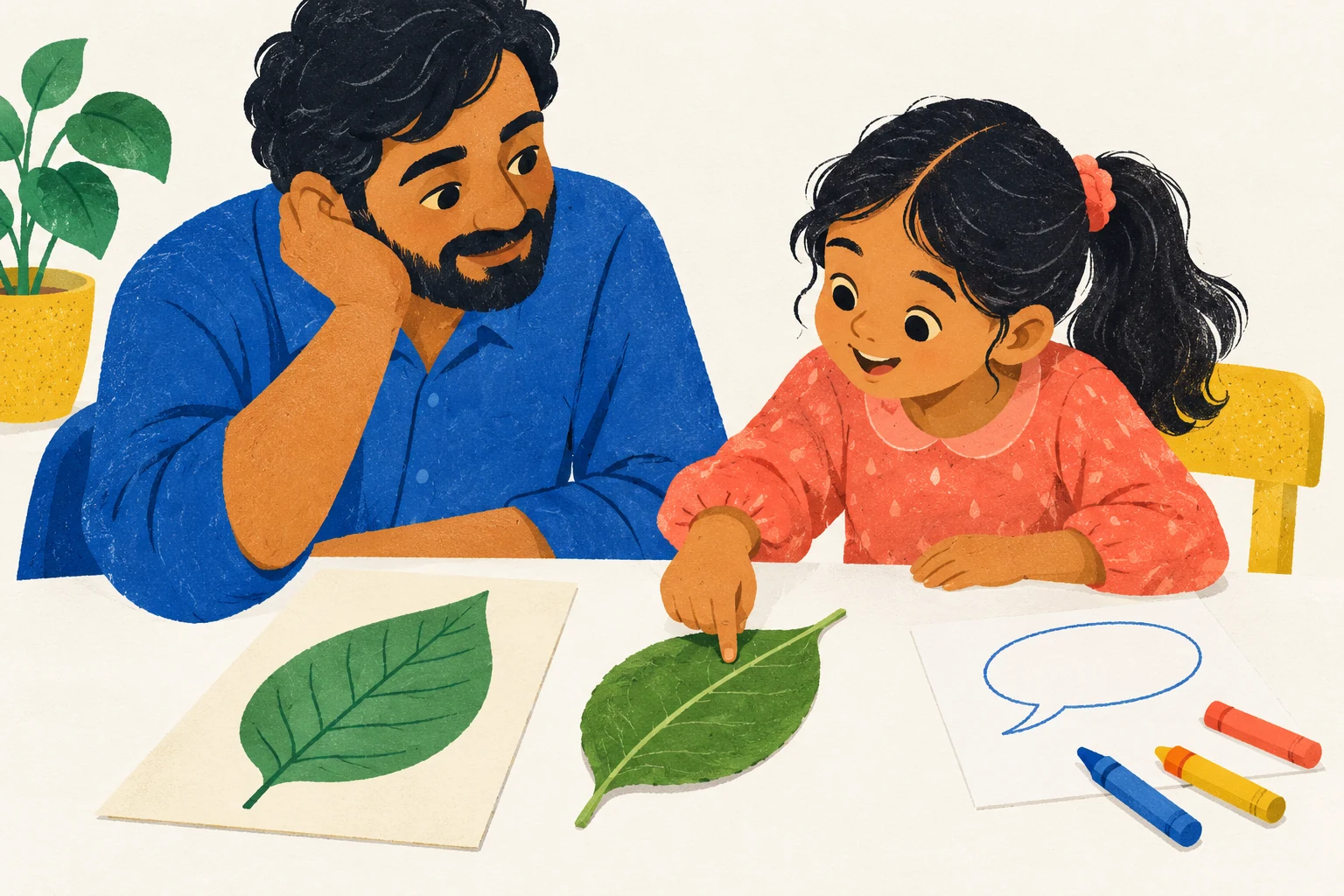
These observation props illustrate one possible investigation, with safe materials and adult supervision.
Keep a small question space: plain cards, a drawing page or an adult-scribed notebook. When a child wonders why two leaves look different, record the actual question rather than replacing it immediately with a more impressive science topic.
Ask which part interests them. “Are these from the same tree?” and “Which is bigger?” require different kinds of checking. Let the learner choose a manageable question while the adult handles safe materials and access to information.
Return to one question before collecting another
An endless list can become another display adults maintain for themselves. Choose a question worth revisiting and discuss what might help: looking more closely, comparing objects, consulting a book or asking someone with relevant knowledge.
Respect questions that cannot be settled by a quick practical test. A question about a distant place or past event may need a reliable source. A child's preference can be heard without demanding evidence as though it were a scientific claim.
Habit 2 — Separate a guess from an observation
Invite a prediction before an ordinary investigation, then distinguish it from what happened. “I think the longer strip will reach” is a prediction. Showing that the strip touches both sides of a pretend gap is an observation.
Neither contribution needs to arrive as a complete sentence. A gesture toward a feature, a demonstration or a drawing can carry an idea. Adults can supply useful vocabulary after listening, without claiming the child already used the word independently.
Explain what would count as finding out
For a comparison, agree which feature matters. For a counting task, decide which objects belong to the selected group. For a picture story, clarify whether the child is inventing a possibility or describing what is visible.
Avoid secret tricks. Changing the conditions without telling the learner can make a task unfair. A good investigation gives children access to the information they need and allows an explanation to change when the evidence does.
Habit 3 — Ask for a checkable reason

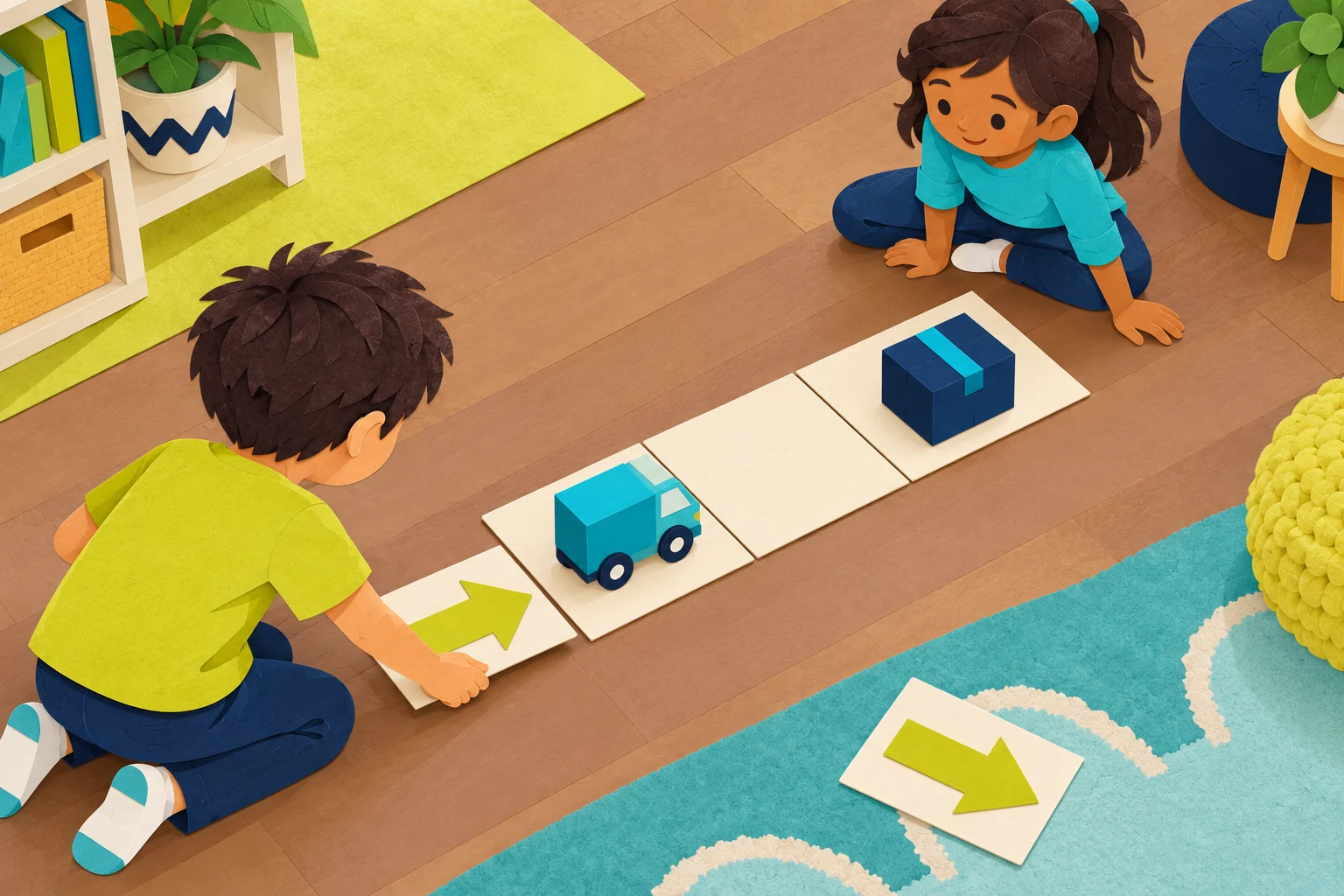
The seven generic cards are homemade props, separate from the actual worksheet and its other counting sections.
For a child ready to count seven, use the top group in Number 7 Worksheet: 5 Brilliant Rainy-Day Discoveries. Its umbrellas are arranged as four above and three below. Ask how someone else could check the collection, then allow the learner to demonstrate a method.
A child might point in order or match seven large counters to the pictures. The value is in making the method visible. Numeral tracing and the lower count are separate tasks; every umbrella across the page should not be combined into one total.
Keep the amount suitable for this learner
If seven is currently too demanding, use a smaller homemade collection. Reaching a larger number is not the purpose of independent thinking practice. A suitable question gives the child room to explain, while an oversized demand can hide what they understand.
The photograph shows seven generic picture cards, not another download supplied with the worksheet. Movable props can extend the discussion, but their quantity and arrangement should remain clear to everyone using them.
Habit 4 — Choose a source that fits the question

The generic illustrated book is a scene prop; adults should select an actual reliable reference suited to the child's question.
The sun picture in Ss Worksheet: 5 Brilliant Sun Bend Activities can start a discussion about pictures and information. Its smiling sun is part of a letter activity, alongside S/s models, tracing and an incomplete picture word. Ask what the illustration shows and which new question would need another source.
For example, a question about the sun’s real features requires an appropriate factual book or a reliable adult-supported reference. The cartoon itself is evidence of what its artist drew, not evidence that the sun has a face. Never invite a child to look directly at the sun to investigate.
A confident answer still needs checking
An adult, a printed page or an AI system can produce an answer that needs verification. Explain in age-appropriate language that a fluent answer is not the same as a checked fact. Model opening a relevant book and locating the part that addresses the question.
The New York State Early Learning Guidelines on investigating and exploring include observation, questions, predictions and gathering information from sources. The guidance uses age bands flexibly; it is not a checklist every child must complete on a birthday.
Habit 5 — Make something before requesting a finished solution
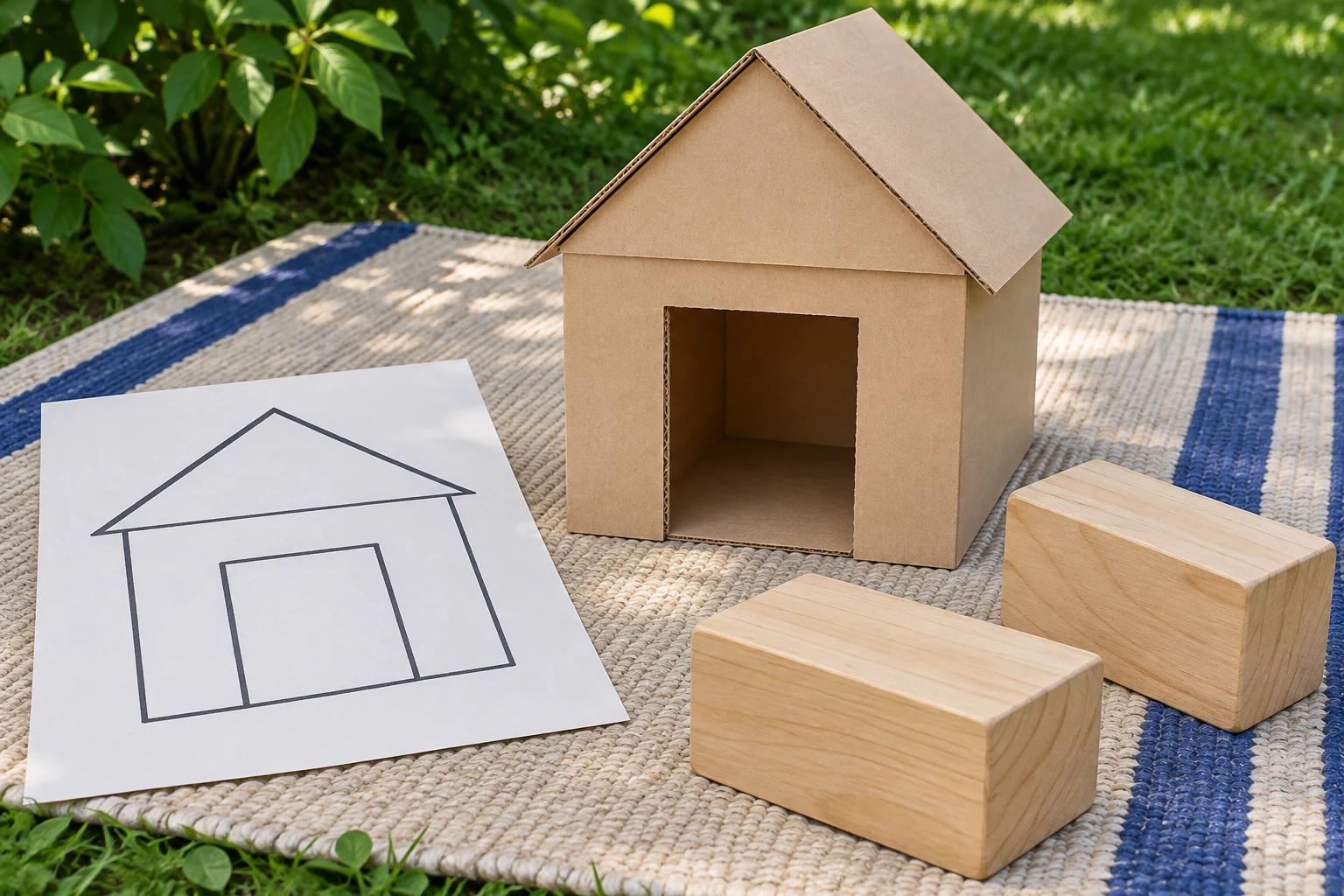
The homemade model and sketch extend a house-picture invitation; they are not extra pages or materials included with the download.
For an interested learner, Color the house: 5 Amazing Steps for Creative Learning! supplies a house scene with a door, windows, roof, trees and sun, plus a smaller coloured guide. Invite the child to choose one feature to include in a separate homemade model or drawing.
Let the learner make a first plan. An adult can cut materials safely, scribe an idea or demonstrate a joining method. Keep clear which decisions came from the child and which support was supplied.
Compare the result with the intended purpose
If a pretend character needs a doorway, ask whether the model provides one large enough for that character. This is a practical comparison. Choosing a favourite roof colour is a preference, and it need not be justified in the same way.
A polished model copied from an adult plan may show useful making skills, but it does not reveal the same decisions as a child’s own design. Notice the contribution that actually occurred rather than assigning independence from appearance alone.
Habit 6 — Compare ideas without making people into winners
Two children may offer different ways to arrange a collection or explain a picture. Invite each to show the feature or action behind their idea. Where an answer can be checked, help the group check it. Where several approaches serve the purpose, allow more than one.
Use respectful language for disagreement. “I counted another way” offers an opening; “You are bad at this” closes it. Adults can model changing an explanation without losing status or turning the correction into a public performance.
Listen for what the quieter learner contributes
A child who talks first or speaks at length is not necessarily doing more reasoning. Provide space for pointing, making, familiar-language responses and adult-supported communication. Do not allow a confident partner to answer every question on someone else’s behalf.
The shared goal is understanding the task. A learner should not have to agree with the adult merely to finish the conversation, but the adult still has responsibility to explain facts, boundaries and safe practice when needed.
Habit 7 — Keep a small trail of how the answer changed
Save one original idea and one later observation when the learner wants a record. An adult might write, “First thought: all the umbrellas were in one row. After looking: two rows.” A picture or moved object can provide the same starting point for discussion.
Ask which detail made a difference. The learner might keep an earlier answer after checking, or revise it for a reason. Revision is not compulsory every time; an explanation that survives a suitable check can remain useful.
Let uncertainty lead to a next step
“We have not found out yet” is a workable outcome when it comes with an appropriate plan or a decision to stop. Avoid filling the gap with an invented fact just to make the activity feel complete.
Independent thinking includes recognising when more knowledge or adult help is needed. It does not require a young child to identify every misleading claim or take responsibility for technology choices that belong to adults.
A practical map of questions and evidence
| The question | A reasonable way to explore | What the result can show |
|---|---|---|
| How many pictures are in this selected group? | Count or match suitable objects | The amount in that group |
| Which strip reaches across the gap? | Compare both strips with the same gap | Which reaches under these conditions |
| What happened in this picture? | Point to relevant visible details | An interpretation supported by the drawing |
| What is true about a real object beyond the picture? | Consult a suitable reliable source with an adult | Information the source actually supports |
| Which design do you prefer? | Invite the learner’s choice | A preference, not a universal rule |
Use the distinction to make conversations more precise. It should not turn every playful exchange into an interrogation or remove the enjoyment of an invented story.
Six capabilities these habits give adults room to notice
- Question ownership: the learner identifies something they want to investigate.
- Observation: a detail comes from the object or picture rather than an adult’s prompt alone.
- Reason giving: the child connects an answer with a visible feature or chosen action.
- Source awareness: the learner begins to recognise that different questions need different information.
- Revision: a changed explanation refers to something noticed or checked.
- Appropriate help seeking: the child knows an adult can assist without taking over every decision.
These are learning opportunities, not promises that an activity will produce general critical-thinking gains or protect a child from every technology risk.
Two hypothetical examples of an answer taking shape
At home: the picture is not the whole explanation
Imagine a child asking whether a smiling sun in a drawing is a real feature. The parent listens, identifies the picture as a made illustration and finds a suitable factual book. The child compares the two representations. In this hypothetical exchange, the useful habit is choosing relevant information, not memorising an adult’s phrase about technology.
At school: the second count has a reason
Picture two learners disagreeing about the selected umbrella group. Their teacher invites one to point while the other matches large counters. They discover one picture was skipped and explain the revised amount. This hypothetical scene shows a check that makes the reason available to both learners. It does not establish a fixed thinking level from one answer.
Try an inquiry invitation in four moves
- Invite a question. Choose one that fits the child’s experience and can be explored safely.
- Provide relevant information. Offer a selected picture, suitable objects or an adult-read source.
- Leave room for the method. Listen to the learner’s idea before supplying a complete solution when that serves the teaching purpose.
- Return to the reason. Discuss what was noticed, what remains uncertain and whether another step is worthwhile.
The umbrella and S/s pages list ages three to six, and the house page lists four to six. Current access panels show watermarked single-page PDF samples for all three; clean membership options appear on the umbrella and S/s pages. Inspect the previews and choose suitable tasks rather than assigning a page solely by age.
Four extensions that keep curiosity in the learner’s hands
Set up an ask-a-person card: an adult records the learner’s question for someone with relevant knowledge, then helps compare the answer with the original question.
Make a two-representation tray with a familiar safe object and a drawing of it. Notice what the drawing includes and leaves out.
Start a not-yet envelope for one unresolved question. Reopen it when a useful source or opportunity becomes available, rather than adding endless compulsory investigations.
Play explain-the-choice curator. The learner selects two drawings for a pretend display and describes a reason for the selection, while accepting that another curator might choose differently.
Protect the pause before an answer
You do not need to turn every question into a lesson. Sometimes a clear explanation is welcome; sometimes a shared investigation is worthwhile. Say “Let’s choose a way to check that” when the opportunity fits. Keep the learner’s idea visible within the support you provide. Independent thinking grows more observable when children can ask, inspect, explain and reconsider in the company of adults who take their questions seriously.