
Number Tracing 1–5: 6 Essential Wins for Proud Kids
✎ Symbols above • Written names below
Two rows can describe the same number without looking much alike. A small symbol says 3; the longer label beneath it says Three. This Number Tracing sheet gives children five chances to explore that relationship, using numerals from one through five and their written names. Some learners will follow a few dotted digits, while others will enjoy trying the word underneath. Both can participate meaningfully. Keep the task small, read unfamiliar labels aloud, and use Number Tracing as a way to connect what a child says with what a hand can record.
Number Tracing links a numeral with its name
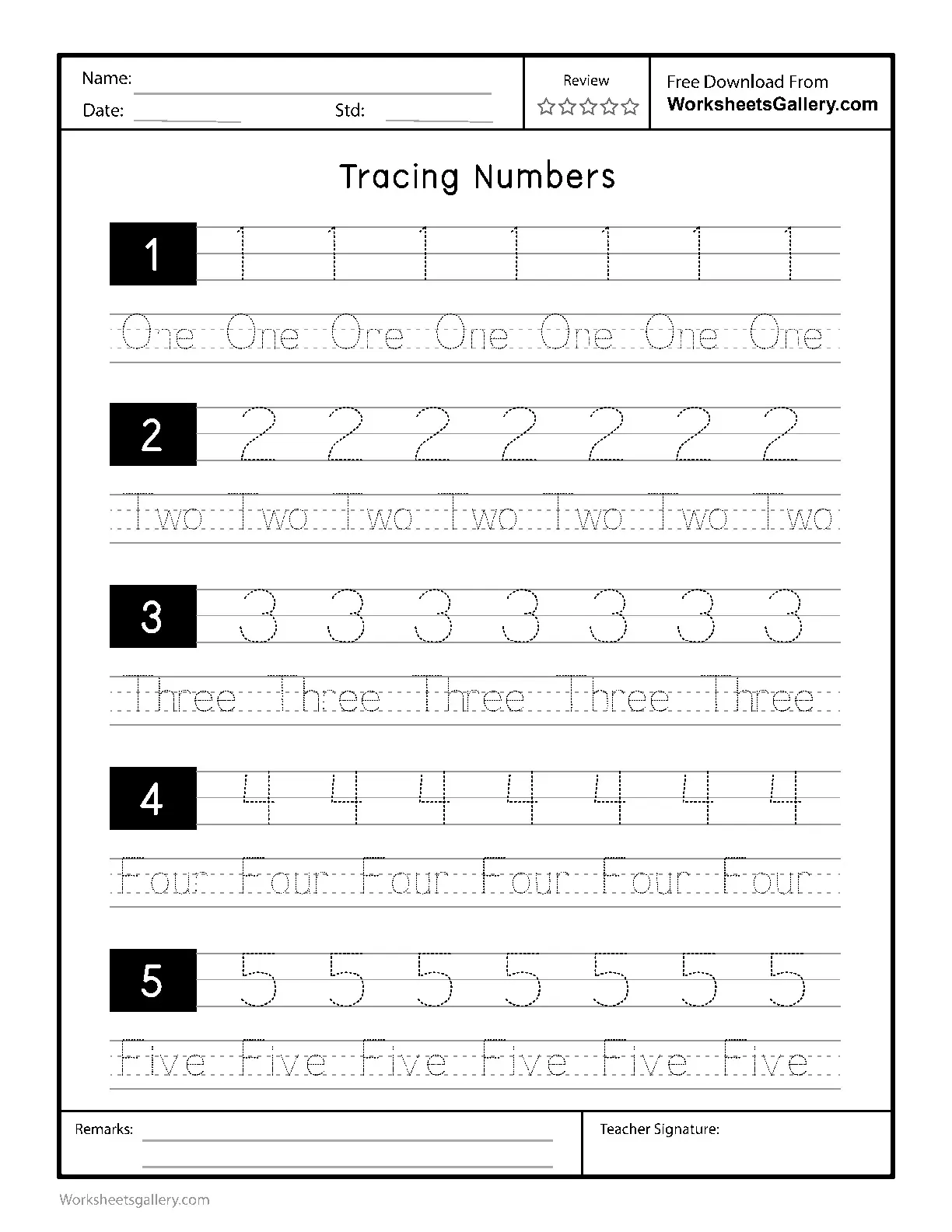
The Number Tracing page has five paired practice areas. Each begins with a white numeral inside a black square, followed by dotted copies of that numeral on ruled guides. Directly underneath sits a row of its dotted English name: One, Two, Three, Four, or Five. The words begin with capital letters, just as they appear in the examples.
This is Number Tracing with a written-language connection. It is not a counting-picture worksheet, an addition activity, or a set of independent blank writing boxes. There are no printed movement arrows or numbered stroke instructions. An adult can demonstrate a familiar formation route beside the page, while the child uses the printed shape as a reference.
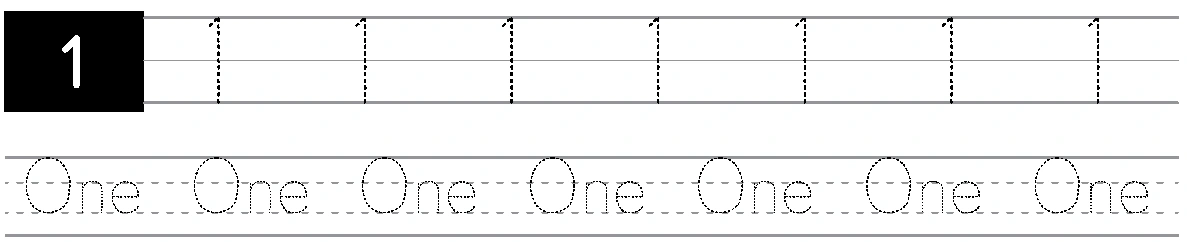
Point between the two bands as you read them. During Number Tracing, understanding that they name the same number matters more than expecting an early writer to read the whole word alone.
Choose the Number Tracing task before you begin
For many children around four to six, the Number Tracing bands offer an approachable starting point. The written names add a greater letter-formation demand. A younger preschooler might identify a model, say the number with an adult, and finger-follow one digit. These are different entry points into Number Tracing, rather than steps every child must finish in the same sitting.
Let recognition, counting, and pencil control inform your choice separately. A learner might reliably identify five objects while finding the shape of 5 awkward. Another might trace 5 neatly without yet connecting it to a group. Number Tracing gives you something to observe; it does not replace a short conversation about the amount.
If moving along a line still takes most of the child's attention, use simple handwriting paths on a different occasion. Keep the numeral model visible and reduce the number of attempts, rather than making the whole page a prerequisite for success.
Travel through five Number Tracing row pairs
Number Tracing can begin with a familiar numeral instead of automatically starting at the top. The descriptions below tell you what to notice; they are not extra instructions printed on the PDF.
- 1 and One: compare the short numeral with the three-letter label. Read the word while pointing below it. A child can trace one or two digits before deciding whether to try its name.
- 2 and Two: look at the curved upper part and the lower ending in the printed numeral. Demonstrate the route slowly on spare paper if following its dots feels uncertain.
- 3 and Three: notice the two curved portions. Its Number Tracing word row requires several letter movements, so an adult can read it without asking the child to trace every copy.
- 4 and Four: inspect the straight segments and where they meet. Keep your Number Tracing demonstration consistent with the open form of 4 printed on this sheet.
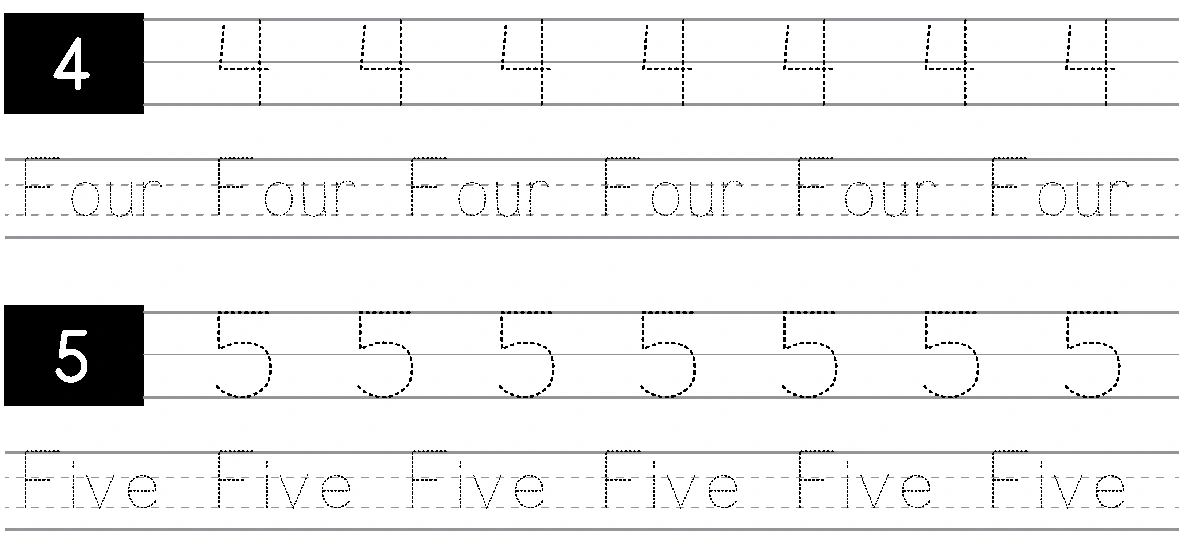
- 5 and Five: compare the straight upper portion with the curved lower portion. End with a small amount of deliberate work, even if several dotted examples remain unused.
A written word's length does not show its quantity. Three takes more letters than Five. That is a useful distinction to mention during Number Tracing if a child assumes the longest label must name the biggest amount.
Separate what the child knows from what the pencil does
| You observe | Try this response |
|---|---|
| The child names a numeral but avoids tracing it. | Acknowledge the recognition, then offer a larger demonstration or a finger-following turn. |
| The child follows dots but cannot name the numeral. | Say its name and briefly connect it with a matching group of objects off the page. |
| The numeral is comfortable; the word feels lengthy. | Read the label together and choose a small amount of letter tracing, or leave it for later. |
Number Tracing becomes easier to adjust when these observations remain separate. “Recognized 4” and “followed its model with help” are more useful notes than a judgment based only on how many rows look finished.
A desk routine for short Number Tracing visits
Place the sheet on a clear, firm surface and choose a comfortable pencil. Identify one row pair together. For Number Tracing at home, sit where your demonstration is easy to see; in a classroom, show the target numeral before children begin individual work.
- Say and point. Name the solid Number Tracing model, then read its written label aloud. Ask the learner to show you where the same numeral repeats.
- Show and try. Demonstrate one route on scrap paper. Invite a small number of dotted attempts while leaving the model available.
- Read and decide. Return to the number word. Offer some word tracing if it matches the child's experience, rather than making it compulsory.
- Notice and stop. Ask for one observation about the mark or label, then finish at the agreed point.
Number Tracing need not include all five numerals in one session. An adult can complete the name and date fields when those demands would crowd out the intended practice. Keep the nonwriting hand on the paper and allow the child to reposition it comfortably.
Six Number Tracing wins to notice along the way
The eyes and language do some of the work
- Recognizing a symbol: finding the same numeral in a model and a dotted row gives Number Tracing a clear visual identification task.
- Connecting two labels: hearing “four” while looking at 4 and Four introduces two written ways of naming the same number.
- Explaining a difference: describing a curve, a straight part, or a longer word brings useful comparison language into Number Tracing.
The hand and attention contribute too
- Planning a movement: watching a short demonstration before trying it asks the child to hold a manageable action in mind.
- Coordinating two hands: steadying the page while making marks supports the physical organization of Number Tracing.
- Reviewing an attempt: noticing where a numeral resembles its model creates a specific opportunity for self-observation.
These are practice opportunities across cognitive, motor, and language skills. A single Number Tracing page cannot establish them all. Look for a modest change that matters to the learner, and offer varied experiences over time.
Compare four and five during Number Tracing
On this sheet, 4 contains straight parts, while 5 combines straight and curved portions. Put the two printed rows beside each other in your conversation: which movement feels familiar, and which needs another demonstration? During Number Tracing, a difference in comfort gives an adult useful information without ranking the child's work.
For a later quantity-focused contrast, the number five tracing, counting and coloring page adds activities beyond the paired Number Tracing rows shown here.
A pretend mission at home, a lending shelf in class
Imani packs four moon rocks
Imani gathers four large play stones for a pretend space trip. An adult counts them with her, then asks which Number Tracing row could record the cargo. She finds 4 among the Number Tracing models and follows two dotted examples. The adult reads Four underneath; Imani decides to try its first few letters with the model nearby.
The stones are a separate play resource, not pictures printed on the PDF. Her counting and tracing can therefore be discussed independently. If one task becomes tiring, the pretend trip can continue without a demand to finish the entire sheet.
Three classroom supplies need a record
A teacher lends a small group three chunky chalk sticks. Before they leave for drawing time, a child counts the set and finds 3 on the worksheet. The teacher reads its name, and the child chooses a short tracing turn. Another learner points to Three rather than writing its letters.
The teacher records that Number Tracing observation in the remarks area. Number Tracing has supported a practical conversation about a real amount, while the children remain free to contribute through speaking, pointing, or marking.
Bring quantities alongside the written forms
Large counters or blocks give Number Tracing a concrete starting point. Arrange groups of one through five on separate spaces, then ask which numeral would label a chosen group. Keep this optional Number Tracing preparation distinct from the worksheet, which contains no object-counting pictures.

Four extensions with a different kind of response
- Hear a label. Clap a small number of times and invite your child to point to its model. Follow with one Number Tracing attempt if the learner wants to record the answer.
- Spread the same group. Count three large counters close together, then spread them apart and count again. Discuss the unchanged amount before finding its numeral.
- Investigate word length. An adult writes One, Three, and Five on separate scrap cards. Compare how long the labels look and discuss why written length does not determine the amount named.
- Park beside a numeral. Make five large numeral cards on spare paper. Roll a toy vehicle to a chosen card, say its name, then locate the corresponding Number Tracing pair. Keep the cards separate from the original sheet.
When a learner is ready for a wider range, explore tracing from one to ten in another session. More numerals should be an invitation, not an automatic extra assignment after this page.
Protect the useful effort from an oversized task
Common Number Tracing snags include reversing a shape, skipping to a different row, and treating the number word as compulsory independent reading. Respond to the actual difficulty. Point to the matching model, read the label aloud, or demonstrate the troublesome portion on another page.
Do not assume a reversed or uneven numeral means the child does not understand the amount. Likewise, a smooth traced form does not prove counting knowledge. Number Tracing works best when you can acknowledge what is known and support the part still developing.
Return in short, predictable visits and agree on the task before opening the pencil case. Save an earlier attempt for comparison, and describe a visible change rather than awarding praise for speed. A small, purposeful finish leaves room to return willingly.
Keep the Number Tracing pairs together at print time
The Number Tracing resource is one portrait US Letter PDF page, 8.5 by 11 inches. The featured JPG shows its complete layout without cropping. For practice, use the PDF itself so the numeral bands, written labels and learner fields stay together.
- The free sample contains the original website credits. Members with a currently eligible plan can use the premium option for the clean Number Tracing copy.
- Save the chosen file, open its print preview, and confirm the outer frame is visible. If printing on A4, adjust the page fitting and inspect the result first.
- Check one test print for clear dotted lines before preparing further copies. The sheet can be used in black and white.
Premium Number Tracing files have no watermark and no ads within the PDF. Website names and domain credits have been removed while the exercises remain intact. Access to that edition follows the site's membership download checks.
Leave the session with a connection your child can show: a numeral, its spoken name, or the word beneath it. A complete page can wait; a meaningful link is worth keeping.
Popular Worksheets
Printable resources families and teachers are downloading now.
 Free
Free
 Free
Free
 Free
Free
 Free
Free