Childhood Friendships: 7 Essential Skills for Tough Moments
A declined invitation, a demand to hide a bag and repeated exclusion call for different responses. Practise seven skills while adults protect safe access to play.
A seat saved for somebody else can feel enormous when you are five. Childhood friendships bring belonging, imaginative games and the occasional bewildering announcement: “You cannot come to my shop.” Adults need to understand what happened before deciding what to teach. This guide offers seven practical skills for preschool and early primary children, with language parents and teachers can adapt. Existing counting, letter and colouring worksheets supply optional starting points for shared play and conversation. The important work happens around the paper: noticing invitations, respecting boundaries, getting help and making room for another person's ideas.
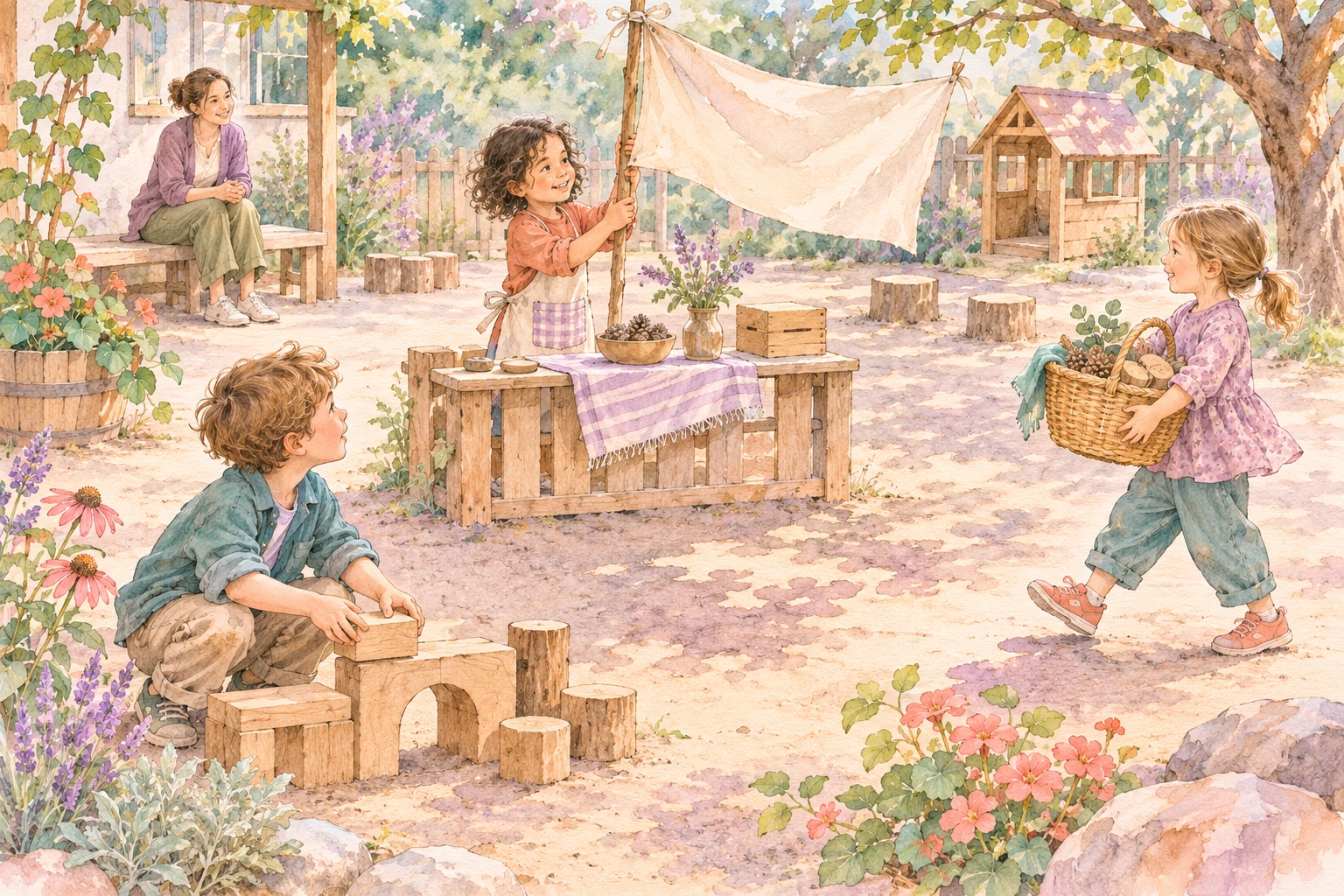
The watercolour scene places an available adult at the back left while the children explore different roles with room between them.
Begin with the scene, not a verdict on the friendship
Ask, “What were you hoping to do?” Then listen for the sequence: who was playing, what was said, what happened next and whether it has happened before. A child's account matters even when details need checking. Avoid a courtroom-style interrogation at pickup; offer food, rest and another opportunity to talk if needed.
Young children are still learning how another person's plans differ from their own. Someone may want a quiet activity, misunderstand a request or guard a construction that keeps getting knocked down. None of those explanations excuses hurtful behaviour. They help adults choose a useful response rather than immediately labelling either child.
Friendship is voluntary; safe, respectful treatment is everyone's entitlement. Children can choose a play partner without controlling who may use a shared classroom area. Adults manage access to communal spaces and investigate patterns of exclusion.
Six worthwhile things to practise
- Readable invitations. A gesture, a prop or a short question can make an interest in joining easier for another child to understand.
- Listening for a reply. Waiting briefly creates space for a partner's answer instead of treating silence as agreement.
- Two viewpoints. Hearing what each person wanted can uncover an ordinary disagreement that needs a practical arrangement.
- Protective boundaries. A clear refusal gives children usable language when a proposed game becomes unkind or unsafe.
- Specific help-seeking. Describing an action and location gives adults something they can follow up, rather than leaving a child to solve harm alone.
- Repair with choice. Rebuilding a knocked-over structure may address the damage, while the affected child decides whether to resume playing.
Childhood friendships: seven skills across three tricky moments
These ideas suit many children around four to seven, with substantial adult support. A younger learner may point, sign or use a communication aid. Spoken fluency, eye contact and a large circle of friends are not entry requirements for belonging.
The NAEYC guidance on helping children play and make friends discusses modelling, practice and thoughtfully arranged opportunities for interaction. The activities below adapt those broad ideas into ordinary home and classroom routines; they are not a social-skills test.
When a game is already happening: 1. Notice, then make contact
Spend a moment finding out what the game is. “They are putting pretend vegetables in baskets” gives a child more information than “Go and make a friend.” Offer a relevant opening: “Would you like another basket?” A child can hold up a prop while an adult helps interpret the gesture.
There is no requirement to deliver a polished sentence. Accept the child's usual communication. Also watch the response: another player may be thinking, may not have heard, or may need help understanding. An adult can clarify without insisting that the approaching child perform repeatedly for acceptance.
When a game is already happening: 2. Offer a small, useful role
Suggest an achievable contribution that fits the existing story: carrying a basket, making a pretend delivery or preparing another animal bed. Ask both children whether that arrangement works. Giving the newcomer the least wanted job forever is not inclusion.
Try Number 4 Worksheet: 5 Wonderful Teddy Picnic Tasks as a starting picture for a pretend gathering. Its upper group contains four teddy bears in a two-by-two arrangement. On separate scrap paper, children can draw a place for each fictional guest and discuss who will carry the cups. Counting and assigning roles are different tasks; an adult can handle one while the children negotiate the other. Never leave out a real child to demonstrate rejection.
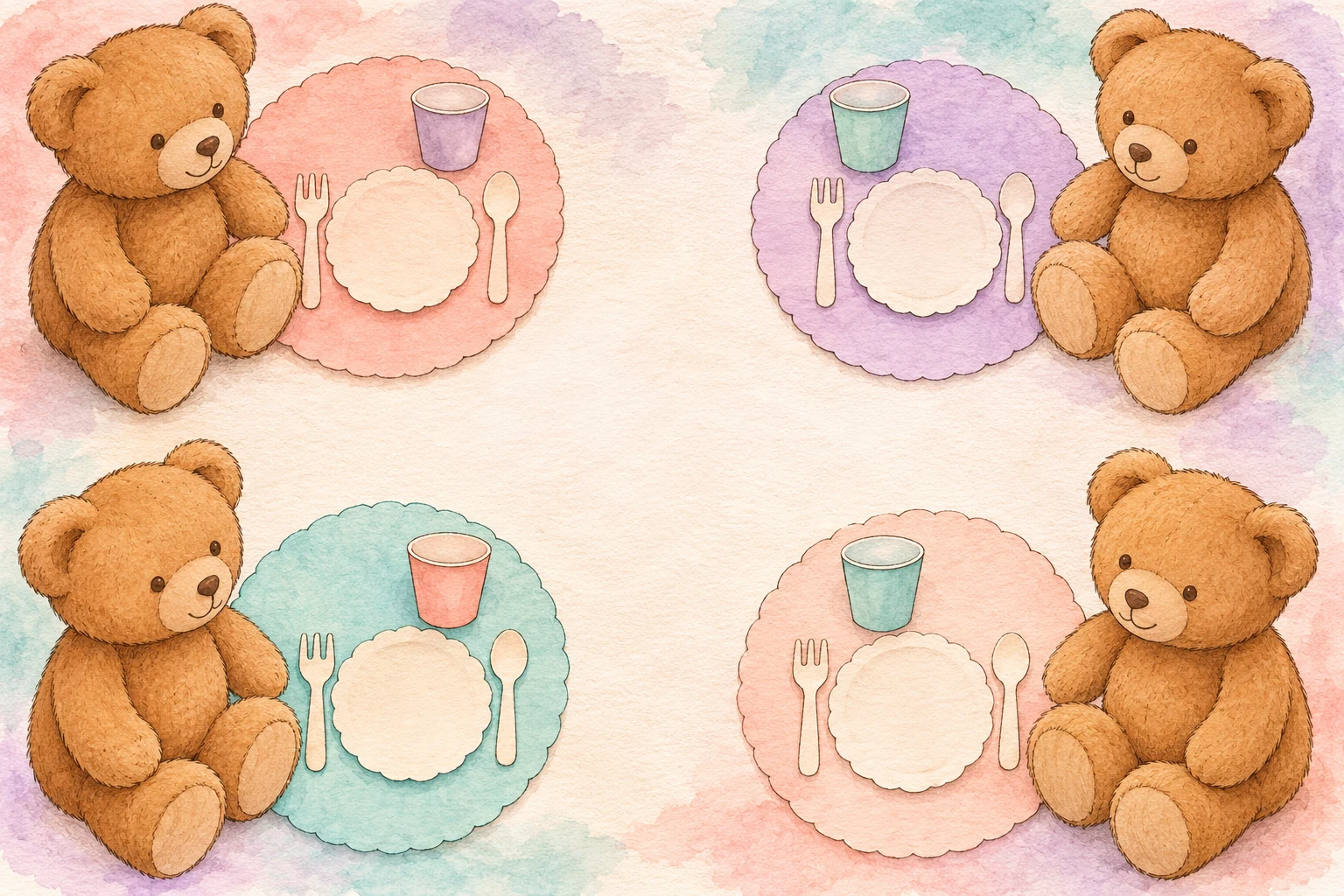
This optional prop arrangement supports a story inspired by the teddy counting page; it is not a reproduction of the PDF.
When a reply hurts: 3. Hear “not now” without swallowing repeated rejection
“That was disappointing. You wanted to join” recognises the feeling without promising an invitation. Help the child find an acceptable next possibility: another activity, another available partner or time with an adult. They do not have to keep asking the same group.
For teachers, check the setting. Is a small construction genuinely at capacity, or does the same child get turned away wherever they go? Offer a fair alternative for a full space and address a recurring barrier. A child who enjoys solitary play can choose it; repeatedly being pushed into solitude is a different experience.
Do not treat one declined invitation as proof that nobody likes the child. Equally, avoid explaining away a pattern with “They are just learning.” Observe, record and act.
When a reply hurts: 4. Say no when belonging has a price
Practise a brief response to an invented demand: “Hide her bag or you cannot be our friend.” A child might say, “I will not hide it,” move toward a safe adult and describe the request. No clever comeback is necessary. Children may freeze or comply under pressure; adults still owe them protection and help.
For a gentle rehearsal, use the dog picture on Dd Worksheet: 5 Powerful Dog Door Discoveries to inspire a separate puppet story. One puppet wants the dog character to grab somebody's building. Pause and invent a safer choice together. The actual printable contains D/d tracing and a dog picture-word task; the dialogue cards and puppets are optional homemade additions. Completing a letter row must never become the price of joining the play.
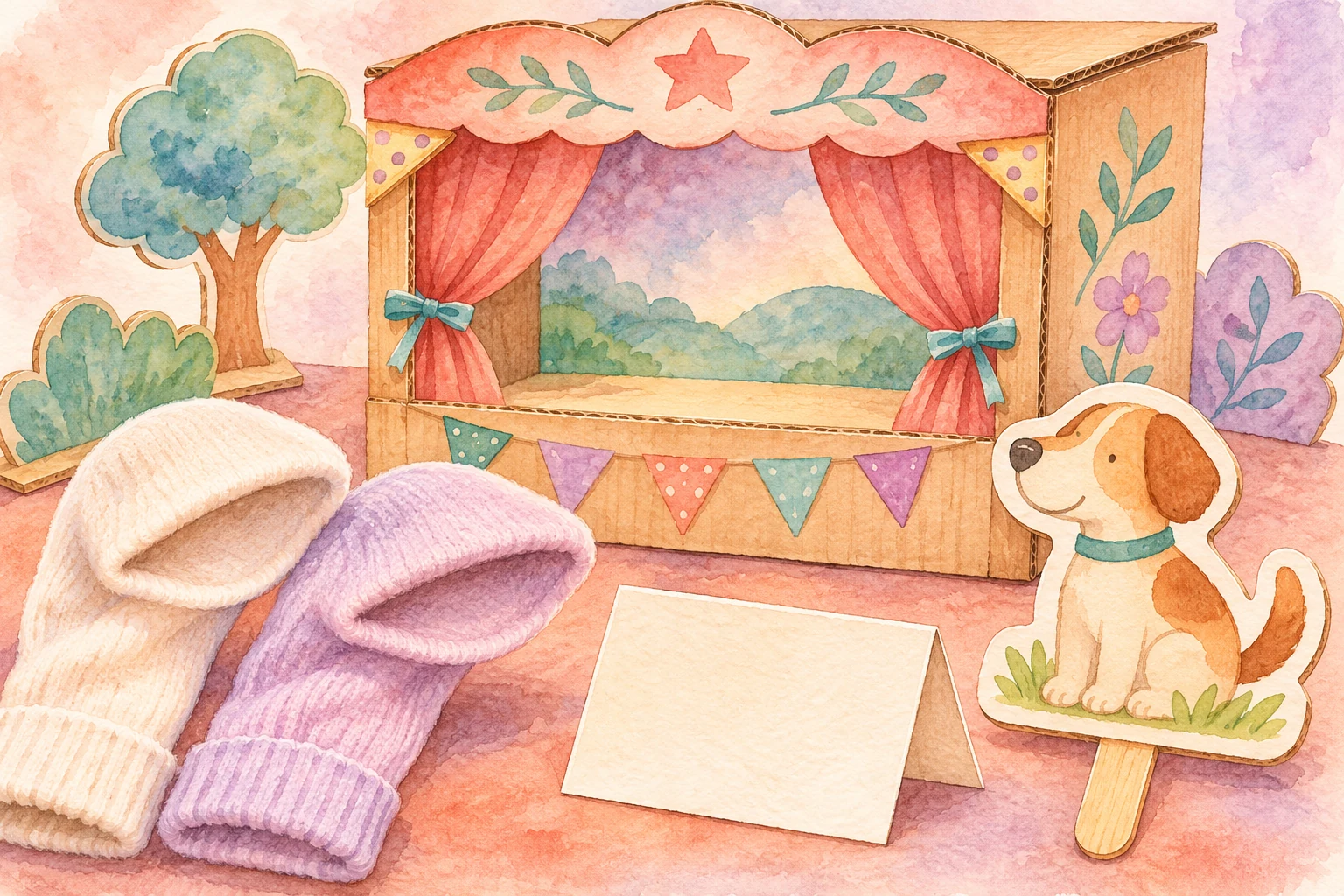
The homemade theatre and dialogue card are optional extension materials, separate from the linked Dd printable.
When harm needs an adult: 5. Recognise the pattern without waiting for a label
An argument over who uses a truck can be a conflict between children with similar power. Repeated intimidation, targeted exclusion or threats may involve a different pattern. StopBullying.gov's explanation of bullying identifies aggression, a real or perceived power imbalance, and repetition or the potential for repetition.
Those features help adults investigate. They are not hurdles a child must prove before receiving help. A single threat or injury still requires a response. For preschool children, describe the actual behaviour and developmental context carefully rather than rushing to assign a lasting identity.
Intervene immediately in dangerous behaviour. Separate children safely when needed, listen individually and follow the setting's safeguarding procedures. Do not require a targeted child to negotiate face to face with someone who frightens them.
When harm needs an adult: 6. Tell someone who can act, then check back
Practise a concrete message: “At the gate, they pushed me when I tried to come through.” A picture, gesture or adult-assisted description counts too. Explain which adults are available at home, in class and outdoors. Adults should say what will happen next in language the child understands.
Follow up after the next relevant transition or play period. Ask what changed, observe directly where possible and coordinate with the responsible staff. If an initial report is dismissed or the situation continues, contact the teacher or safeguarding lead again through the school's procedure. Children should not be asked to gather evidence by placing themselves near danger.
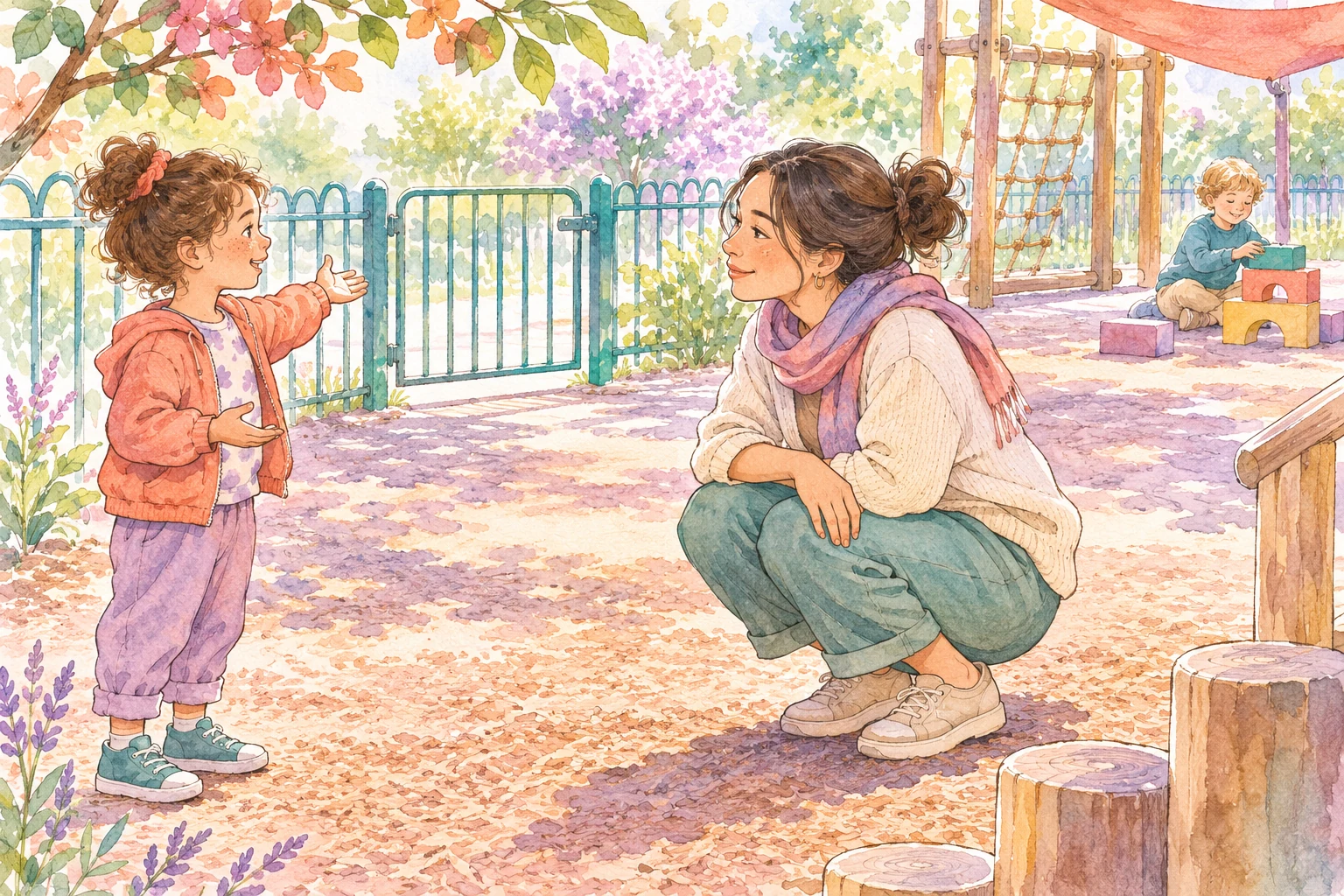
The safe playground scene illustrates a private, respectful conversation with comfortable personal space and no depicted aggressor.
When harm needs an adult: 7. Repair the action while respecting the relationship
After everyone is safe and ready, ask what needs putting right. Returning a taken object, helping reconstruct a model or replacing a torn drawing may be useful. An adult can help a child name the action without turning the conversation into public humiliation.
An apology cannot purchase access to another person's body or friendship. Offer words, a drawing or a practical repair without forcing a hug. The hurt child can accept the repair and still choose a different activity. Watch what happens afterward; changed behaviour matters more than a rehearsed phrase.
Match the adult response to what happened
| What you notice | What to clarify | A useful adult response |
|---|---|---|
| One child wants to build alone | Is this a chosen activity with fair access to shared materials? | Respect solitude and offer other available spaces. |
| Two children both want the same classroom crayon | What arrangement would let each continue? | Offer an available equivalent or help agree on turns. |
| The same child is excluded across activities | Who controls access, and how often does it happen? | Observe the pattern, remove barriers and follow up. |
| A threat, shove or demand to hurt someone occurs | What must happen now to keep children safe? | Intervene, support the affected child and use safeguarding procedures. |
Children need predictable responses across adults. A short staff handover about a difficult transition can be more useful than another general speech about kindness. Share factual observations through the setting's appropriate channels, keeping other children's personal information private.
Rehearse one moment in four small steps
- Choose a low-pressure situation. Use an invented puppet problem when everyone is settled. Do not replay a recent upsetting event for an audience.
- Offer one manageable phrase or gesture. “Can I carry a basket?” is easier to try than a long explanation about being friendly.
- Exchange roles with consent. Let the child coach the adult. They can decline the acting and direct a puppet instead.
- Return to ordinary play. Notice a specific action later: “You waited for her answer.” Ask whether the arrangement worked for both children.
Keep practice brief enough to remain playful. A child who remembers a phrase with a puppet may still need an adult beside them in a noisy playground. That is information about the support required, not proof they did not listen.
Paper can start the conversation, then step aside
For side-by-side art, offer a separate copy of Vibrant Carrot Coloring: 5 Fun Steps for Fine Motor Skills to each willing child. The large carrot outline leaves room for individual colour choices. Put readily available communal crayons between the pages and ask how both artists can reach what they need. Provide extra materials or adult support when waiting is too demanding; do not manufacture scarcity to provoke cooperation.
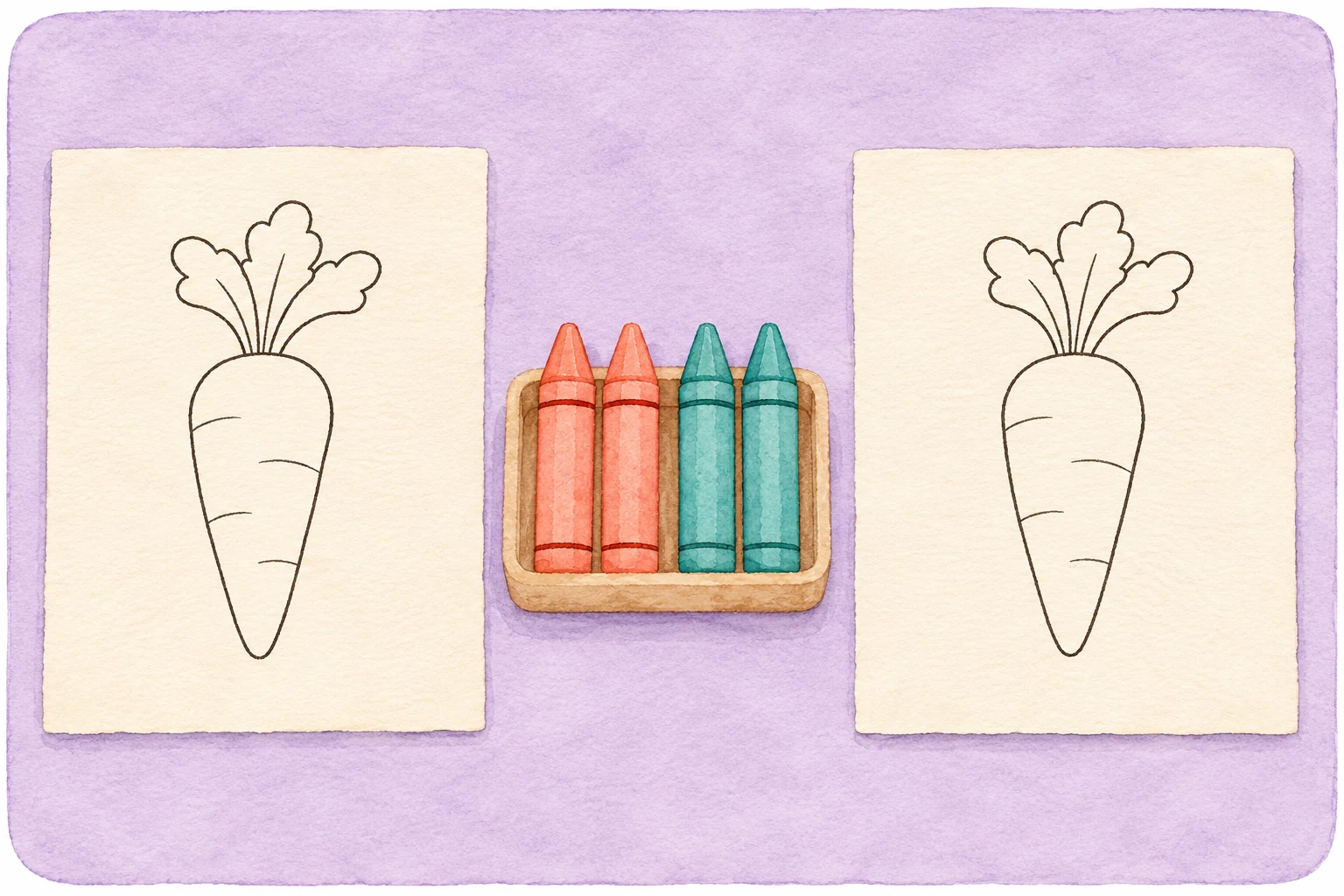
The generic art setup demonstrates accessible communal supplies and individual working spaces, without copying the downloadable worksheet.
The six-year-old who colours quickly is not appointed supervisor of a younger child's picture. Each learner owns their marks and can ask before commenting on another page. Personal treasured pens can stay private; sharing classroom resources does not mean surrendering every belonging.
The teddy and Dd pages list ages three to six; the carrot page lists three to five. Choose by the child's interests and current skills. Their current pages offer a free watermarked, one-page PDF. The teddy and Dd pages also display a clean membership option. Check the chosen page's access panel before printing; these suggestions do not include a separate friendship worksheet or a downloadable puppet kit.
Four extensions that leave room for real preferences
- A pretend café with changing jobs. Let willing players choose preparing, delivering or ordering, then discuss whether anyone wants a different job. The adult handles food safety and any real snacks.
- A story with two endings. Invent a character whose invitation is declined. One ending finds another enjoyable activity; another asks an adult about repeated exclusion. Compare what information changed.
- A shared materials sketch. Draw where communal crayons and spare paper could go so both artists can reach them. Test the arrangement without moving anyone's personal supplies.
- A repair menu. On blank paper, draw returning, rebuilding and asking what would help. Explain that the affected child can choose space instead of an immediate conversation.
Two imagined situations to think through together
At home: the visiting cousin wants a different game
In this hypothetical example, five-year-old Amira prepares an animal shop, but her cousin wants to draw. Amira announces that the cousin is no longer her friend. Her parent acknowledges the disappointment and describes both plans without taking sides over which is better.
They offer separate activities nearby and leave an invitation open for later. Amira dictates a pretend delivery note while the cousin draws an animal. Perhaps the games eventually connect; perhaps they do not. The useful observation is whether both children could make a choice without threats. One peaceful visit does not establish a lasting friendship outcome.
In class: a gate keeps becoming a barrier
In this hypothetical classroom example, a six-year-old reports that two classmates repeatedly block an entrance and demand a toy before letting him pass. The teacher makes the entrance accessible, checks the child's immediate safety and listens to the accounts separately. She follows the school's procedure and arranges closer supervision at the transition.
A later conversation about saying no supplements that adult action. It does not replace it. The teacher checks back with the child and responsible colleagues to see whether the behaviour stopped. A friendly group activity alone would not address the repeated barrier.
Leave children with a believable promise
You cannot guarantee that every invitation will be accepted. You can promise to listen, help make shared spaces safe and take repeated hurt seriously. A quiet friendship, a brief cooperative game and a comfortable moment alone can all belong in a child's day.
Start with the situation the child actually meets tomorrow. Offer one phrase, one helpful arrangement and an adult who follows through. Belonging grows through many ordinary encounters in which children's choices matter and adults remain responsible for their care.