Free Phonics Worksheets: 7 Essential Kindergarten Steps
Decoding, rhyming and tracing ask for different things. Seven practical steps connect three existing resources with taught sounds, careful word choices and adult support.
Reading a picture and reading a word can look similar until the picture disappears. Phonics gives beginning readers a way to use the printed letters themselves, linking taught spellings with speech sounds and blending those sounds into words. This kindergarten guide explains seven steps for using free worksheet samples without asking a child to guess. Three existing resources provide examples for short vowels and simple word reading. Choose only the sections that match current teaching, and let an adult read unfamiliar instructions. A manageable attempt is more useful than a completed page whose answers came from clues outside the print.
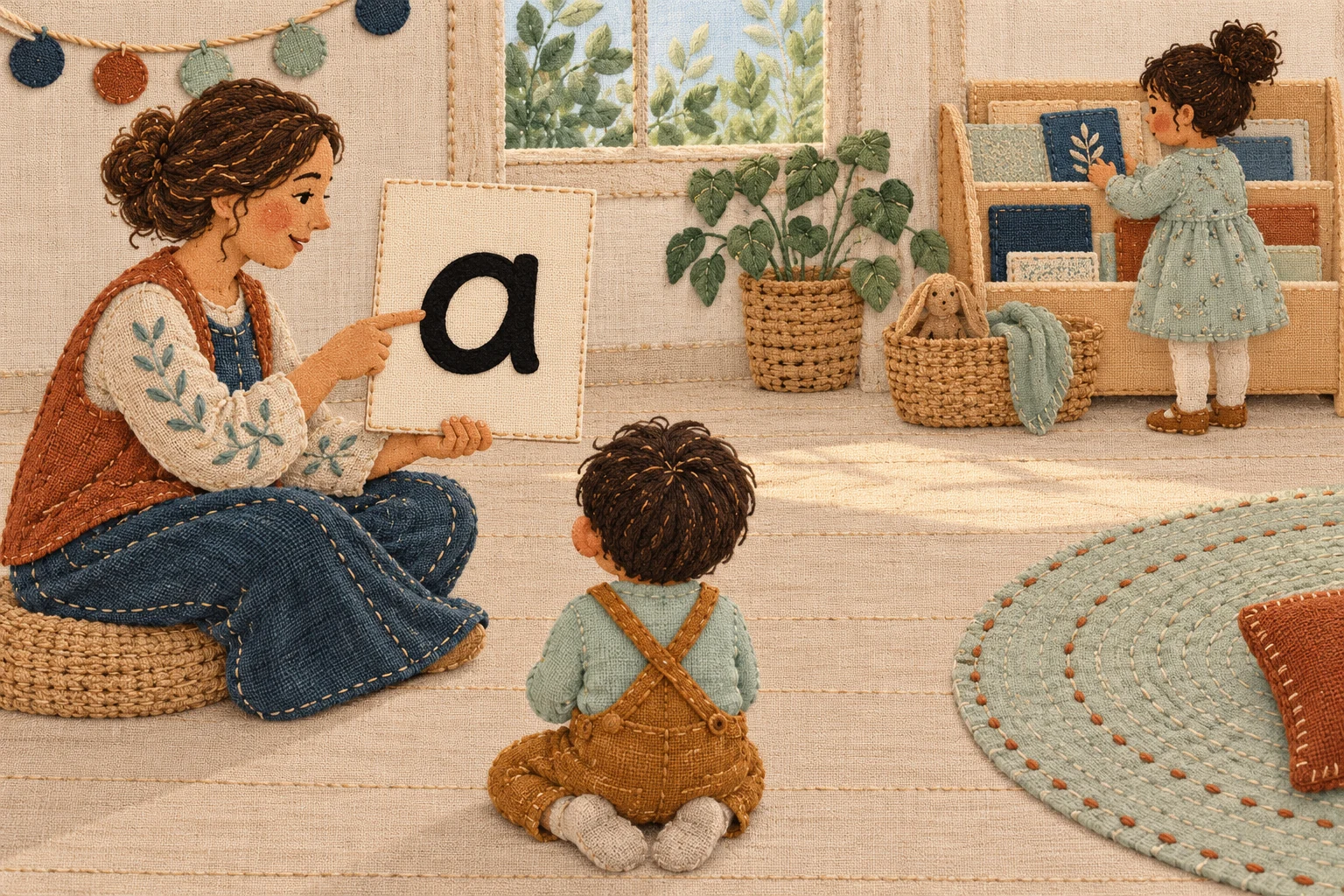
A stitched classroom scene illustrates an adult model and more than one way for children to participate.
📖 Three terms that keep phonics practice clear
A phoneme is an individual speech sound. A grapheme is the letter or group of letters representing a sound in print. Blending means bringing sounds together to say a word; segmenting means separating a spoken word into its sounds. A short spoken word can have three phonemes without having three letters: “fish” has four letters, with sh representing one sound.
Phonemic awareness can be practised orally. Phonics connects those sounds to print. Rhyming can be useful language play, but identifying that “cat” rhymes with “hat” does not by itself show that a child decoded either printed word. Tracing letters offers handwriting practice; its neatness does not establish word-reading knowledge either.
The University of Oregon’s phonics guidance explains systematic letter–sound teaching and its application to reading and spelling. Keep this guide alongside the sequence used by the child’s teacher. These seven steps organise adult preparation and support; they are not a replacement phonics programme or a timetable every kindergarten child must meet.
Step 1: start phonics with the correspondences already taught
Ask the teacher which sound–letter relationships the child is currently practising. At home, prepare a small selection from that set rather than moving through the alphabet in order. If a worksheet contains unfamiliar spellings, select another part or save it. A familiar theme does not make an untaught word independently decodable.
Use letter sounds accurately and avoid adding an unnecessary vowel after a consonant. For instance, a long “muh” can make blending harder than a clean /m/. Follow the pronunciation model used in the child’s instruction and allow for normal accent differences. The phonics purpose is connecting the intended sound and spelling, not correcting a family’s accent or home language.
Keep letter names available for talking about print, while distinguishing them from the sounds used to blend a word. Knowing the name “em” and applying /m/ during reading are related but different actions. A brief adult model can make the phonics invitation clear before the child has a turn.
Step 2: listen before adding print to phonics
Choose a familiar spoken word from the taught set. Say it naturally, then model separating its sounds. With “cat,” the sounds are /k/ /a/ /t/. Move one large counter for each sound, using safe age-appropriate materials under supervision. This oral part supports the phonics task that follows; counters represent sounds, not syllables or letter names.
Invite the child to blend sounds you say and to segment a word you give. They may need adult modelling or a smaller task first. Do not demand independent handwriting while they are trying to hear the sound sequence. Keep the phonics activity focused enough that a difficulty can be noticed: was it hearing the sequence, recalling a sound for a letter, or bringing the sounds together?
Step 3: connect each phonics sound with a taught spelling
Show the print after the oral model, then point from left to right. Use a clear, familiar letter form. For a simple three-letter word such as “cat,” an adult can write three large letters on separate scraps. These homemade cards are a demonstration aid, not an additional downloadable worksheet supplied by the site.
Map each grapheme to its sound, then blend to the whole word. A picture can confirm meaning afterward, but it should not supply the answer before the child attends to the letters. In phonics practice, “look at the first letter and guess from the picture” is a different strategy from checking the complete printed word.
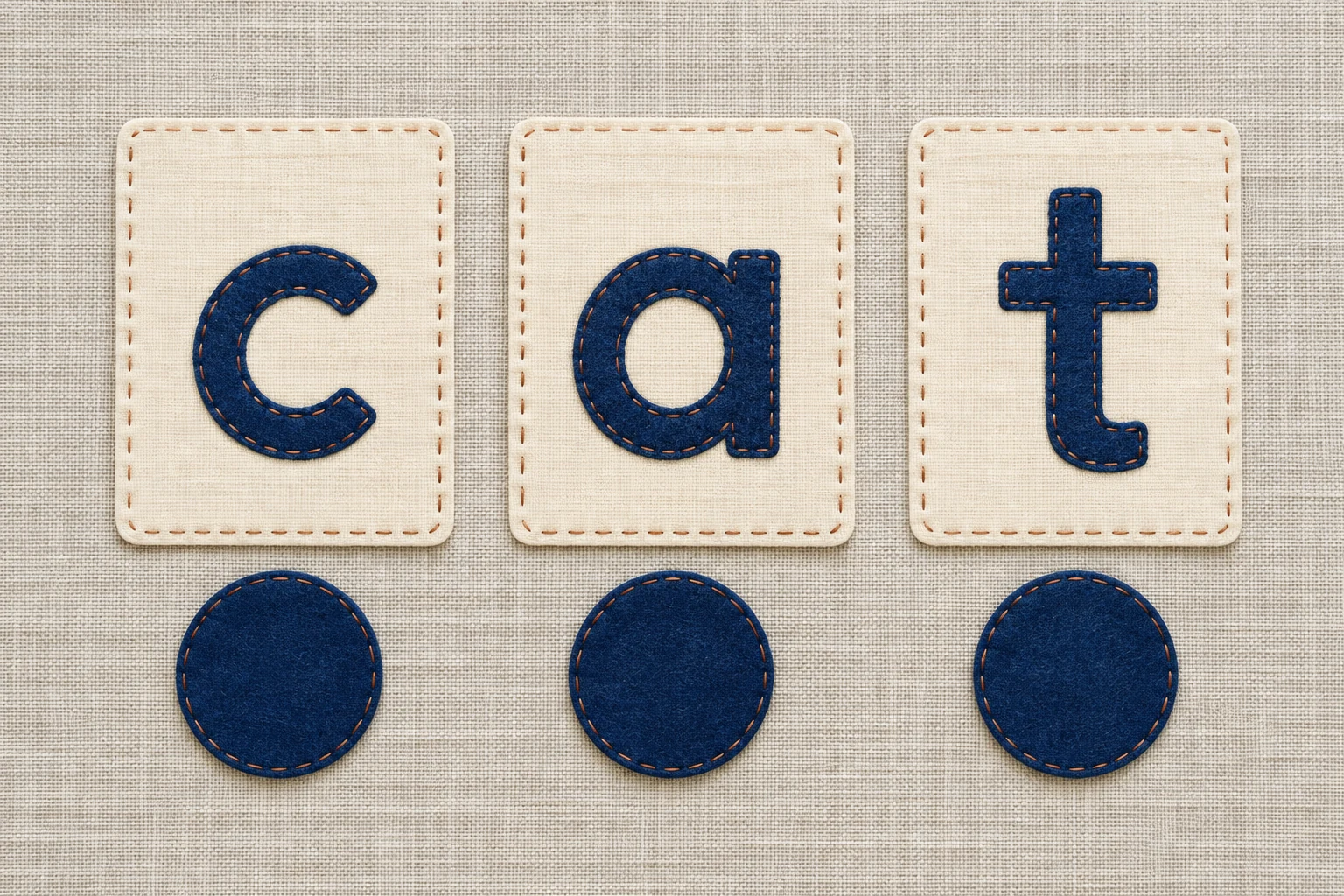
Separate letter cards and counters illustrate the cat example discussed in the guide, without a picture cue supplying the word.
Step 4: choose a small at-word phonics task
Master 7 Essential CVC -at Words for Reading Triumph! includes a hat model, rhyme choices, picture choices and a sentence task. Its preview also includes the word “flat,” which begins with a consonant cluster. Select a simple taught example such as “cat,” “sat” or “bat” for the first phonics attempt, rather than treating every printed item as equally suitable for a beginner.
An adult can read the directions and any non-target words aloud. Ask the learner to attend to the chosen word’s letters, say the sounds and blend. Then discuss whether it rhymes with “hat.” This keeps decoding and rhyme comparison distinct. The phonics evidence is how the child reads the target word, not whether a picture was coloured correctly.
Leave the cluster word and sentence completion for a lesson that matches the child’s knowledge. A worksheet can contain several invitations, and choosing one is legitimate teaching. There is no requirement to complete every box before moving to a book or a different phonics activity.
Step 5: make short-vowel phonics choices selective
Master Short Vowels: 7 Crucial a e i o u Phonics Steps! asks learners to choose a missing short vowel from a, e, i, o and u. Its picture prompts include dog, pen, duck, bus, cat, pig, rat, fish and ten. Start with a small number of words whose surrounding spellings have been taught, rather than introducing all five vowel correspondences together just because the bank displays them.
Name the intended word aloud before asking about its sounds. A child may call the picture beside p_n a “pencil”; that is a vocabulary or picture-label issue, not evidence of a phonics failure. Choose a clearer familiar item or explain the intended spoken word. “Fish” and “duck” include sh and ck respectively, so reserve them if those graphemes have not been introduced.
For a chosen word, say it, listen for the middle sound and connect that sound to its taught vowel letter. Check by blending the completed printed word. Phonics practice remains about sound–spelling relationships, rather than placing a vowel that happens to fit a remembered picture label.
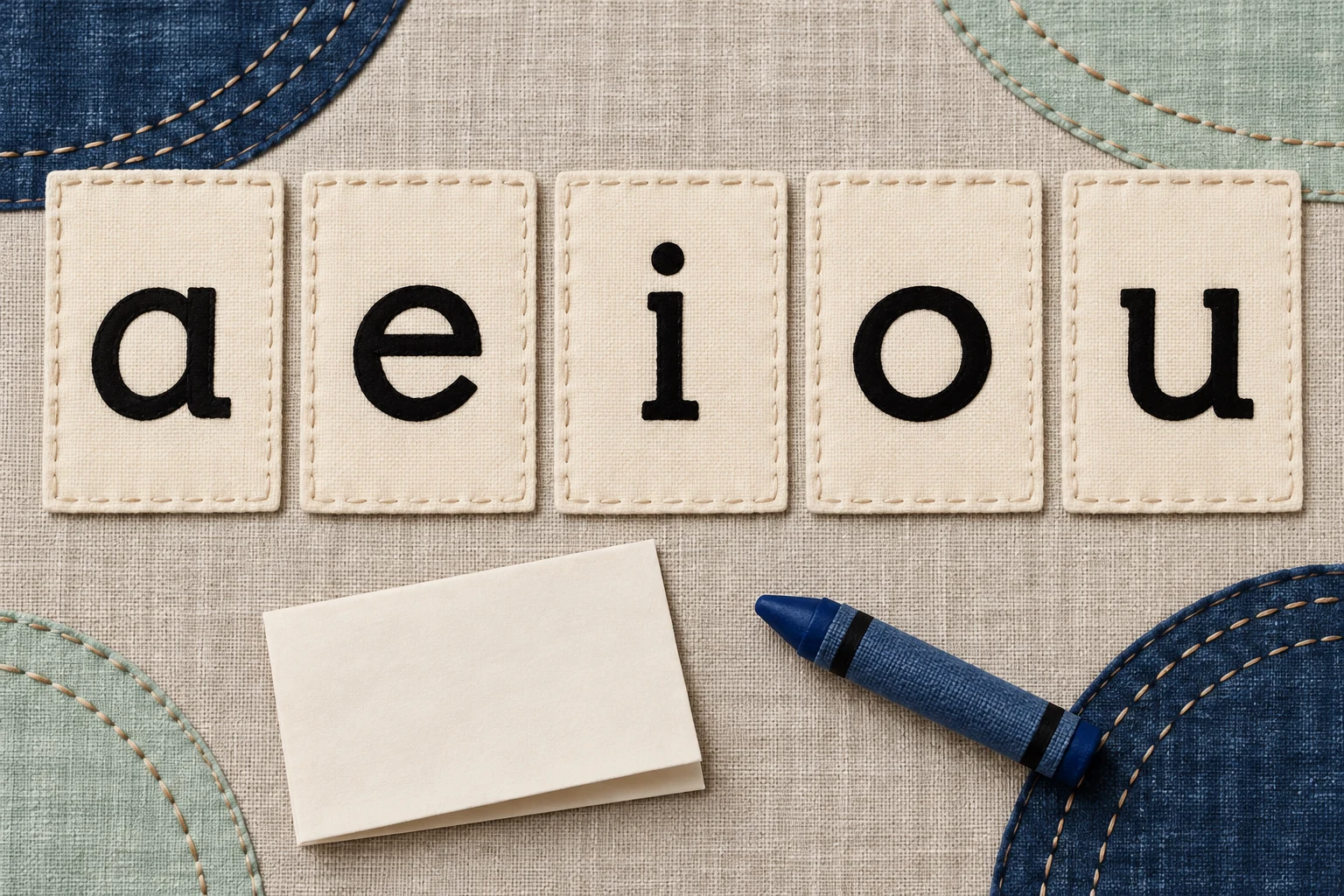
The separate vowel cards show the available letters; the adult selects a taught sound–spelling relationship for the current task.
Step 6: read an ap-word in phonics before tracing it
Master Tricky CVC -ap Words: 7 Stellar Practice Steps! has eight printed word models with tracing and writing spaces, including cap, gap, lap, nap, map, rap, sap and tap. Choose one or two whose correspondences the child knows. Some meanings may need explaining orally. The resource’s title uses “Tricky,” but these regular examples can be blended from taught sounds; the title does not make them exception words to memorise whole.
Read a selected word first, then invite a spoken segmentation and an optional writing attempt. For “map,” hear /m/ /a/ /p/ and connect the sequence to print. The phonics and handwriting demands can be adjusted separately: an adult may write while the child supplies sounds, or the child may trace one model after reading it.
Keep the phonics check available after the writing. Point back to the letters and blend again. Copying a word accurately can be useful practice, but it is not enough on its own to establish that the child read it. A brief reread gives the adult a clearer view of what support is still needed.

The word study illustrates three examples available on the linked ap-resource, with print kept separate from handwriting demands.
Step 7: take phonics back into suitable reading
After practising a word, return to a teacher-selected decodable text or a short example containing correspondences already taught. A worksheet is a practice resource, not a complete reading curriculum. Shared story reading can continue separately, with an adult reading more complex language aloud while the child enjoys vocabulary, meaning and the story.
England’s Department for Education word-reading guidance, updated in July 2026, emphasises applying current phonic knowledge to words and suitable text. Its assessment context is specific to England; the useful principle here is matching practice to instruction. The guide does not turn those local criteria into a universal kindergarten entry test.
Ask the child to explain something they read or to use a decoded word in a spoken sentence. Phonics supports access to meaning; it is not the only part of becoming a reader. Keep conversation, knowledge-building, books and enjoyment present alongside accurate word reading.
Prepare the next phonics session with this quick table
| What the task asks for | Check first | A manageable response |
|---|---|---|
| Read a printed word | Have its correspondences been taught? | Model and blend a suitable example |
| Supply a missing vowel | Is the spoken word clear and familiar? | Say the intended word, then examine its sounds |
| Compare rhymes | Is the adult reading unfamiliar choices? | Keep oral rhyme work distinct from decoding |
| Trace a word | Can the child attend to sounds and marks together? | Read first; adjust the handwriting demand |
| Read a sentence | Does the text match current phonics knowledge? | Use a suitable teacher-selected example |
Five useful signs to notice during phonics practice
- Attention to phonics print. The child looks beyond the first letter and checks the remaining print. Pointing can make this process visible.
- A known sound recalled during phonics. A taught grapheme prompts its sound. An adult can record where a reminder was needed without labelling the learner.
- Purposeful phonics blending. Separate sounds become a meaningful spoken word. Ask about that meaning after the reading attempt.
- Clear phonics and rhyme tasks. The child can join a rhyme comparison even when an adult reads its choices. That contribution deserves recognition without being misreported as independent decoding.
- A return to the model. The learner checks a letter or word after an uncertain attempt. Revisiting the print is useful information for the next phonics invitation.
Two phonics situations with different next steps
At home: a familiar picture changes the phonics clue
Imagine a child naming the pen picture “pencil” and struggling to hear a three-sound word. The parent accepts the sensible picture name, switches to the clearly named “cat” item and models its sounds. The phonics activity continues with a clearer spoken target. This hypothetical example shows an adult adjusting a prompt, not correcting a child for noticing what the picture resembles.
In class: fewer phonics items, closer attention
Picture a teacher offering two familiar ap-words while another small group works with a wider taught set. One child blends accurately when the teacher points to each grapheme, then tries a word without that support. The teacher notes the kind of help used. This phonics scenario illustrates responsive teaching; it does not prescribe a fixed number of words or claim that one page measures a child’s reading level.
Four ways to extend a focused phonics attempt
- Change one spelling in a phonics word. On homemade cards, move from “cat” to “mat” only if the relevant relationships are known. Blend the whole word again rather than guessing from the shared ending.
- Give a word a meaning. After reading “cap,” ask how someone might use one. An adult can write the child’s sentence elsewhere without making it independent reading practice.
- Build from a spoken word. Segment a familiar word with large counters, then choose its taught letters. Keep the sequence short and check by rereading.
- Explain an adult’s deliberate swap. With agreement, change one letter on a card and ask what happened to the word. Check together; avoid treating the mismatch as a trick to catch the child out.
Keep free phonics practice clear and encouraging
All three linked pages currently list ages four to six and offer a free watermarked, single-page PDF sample. Read the current access label before downloading. A sample may be enough for one carefully selected phonics task; its age label does not mean every item is suitable for every child in that range.
Choose a taught example, model clearly and notice the strategy. “You checked the middle sound again” recognises something the learner did. If difficulties keep recurring, share specific observations with the child’s teacher so support can be coordinated. End with a readable word or a shared book, leaving the next phonics step small enough to approach with confidence.