Sounds: 5 Essential Games for Confident Early Readers
A familiar picture opens a listening conversation. Explore beginnings, blending, segmenting and taught letters with five games and three alphabet pages.
“Moon begins like my name,” says a child, stretching a quiet hum. The adult has an opening for a useful conversation about sounds before anyone picks up a pencil. Early reading involves noticing speech, connecting it with letters and learning how those letters work together in words. These five games give parents and teachers concrete ways to explore that connection with children around four to six. Familiar pictures, a few large counters and three existing alphabet worksheets provide starting points, with support adjusted to the learner rather than a race through every activity.
👂 Decide what you want the sounds activity to reveal
| Today's question | What the child can do | What that response shows |
|---|---|---|
| Can they notice beginning sounds? | Point to two pictures beginning alike | A comparison of spoken words |
| Can they blend sounds? | Hear separate speech units and say the word | Combining a spoken sequence |
| Can they separate sounds? | Move one counter for each phoneme | Analysing the spoken word |
| Can they connect sounds with print? | Find a taught letter for a familiar phoneme | A sound-to-letter relationship |
| Can they form the letter? | Make an independent mark | A writing action, observed separately |
These questions overlap in a reading lesson, but they do not mean the same thing. A child can recognise a letter without yet blending a word, or hear the beginning of moon while still finding lowercase m difficult to write. Knowing which question you asked makes the next invitation clearer.

The moon picture supports a listening invitation before the adult connects the spoken beginning with print.
Spoken sounds, printed letters and a familiar picture
Phonemic awareness concerns individual speech sounds. Phonics connects those speech units with written letters and letter groups. Alphabet tracing adds a movement task. You can bring the three together thoughtfully without treating a neat tracing row as evidence that a child can already read a new word.
The University of Oregon's phonemic awareness resource describes identifying, blending and segmenting sounds and linking that learning with print. For today's play, select one manageable listening task and a relevant letter connection. There is no need to make a child master every oral game before introducing familiar letters.
Pictures keep the spoken word available, but they do not replace decoding. Name a pictured object together before using it in a listening game. A child who calls a mat a rug is using a reasonable word; that changes its beginning sounds. Agree which word you are exploring rather than treating the alternative label as a listening mistake.
1 · Meet the first sounds in a known word
Open Mm Worksheet: 5 Brilliant Moon Peak Journal Missions and talk about the moon pictures. Say moon naturally, then draw attention to its beginning /m/. The slash marks in this article indicate a speech sound, not a request to say the letter name. A soft, continuous /m/ can make that beginning easier to notice without adding another syllable.
Ask the child to listen again. They might repeat the beginning, point to the moon when you say /m/, or notice another familiar word beginning the same way. Keep the exchange short. Exploring sounds should not require producing a long sentence before the child can continue.
Next show the printed M and m models, naming the letter when that is your purpose and modelling /m/ when discussing its common sound. The page also has tracing rows and a missing initial in moon. Choose one appropriate connection rather than moving automatically from listening to completing every small model.
2 · Compare first sounds, then inspect the letters
Prepare simple separate pictures for moon, mat and dog. Name them together and ask which two begin alike. Say the words slowly enough to hear their beginnings while keeping each whole word recognisable. Moon and mat begin with /m/; dog begins with /d/. Their pictures do not need matching colours or shapes.
For a different pair, use the sun picture on Ss Worksheet: 5 Brilliant Sun Bend Activities alongside a familiar sock picture you supply. Sun and sock share initial /s/. Draw attention to the sound before showing the S and s models. A supplied photograph or adult drawing is an extra play prop, not an additional printable promised by the worksheet.
Beginning sounds are the comparison here. The words need not rhyme or contain the same number of letters. If the child groups sun with moon because both are in the sky, acknowledge that useful meaning connection, then explain today's listening rule. Another round can deliberately explore how a different rule changes the grouping.
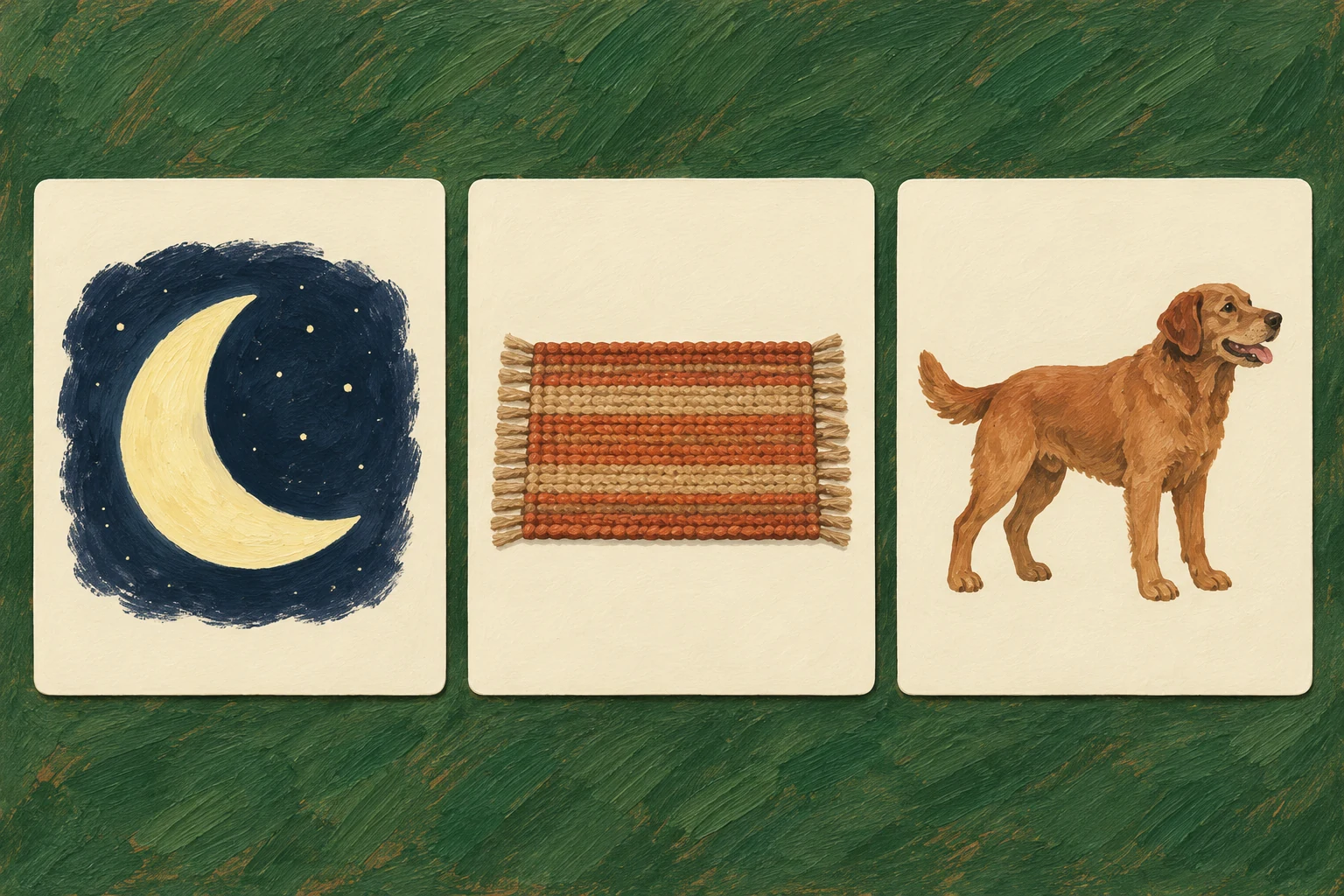
Name each object together before comparing the spoken words. These separate cards are additional play props.
3 · Bring separate sounds together
Say a short familiar word in its individual phonemes and invite the child to blend them. For sun, model /s/, the short vowel heard in sun, and /n/. Bring them together smoothly, then say sun naturally. Keep the first and last consonants clear rather than adding “uh” after each one.
You can show a small choice of familiar pictures so the child can point to the word they heard. That supports participation when speaking on demand is uncomfortable. It remains an oral blending game: the adult supplies sounds, and the learner combines them. Naming a picture before the sounds are spoken would answer a different question.
Start with a model and one attempt together. If the child needs more support, say the sequence again with shorter gaps. Do not make a long guessing game from a word they have never heard. Familiar vocabulary leaves more attention for combining the speech units.
4 · Give each of the sounds a counter
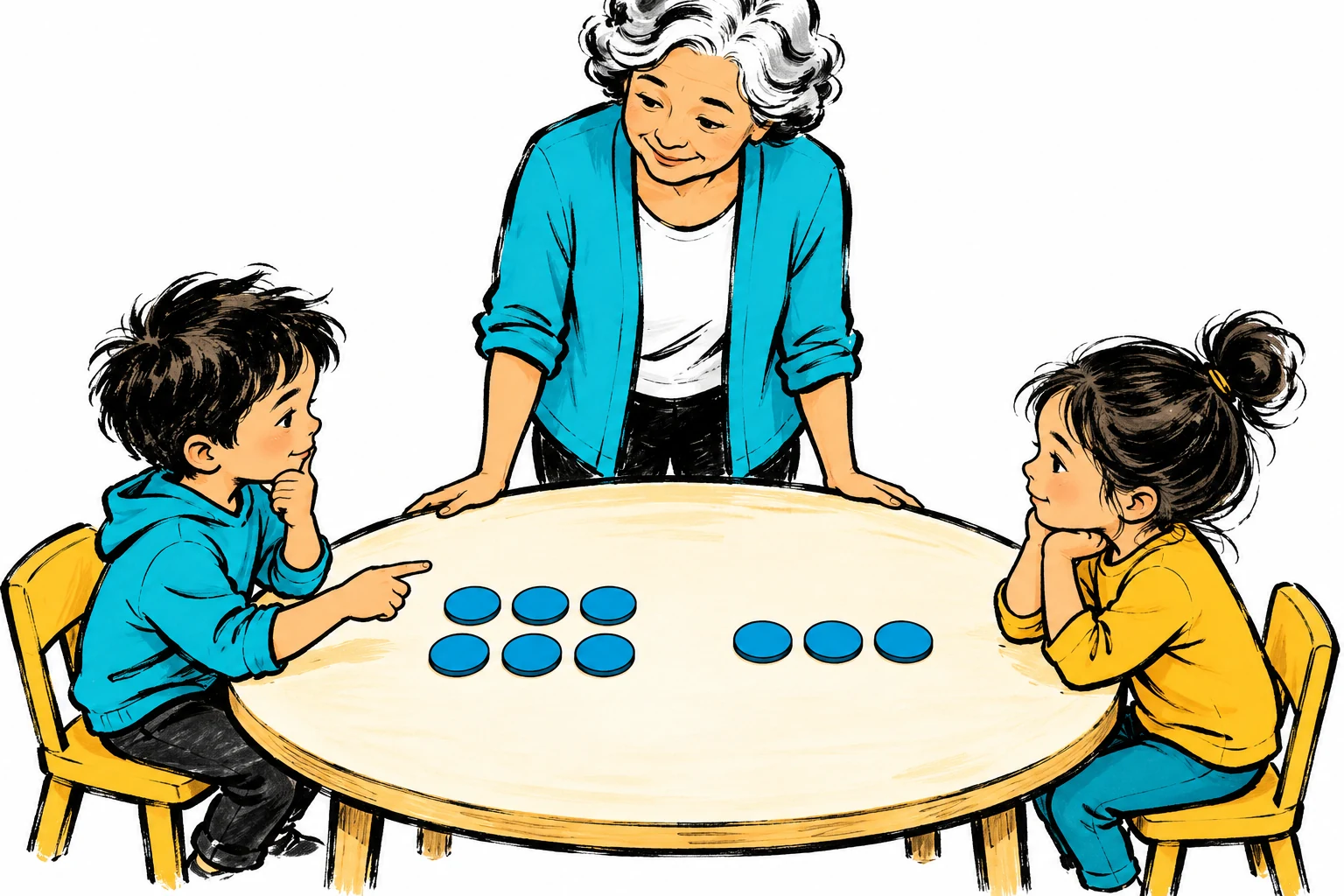
Now work in the other direction. Say sun as a whole word, then model separating its three phonemes. Move one large counter for each of the sounds, ending with three counters in view. The image below is a reminder of this adult-led demonstration; the picture does not itself tell a child how to segment the word.
Use objects that are suitable for the learner and easy to move. A child can point while an adult moves the counters if handling them distracts from listening. Reset the collection before another attempt so it is clear which counters represent the current word.
Do not confuse phonemes with syllables. Sun has one syllable and three individual sounds in the English example used here. Clapping the whole word once is a syllable task; moving three counters for its phonemes answers another question. Tell the child which unit you are listening for instead of switching the rule without explanation.
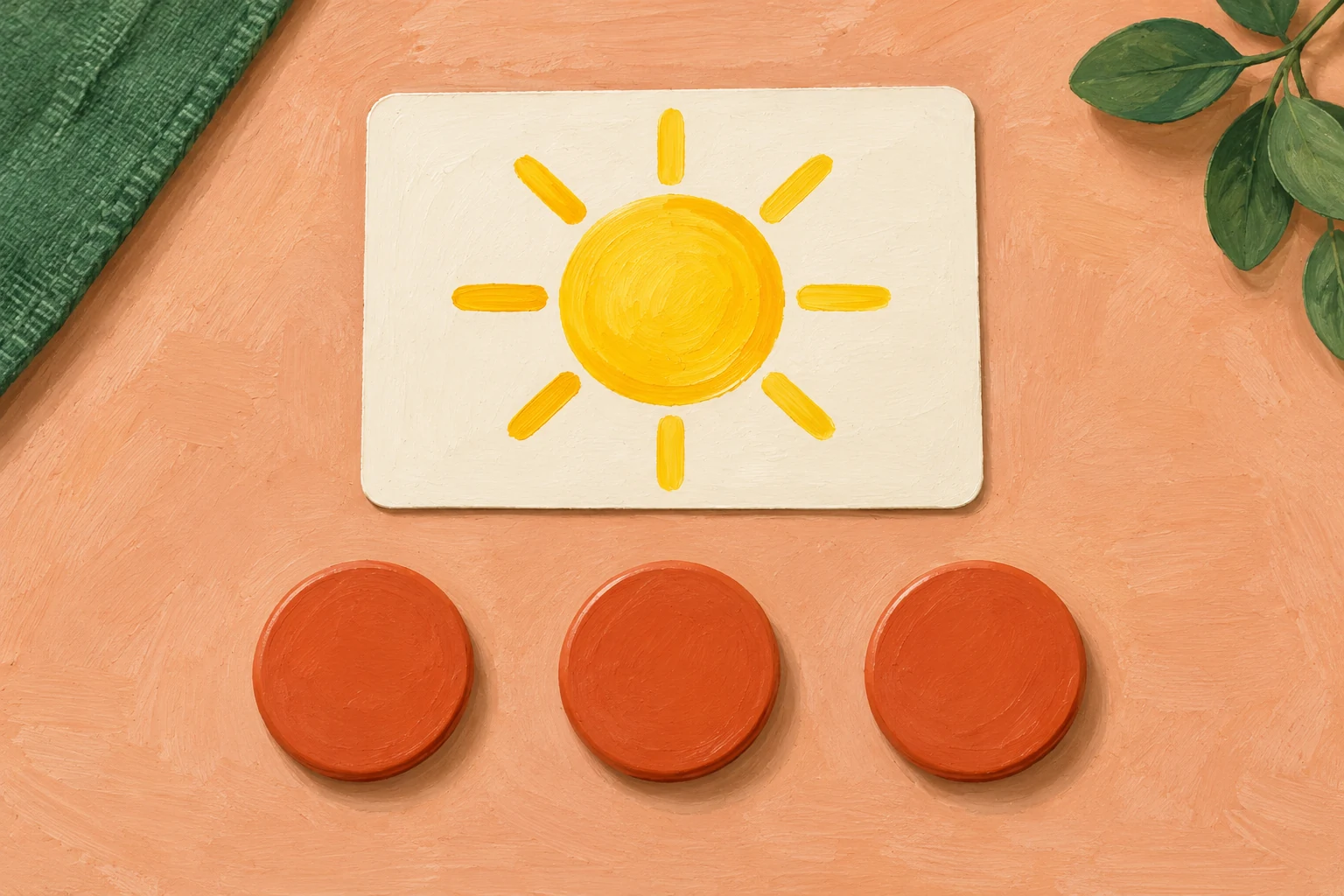
An adult models one counter movement for each phoneme. The picture alone does not teach the spoken segmentation.
5 · Connect the sounds you hear with taught print
In Dd Worksheet: 5 Powerful Dog Door Discoveries, the dog pictures accompany D and d models and an initial-letter gap in dog. Name dog, listen to its beginning /d/, then locate the relevant printed form. Keep /d/ brief; stretching it by adding a vowel changes the spoken example. Follow the pronunciation used in the child's phonics teaching where there is an established programme.
A child might point to d while an adult models writing it on separate paper. Another learner may be ready to place the missing initial themselves. Observe the sounds-to-print connection separately from the size and control of the mark. An adult-written answer should be described as adult support.
England's Department for Education word-reading guidance, updated in July 2026, focuses on applying taught letter–sound knowledge when blending words. Use that practical principle to choose reading material: the child should encounter spellings they have been taught, with adult help for unfamiliar ones. These optional games support a reading conversation rather than replacing a coherent teaching sequence.
Five observations worth keeping about sounds
- A known word is available. Check that the child understands and can recognise the spoken word before interpreting their response to its phonemes.
- The comparison follows the question. Notice whether they grouped by beginning sounds, meaning or picture colour. Each answer tells you what they attended to.
- A model changes the attempt. Record whether repeating a clear example or shortening the spoken gaps helped. That gives the next session a useful starting point.
- Counters represent speech. Watch whether a counter moves with each phoneme rather than with each letter or syllable. Keep the unit explicit.
- Print is connected deliberately. A child can identify the letter linked to one of the sounds while still needing help to form it. Describe both actions accurately.
These are teaching observations, not an informal diagnosis or a promise of reading progress on a fixed timetable. Share specific examples with the child's teacher when planning consistent practice. “She found the two /m/ pictures after a model” provides more information than a general comment about being good at phonics.
Try a short sounds routine in this order
- Select a familiar word. Name its picture and check the meaning. Pick one of the sounds or one blending task that fits what the child is learning.
- Show the listening action. Model the beginning, blend or segmentation once. State which part of the speech you want the learner to notice.
- Invite a manageable response. Offer pointing, a spoken attempt or directing an adult's counters. Avoid attaching a handwriting demand to every answer.
- Make the relevant print connection. Show a taught letter for the sounds under discussion. Keep new spellings clearly supported by the adult.
- Stop with a useful observation. Note what the child noticed and which support helped. Continue shared reading and conversation beyond the small game.
Home sounds: the mat is called a rug
Imagine Farah comparing the moon, mat and dog pictures with her uncle. She calls the middle picture a rug, then chooses moon alone when asked for the /m/ group. Her uncle checks the label instead of repeating the question more firmly. They agree to use mat for this round and say it together.
Farah then places moon beside mat. Their discovery concerns the first sounds in the agreed words. Her uncle does not claim that the correction proves she can read either printed word. This hypothetical home example shows why vocabulary and task clarity matter during a listening invitation.
Classroom sounds: one counter moves too soon
In another imagined scene, a teacher says sun while a child quickly pushes all three counters forward. The teacher resets them and models a slower demonstration, moving one with each phoneme. The learner points while she handles the pieces, then tries one movement themselves.
The teacher records that the child participated with adult pacing. A later invitation can revisit the same sounds with familiar materials before adding another word. Other children may need a different amount of support; their counters do not have to move at the same speed for the exchange to be worthwhile.
Four light extensions for familiar sounds
A puppet asks for beginning sounds
Let a puppet name a known picture and ask to hear its first phoneme. Model an answer when needed. The puppet can repeat the child's response naturally without demanding a louder or longer performance.
Picture deliveries for familiar sounds
An adult requests a picture beginning with one of the sounds already explored. The child delivers or points to it. Name all the pictures first so an unfamiliar label does not turn the game into a vocabulary puzzle.
Swap who gives the sounds
The child gives an adult two or three familiar phonemes to blend, with help selecting the word. Taking the speaker's role can make the purpose of the separate sounds clearer than answering repeated adult questions.
Connect sounds with a letter afterwards
Following a short oral round, look for a taught letter in a book title or name card. Explain whether you are identifying its shape or discussing the sounds it represents in that particular word. Do not assume every example uses the same pronunciation.
Leave room for a confident next attempt with sounds
Keep the tone conversational, and offer a clear model whenever the sounds task becomes uncertain. A quieter response can still carry useful information. Pointing to a picture, asking what it is called or finding a relevant letter can all guide the adult's next move. Clarity is more helpful than speed.
The three linked pages list ages three to six and offer one-page PDF samples with watermarks; clean files require active membership. Their letter models, tracing and initial gaps can support selected print connections. Use them alongside oral language, explicit phonics teaching and enjoyable shared books, with an amount of practice that leaves the learner willing to return.