Montessori-Inspired Worksheets: 6 Powerful Ideas, Ages 3–6
An accessible tray and a real object can come before a printable. Explore six optional home invitations built around observation, choice and care for materials.
🌿 Before paper, prepare a place to work
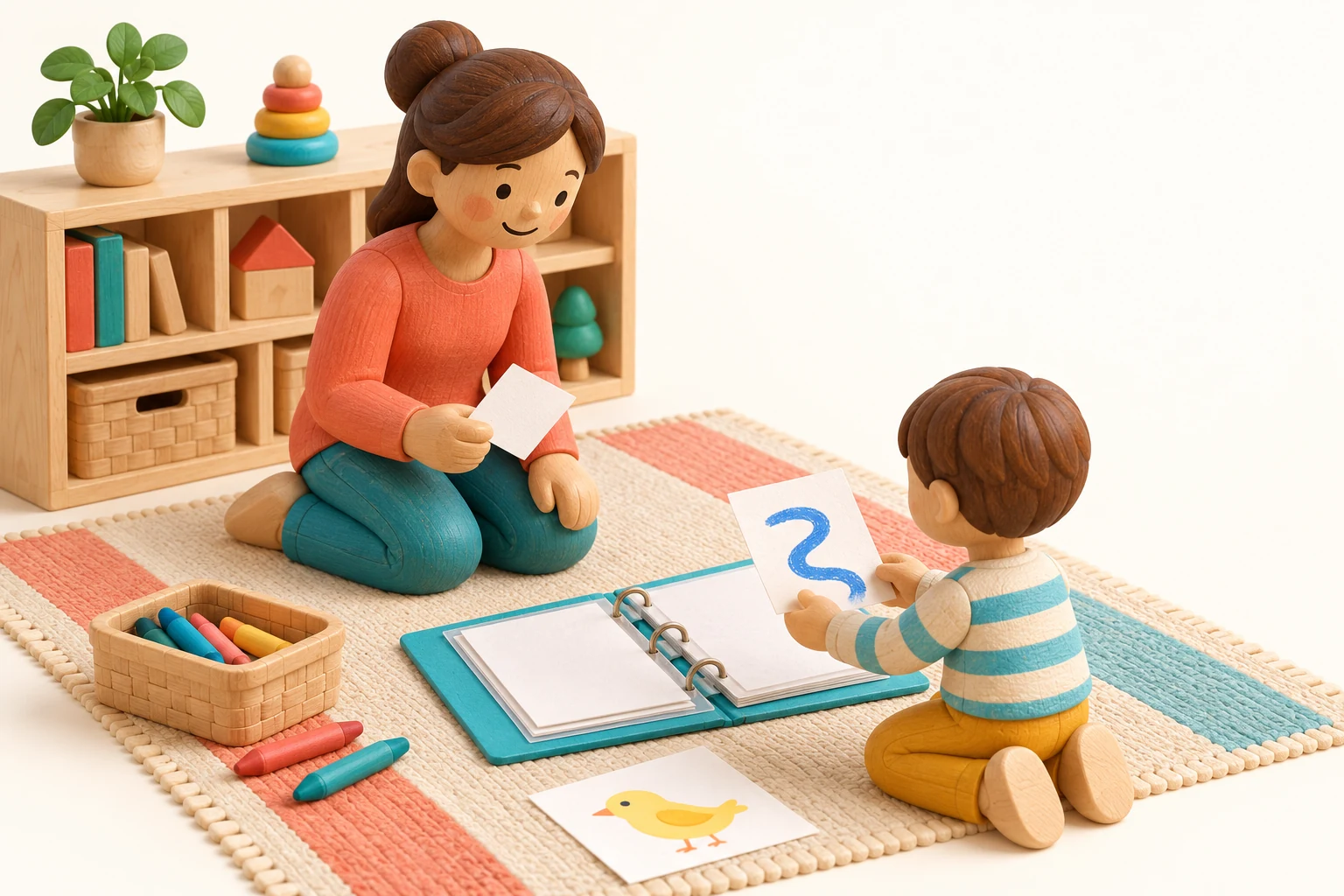
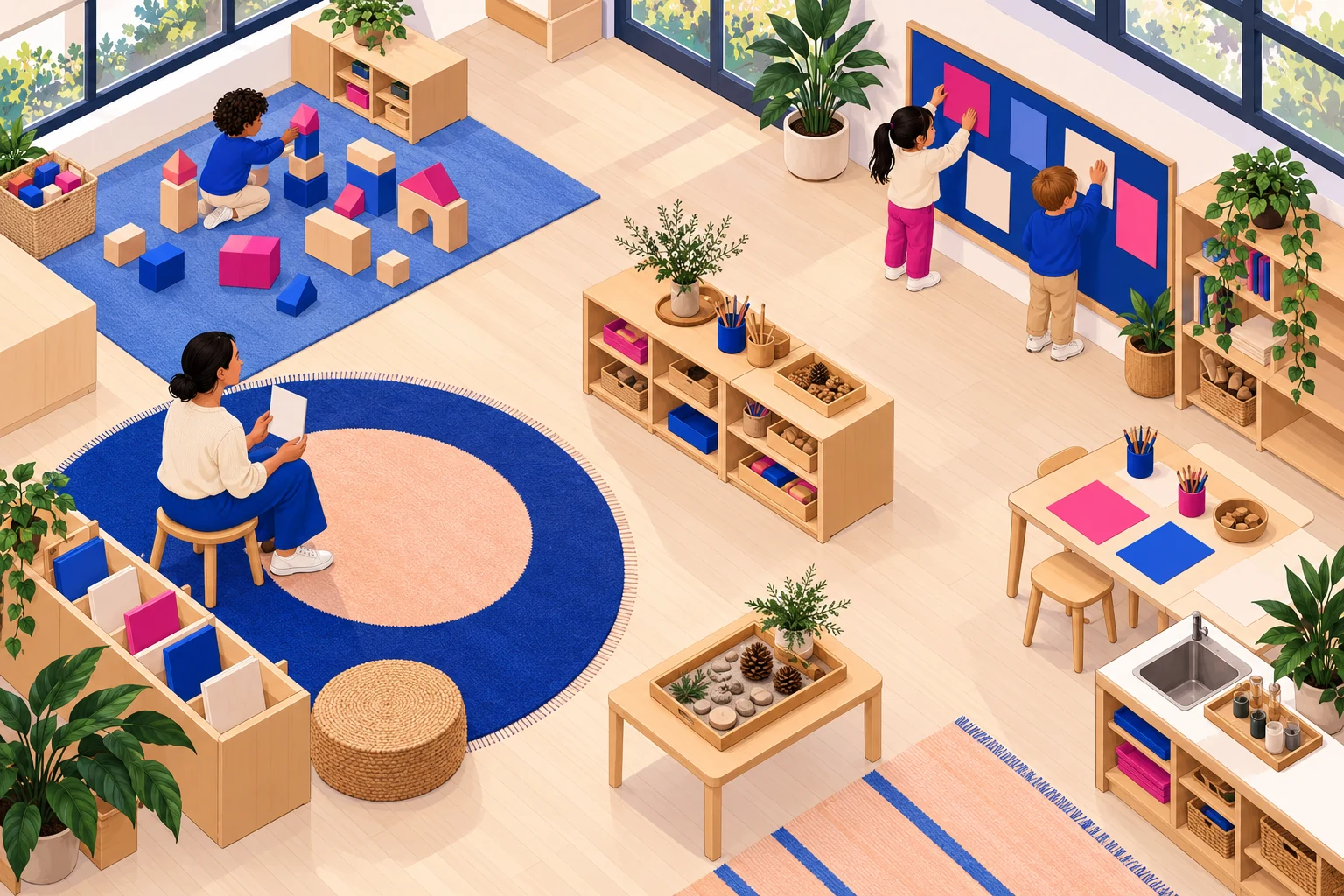
Two trays wait on a low shelf: one holds a small collection to explore, the other a familiar page and crayons. A child chooses, carries the tray and settles into a space that feels manageable. That is the starting point for these Montessori-inspired printable ideas for ages three to six. The suggestions connect paper with real objects, careful observation and everyday responsibility. They are optional home or classroom extensions, rather than a complete Montessori programme. You will find six practical invitations, three existing worksheet recommendations and ways to observe without turning independent work into a performance.
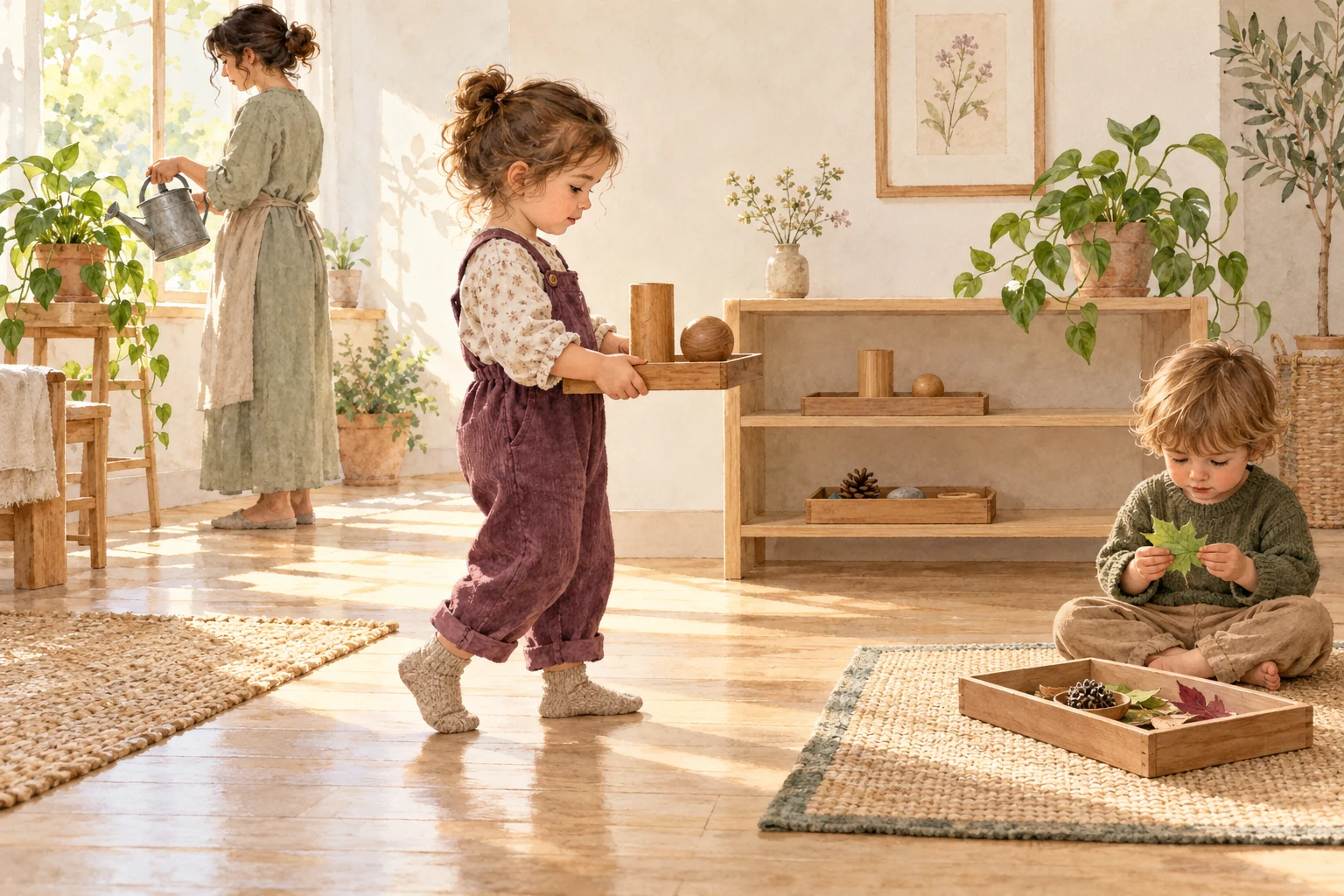
The Montessori-inspired arrangement shows accessible trays and separate work spaces without presenting a complete classroom programme.
What Montessori-inspired means on this page
Montessori education involves a prepared environment, specially designed materials and trained adults. A printable cannot supply all of those. Here, Montessori-inspired describes a limited set of adaptations: accessible materials, a clear purpose, meaningful choice and room to repeat an activity.
The Association Montessori Internationale’s account of ages three to six emphasises real-life experiences, concrete exploration and children’s developing independence. Those principles inform the direction of this article; AMI has not endorsed these worksheets or activities.
Place an object before its picture when practical. Let the child handle, notice and name it, then offer a paper response if wanted. For a family exploring Montessori-inspired routines in 2026, an orderly, usable corner matters more than buying a fashionable shelf or printing a huge matching set.
A useful boundary for adults
Use these ideas alongside your child’s existing teaching. A Montessori guide may recommend a different material or sequence; follow that guidance when coordinating with a school. Do not call a generic tracing page a sandpaper-letter lesson or claim that ordinary counters replace the full mathematics materials.
Montessori-inspired work should also remain accessible. A stable tabletop can suit a child better than a floor mat. An adult may carry a tray, enlarge a picture or offer an alternative marking tool. Independence can include asking for appropriate support.
Montessori-inspired: match the invitation to the child, not the birthday
The age range three to six covers many starting points. One child may enjoy transporting a tray but prefer not to draw; another may count objects confidently and ask to record the quantity. Select a Montessori-inspired invitation from what you have observed, rather than working through a fixed age ladder.
| What you notice | A manageable offer | A sensible adjustment |
|---|---|---|
| Enjoys matching familiar things | An object and its picture | Begin with one unmistakable pair |
| Counts a small group by touching | Two objects beside one selected picture group | Keep extra objects out of the collection |
| Chooses broad marks | One large path and a comfortable crayon | Offer a larger homemade route first |
| Returns to close observation | A real vegetable and an outline | Accept pointing or spoken description |
This Montessori-inspired table is a planning aid, not an assessment. Change an invitation if the materials demand more handling, language or attention than the child currently wants to give.
Montessori-inspired invitation 1: make a quantity before meeting its symbol

This Montessori-inspired quantity invitation uses ordinary toys before connecting them to a selected picture group.
Bring two large, familiar objects to a clear space. Two toy boats make a direct connection with Number 2 Worksheet: 6 Powerful Games for Happy Sailors, although two cups or broad blocks can also represent the same quantity. Count the chosen pair by moving each object once.
On the printable, select the top pair of boats. The page contains additional practice areas; they are separate tasks, not a single larger collection. Invite the child to connect the two real objects with that selected group, then look at the numeral if they are interested.
The Montessori-inspired decision is to begin with a quantity the child can manipulate. Writing the numeral is a separate offer. There is no need to complete every tracing row or to remove the objects once paper appears.
Montessori-inspired: let the child check the match
Ask whether each selected boat picture has an object beside it. If one is missing, leave time to notice. You can demonstrate matching again rather than announcing a score. This Montessori-inspired adaptation gives the child something concrete to check, but the worksheet itself is not a specially designed self-correcting Montessori material.
Afterwards, return both objects to their tray. A simple reset preserves the same clear invitation for another attempt. Avoid adding more objects merely because the first count was quick; repetition can be a chosen use of time.
Montessori-inspired invitation 2: choose one route, then move deliberately
Use Trace 5 Essential Lines and Curves: Fun Paths for Little Hands (Ages 3-5) to select a straight line, slant, curve or circle. The page includes several forms with starting points. Begin with one form that the child has already noticed, perhaps tracing a broad curve on a homemade sheet before offering its smaller printed counterpart.
Show the movement once, slowly, and pause. The Montessori-inspired emphasis here is an observable action the child can repeat. They might use a finger first and a crayon later, or stay with a larger route. Do not guide the child’s hand into a finished result.
Montessori-inspired: keep the purpose visible
“I’m following this curved route” describes a specific task. “Make the whole page neat” changes the task into adult approval. In a Montessori-inspired setting, select a comfortable marking tool and let the child decide whether another attempt is useful.
If the paper keeps slipping, offer a stable surface or a way to secure it. Changing access is different from doing the route for the child. A few considered movements can be enough; the remaining paths are available another day.
Montessori-inspired invitation 3: observe a carrot before colouring one
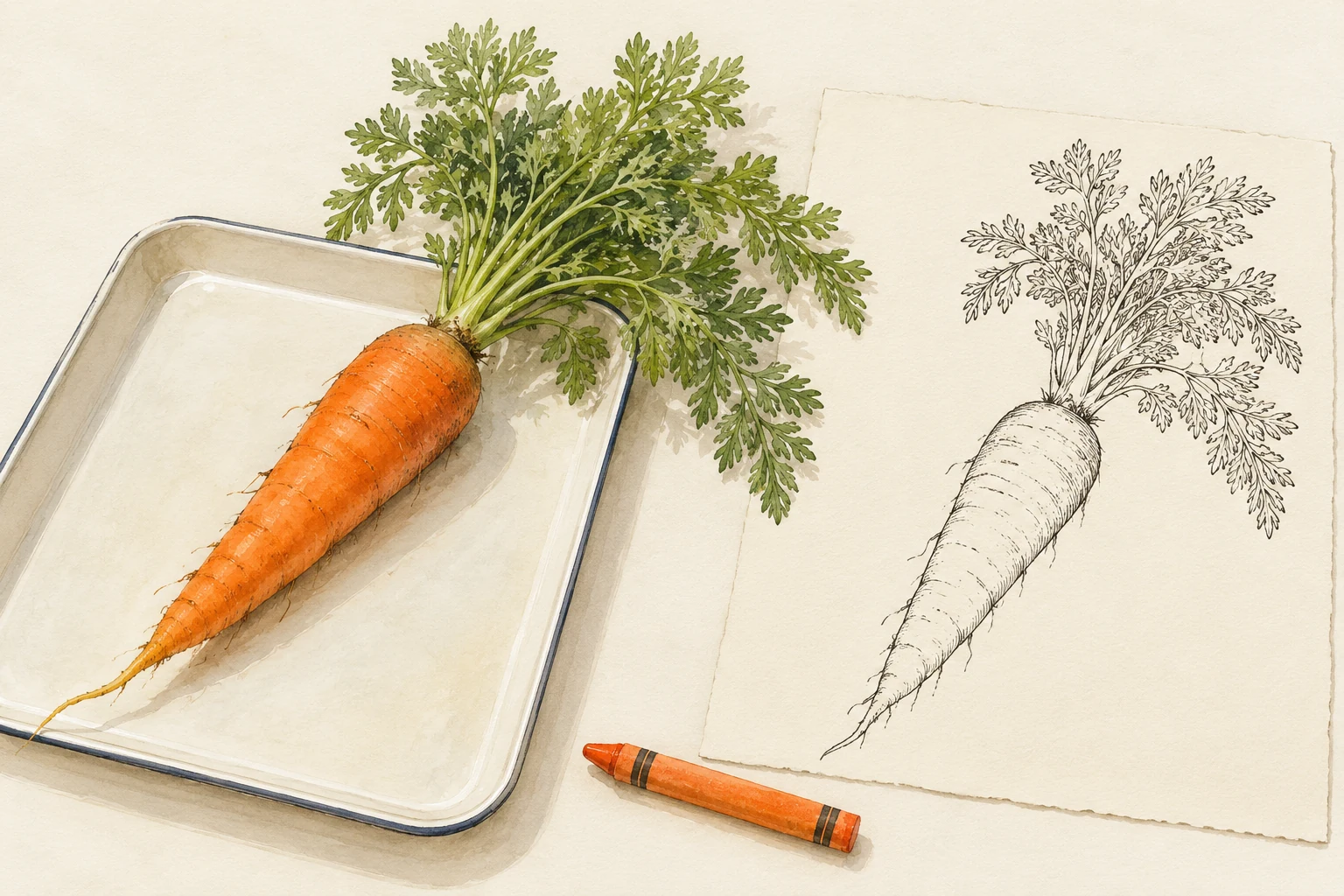
The generic observational sketch is more detailed than the linked colouring resource and is not a screenshot of its PDF.
Place a clean whole carrot on a washable tray, with adult supervision. Look at its root, fine surface lines and leafy top if present. The illustration beside this section shows a generic observational drawing; the linked printable has its own simpler design.
Offer Vibrant Carrot Coloring: 5 Fun Steps for Fine Motor Skills, which displays a large outline and a smaller orange-and-green reference. Compare the real object with the picture. Is the actual carrot straighter, shorter or less evenly coloured? Montessori-inspired observation leaves room for real differences instead of insisting that every carrot matches the printed example.
Montessori-inspired: decide what the paper will record
A child can colour one detail they noticed, dictate a sentence or choose not to mark the page. You might write, “There are thin lines near the point,” beneath their drawing on a separate sheet. This Montessori-inspired follow-up uses paper to preserve attention to a real object.
Keep this an observation activity. Food preparation, tasting and cutting need their own appropriate planning and supervision. The linked page is listed for ages three to five; an interested older child can choose a more detailed observational drawing on blank paper.
Montessori-inspired invitation 4: prepare only what the chosen work needs
Invite the child to select between two familiar offers. Gather the required paper and a small, usable selection of tools together. Place them where the child can see how to begin. In this Montessori-inspired routine, preparation belongs to the activity rather than being an invisible adult service.
Avoid making a child request every crayon individually. Equally, a huge open box can obscure the immediate purpose. Adjust the amount and position from observation: is a tool difficult to reach, or are unrelated items interrupting the task?
Montessori-inspired: practice the carrying route
Demonstrate moving an empty tray before adding materials if that would be useful. Check that the walking route is clear and the load manageable. Offer help or use a fixed workspace when carrying is unsuitable. A Montessori-inspired choice should not depend on a physical task a particular child cannot comfortably perform.
The goal is practical participation. Setting out two crayons, moving one mat or pointing to the chosen tray can each be a meaningful contribution. Avoid treating one prescribed sequence as a test of independence.
Montessori-inspired invitation 5: repeat something by choice
After an activity, ask whether the child would like to use it again or return it. A second attempt may look similar to the first, and that can be fine. Resist introducing a harder worksheet simply to make the work appear to progress.
The Montessori-inspired question for adults is whether repetition remains purposeful to the child. Watch for deliberate handling, a chosen change or a return to a familiar movement. If the child wants to leave, help with the reset and move on without bargaining for one final row.
Montessori-inspired: keep a quiet adult observation note
Record what you actually saw: “Matched two objects without another demonstration” or “Chose the curved route twice.” Leave interpretations such as “excellent concentration” for later reflection, if needed. A Montessori-inspired note should help plan access and the next invitation, not produce a ranking.
Keep personal observations private. A public display can show a child’s chosen work with appropriate permission, but there is no need to post their mistakes or compare how long different children stayed at a tray.
Montessori-inspired invitation 6: return the materials for the next person
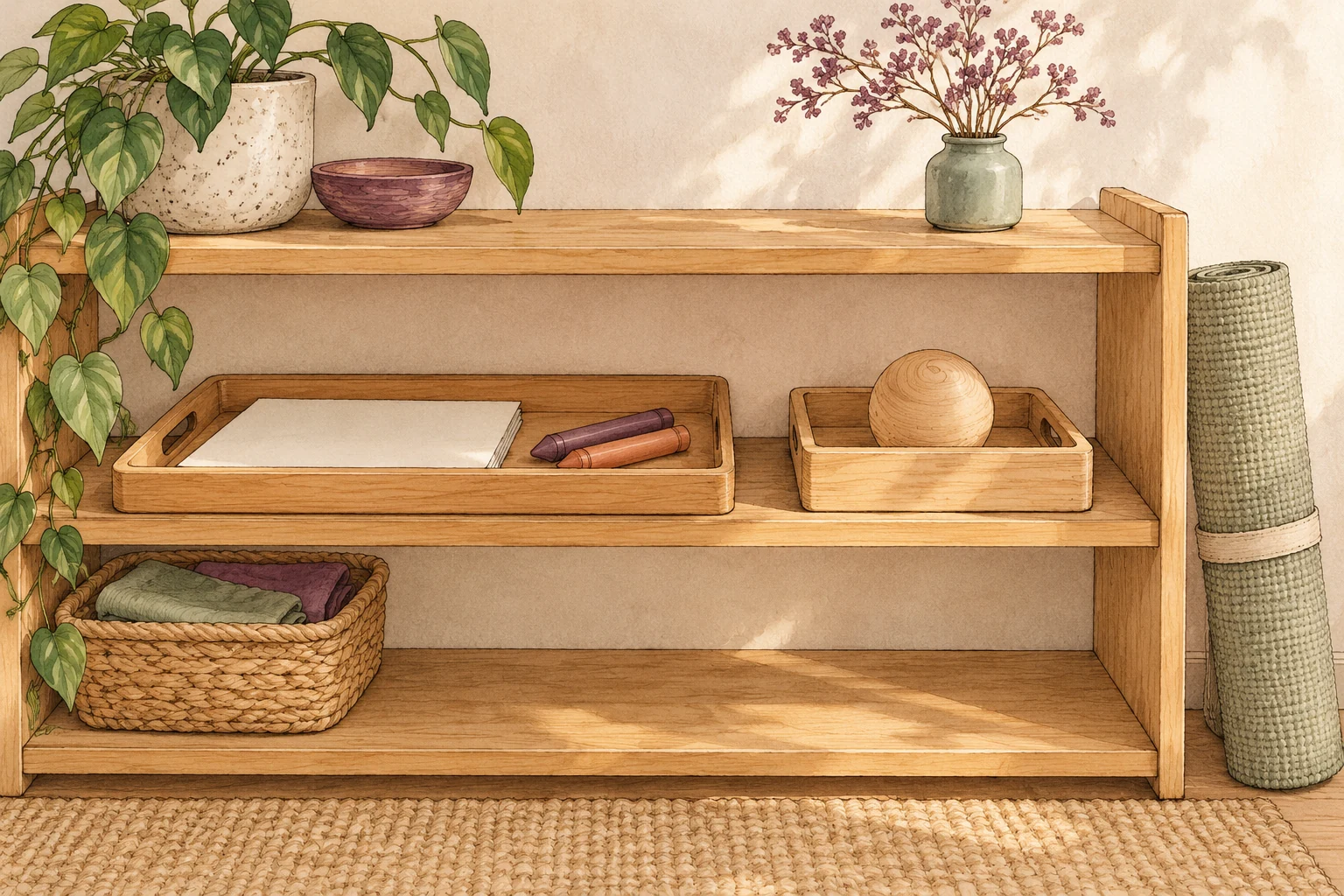
The Montessori-inspired shelf study shows a few accessible offers and open space rather than a packed collection of worksheets.
Show where each item belongs. Invite the child to put tools back, carry or indicate the tray’s place, and leave the work surface usable. The Montessori-inspired value lies in care for a shared space, not in making a shelf look perfect for a photograph.
When a page is unfinished, offer a named folder or another agreed place to save it. Completed paper might go home or join a small collection the child chooses. Clear storage prevents a tray from becoming a pile of abandoned sheets.
Montessori-inspired: repair the arrangement when something is missing
If the crayon is lost or the paper is damaged, involve the child in a manageable part of restoring the invitation. They could identify the missing tool or choose a replacement sheet. The Montessori-inspired response is practical: find what the activity needs so another person can use it.
The AMI description of Montessori environments explains the relationship between accessible spaces, concrete materials and adult observation. These modest home adaptations borrow only selected ideas from that broader approach.
What these Montessori-inspired offers can make possible
- Deliberate choice: two understood Montessori-inspired activities give a child a real decision with a visible starting point.
- Concrete connections: in Montessori-inspired work, handling objects before comparing pictures gives adults a clearer view of what the child understands.
- Careful looking: a real carrot offers details that a simplified outline cannot supply on its own.
- Control of movement: moving a tray or following a route invites coordinated action at an appropriate scale.
- Responsibility with support: returning tools makes care for a shared space part of ordinary work.
- Useful adult observation: brief factual notes can guide the next offer without requiring a finished worksheet.
These are opportunities, not promises that a Montessori-inspired printable will produce a particular developmental outcome. The child’s response remains the best reason to continue, adapt or stop.
Montessori-inspired: two hypothetical scenes: an invitation can stay unfinished
At home, the objects hold the interest
Imagine a three-year-old matching two toy boats to the selected picture pair. When offered a crayon, the child returns to moving the boats instead. The parent leaves the number-writing row for another day and helps return the tray. Their Montessori-inspired choice preserves the concrete activity rather than requiring a paper result to prove that learning occurred.
In class, a quieter response still counts
In a hypothetical early-years room, an educator offers the carrot and outline after a child has explored vegetables. The child points to fine lines but says little. The adult names that detail briefly, then waits. Later, the child adds short marks to the outline. This Montessori-inspired exchange allows observation and communication without making a spoken explanation the price of participation.
Montessori-inspired: four ways to carry the interest beyond a sheet
Try an object photograph match using your own pictures of familiar, safe household items. Match one real object at a time before adding another. This Montessori-inspired extension needs no special purchased set.
Make a care-of-materials visit. Look together at one tray: is a tool dry, usable and ready for someone else? Let the child choose a manageable repair or ask for help.
Offer a detail sketchbook. Add one observed feature from a familiar object, with dictated words if wanted. Date the page for revisiting rather than scoring the drawing.
Take a familiar-object walk around the room. Find a pair used together, such as a cup and jug, and explain their purposes. Keep the Montessori-inspired conversation grounded in what people actually do with them.
Prepare a Montessori-inspired offer in five steps
- Observe one familiar interest and choose a manageable activity connected to it.
- Check the printable preview and access details before adding paper to the offer.
- Prepare the real objects, clear space and comfortable tools that make participation possible.
- Demonstrate the immediate task briefly, then wait for the child's response rather than adding more instructions.
- Agree where materials and unfinished work will go when the child is ready to stop.
For a Montessori-inspired routine, revisit these decisions when the child's response changes. A better-sized tool or a quieter location may be more useful than a harder worksheet.
A workable rhythm beats a perfect shelf
Check the actual preview and current download panel before printing. All three suggested resources have free watermarked, one-page samples; the number and line pages also list membership access to clean files. They are ordinary Worksheets Gallery resources, not certified Montessori materials.
End with a specific acknowledgement: “You put the two boats back where the next person can find them.” Some days the useful change will be a clearer space or a better tool. Let Montessori-inspired routines grow from those small observations, keeping the child’s participation at the centre of the work.