STEM: 15 Brilliant Preschool Science and Math Activities
A folded bridge, a rolling car and six movable blocks invite real questions. Try fifteen preschool investigations with three existing printable starting points.
🔎 STEM begins with a question worth trying
A cardboard bridge dips, a toy car stops early, and a child announces, “We need another way.” That moment gives preschool STEM a useful starting point. Science, technology, engineering and mathematics become approachable when children notice, compare, build and try again. The fifteen activities below pair everyday materials with selected Worksheets Gallery pages, giving adults practical invitations for ages three to six. You can choose one investigation for a quiet afternoon or revisit a question across several classroom sessions. A finished sheet matters less than the explanation, gesture or new attempt that follows it.
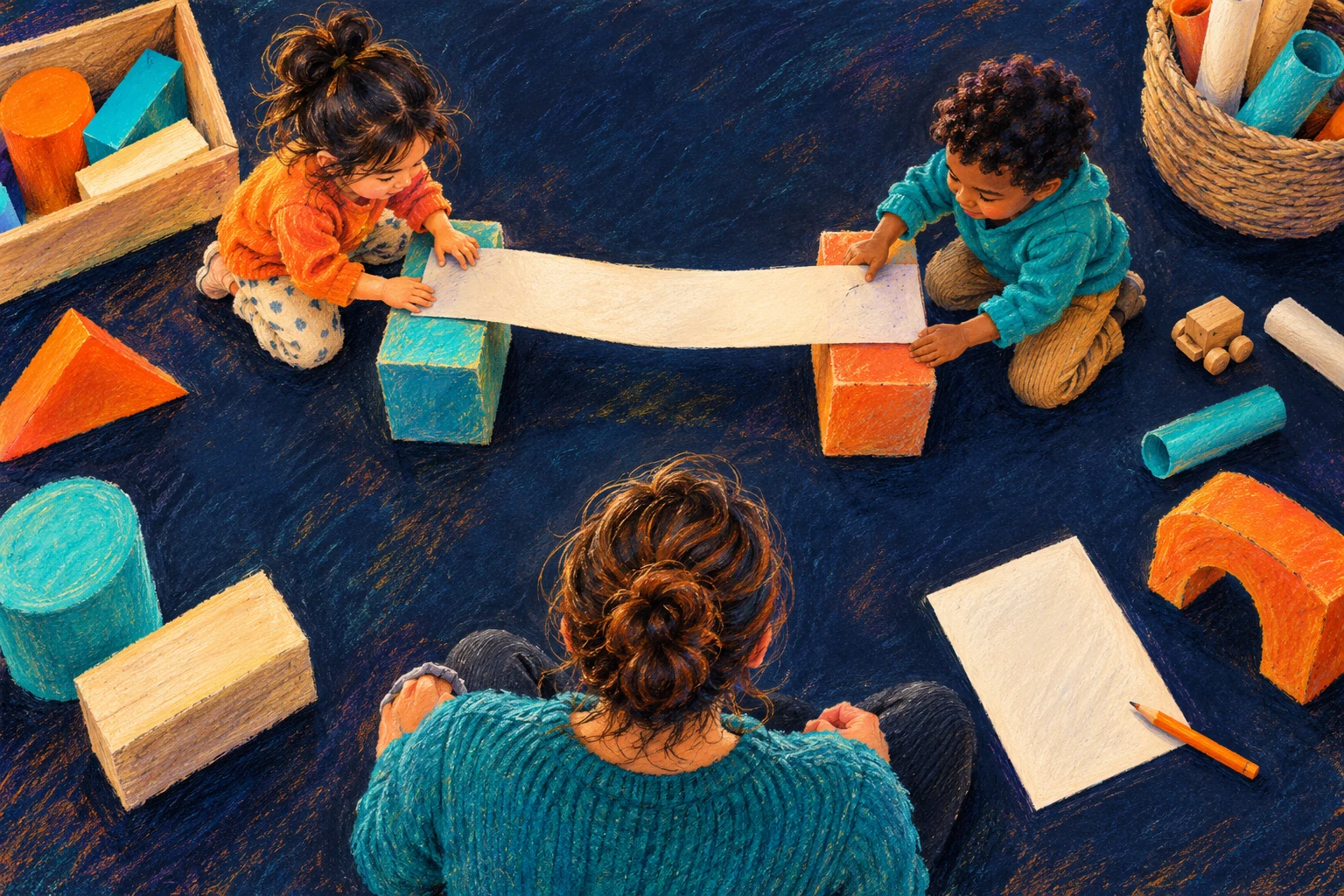
A high overhead view leaves room around the low bridge, large blocks and blank recording paper.
What counts as preschool STEM?
STEM can involve counting blocks, testing a paper fold or describing a leaf. Technology includes useful human-made tools such as a magnifier; it does not require an app. Engineering introduces a purpose: build something that spans a gap. Mathematics gives children ways to compare quantities, lengths and shapes.
The Head Start guidance on science in preschool places observations, questions and investigations within everyday experiences. Its established framework supports this approach; these activities are suggestions, not a new set of requirements for 2026.
Keep a question–try–notice rhythm. “What happened?” is often more useful than supplying a technical definition. Drawing, pointing and speaking all offer ways into STEM, including for children who cannot yet write a sentence.
Three real printables, fifteen possible STEM investigations
The linked pages are existing resources, not a newly available fifteen-sheet science pack. Their free samples are watermarked, one-page PDFs. The number and line resources also offer clean downloads through membership. Check the current download panel before printing.
| Existing resource | Starting invitation | What adults add |
|---|---|---|
| Number 6 Worksheet: 4 Powerful Duck Pond Successes | Look at the selected top group of six ducks | Six large blocks and a clear counting space |
| Trace 5 Essential Lines and Curves: Fun Paths for Little Hands (Ages 3-5) | Choose a single line or curve as a route prompt | Plain paper for a larger route and observation marks |
| Color the house: 5 Amazing Steps for Creative Learning! | Notice the house, roof and surrounding trees | Large construction pieces for a small model |
The house page is a colouring resource, not an engineering plan. The line page offers movement patterns, not ready-made results tables. In this STEM approach, adults prepare any blank record strips, paper bridges and comparison trays themselves.
Set up a small STEM investigation
- Choose one question, such as whether a folded strip spans a gap differently from a flat strip. Put unrelated materials away.
- Gather large, age-appropriate pieces. Keep ramps and structures low on a stable surface; remove anything unsuitable for children who mouth objects.
- Let the child predict using words, a gesture or a drawing. A prediction is an idea to investigate, not an answer to grade.
- Agree on the part to keep the same and the single part to change. Help with handling while leaving the child room to choose and observe.
- Record one useful detail. An adult can write a dictated sentence; the child might draw the stopping point or select an object to represent a quantity.
- Return materials together and decide whether there is a reason to revisit the question. Stopping after one worthwhile trial is acceptable.
For a first STEM session, skip the recording step if it interrupts concentrated exploration. You can describe the observation together afterwards.
Investigations 1–3: quantity that can move
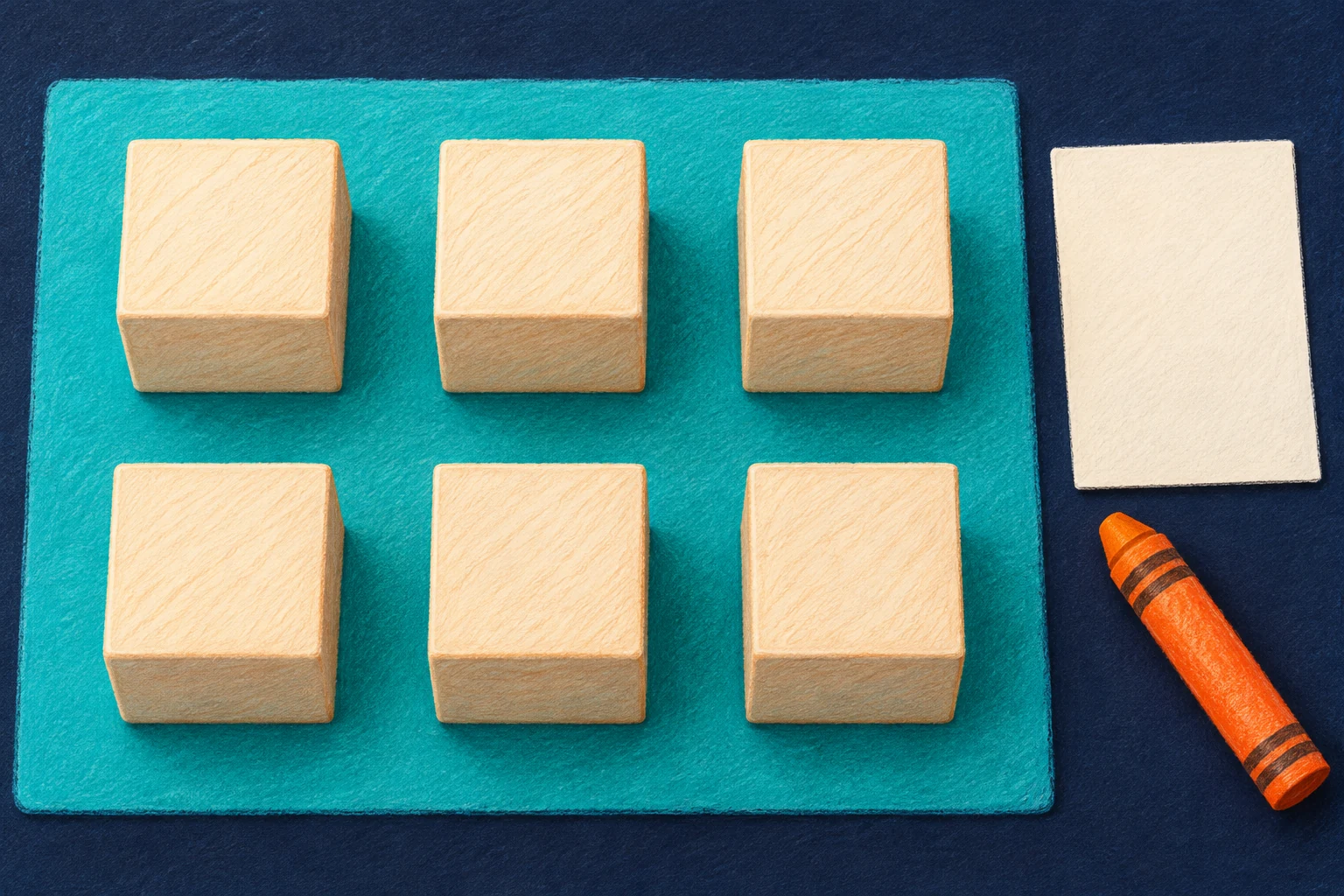
The arrangement represents one small collection; it is separate from the other counting tasks on the linked number page.
STEM 1. Give each duck a block
Use the top group on the number-six page. Invite the child to place one large block beside each of those six pictures, then move the blocks to a mat and count them. Other duck groups elsewhere on the page belong to separate tasks; do not combine every duck into one count. STEM begins here with a precise collection rather than a page-wide guess.
STEM 2. Spread the same six
Rearrange those six blocks into a long line without adding or removing any. Ask, “Do we need to count again to check?” Accept recounting. Move them close together and discuss what changed and what stayed. This STEM comparison separates occupied space from the number of objects without demanding an explanation the child is not ready to give.
STEM 3. Invent a shape sort
Offer a small mixed collection of large blocks. Invite two groups, then ask what makes each group belong together. A child might choose curved surfaces versus straight edges. Try another rule using the same pieces. Naming a sorting rule brings mathematical language into STEM; recognising a formal shape name is optional.
Investigations 4–7: routes, rolling and a fair comparison
STEM 4. Measure a paper road
Select a straight route from the line page as inspiration. Draw a larger straight road on plain paper, then lay identical blocks end to end along it, without gaps or overlaps. Compare another road using the same blocks. Count whole units together and describe a leftover part informally. STEM measurement is clearer when the unit stays consistent.
STEM 5. Roll a cylinder and a cube
Place a broad cylinder and cube at the top of a very low ramp in turn. Release each without a push. Notice whether it rolls, slides or stays. Rotate the pieces and try again. Treat this STEM encounter as a question about these objects and positions, not proof that every curved object behaves identically.
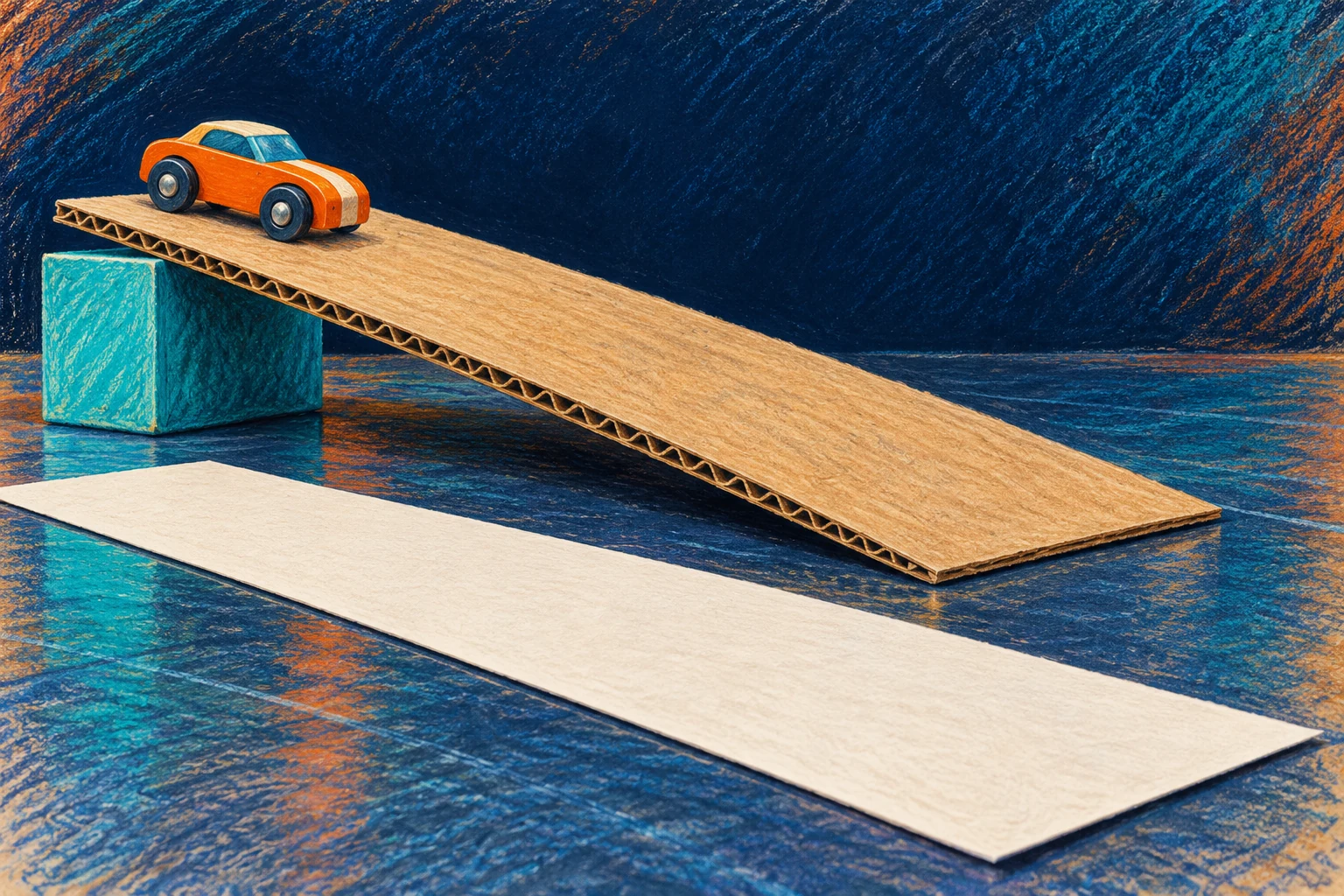
The low side view shows the car, ramp and flat run-out surface without imposing a predicted result.
STEM 6. Change the ramp height
With one toy car, one ramp and one surface, compare two low heights. Use the same release point and no extra push. Mark where the car stops on a homemade paper strip beside its path. Repeat if the child wants. Ask whether the second run resembled the first; one surprising result is a reason to look again.
STEM 7. Try a different road surface
Return the ramp to one height. Compare smooth paper and a securely laid rougher sheet on the flat run-out area, keeping the car and release point consistent. Describe what you observed without promising which material must win. This STEM comparison works best when a loose edge is not secretly acting as a bump.
Investigations 8–11: build for a purpose

The unloaded bridge study invites adults to make equal strips and gaps for their own comparison.
STEM 8. Bridge a short gap
Set two low supports a short distance apart. Ask the child to choose a strip wide enough to reach both. Check whether it rests on both ends before adding any lightweight load. Keep the gap short and work at floor level. The STEM purpose is visible: connect two places with something that stays up.
STEM 9. Fold, then compare
Use two equal strips of the same paper and equal gaps. Leave one flat and accordion-fold the other with adult help. Compare their shapes under their own weight first. If adding a lightweight object, use the same object and position each time. Folding is the change; swapping paper thickness at the same time would confuse the comparison.
STEM 10. Widen a house base
Look at the colouring page, then build two very low block structures with narrower and wider bases. Compare how steadily each stands on the same level surface. Do not encourage knocking tall towers towards people. Preschool STEM includes noticing when a design needs a different arrangement, even when the original drawing looked convincing.
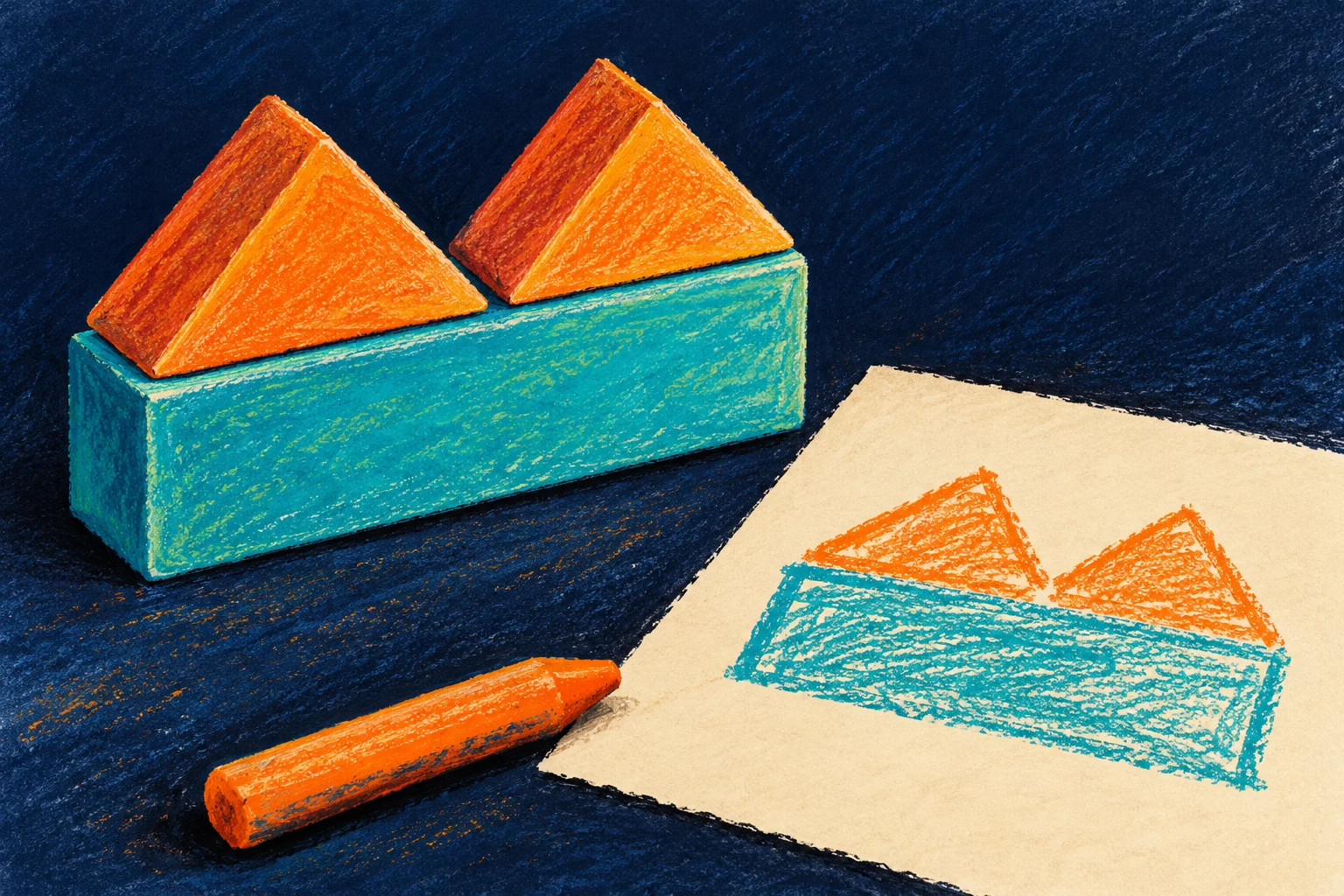
The simple low construction shows a broad base and two roof shapes rather than a copy of the linked colouring sheet.
STEM 11. Sketch a roof that fits
Offer broad triangular and rectangular pieces for a small model house. Which can sit across the chosen base? Let the child draw a plan, build it and alter the drawing afterwards. It is fine if the plan changes. The STEM connection lies in moving between a representation and an actual object, not reproducing the worksheet’s house exactly.
Investigations 12–15: look closely and leave a record

The observation tray combines real objects with simple recorded outlines; species identification is not required.
STEM 12. Compare two leaf outlines
Choose clean, familiar fallen leaves with an adult. Compare a smooth edge and a lobed edge, then draw around each on plain paper. A magnifier offers another look. Ask what is alike before asking what differs. Avoid tasting plants or treating leaf colour alone as a reliable way to identify a species.
STEM 13. Find an indoor shadow
An adult positions a cool LED light safely beside a large object on paper. Mark its shadow, then change the light’s position while keeping the object still. Notice the outline. Keep cords clear and never shine the light into eyes. This STEM investigation needs neither direct sunlight nor looking towards the sun.
STEM 14. Watch a small water mark
Place equal-sized pieces of two plain paper types on a washable tray. An adult adds one small drop of water to each using the same dropper. Observe the spreading patches before discussing absorption. Wipe spills promptly. This STEM task uses water only; it does not require cleaners, mixtures or a written explanation of molecules.
STEM 15. Choose a question to revisit
Offer the child the earlier sketches or marks and ask which result deserves another try. Keep the original arrangement available, change one chosen feature and add a second observation beside the first. A changed mind can be valuable evidence of attention. STEM gains meaning when a record helps decide what to do next.
Six useful gains to notice during STEM
- One-to-one attention: matching a block to each selected duck makes skipped or double-counted objects easier to discuss.
- Comparison language: wider, smoother, longer and the same give children precise ways to share observations.
- Purposeful tool use: a magnifier or repeated measuring block serves an actual question instead of becoming a decorative accessory.
- Reasoning about change: holding several features steady makes one alteration easier to notice, with adult support where needed.
- Representation: a sketch, tally or dictated comment can preserve an idea long enough to revisit it.
- Collaborative persistence: children can share materials, hear a partner’s explanation and change a design without labelling an early attempt a failure.
These are opportunities within STEM, not guaranteed outcomes from completing fifteen activities. A child may show one through conversation and another through careful movement. Notice the process as well as the product.
Two imagined STEM sessions with different priorities
At home: the car stops somewhere unexpected
In this hypothetical example, a parent and four-year-old mark two car journeys. The second stops sooner. Instead of correcting the child’s prediction, the parent asks what could have changed. They spot a lifted paper edge, flatten it and try again. Their STEM record includes three marks and an adult-written note: “The road had a bump.” They leave the number page unfinished because the investigation already has a useful conclusion.
In class: a bridge needs a shared decision
Imagine two children choosing paper for the same short gap. One prefers a wide strip; the other wants folds. The teacher gives them equal strips to compare and records their words. A child who prefers pointing selects the arrangement to try first. Later, the group returns to the photo or sketch. This STEM discussion can include children with different writing and speaking confidence without assigning everyone the same response.
Four extensions after the first STEM investigation
Try a museum label: the child dictates one sentence beside a model explaining what changed. The label should describe a real observation, not an adult’s ideal answer.
Create a builder’s request. A toy character needs a bridge across the same short gap, but only broad blocks and paper are available. Invite a new solution and explain what each material contributes.
Play observation detective. An adult describes a leaf edge or block surface without naming the object. The child selects a match and points to the evidence. Trade roles if wanted.
Start a return tray containing one drawing and the safe materials from a chosen STEM question. Revisit it another day, allowing the child to remember, revise or leave the question behind.
Leave room for the answer you did not expect
The Department for Education’s natural-world guidance values first-hand exploration, talk and observation. Its assessment context is England; it is not a universal preschool checklist. Those broad practices are useful when a printable becomes a starting prompt for looking at real things.
Keep STEM inviting with a specific comment: “You noticed the fold held its shape. What would you like to try next?” If the child is tired, save the materials and stop. A thoughtful question, an altered plan or a small drawing can make today’s STEM experience worthwhile without an impressive display or a fully completed page.