
Exciting Number 3 Tracing: 5 Essential Tips for Math Success

Number 3 Tracing gives learners focused practice. Building a solid mathematical foundation starts with recognizing and forming the symbols that represent quantities. Today, we are focusing on the elegant curves of the third numeral. Our Number 3 Tracing worksheet is designed to transform what could be a repetitive task into a multi-sensory adventure. Rather than just staring at a page, children interact with the concept of 'threeness' through coloring, searching, and precise motor control practice. This specific printable provides a balanced approach, moving from large-scale guided movements to smaller, more refined handwriting repetitions, ensuring that every child finds a comfortable entry point into the world of numbers.
Number 3 Tracing gives learners focused practice. 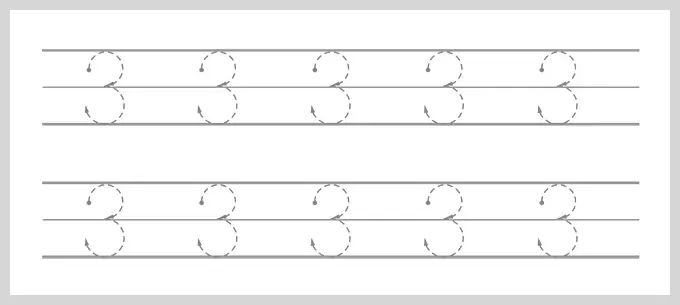
The Core Concepts of Our Number 3 Tracing Sheet
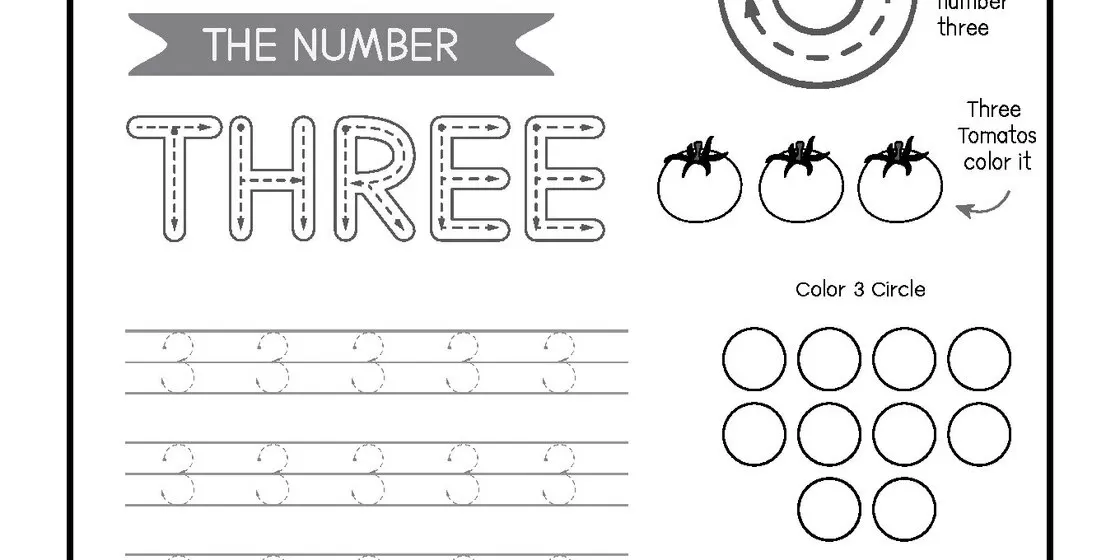
Understanding the number three is a significant milestone for a preschooler. It marks the transition from simple pairs to the concept of a small group. This worksheet targets the visual and physical construction of the digit. At the top right, a large '3' features directional arrows. This is the crucial first step where children learn that a 3 is essentially two open curves stacked vertically. By following the path from the top dot, around the middle, and down to the base, they internalize the flow required for fluent writing later on.
Visual Recognition
The 'Circle all of the number 3s' section acts as a visual discrimination game. Children must filter out distractions like 2s, 5s, and 9s to find the target digit. This sharpens their ability to spot the specific geometry of a 3 in different contexts and font weights.
Quantitative Counting
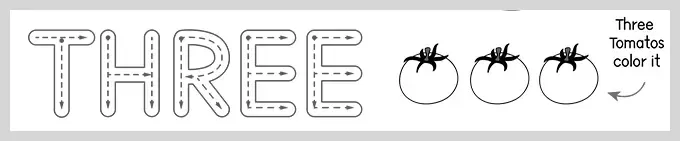
Linking the symbol to a physical amount is vital. The 'Three Tomatos' section and the 'Color 3 Circles' exercise provide concrete ways to visualize the value. It’s not just a squiggle on a page; it represents three distinct objects.
7 Remarkable Benefits of Number 3 Tracing
- Refinement of Curvilinear Strokes: Unlike the straight lines of a 1 or 7, the number 3 is all about curves. This practice builds the specific wrist flexibility needed for many letters in the alphabet.
- Attention to Detail: Following the dotted lines exactly requires focus. This discipline helps children learn to slow down and prioritize accuracy over speed.
- Early Math Vocabulary: As parents and teachers guide the child, they naturally use words like 'curve', 'middle', 'bottom', and 'total', enriching the child’s descriptive language.
- Confidence Building: The repetitive rows allow for rapid improvement. Seeing their fourth row look better than their first provides an immediate sense of accomplishment.
- Fine Motor Precision: Managing a pencil within the constraints of the dotted lines strengthens the small muscles in the fingers and hands.
- Number-Quantity Correspondence: By coloring exactly three tomatoes, the child learns that the number '3' represents a specific, unchanging set size.
- Independent Work Habit: The clear sections allow children to complete parts of the page on their own, fostering a sense of self-reliance in their learning journey.
Practical Implementation: Home and Classroom
In a home setting, this Number 3 Tracing worksheet can be a quiet afternoon activity. A parent might sit with the child and say, "Let's find all the tomatoes first!" This turns a 'lesson' into a collaborative game. Use a variety of tools; perhaps the first row of tracing is done with a green crayon and the second with a blue pencil. This variety keeps the sensory experience fresh and engaging for a four-year-old.
In the classroom, teachers can use this printable as a center station. After a group lesson on the number three—perhaps using physical blocks—students can move to their desks to reinforce the concept on paper. It serves as an excellent assessment tool; a teacher can quickly glance at the 'number search' box to see if a student is confusing 3s with 8s or 2s. For more foundational practice, you might also explore our Number 1 Tracing or Number 2 Tracing resources to ensure a sequential learning path.
Cognitive and Motor Skill Development
The act of tracing is a complex neurological process. The brain must coordinate visual input (the dotted line) with motor output (moving the hand). This develops the 'pincer grasp,' which is essential for all future writing. Beyond the physical, the search-and-find activity in the bottom right corner builds cognitive scanning skills. A child must look at a field of numbers and use 'working memory' to keep the shape of the number 3 in mind while rejecting other shapes. This is a precursor to reading fluency, where we must quickly recognize letters within words.
Games to Extend the Learning
1. The Three-Object Hunt
After finishing the worksheet, give the child a small basket and ask them to find three of different items around the room: three socks, three spoons, or three blue toy cars. This bridges the gap between the paper and the real world.
2. Sensory Sand Tracing
Before using the pencil on the sheet, have the child draw the number 3 in a tray of sand or salt. The resistance of the sand provides tactile feedback that makes the Number 3 Tracing on paper much easier.
3. The Tomato Market
Roleplay a grocery store. The child is the shopkeeper, and you want to buy exactly three tomatoes. Use the colored tomatoes on the worksheet as 'currency' or 'coupons' for the game.
4. Finger-Tracing Race
Use your finger to trace the large number 3 at the top. See how fast or how slow you can go while staying perfectly on the line. Slow is often harder and better for muscle memory!
Common Mistakes to Watch For
When children first attempt the number 3, they often face a few common hurdles:
- Reversals: It is very common for children to draw the 3 facing the wrong way (like an 'E'). This is why the directional arrows on our worksheet are so important.
- The 'Middle Gap': Sometimes kids forget to touch the middle point between the two curves, resulting in a shape that looks more like a wavy line. Remind them to "come back to the middle" before starting the bottom curve.
- Size Inconsistency: Beginners may start the top curve very small and the bottom curve huge. The tracing rows provide a frame to help them keep the proportions balanced.
Encouragement and Positive Reinforcement
Avoid focusing on perfection. If a child goes outside the lines, celebrate the effort. Use the "Remarks" and "Teacher Signature" sections at the bottom of the page to write a specific compliment, such as "Great job finding all the hidden 3s!" or "Your second row of tracing is very smooth!" Positive feedback ensures they want to come back and try the next number. You can even let them use a 'special' pen or a glitter marker for the final row of tracing as a reward for completing the counting activities. Success in early math is as much about attitude as it is about skill.
Age Group Recommendation
This worksheet is most effective for children aged 4-5. At this stage, most kids have the hand strength to hold a pencil properly but still need the visual 'scaffolding' of dotted lines to guide their letter and number formation. It also fits perfectly into a Kindergarten prep curriculum.
How to Download and Use
Getting started is simple. We provide high-quality, printable PDF files that are completely free of watermarks and distracting advertisements. Simply click the download link to save the file to your device. For the best experience, print on standard letter-sized paper. If you want to reuse the worksheet, you can slide it into a plastic sheet protector and have the child use a dry-erase marker. This is a great way to provide extra practice without wasting paper. Once the child is comfortable with the number 3, consider moving on to our letter A tracing activities to mix math with literacy.
| Activity Type | Skill Focused |
|---|---|
| Large Arrow Guide | Directional Awareness |
| Four Tracing Rows | Repetitive Muscle Memory |
| Tomato Coloring | One-to-One Correspondence |
| Number Search Box | Visual Discrimination |
Popular Worksheets
Printable resources families and teachers are downloading now.
 Free
Free
 Free
Free
 Free
Free
 Free
Free