
Fun Number 4 Tracing: 10 Remarkable Steps for Math Brilliance

Mastering the shape of four is a major milestone for young children. They must move beyond simple straight lines into more complex intersections. This comprehensive Number 4 Tracing worksheet provides a structured yet playful environment. Here, little learners can refine their fine motor control and digit recognition. Furthermore, by combining tactile tracing rows with visual discrimination games, we ensure that the concept of 'fourness' sticks. Whether your child is just starting their numeracy journey or needs a bit of extra practice with pencil grip, this printable offers the perfect balance of challenge and support. It provides this without the distraction of watermarks or advertisements.
Creative Ways to use the Number 4 Tracing Worksheet
Home Learning Scenario
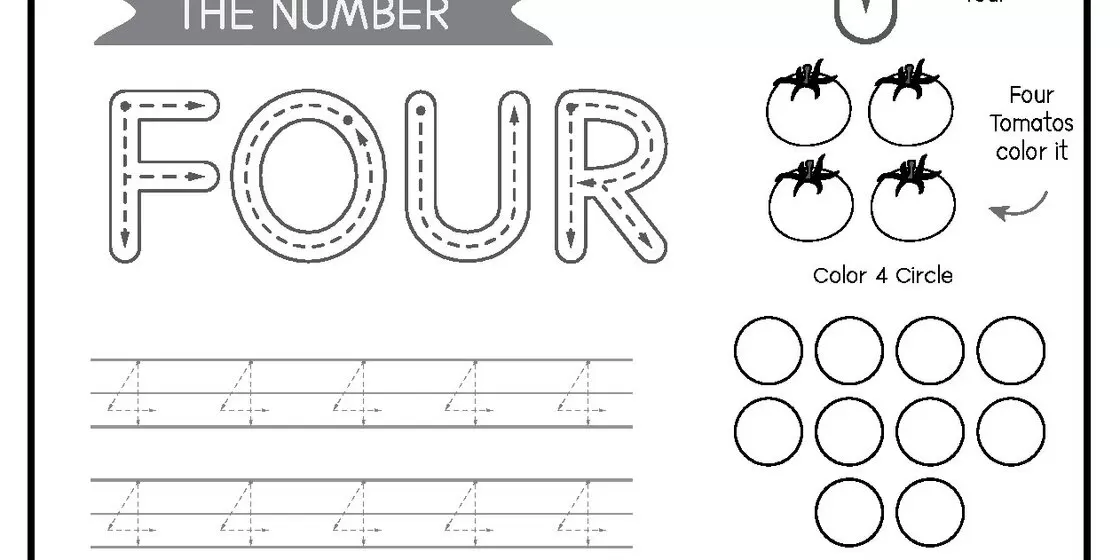
Initially, set up a quiet 'math corner' at the kitchen table while you prepare a snack. Give your child 4 actual cherry tomatoes to match the tomato illustration on the page. As they complete the Number 4 Tracing rows, encourage them to eat one tomato at a time, counting down. Consequently, this tactile connection between the paper exercise and real-world objects reinforces the quantitative value of the number they are writing.
Classroom Integration
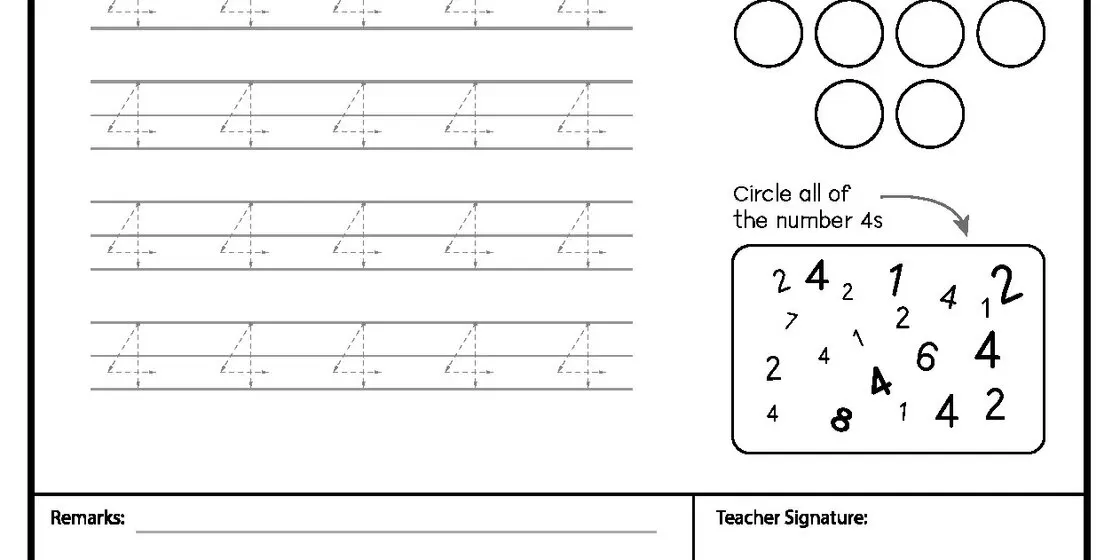
Alternatively, teachers can use this as a 'Bell Ringer' activity. As students arrive, they can start with the large 'LET'S LEARN' section. Use the 'Circle all of the number 4s' box as a timed challenge to see who can find all the hidden fours first. In effect, it turns a standard handwriting lesson into a high-energy visual scanning game that keeps 4-5 year olds engaged from the moment they sit down.
Why Number 4 Tracing is Vital for Development
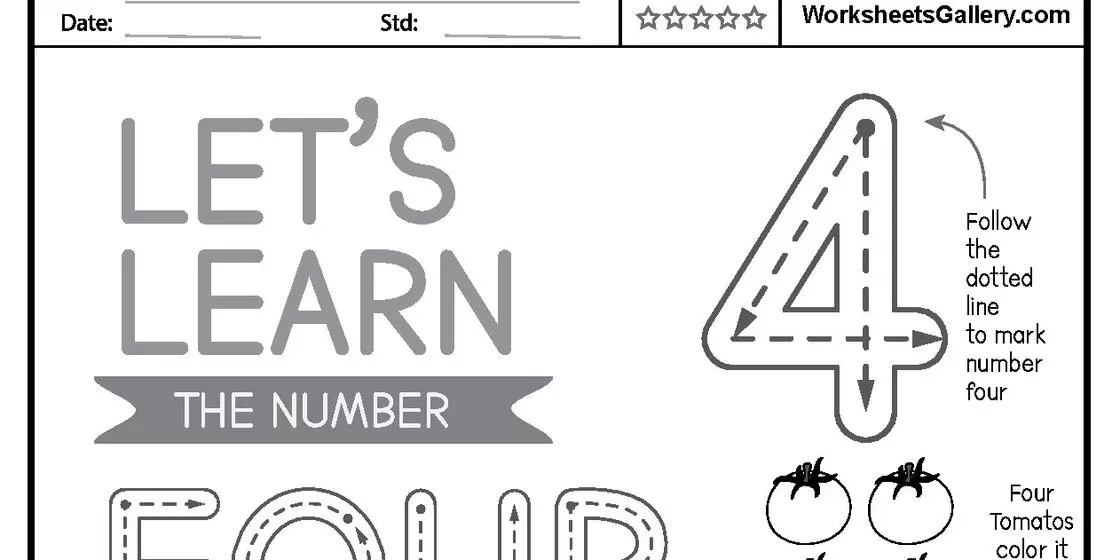
The number four is unique because it often involves a lift-and-replace motion with the pencil. This differs from the continuous curves of three or the single stroke of one. This helps children practice spatial awareness and planning. Specifically, here are some key benefits found in this activity:
- 01
Fine Motor Precision: Navigating the sharp angles and cross-sections of the 4 requires delicate finger strength and steady wrist movement.
- 02
Visual Discrimination: The 'Search and Circle' box helps children distinguish 4 from similar-looking numbers like 7 or 1, preventing future reversals.
- 03
One-to-One Correspondence: Coloring the four tomatoes and four circles teaches children that the symbol '4' represents a specific quantity of items.
- 04
Directional Flow: Following the numbered arrows ensures students learn the correct 'top-to-bottom' writing mechanics used in standard penmanship.
- 05
Confidence Building: The transition from large, bold guides to smaller dotted rows allows children to feel successful at every stage of the page.
Deep Skills Development Breakdown
This worksheet isn't just about ink on paper; it's a multi-faceted tool for cognitive growth. When a child engages with Number 4 Tracing, they are working on three distinct skill sets simultaneously.
Cognitive and Math Logic
By identifying the number 4 among a jumble of other digits, the brain practices 'pattern matching.' This is the same skill used later in life for reading and complex math problem solving. If they enjoyed this, they might also like to try our Essential Number 1 Tracing for simpler stroke practice or the Master Number 2 Tracing worksheet to compare curves and straight lines.
Motor and Sensory Integration
Hand-eye coordination is pushed to the forefront here. The student must look at the dotted path and command their hand to follow it exactly. In addition, we recommend using different colors for each row—perhaps a 'rainbow 4'—to keep the sensory experience fresh and exciting. This variety prevents the repetitive nature of tracing from becoming a chore.
Extended Learning Games and Storytelling
To make the most of this Number 4 Tracing session, try these four extension activities that take the learning off the page and into the world around you:
1. The Four-Legged Parade
Ask your child to find all the toys in the house that have four legs (dinosaurs, chairs, tables, dogs). For every item they find, they get to come back and trace one row of the number 4 on the worksheet.
2. Tomato Soup Storytime
While they color the tomatoes on the page, tell a story about a chef who needs exactly four tomatoes to make a magical soup. If he has three, it's too cold; if he has five, it's too spicy. This reinforces the exactness of the number.
3. Air Writing Challenge
Before putting pencil to paper, have the child use their whole arm to 'write' a giant number 4 in the air. This gross motor movement helps cement the shape in their muscle memory before they attempt the fine motor version.
4. The Number Detective
Use a magnifying glass if you have one! Have the child 'detect' the number 4s in the search box. Once they find one, they can 'capture' it by circling it with a bright highlighter.
Addressing Common Mistakes
It is perfectly normal for children in the 4-6 age range to make errors. Recognizing these early can help you guide them gently without causing frustration:
| Common Mistake | Why it Happens | How to Help |
|---|---|---|
| Writing the 4 backwards | Brain is still learning symmetry | Point to the start arrow every time |
| Joining all lines into a triangle | Lack of lift-off control | Encourage 'picking the pencil up' after the first L-shape |
| Ignoring the dotted lines | Excitement to finish quickly | Practice 'turtle speed' tracing for one row |
The Importance of Multi-Sensory Math
Multi-sensory techniques are highly effective for early numeracy. When children use our Number 4 Tracing sheets, they aren't just engaging their eyes. By saying the number aloud, they build auditory memory. Feeling the friction of the pencil on paper and counting physical objects like the tomatoes shown builds tactile memory. This 'Whole Brain' approach ensures that the symbol 4 is linked to its name, its sound, and its physical quantity.
Furthermore, research suggests that children who engage in varied tracing activities develop better handwriting stamina. This is why we include different sizes of the number 4. Starting with the large 'Word Tracing' at the top allows for broader movements, while the smaller rows at the bottom require the precision needed for future school assignments. If your student is showing signs of fatigue, try alternating this math practice with something different, like the 9 Clever Letter W Tracing Tips or the Super Letter V Tracing guide to keep their interest high.
Tips for Encouragement and Persistence
Positive reinforcement is the key to turning a worksheet into a favorite activity. Instead of saying 'that is wrong,' try 'Look how close you stayed to the dots on that one!' Moreover, use the 'Teacher Signature' and 'Remarks' section at the bottom to give them a gold star or a smiley face. This small ritual makes the child feel that their work is valued and important. We have found that children who receive specific praise—such as 'I love how you lifted your pencil for the second stroke'—are much more likely to complete the entire page without losing focus.
If they find the number 4 challenging, take a break and try some letter tracing like the Terrific Letter T Tracing which uses similar straight lines. You can also explore our Free worksheet library to find shapes that use simpler vertical strokes to build up their hand strength. Remember, the goal is progress, not perfection. Every small win builds the confidence they need for more complex tasks like the Queen's Letter Q Tracing later on.
Simple Download and Printing Instructions
We believe high-quality education should be accessible to everyone. That is why our Number 4 Tracing worksheet is designed for easy, crystal-clear printing at home or in the classroom. By providing these resources for free, we aim to support parents and educators in creating a rich learning environment without financial barriers.
- Click the download button to save the high-resolution PDF directly to your device.
- Open the file using any standard PDF viewer. You will notice there are no watermarks to obscure the tracing paths.
- Load your printer with standard A4 or Letter size paper. Black and white printing is recommended to save ink and allow children to add their own colors.
- Ensure your printer settings are set to 'Fit to Page' for the best results.
- Finally, print as many copies as you need for your household or classroom—it is completely free and ad-free!
Once your child has mastered the number four, why not move on to the Exciting Number 3 Tracing to keep the momentum going? Every digit they learn is a stepping stone to mathematical fluency and a lifetime of confident learning.
Popular Worksheets
Printable resources families and teachers are downloading now.
 Free
Free
 Free
Free
 Free
Free
 Free
Free