
Three Addends: 4 Powerful Games for Joyful Counting
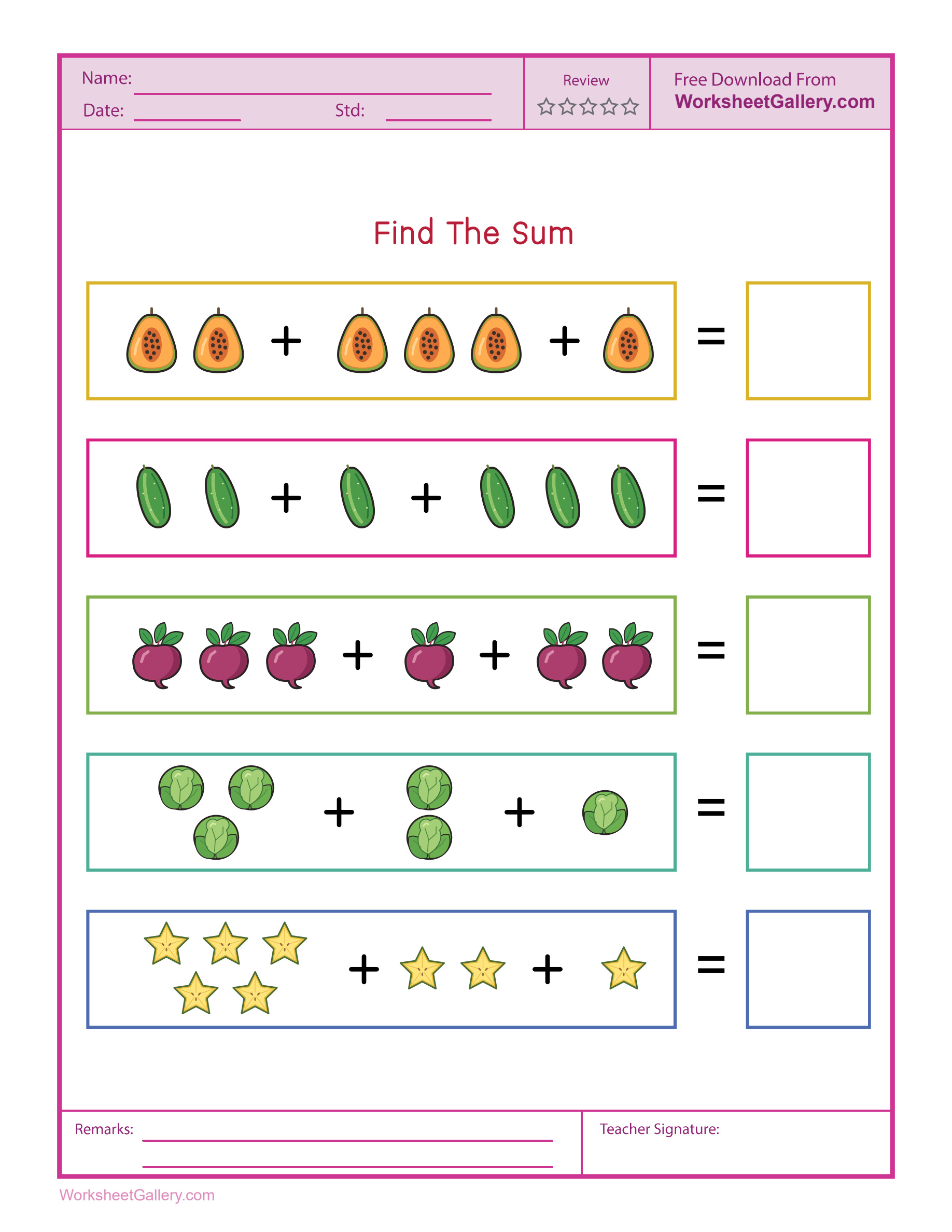
Two plus signs mean the job continues beyond the second group. Three Addends give children three separate picture collections to include before recording one combined amount. On this sheet, papaya pictures, cucumbers, purple roots, leafy heads and yellow star-shaped slices fill five colorful equations. A learner who counts the first two groups accurately may still need a reminder to inspect the third. Explore Three Addends with an imaginary notebook that has three picture pockets, giving every collection a place and every final answer a reason to be checked.
Three Addends ask for three picture collections

The first Three Addends equation shows two papaya pictures, then three, then one. There are two plus signs because three groups are being combined. Count each pictured piece once, including the final single drawing after the second plus sign. The complete quantity is six.
A child might count the first two groups and say five. That is a correct amount for those two groups, but another picture remains in the equation. Three Addends require the learner to decide whether an amount describes a partial collection or the complete one.
Use ordinary language first: “These two, these three, and this one.” An adult can supply the word addend for a quantity being added, without requiring a preschooler to memorize the term before participating. The visible collections make the idea available through pointing.
The papaya seeds in this Three Addends example are interior features of the drawings. They are not extra counting objects. In Three Addends work, agree that one complete picture is the unit before beginning, so the question remains about the shown collections rather than their decorative details.
Follow both plus signs in Three Addends
Notice the first and middle collections, then look onward before deciding the equation has ended.
Include the final collection before relating the pictured amount to its empty answer square.
The equals sign appears after the third picture group. It relates the combined amount to the numeral that will be written in the square. Three Addends do not call for a different answer at each plus sign; the printed row has one place to record its completed total.
You may describe a running amount while demonstrating. Two papaya pictures with three make five so far, and the last picture brings the amount to six. Explain what “so far” includes. It keeps Three Addends from turning a correct intermediate result into an unfinished final response.
Ada checks Three Addends in her notebook
Ada and her older sister prepare an explorer notebook using three paper pockets. Two large picture cards go into the first, three into the next and one into the last. Before closing the notebook, Ada wants to tell her sister how many cards it holds altogether.

She counts the first pockets and reports five. Her sister asks whether that description includes the final pocket. Ada checks its single card, revises the complete amount to six and explains why her first answer described only part of the notebook.
They return to the Three Addends papaya row and compare each pocket's quantity with one printed group. The cards provide movable objects, while the worksheet provides a stable record of the same three-part arrangement. Ada can point, describe or dictate the final numeral.
The photograph introduces the notebook setting with empty pockets. It is not a solved arithmetic display. Use deliberately counted cards for the play example. Three Addends discussion works without a special notebook too; three separate spaces on ordinary paper can keep the collections visible.
Six Three Addends learning opportunities to observe
- Three Addends completion. Looking beyond a second collection gives the learner a concrete reason to inspect the entire equation before recording its answer.
- Three Addends part tracking. Naming the first, middle and final groups helps a child keep three quantities distinct while discussing their combined amount.
- Three Addends number sequence. A continuous count can cross both plus signs, with each next number still tied to a visible picture.
- Three Addends working attention. Remembering which group has already been included supports a deliberate plan rather than a restart prompted by each symbol.
- Three Addends spoken reasoning. Explaining what “so far” includes lets a partner distinguish an intermediate amount from a completed answer.
- Three Addends coordinated recording. Pointing through the collections and placing a numeral in the correct square join visual tracking and hand movement with the mathematical decision.
These tasks can suit preschool or kindergarten practice around ages three to six, with an adult adjusting support. Counting several collections may be demanding for a younger learner even when each collection is small. Choose one row and a response the child can explain, leaving writing to an adult if that helps.
A classroom checks the final Three Addends group first
Before solving, a teacher asks learners to identify the group nearest the equals sign. They point to that collection and say how many pictures it contains. The class then locates the other two groups and both connecting plus signs.
This opening gives the final collection a clear place in the task. The teacher models a Three Addends count across the whole row, naming each picture once. At its end, she asks which collections her answer includes, so the amount is linked to all the relevant objects.
At tables, one learner describes the three group quantities and another points as each is mentioned. They check the description against the source before calculating. Change roles after a short attempt. Three Addends language can be shared through gestures and short phrases as well as complete sentences.
For a learner who needs help, an adult can establish the first two groups and explain the running amount, then invite the child to include the last group. Someone ready for independence can count every drawing and record the numeral. Both contributions should preserve the meaning of the complete equation.
The star-shaped Three Addends row needs its last single slice

Five star-shaped slices form the first group, with three above two. The middle collection contains two more, and a final single slice follows another plus sign. The complete count is eight. If the last drawing is overlooked, the first two groups produce only seven.
This makes the Three Addends completion question easy to inspect: does seven include the single picture after the second plus sign? Invite a pointing explanation before another count. A learner can identify the missing collection even when the adult still supports the number sequence.
Count the whole yellow picture rather than its points. Seeds, outlines and pointed tips do not create additional units. Naming the shapes descriptively is enough for the addition task; the child does not need a particular fruit vocabulary to establish how many drawings are present.
The first four rows total six, while this row totals eight. Do not let a repeated earlier answer become the rule for every Three Addends problem. Inspect the parts of the selected equation and check its own complete amount.
Four Three Addends notebook games with a clear finish
1. Audit every Three Addends pocket
Prepare three separated collections of paper picture cards to match a source row. The learner indicates each pocket in order and describes its quantity before finding the whole amount. Ask which pockets the final number includes.
The Three Addends audit ends only when all three collections have been accounted for. If the child gives a partial amount, use it to discuss what remains rather than discarding the correct counting already done.
2. Give Three Addends a middle-pocket clue
Ask for a row whose middle collection contains one picture. The cucumber row and the purple-root row both fit. Let the learner establish the other parts and explain why either selection answers the clue.
This Three Addends game directs attention to an interior collection, not just the first or last group. The clue can change to a middle group of two when the child wants another search.
3. Describe Three Addends without the object name
An adult describes the quantities as two, three and one. The learner locates the matching papaya row and shows each group. Confirm the quantities before counting the whole equation, then let the child give a different quantity description for the adult to find.
Three Addends listening here concerns the order of the part amounts. The adult supplies any unfamiliar number word and keeps the source available for checking rather than asking for recall from memory alone.
4. Finish the Three Addends notebook report
Use the star-shaped row and ask the learner to report what has been counted after its first two collections. Establish seven so far, then invite a report that includes the remaining single drawing. Compare the incomplete and complete descriptions with the pictures.
An adult may write the final numeral on a separate note before it goes in the square. This Three Addends job makes recording the conclusion of a checked explanation, with the learner's attention still on the collection being described.
Keep a Three Addends answer guide beside the adult
| Row pictures | Three quantities | Complete amount |
|---|---|---|
| Papaya drawings | 2 + 3 + 1 | 6 |
| Cucumber drawings | 2 + 1 + 3 | 6 |
| Purple-root drawings | 3 + 1 + 2 | 6 |
| Leafy green heads | 3 + 2 + 1 | 6 |
| Star-shaped slices | 5 + 2 + 1 | 8 |
The source's response squares stay blank. Consult the guide after hearing the learner's explanation, checking not just the numeral but which pictures it represents. A correct total guessed from an earlier row tells you less than a visible count through the current collections.
The leafy green drawings are unlabeled, so their visible description is used here. Their first three appear as two above one; their middle two are vertically arranged. Three Addends counting should include those levels without turning the separate leaves within a head into extra pictures.
When Three Addends counting restarts too soon
Some learners return to one each time they cross a plus sign. Separate part counts can be useful for identifying the three quantities, but they do not yet supply a combined answer. Announce when the next demonstration is a complete count, and carry it through the pictured objects across both symbols.
Another learner may merge the first two groups, write that running amount and stop. Ask where the equals sign sits and which collection comes immediately before it. Three Addends have a final visible part that can guide the next observation.
If a picture is counted twice, agree on a route through its group before starting again. For two-level collections, indicate the upper and lower pictures in a predictable order. Keep enough distance between the pointing finger and the next drawing that the learner can still see it.
Make a later Three Addends visit a short report
Ada can reopen one notebook pocket on another day and ask what a complete report needs to include. Choose a single source equation and let the child name or point to its three collections. Revisit the counting method that was understood before introducing a new demand.
Notice an observable change: the final slice received a count, the middle group was named correctly, or the answer square was chosen after checking. Say what the total includes. That invitation keeps Three Addends practice focused on meaning instead of page completion.
For a different collection of picture problems, explore the illustrated Find the Sum resource. The fruit addition page within ten provides another format. A smaller recording task appears in the five-object count and tracing activity when numeral formation needs separate practice.
Download Three Addends with both plus signs preserved
The original branded PDF is supplied as the free sample. The clean premium Three Addends edition uses the website's member download for a current, qualifying membership. Website-name credits, domain lettering and promotional watermark branding are absent from that printable, which has no added advertisements.
Inspect the downloaded file and choose portrait US Letter printing. Fit the full page frame inside the usable print area, then examine a test copy for the single pictures after the second plus signs. The blank answer boxes and all three collections in each row must remain easy to see.
Set out the Three Addends worksheet with a pencil and choose one equation to explain. The notebook can close after every pocket has contributed to the report, leaving another row for a future visit.
Popular Worksheets
Printable resources families and teachers are downloading now.
 Free
 Free
 Free
 Free