
Hundredboard Number 100 Tracing: a Brilliant Ten-by-Ten Finish
Continue from the hundredboard lesson on sheet 100 with all 100 worksheets in one $8 PDF.
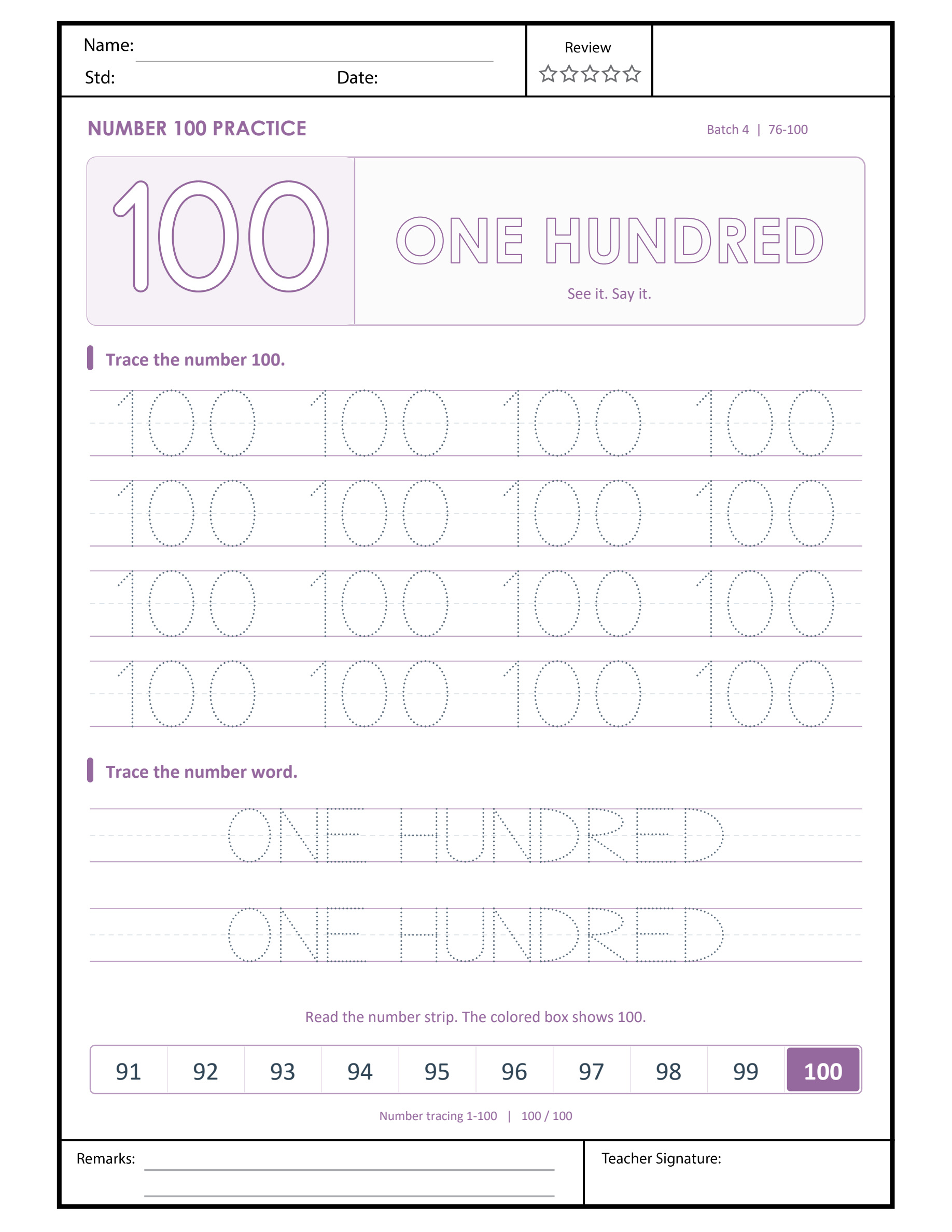
Sheet 100 shows the large reference, six practice lines and the ten-cell strip in context.
Full-page preview of ONE HUNDRED from the clean collection, with 4 numeral models per row and the original page frame.
A ten-by-ten paper board is one square short of full. Lio brings the missing square from a supply tray. The class now needs a new label with room for three digits and a new place for the complete group of one hundred. Open Number 100 Tracing when the count has a label. Find 100 in the large display, then compare the same amount in the printed word area. Read through the 91–100 strip to check the sign. Treat the dotted rows as room for short return visits.
From the hundredboard story to a label of 100
Ten ones can be exchanged for one ten. Ten tens can be exchanged for one hundred. In 100 the leading 1 names one hundred, while the two zeros say there are no ungrouped tens or ones. Keep the hundred display visible during the explanation.
Lay ten complete strips of ten in a large square. Move the whole square under a hundreds label. When asked what remains outside it, the learner can record zero loose tens and zero loose ones. The new 1 belongs at the left because it counts one whole hundred.
Keep a draft sign face down until a second person has counted the hundredboard arrangement. Then turn it over and hear both ways of explaining 100. One explanation can follow the order in which the materials arrived; the other can start with their final grouped form.
Number 100 Tracing with one change at a time
For this practice, start with 1 and close two separate ovals, keeping all three digits aligned. Put a plain piece of paper over the rows below the chosen model so the next movements stay in view. Let the learner take one breath between studying the guide and drawing the new 100.
Compare the result with the model instead of counting how many marks were completed. Check the opening shape near 1, the distance to the next part and how much room the remaining digits use. Say what helped the hundredboard label read clearly when held upright.
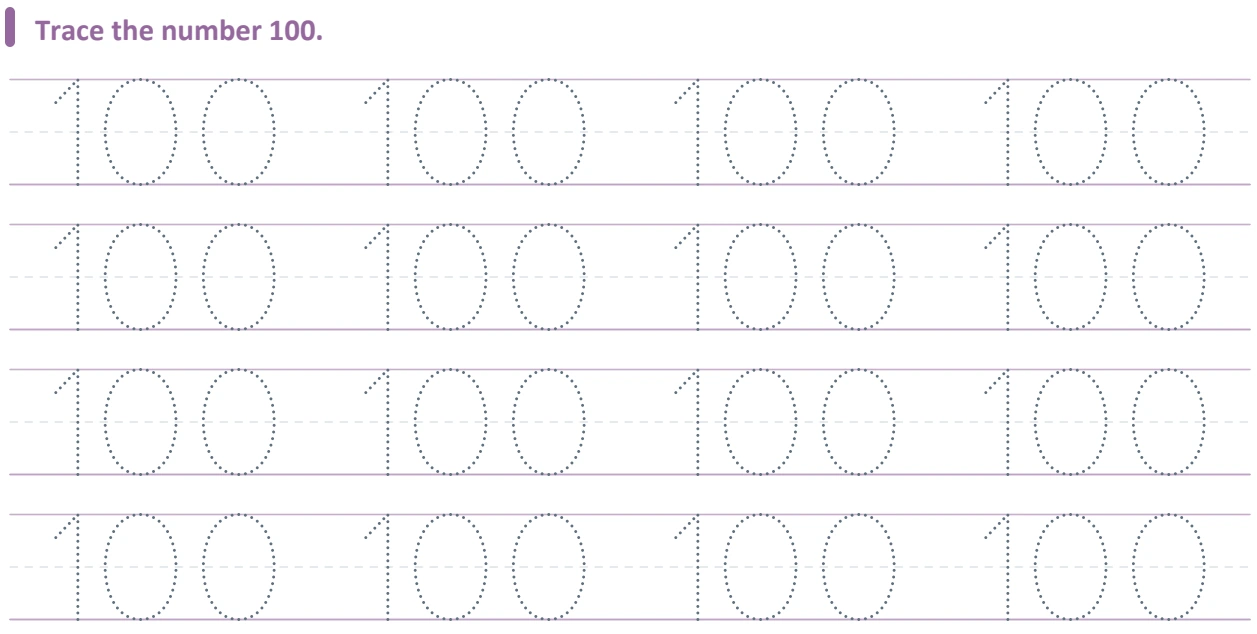
The sheet offers 4 copies per numeral row across four rows. Use a different row for each return if that helps the learner see progress. A child can leave several examples untouched and use one later to try a different grip or paper angle.
What the large 100 shows the recorder
Study the outline of 100 before following any dots. Draw a wide copy in the air and let a partner point to the first mark. Turn the sketch into a hundredboard label only once the recorder can read it aloud without looking at the small writing guides.
Cover the outline with a strip of paper, leaving the written name visible. Say one hundred, then slide the strip away and check what that label looks like as a numeral. Ask whether the two boxes can be read in either order and still report the same count.

Help the hundredboard recorder after the first try
| What you notice with 100 | A small cue | Follow up at the hundredboard table |
|---|---|---|
| An incomplete hundredboard sign | Read the 100 sign while touching the count that each written position describes. | Give the materials to a partner who can rebuild the full count of 100. |
| A crowded copy of 100 | Put a fingertip between the first model and the two zeros to point out the breathing room. | Make one new copy on scratch paper and compare its spacing with the dotted guide. |
| The label stops before ONE HUNDRED | Use the large printed name to rehearse the missing part as one chunk. | Match the complete word to the 100 card without pointing to the objects. |
| The shaded 100 gives away the answer | Mask only the shaded cell and show a neighboring figure. | Tell which direction to move from the visible value to reach 100. |
Take only one cue from this table for each visit to the 100 worksheet. A child who explains the amount accurately may still find a stroke difficult. Give that child a different way to report the count, such as finding the right card, before offering the pencil again.
Give the completed board a new label
Make a fresh hundreds sign from a folded piece of paper with space for three digits. Let a reader verify ten rows of ten before writing it. Then have the child set out two additional spaces for loose tens and loose ones and explain why nothing from the full board is placed in either space.
Cover the final square with a removable paper flap. A partner can compare the board at 99 with the board after lifting the flap and decide when to switch its sign. A final discussion can use 101 on a separate slip to ask where the next single would go. The worksheet’s printed sequence ends at 100, so place that slip beyond it.
Look for 100 between 91 and 100
Say the first value, 91, as the finger touches the first cell. Keep each number word on its own square until reaching position 10. Stop above 100 rather than after it, and tell a partner how to find that position when the shading is hidden.
Step left to the printed 99. Use a separate 101 card beyond the last box. Connect each change to moving just one object. Let the learner speak the result before touching the next card. When the strip runs out, a separate card can keep the count going without writing on the worksheet.
To test sequence separately from writing, cover the 100 square with paper and leave the nearest printed value visible. Invite the child to name the missing cell from that clue. Bring back the uncovered strip to check rather than asking the child to copy the answer.

Let a partner read the ONE HUNDRED sign
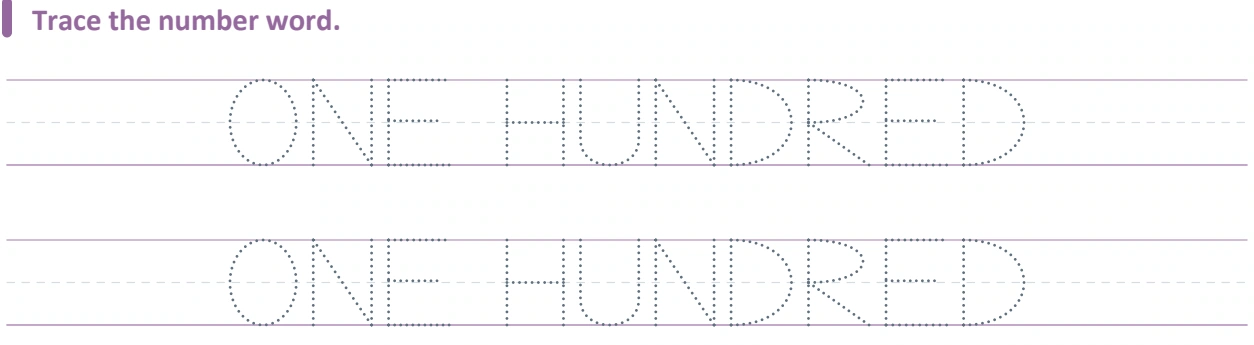
At the start of the reading turn, read ONE HUNDRED as two printed words separated by a space. The worksheet has two word rows in capital letters. Use one for following the printed name at speaking speed, and use the other for a slower pencil turn if the learner is ready.
Put a separate sign marked 100 next to a card with ONE HUNDRED. One person can quietly choose the card they are going to read. The listener holds up its match and explains why both can stand beside the same hundredboard display. Swap the cards before giving the next turn.
Two ways to run the hundredboard lesson
Family version. Fill a ten-by-ten grid, then label the entire grid as one hundred. Compare it with a single ten strip and one loose square to show the three different units.
Classroom version. Ask one team to check ten squares per row, a second to check ten rows and a reader to label the complete amount. Have a partner read the three digits in their written order.
Before switching roles, ask: How can a learner show that the two zeros in 100 do not make the whole amount zero? A child who can move the pieces but cannot yet explain the answer can show the action first. Give the next person a chance to describe what moved and what stayed fixed.
An independent check for the next 100 visit
Set out the hundredboard materials in a different arrangement but keep the total unchanged. Hand the child a correct 100 sign and another marked 99. Ask for a check that would convince a partner who did not watch the rearranging.
Switch from a written answer to a spoken one partway through. The learner can explain how the digits in 100 are ordered, then read one hundred back to the listener. If the words come easily but the count does not, return to the materials before filling more lines.
Keep the small success visible: set aside one readable numeral, one sensible explanation or one accurate sequence step. At the next visit, start by asking how the learner found it. Have the child pick a fresh model only after describing what they want to see in their own 100.
Find out which digit would change next
Set a small counter beside the completed hundred board. Ask the child to show where the counter would be placed if it belonged to the display. Draw three places on a card and invite a reader to mark the position they would change in 100. Then ask a partner to take the counter away again. The printed worksheet can serve as the report for the board alone, while the extra count goes on a separate card. Compare the zeros on the page with the two locations for pieces outside the board. This gives a reason for both marks even though there are no complete tens or ones sitting loose.
Choose a second activity after the hundredboard count
Try the 1–10 beginner tracing sheets for a shorter turn with earlier values, short practice with single digits for a change of pace, or an even-number game with dice as a different challenge. Ask which activity would help the 100 recorder most, and name one thing to watch while doing it.
The NAEYC family play articles offer ideas for taking turns. PBS KIDS Learn & Grow has early math activities for a day when the hundredboard learner would rather count, move or talk.
Print the 100 sheet for another visit
Download the original free PDF for 100, or sign in with an eligible membership to get the version without site branding. For either copy choose US Letter in portrait. Check that the outer rule and the bottom number strip both fit before making copies for a group.
Test the printed ONE HUNDRED rows on one sheet. If the guide dots are too light to follow, use the printer’s normal setting. The existing $8 collection contains this worksheet on page 100, and its page list continues in numerical order from 1 through 100.
Related Topics
Popular Worksheets
Printable resources families and teachers are downloading now.
 Free
 Free
 Free
 Free