
Clockface Number 12 Tracing for a Clever Read Beyond Ten
Keep the twelve lesson handy alongside the other 99 original tracing sheets in one $8 printable collection.
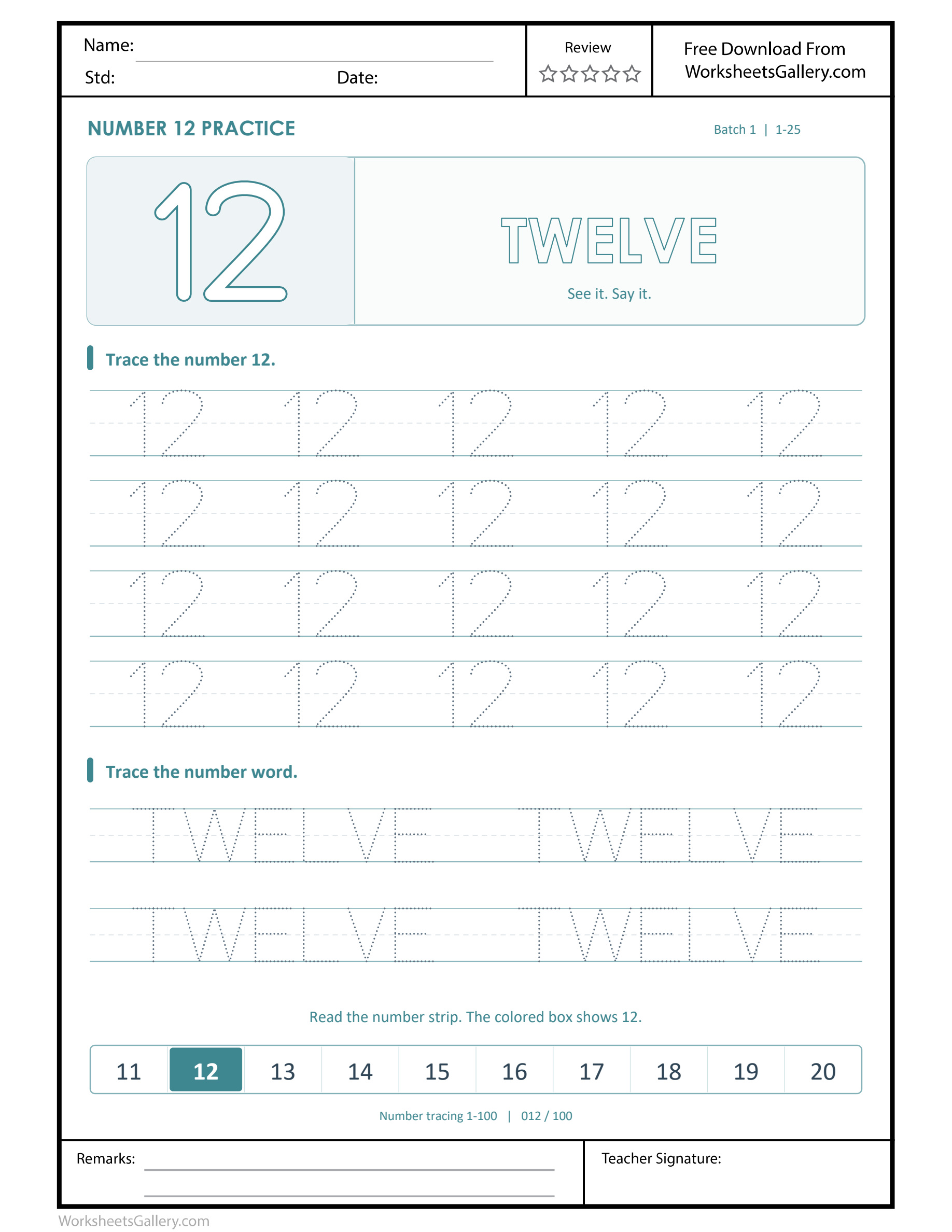
The original TWELVE worksheet retains every numeral, word and sequence activity.
The full sheet pairs the large 12 model with four numeral lines, two TWELVE writing rows and its ten-number strip.
Lina sets paper 12 at the top of a clock face, then searches for 12 in a row of number cards. The same symbol stays twelve while it occupies a different position in each arrangement. Bring the clock number cards to Number 12 Tracing and look for the printed answer. The word TWELVE has its own place, while 12 appears first as a big outline and later on dotted lines. Finish the clockface example by finding 12 on the short sequence strip.
Speak TWELVE and find its letters
Say TWELVE while showing 12. In this reading turn, read TWELVE aloud before noticing its TW and LV groups. Track TWELVE from its first letter onward. After one TWELVE trace, read 12 aloud again.
Make a loose 12 card and a separate TWELVE card. Put a few clock number cards nearby to keep the reason for using a label visible. The learner chooses which card to hold up when an adult says twelve during the clockface game.

Four places to look on the 12 printable
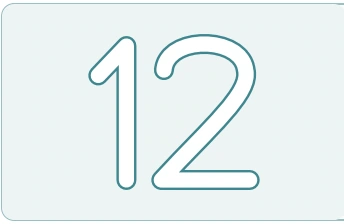
- Find 12 and TWELVE. The top panel separates 12 from its name. Say twelve, then point to the outlined 12.
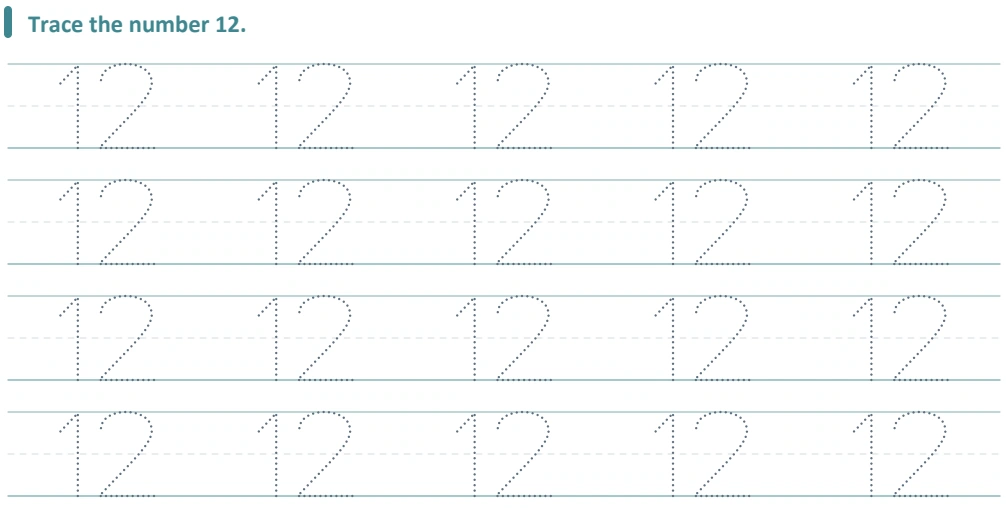
- Choose a line for 12. Each line has 5 dotted models of 12. Use just part of a row to hold the leading 1 straight, then follow the turn and base of 2.
- Trace TWELVE. Its two ruled lines show TWELVE in dotted capitals. Save the lower TWELVE line for another day.
- Locate 12. Position 2 on the strip shows 12. Point at 11 and 20 and decide whether 12 sits near an end.
A short clockface lesson at home
Make a small circle of paper number cards and lift 12 out. Place that same card next to 11 and 13 in a line, matching the printed strip's order.
- Start with the clockface supplies. Say 12 together before pointing at its outline.
- Ask how the clock number cards show one set of ten cards and two further cards. Let the child move those clock number cards while explaining.
- After the clockface activity, pick a dotted 12 model and have an adult read TWELVE.
- Note which part of 12 needed a cue. Plan the next clockface visit around that movement.
Place twelve at the end of a row
Take twelve cards from a pretend clock and set them in increasing order on a long table. Have the learner point at 12 at the right end, then turn to the worksheet. The worksheet begins at 11 and extends past 12, so the same number has moved relative to the edges. A child who knows the clock label can look at the print rather than using top or end as a guessing strategy. Make a separate 12 sign for the card set. Read TWELVE together while the written label still has a job.
Number 12 Tracing with a single movement cue
Make 12 on an imaginary board with a big arm motion. Reduce it to a finger motion when the learner can explain where to start. During that smaller rehearsal, hold the leading 1 straight, then follow the turn and base of 2. Keep the printed 12 in sight as a reference.
TWELVE gives a chance to hear a number name that is not produced by saying the two digits. Read it first. Then use the letters as a route for the hand. A child who knows twelve by ear may need adult help to match the spoken word to the capitals in its top panel.
Use twelve as a clock label and as a total
Put a numeral 12 on a clock drawing, then use a second copy on a collection of twelve round paper tokens. Ask which 12 could move from the clock's top to the token pile and still be read the same way. Look at the worksheet strip and have the child show how 11 leads to 12. A spoken answer tells you whether the label is familiar. A separate trace can show whether the 2 stays to the right of the 1. Listen for both clues before planning another worksheet turn.
What the label 12 says about clock number cards
Twelve as a clock label can occupy the top position, while the worksheet places it immediately after 11. Those places are meaningful in their own displays. Lina can hold the card between them and say the number each time. With counters, show a full ten and a pair to add a quantity model. A clock drawing is an extension outside the printable.
Why does the 12 card keep its name when Lina brings it down from the top of the clock? Listen for one set of ten cards and two further cards. With the clock number cards in view, decide together whether 12 still fits.
Six skills visible in the TWELVE practice
Troubleshoot 12 with a small second attempt
| What happened with 12 | Cue | Check for TWELVE |
|---|---|---|
| Reading 12 as 21 when the curved digit catches the eye first. | Return to one set of ten cards and two further cards. | Show the clock number cards and check the first label. |
| The pencil leaves a dotted 12. | Show where the printed 12 changes direction. | Follow one dotted 12 slowly and compare that turn. |
| The TWELVE label gets a quick guess. | Point across TWELVE. | Revisit a missed letter from TWELVE. |
| The reader misnames the 12 cell. | Look for 13 to the right of 12. | Hide 12 and read a neighbor. |
Choose one cue for the clockface moment. If the child rushes 12, check the count with the clock number cards first. Return to a short 12 attempt once the amount is clear.
Locate 12 without relying on the color
Look for 13 to the right of 12. Hide the shaded 12, read its exposed neighbors and ask which value is covered. Reveal 12 and read twelve. One correct location is enough during the clockface exercise.
Read just two or three cells near 12 while moving one finger per number. If a learner begins reciting at one, point back to 11 and say the printed starting value out loud. Let the child take over when the row reaches 12.

Share the clockface example with a small group
In a small group, compare a clock's 12 with the strip's second box from the left. Read 12 together first. Then divide the clockface jobs.
Assign one partner to move the clock number cards and another to read 12. A third child can ask, “Why does the 12 card keep its name when Lina brings it down from the top of the clock?” Rotate after one clockface explanation. Leave 12 in view for the partner who checks it.
Make a second clockface display by rearranging the clock number cards. While one learner writes 12, another can explain one set of ten cards and two further cards. Ask the group to find 12 on the 11–20 strip.
Five ways to bring 12 into play
- Make a clockface sign. Ask the learner to match an ordered card row ending at 12 to a clock model. Let a partner explain why 12 fits before tracing it.
- Rearrange the clock number cards. Count 12, move the clock number cards and predict the recount. Add one to 12 for a different result.
- Point to 12 in silence. Indicate 12 and a neighbor on the 11–20 strip. A partner reads 12 and chooses the TWELVE card.
- Record the clockface report. A child can explain one set of ten cards and two further cards in a pretend message. Give the report a 12 label.
- Write 12 on another surface. Set TWELVE next to a board or dark paper. Compare your two 12 attempts with the outline.
Return to 12 when the child is ready
The TWELVE page suits kindergarten and early primary learners around 4–7 with some pencil control. During clockface play, a younger child can point at 12 or move the clock number cards. Let the child choose when to try writing 12.
Give each visit to 12 a purpose. Try the shape of 12 today and explain the clockface count another day. Ask which TWELVE task to revisit.
Ask what changed in the latest 12. Did it help to hold the leading 1 straight, then follow the turn and base of 2? Save one TWELVE line for later. End with the child's description of 12.
Practice to pair with the clockface lesson
Compare a mixed 1–10 numeral sheet with your 12 lesson. Try the even-number dice game after clockface play, or pair 12 with the printable 1–6 dice activity.
Family play with clock number cards can grow from NAEYC family play ideas. For a clockface variation, browse PBS KIDS for Parents and adapt an activity around 12.
Download and print the TWELVE worksheet
Use the free download on this page for the original TWELVE worksheet. If you have an eligible active membership, sign in and choose the member download for the clean 12 PDF.
Select US Letter portrait for the 12 PDF. Check the border around TWELVE in print preview. Give the 12 dots a standard-quality test.
Print the clean TWELVE file without watermarks or ads. The $8 collection includes 12 and the other 99 sheets.
Related Topics
Popular Worksheets
Printable resources families and teachers are downloading now.
 Free
 Free
 Free
 Free