
Meadow Number 6: 7 Happy Butterfly Number Connections
Continue beyond six with the ten Number Discovery Boards. The clean 1–10 collection brings every lesson into one $4 PDF.
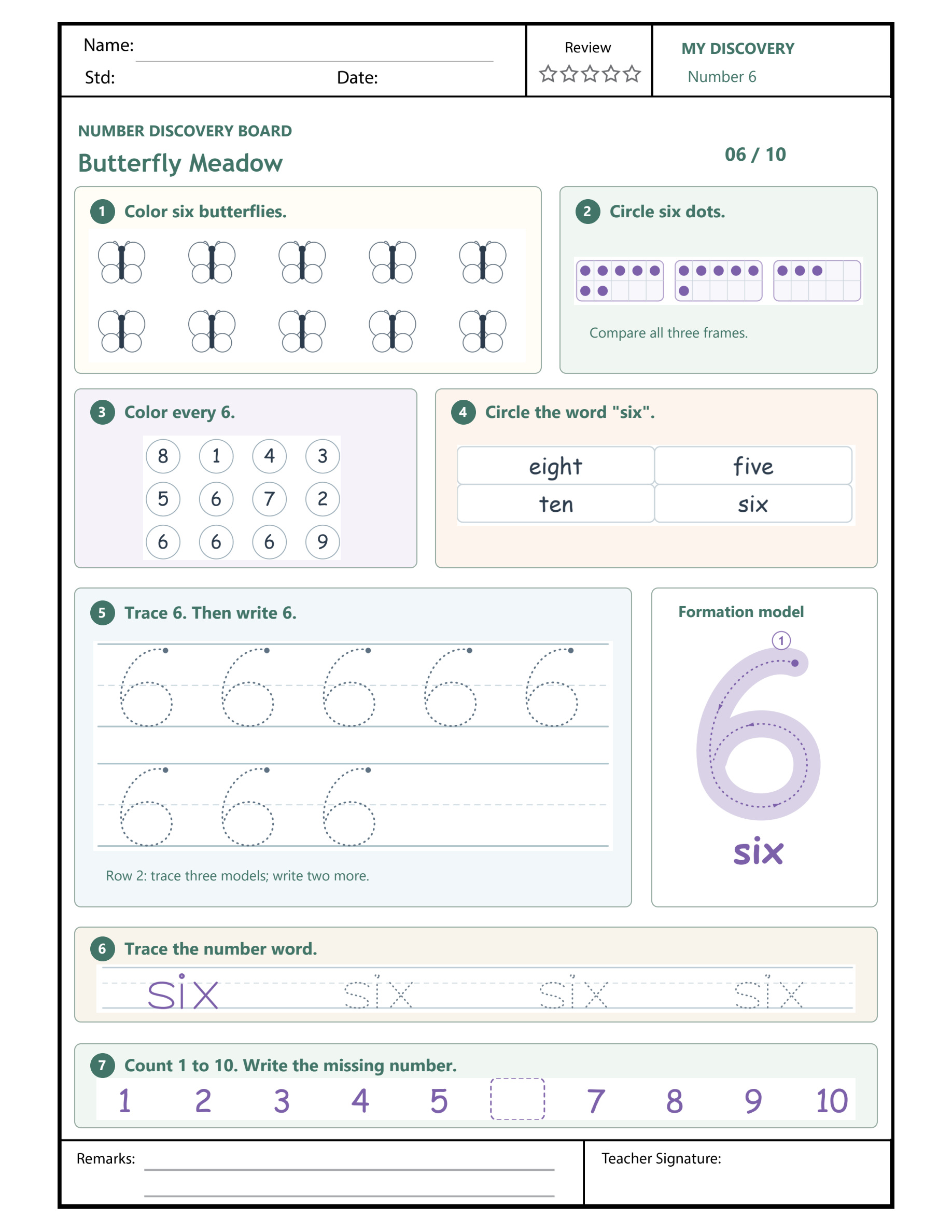
The entire six board is shown without cropping.
Butterfly Meadow retains picture quantities, frame choices, print recognition, numeral and word practice, and a missing-6 sequence.
Farah has five paper butterflies resting along a green strip when another butterfly arrives on a separate leaf. This time the amount really changes: there is a new member to include. Number 6 explores that arrival through the Butterfly Meadow board, linking a complete row of five with one additional dot, six selected pictures and the written numeral. The worksheet also offers word choices, tracing and an unfinished count. Use the arriving butterfly to establish the quantity, then decide which printed comparison will help Farah explain six with the least unnecessary pencil work.
Discovery note 01Number 6 begins one beyond a full five
Keep the first five butterflies on their strip and place the newcomer beside them. Count every complete insect, or use the familiar group of five and include one more if that method already makes sense to Farah. Neither approach needs to become a speed test. The important point is that the new butterfly joins the total rather than replacing one of the original group.
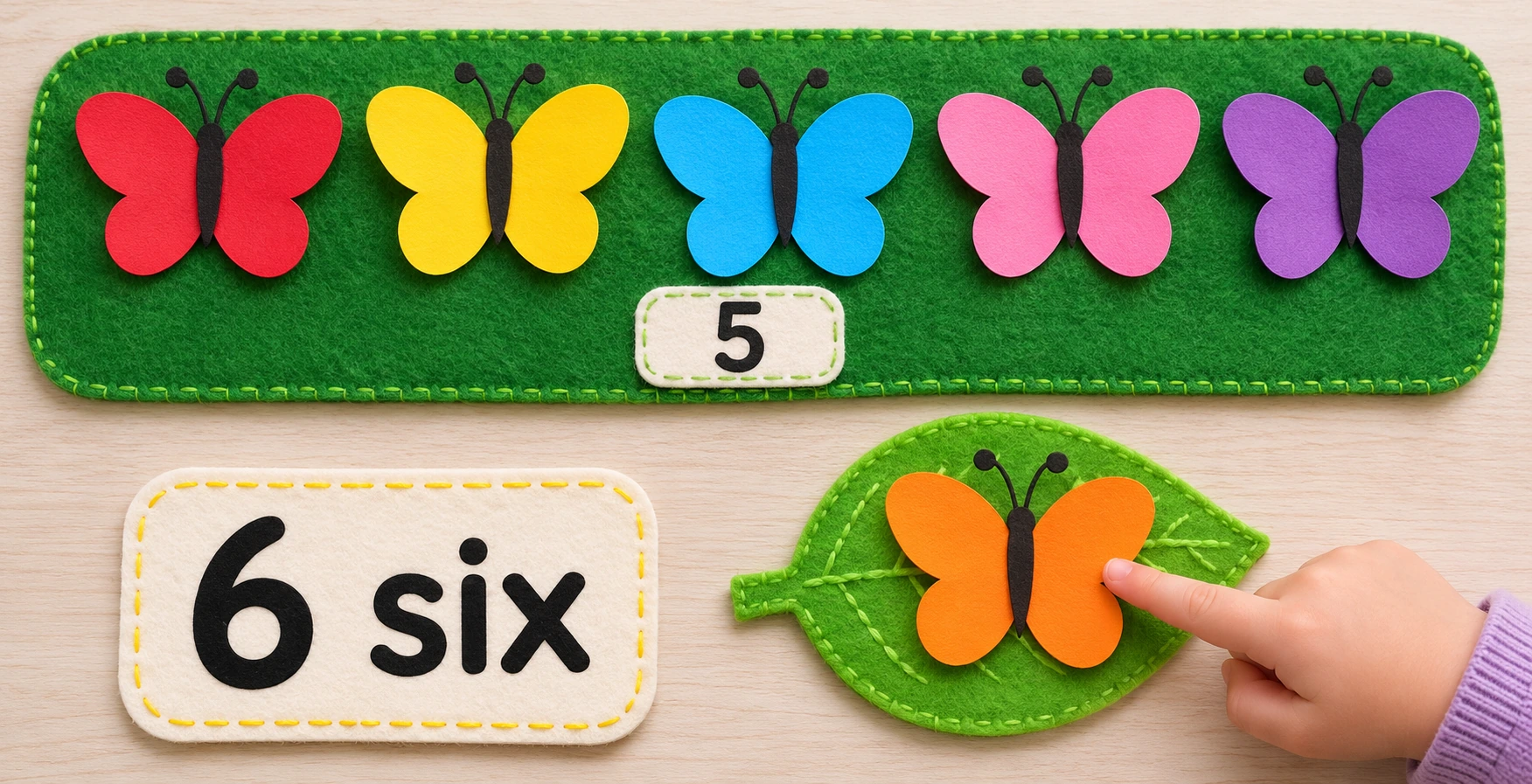
Contrast the arrival with moving an existing butterfly to another location. Adding a piece changes the quantity; relocating one of the same pieces does not necessarily do so. Show those events separately and name what happened. Asking the child to follow both changes at once would make it harder to understand which idea an explanation refers to.
Discovery note 02A meadow visit before opening the worksheet
At home, make a long resting strip and a smaller leaf shape from paper. Farah parks five large butterfly cutouts on the strip while the adult holds the sixth in view. Invite the child to decide where the newcomer should land. Once it is down, place a completed 6 card beside the whole scene and ask how the label could be checked.
The adult can act as a visiting naturalist who needs a report of the resting butterflies. Farah may point, move pieces or explain orally. Bring out the printed board after the group is established. A single frame decision can be enough to connect the pretend meadow with the paper, leaving writing and word recognition available for a different visit.
Discovery note 03Compare seven, six and three before choosing
The dot boxes show seven on the left, six in the centre and three on the right. The middle alternative has a full top row and one occupied place below. Its four other lower cells remain empty. Farah can compare that arrangement with the five butterflies on the long strip and the one on the separate leaf.
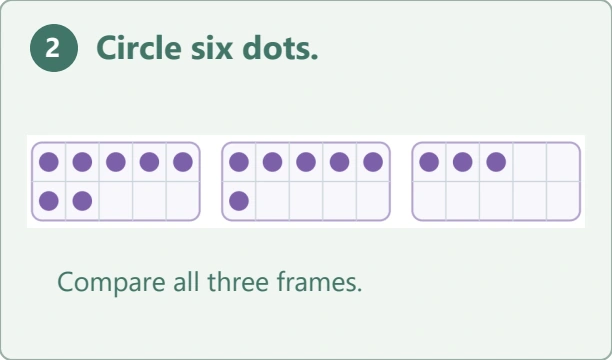
If the left frame is selected, inspect its lower row. Two extra dots accompany the full five there, whereas the request is for six. Let the child demonstrate the difference with large counters rather than merely moving the answer circle. Counting every dot is still appropriate when the grouped comparison is unfamiliar. The frame should support a decision, not impose a counting shortcut before it is understood.
Discovery note 04A quick evidence map for the adult
| Meadow task | Exact source detail | What agrees with six |
|---|---|---|
| Picture selection | Ten complete butterfly outlines | Six chosen, four left unselected |
| Symbol hunt | Twelve circles, four across | Cells 6, 9, 10 and 11 |
| Written-name choices | eight, five, ten, six | The lower-right word |
| Counting gap | 5 before the space, 7 after it | A complete written 6 |
Use this map after Farah has attempted a choice, or consult only the row relevant to the present question. The adult does not need to introduce every answer location during a first session. One explained decision is more informative than seven responses produced by following a pointing finger.
Discovery note 05Five reasons to keep the arrival visible
- A meaningful increase: the sixth butterfly shows why a quantity label changes, rather than presenting six as a detached symbol to remember.
- A grouped comparison: the resting strip and leaf give five-and-one language a concrete referent that matches the frame.
- A whole-object count: distinct butterfly bodies prevent wings and antennae from being mistaken for extra counted members.
- An orientation question: comparing the displayed 6 with a distracting 9 invites attention to where the numeral's loop belongs.
- A supported written response: the model and practice guides allow quantity understanding to be recognised even when handwriting still needs demonstration.
These opportunities combine reasoning, attention, descriptive language and controlled movement. Their value comes from the child's decisions and explanations, not simply from completing every printed space. Preserve room for the learner to choose a useful way of showing the quantity.
Discovery note 06Select insects, not wing shapes
Ten outlined butterflies occupy the picture bank. Each drawing has several visible parts, but it represents one complete insect. The instruction asks for six butterflies to be coloured. Farah can identify six intended outlines using large removable counters, then decorate those butterflies in any chosen colours. The remaining four stay outside the selected group.
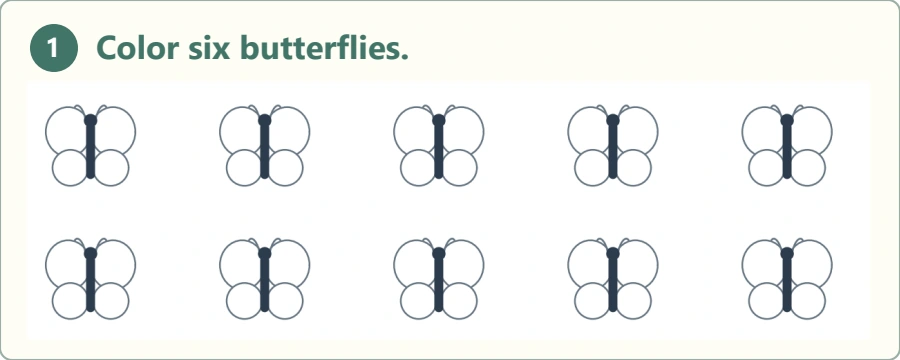
If a learner counts a pair of wings as two butterflies, move one whole paper cutout and describe it as a single insect. Compare the body and its attached wings with a complete printed drawing. There is no need to introduce a biological vocabulary test; the practical purpose is to establish which complete picture receives one count.
Discovery note 07Four matching 6s do not make the target four
The numeral search asks for every printed 6. Four entries match, at positions 6, 9, 10 and 11. Read the circles across the first row, continue across the second, then inspect the last row. The three neighbouring 6s in the final row can make it easy to miss another match elsewhere, so a deliberate checking pass is worthwhile.
A 9 appears at the end of that last row. Compare its upper loop with the lower loop on the displayed 6 model, keeping the paper upright in its intended reading direction. Rotating the page can change the visual comparison and confuse the instruction. Offer the model again whenever the learner is unsure; this is supported recognition rather than an unsupported recall challenge.
Discovery note 08Four meadow games to try between paper visits
Announce a real arrival
Start with five cutouts and invite a sixth to land. Farah changes the completed quantity label from 5 to 6 only after the new member is visible. Ask which event made the label change. Moving an old butterfly between leaves can be tested separately.
Make three pairs
Arrange the six pieces as three groups of two, then gather them into a single display. Let the child choose a checking method. The new grouping offers another view of six without requiring the worksheet's frame to be altered.
Compare two meadow reports
One puppet reports that seven butterflies landed; another says six. Keep the actual six pieces visible and invite Farah to check the reports against them. Accept pointing or moving as well as speech, and make the correction about evidence rather than about a puppet being clever.
Label a new resting place
Move all six paper insects onto a different mat and prepare a completed 6 sign for that display. Discuss the changed location and the unchanged members. The child can dictate a caption for an adult to write beside a short numeral attempt.
Discovery note 09Six has a short written name
The word-choice grid offers eight and five on top, followed by ten and six. The intended match sits at the lower right. Give Farah the model six to inspect and read its name aloud. A child may understand the butterfly total before recognising this spelling, so the reading support should remain available during the comparison.
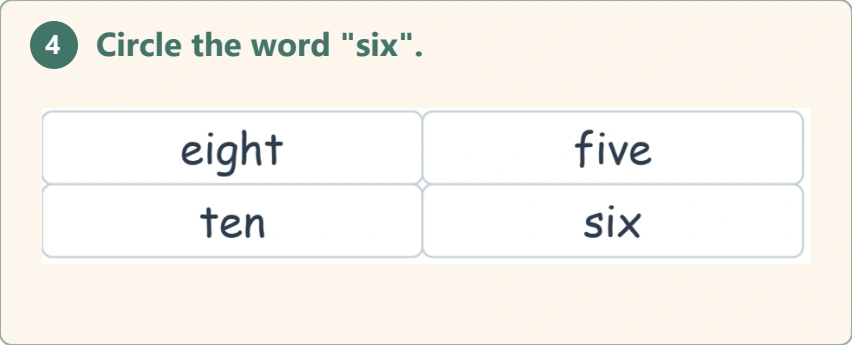
The writing strip contains an outlined six and three dotted versions. Its three letters do not mean the quantity is three. Connect s-i-x with the spoken name and the complete six-butterfly group. Letter counting may be interesting as a different activity, but it should not silently replace the number question the board is asking.
Discovery note 10Give the lower loop a planned movement
Look at the start marker on the large numeral model and follow its route into the lower loop. An adult demonstration on a separate large sheet can make that movement easier to observe than a quick correction over the child's pencil. Farah may rehearse with a finger before choosing one dotted example on the board.
There are five models across the first numeral row. Three more begin the second row, with space for two independent 6s afterwards. The lower-row note refers to tracing three examples of the current target. Stop after a useful attempt if the movement is tiring. Being able to explain six butterflies does not depend on producing ten fluent handwritten copies in the same sitting.
Discovery note 11A missing six follows a visible five
The sequence at the foot of the board leaves its sixth position open. The printed neighbours are 5 and 7. Farah can say the missing name, choose a numeral card or write 6 after discussing that local relationship. Those options let the adult separate a sequencing decision from the motor demands of forming the answer.
Use a short card sequence containing five, six and seven if the longer line is distracting. Restore the middle card after removing it in view, then compare with the page. A learner who skips the spoken word may need that ordered comparison; another who says six correctly but writes a reversed mark may need help with formation instead.
Discovery note 12Let a classroom group document the newcomer
Give learners the jobs of meadow arranger, arrival announcer and quantity checker. The arranger begins with five large butterfly pictures. The announcer introduces the sixth, and the checker explains which completed numeral label now belongs. Rotate the jobs so that handling, speaking and checking do not remain fixed to particular children.
The teacher records the children's account beside the visible display, then offers the corresponding board for individual frame choices. Invite a short explanation before discussing responses together. A learner can contribute a precise pointing action while an adult supplies the spoken phrase. There is no need to turn an arrival story into a race to be first with a written answer.
Discovery note 13Make repetition answer a particular question
For adult-guided learners around three to six, the practical arrival may be more accessible than the full printed page. Begin there when necessary. A confident child might compare the six- and seven-dot alternatives, while a beginning writer chooses one lower-loop rehearsal. The arrival story can serve Farah's group while each learner tackles a different amount of writing.
On a return visit, change the butterfly colours or landing place while keeping the number of actual pieces explicit. Notice whether Farah includes the newcomer, checks the extra dots or distinguishes 6 from 9. Avoid interpreting a single incorrect mark without asking what it represents. A calm explanation and a manageable next attempt can keep the meadow inviting.
Discovery note 14Connect six with another view of quantity
The lemon-and-finger six lesson provides another visible grouping. The picture-counting choice page offers a different selection decision. A separate pencil-movement concept workshop can support an isolated turn or curve. For additional shared play, consider NAEYC's family resources on play and PBS Parents' learn-and-grow ideas.
Discovery note 15Retrieve the Butterfly Meadow version you need
The original upload remains the free sample for this lesson. Active eligible members can choose the clean six board from their account's premium download route. Its printable removes domain credits, website watermarking and advertising. The related collection card opens a separate $4 purchase that combines the complete ten-board sequence in one clean PDF.
Try one US Letter print and check the whole frame, small wing outlines and numeral guides before making extra copies. Keep the chosen version with the meadow pieces so another visit can begin from a useful observation rather than a search for the file.
Related Topics
Popular Worksheets
Printable resources families and teachers are downloading now.
 Free
 Free
 Free
 Free