
Number Discovery Boards: 10 Brilliant Counting Journeys
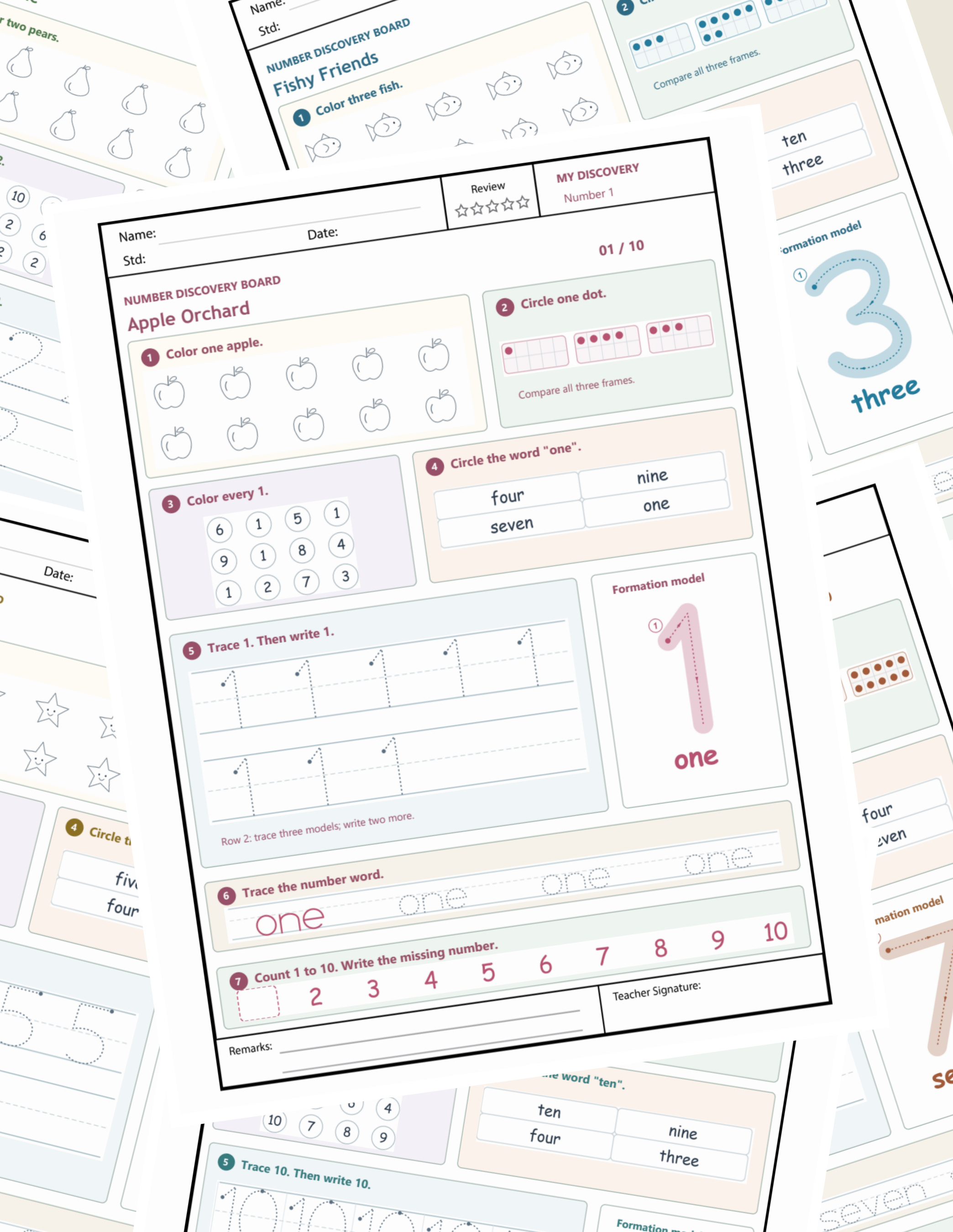
The collection preview uses its own clean worksheet pages.
The complete Apple Orchard board sits in front of angled pear, fish, star, kite and shell sheets.
A shell tray is full, a picnic needs two pears, and one apple has already been chosen. Those situations ask children to do more than recite a counting rhyme. Number Discovery Boards gathers ten printable lessons that connect an amount with its pictures, dot pattern, numeral, written name and place in a sequence. The clean collection costs $4 and contains one board for each number from 1 through 10. Its quantity-first arrangement invites a conversation before handwriting, leaving adults free to choose the task that addresses the learner's actual question.
Discovery note 01Ten settings with a different quantity question
The collection follows Apple Orchard, Pear Picnic, Fishy Friends, Flower Garden, Star Party, Butterfly Meadow, Kite Day, Rocket Trip, Cupcake Cafe and Seashell Shore. Every setting provides ten pictures, but the requested selection changes. One apple leaves nine pictures untouched; ten shells requires the complete supply. Finishing a colouring panel therefore means meeting its particular quantity, not filling every available outline.
Each number also appears among twelve numeral choices, four written number names and three ten-frame alternatives. These are different comparisons. A child may recognise a familiar digit while still counting objects twice, or count accurately while needing the adult to read a number word. The boards make those differences available for discussion instead of hiding them behind one overall completion score.
Discovery note 02Number Discovery Boards begin with quantities
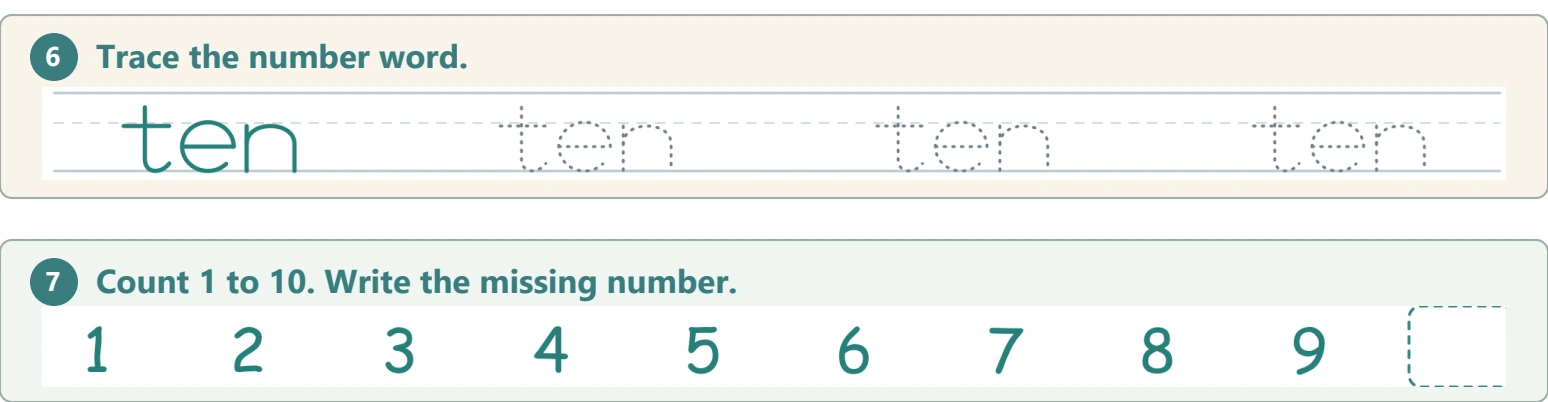
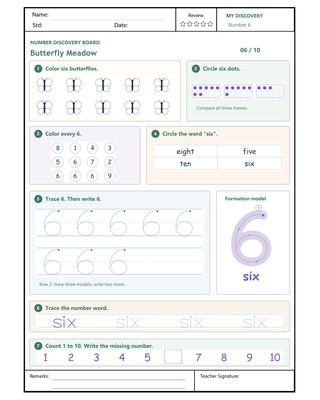
The upper shelf pairs picture selection with dot-frame comparison. Recognition sits beneath it: a numeral search on one side and written-word choices on the other. Lower down, the numeral studio keeps a large formation model beside two ruled practice rows. The number-name strip and the unfinished 1–10 sequence complete the route. These seven activities preserve the supplied exercises inside their established outer frame.
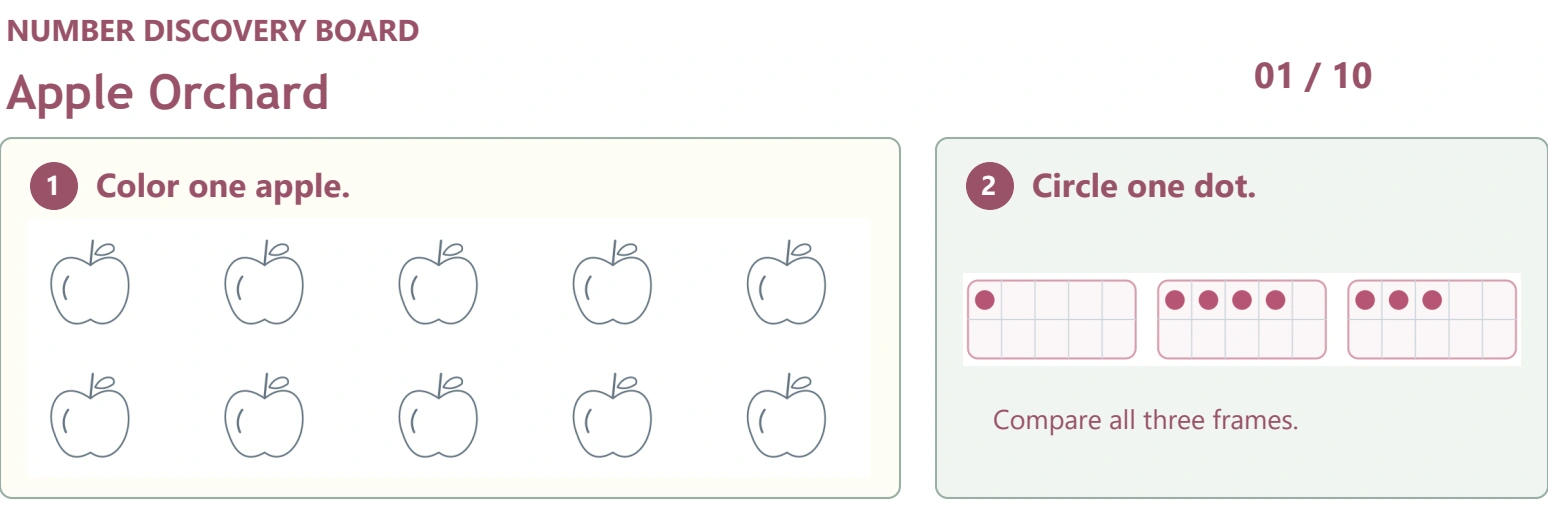
That physical order is an invitation, not a lesson timetable. Someone who already understands a quantity may begin with the word choice. A child confused by a dot arrangement may need movable counters before touching a pencil. Adults can visit one shelf, turn the paper over for a conversation, and return to another area later. The page does not become less useful because part of it remains unmarked.
Discovery note 03Seven connections to watch for
- A stable amount: moving selected objects farther apart can test whether the child thinks the quantity changed with the spacing.
- One count for each item: pointing or moving pieces reveals whether a spoken counting word is being paired with each object.
- A deliberate stopping point: selecting the requested number means leaving the remaining pictures alone when the target is below ten.
- Pattern comparison: ten-frame choices let a learner compare occupied places, including a full row of five and additional dots.
- Recognition across print: a numeral and a written name refer to the same amount while looking very different on paper.
- A planned pencil movement: the large model, dotted attempts and open writing space provide different levels of formation support.
- A place in order: the final gap asks where the target belongs in the familiar sequence, adding a relationship beyond isolated recognition.
Treat these as things to observe together. Correct handwriting alone does not establish accurate counting, and a confident oral explanation does not mean a child can yet form a numeral independently.
Discovery note 04What a ten-frame asks the reader to compare
A ten-frame has ten available places, arranged as two rows of five. The matching frame on the six board contains a complete row and one more dot. The eight board requires five and three. The ten board shows both rows occupied. Empty places remain part of the frame; they do not become invisible simply because they hold no dots.
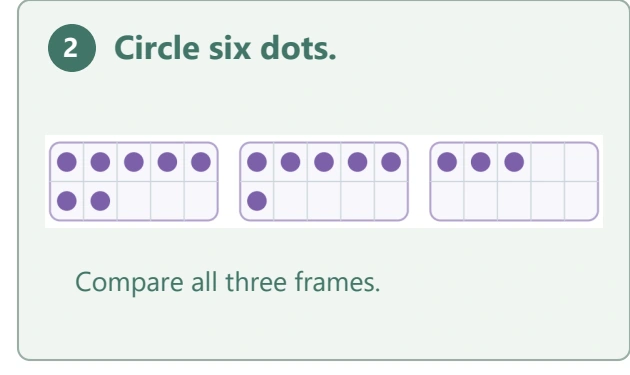
The three alternatives differ on each board. Encourage a comparison of their actual dots, rather than teaching that the centre or right-hand box is usually correct. For a child who needs to count each mark, cover the other alternatives temporarily with a loose sheet. After counting, uncover them and ask how the chosen amount differs. The covering is a temporary support, not a requirement to memorise positions.
Discovery note 05A home session beginning with an unfinished picnic
Set out two large pretend pears and a picnic cloth. Ask the child to prepare a pair for a toy guest. Once both pears are visible, move them apart without adding or removing anything. Invite a description of what changed. The distance changed; the quantity did not. Bring out the two board and locate a picture selection or dot frame that agrees with the picnic.
Writing can follow that practical check. An adult points out the start dot and demonstrates the route once. The learner may try one dotted example while the adult writes a short picnic caption on spare paper. Stop before hand fatigue makes the next part unpleasant. Another day, change the fruit props or the guest while keeping the requested pair, so the child's response has a fresh setting.
Discovery note 06Small-group teaching without a race
At a classroom table, give one learner the role of arranging large counters and another the role of describing the arrangement. A third can select a numeral card. Rotate after a shared explanation. Use one board at a time so that nobody has to search ten sheets while also remembering a spoken instruction. The teacher reads unfamiliar surrounding words.
Choose a precise observation for each learner. Perhaps one child stops after selecting seven, another notices an unfilled frame place, and another checks a written name against its model. Record the help that made each response possible. Comparing who finishes first would obscure those useful details, particularly when children differ in language experience, confidence or pencil stamina.
Discovery note 07Read the practice rows literally
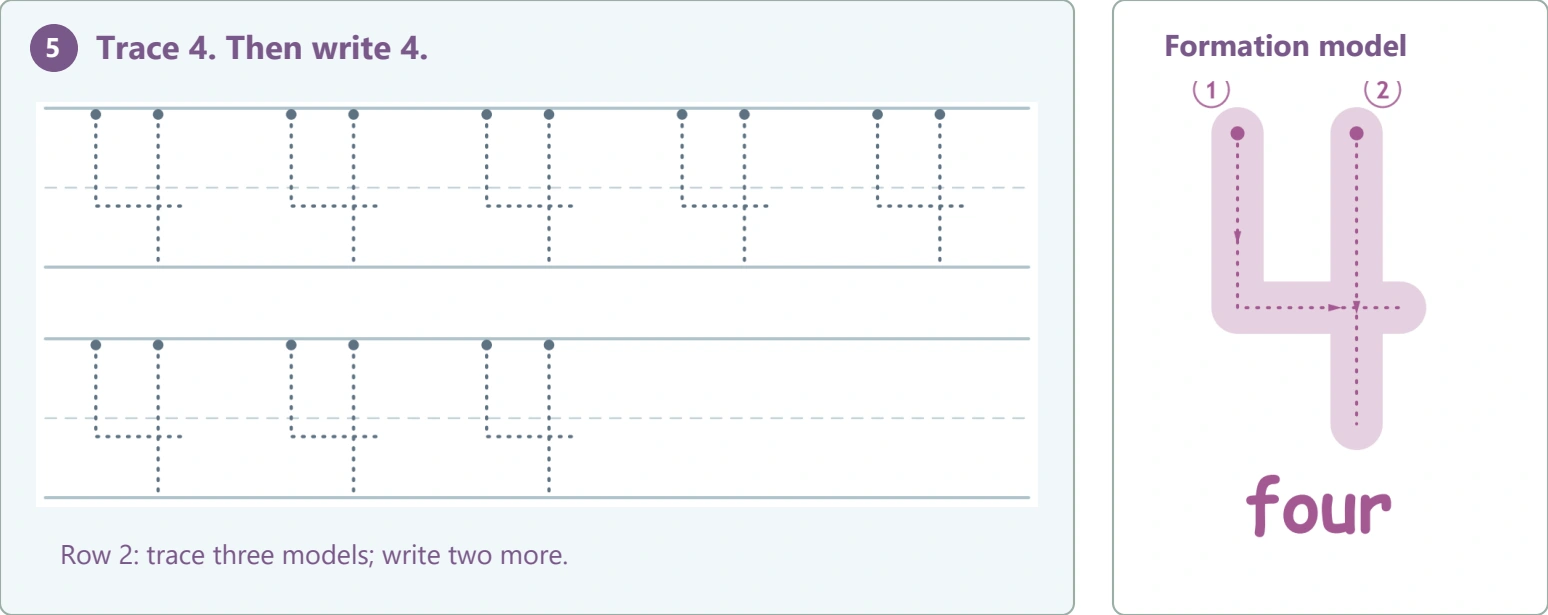
The numeral studio contains five dotted examples on its first ruled row. The second row supplies three dotted models and room for two more attempts. Its instruction to trace three refers to three examples of the current target; it does not ask every learner to write the digit 3. On the ten board, each example is the complete two-digit numeral 10.
The number-word strip offers an outlined name followed by three dotted versions. A learner may recognise the amount before being ready to spell its name. Read the whole word naturally and show how it connects with the numeral. Avoid making independent reading of every number word a prerequisite for counting the pictures accurately.
Discovery note 08Choose support from the response you hear
| Observed response | A useful adjustment | Check afterwards |
|---|---|---|
| Counts an item twice | Move each large counter to a finished area. | Does each object receive one count? |
| Chooses the widest group | Keep the objects and change their spacing. | Can the child explain whether the amount changed? |
| Knows the amount, avoids writing | Accept pointing and demonstrate one formation. | Is a short supported attempt comfortable? |
| Copies without interpreting | Ask for a matching picture selection. | Does the written symbol connect with quantity? |
These adjustments answer different difficulties. More copying cannot by itself explain why six is one beyond a full row of five. Equally, another counting game may not resolve an unfamiliar pencil turn. Keep the question small enough that the learner and adult can tell what the next attempt is meant to investigate.
Discovery note 09Five ways to take the boards off the table
Build a travelling number museum
Choose three boards and prepare a matching display of large objects. Give every display a completed numeral label. A visitor describes one collection before looking at the paper. Swap the labels deliberately only after the correct arrangement is understood, then invite the curator to repair the mismatch and explain the decision.
Make a star row, then disturb the spacing
Arrange five large paper stars in a clear row. Count them together, then spread them unevenly while everyone watches. Let the child decide whether a recount is needed. The stars have changed position, while the group can still correspond with five. Return to the printed frame when the learner wants a stable comparison.
Prepare a pretend launch hangar
Place eight paper rockets in two groups of four. Rearrange them as five and three without hiding any. Ask partners to compare their descriptions of the same total. The rocket board supplies a written eight and a structured dot pattern, but the loose rockets allow children to make and discuss their own grouping.
Open a cupcake order desk
Use nine paper cupcakes and an order card labelled 9. One child fills the order; another checks by pairing each cupcake with a position on a ten-space tray. The empty position is informative. Change to a different number only when the original order has been checked, rather than mixing several quantities during an uncertain first attempt.
Complete the shore display
Put ten large shell pictures on two five-place strips. Read the label ten and show the written 10. Ask what happens if one shell moves to another part of the display. Keeping every shell visible lets a child compare location with quantity before confronting a partly hidden collection.
Discovery note 10A sensible age range with room for different starting points
Adults can use these lessons with many preschoolers and kindergarten learners, often aged three to six. The youngest participants may work mainly with objects and spoken descriptions. Others may be ready for careful comparison, number-name recognition or independent writing. Age does not make those skills arrive together, and the complete board is not a compulsory task list.
Start with a quantity the child can investigate meaningfully. Being able to recite numbers to ten does not automatically establish a reliable count of ten objects. Offer time to point, rearrange, gesture and explain. A hesitant response may reflect unfamiliar instructions rather than an absence of number understanding. Showing one example is often more useful than repeating the same question more loudly.
Discovery note 11Keep the return visit recognisable but worthwhile
Save a brief note about the first session: which quantity was chosen, which arrangement was used and what assistance helped. On a later visit, alter one feature, such as the spacing or the kind of large counter. That gives the child a reason to think again without making every part unfamiliar. Invite a choice between two suitable activities.
Notice an actual decision when offering encouragement. A learner might catch a skipped picture, explain an empty frame space or remember both digits in 10. Those observations describe learning more accurately than a general promise about being brilliant at maths. The child can leave the table after one worthwhile contribution and still have something concrete to revisit.
Discovery note 12Follow another route when the need changes
The finger-counting collection offers another way to represent amounts. For a more focused sequence question, explore the number-neighbour homes activity. A separate prewriting concepts workshop can address pencil movements without adding quantity decisions. Families can also find shared-play ideas through NAEYC's play resources and PBS Parents' learning activities.
Discovery note 13Buy one clean file and print the boards you need
The collection purchase is $4 USD. Use its purchase control, complete the website checkout and retrieve the authorised download from your account. The merged PDF contains the ten discovery boards in numerical order. The clean pages omit the site's watermark, domain lettering and advertisements. Membership access to an individual clean board is a different download option from purchasing this combined product.
Choose Letter-size paper and proof one selected board before making more copies. The outer frame, small search choices and faint writing guides should remain visible. Keep the file available to the adult who chooses the next lesson. Printing all ten pages is optional; selecting one useful quantity can be a complete beginning.
Related Topics
Popular Worksheets
Printable resources families and teachers are downloading now.
 Free
 Free
 Free
 Free