
Seashore Number 10: 7 Wonderful Shell-Counting Tasks
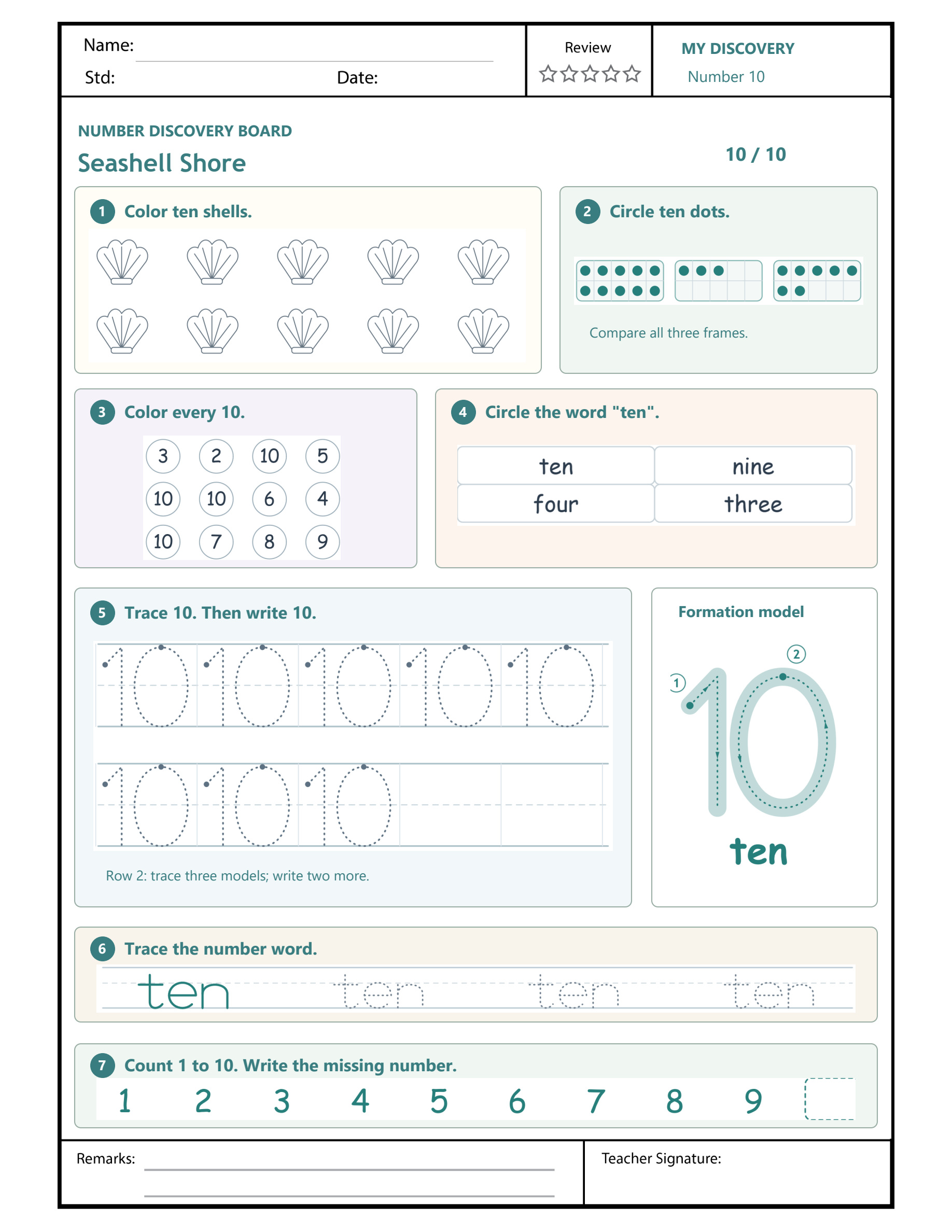
Continue beyond ten with the ten Number Discovery Boards. The clean 1–10 collection brings every lesson into one $4 PDF.
The entire ten board is shown without cropping.
Seashell Shore retains picture quantities, frame choices, print recognition, numeral and word practice, and a missing-10 sequence.
Joon finishes a shell display by placing one picture in every compartment of a two-row tray. Five shells sit above five more, and the completed label reads 10. Number 10 connects that full collection with the Seashell Shore discovery board. Seven activities explore the amount through pictures, dots, a two-digit numeral, its written name and the end of a counting sequence. Begin with the complete tray and a spoken check. The writing model can then show how two separate digits work together in one number, without making every paper task part of the same sitting.
Discovery note 01Number 10 writes one amount with two digits
The numeral 10 contains a 1 followed by a 0. Read the complete pair as ten when it labels this shell collection. The 0 is part of the written number; it is not a separate instruction to select no shells. Keep a completed 10 card beside the actual tray so the combined notation has a visible quantity to refer to.
Show the two digits in their intended left-to-right order. Joon can point to each part while the adult reads the complete name. There is no need to teach a long place-value lesson before using the board, but it is useful to distinguish the two written characters from two separate quantities. Every dotted example on the sheet shows the full numeral 10.
Discovery note 02Two full rows agree with the shore label
The correct ten-frame is the left alternative. It has five dots in each row, filling all ten available places. The middle choice contains three dots, and the right contains seven. A frame being large or rectangular is not enough to make it ten; the occupied positions have to agree with the requested amount.
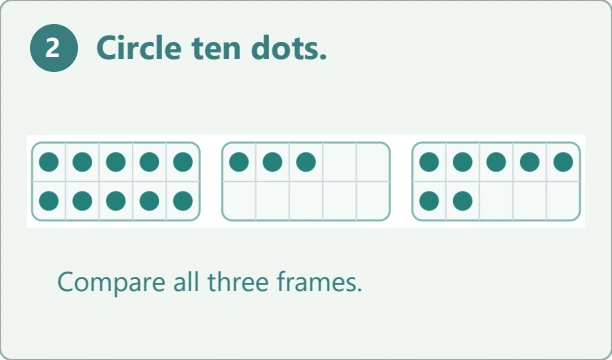
Compare the complete frame with the shell tray. Each place in one row can be paired with a shell picture above, and the lower row with the other five. Count every shell if that is Joon's preferred method. Seeing two full five-place rows may become a useful way to describe ten, but the adult should not require an instant total before the arrangement is understood.
Discovery note 03Build a complete shell exhibit at home
Prepare ten large shell drawings and a mat divided into two rows of five places. Joon becomes the curator, putting one picture in each compartment while the adult checks the display. If a place is empty or holds two shells, the structure makes it possible to inspect the mismatch. Keep the unused pieces visible until the arrangement has been checked.
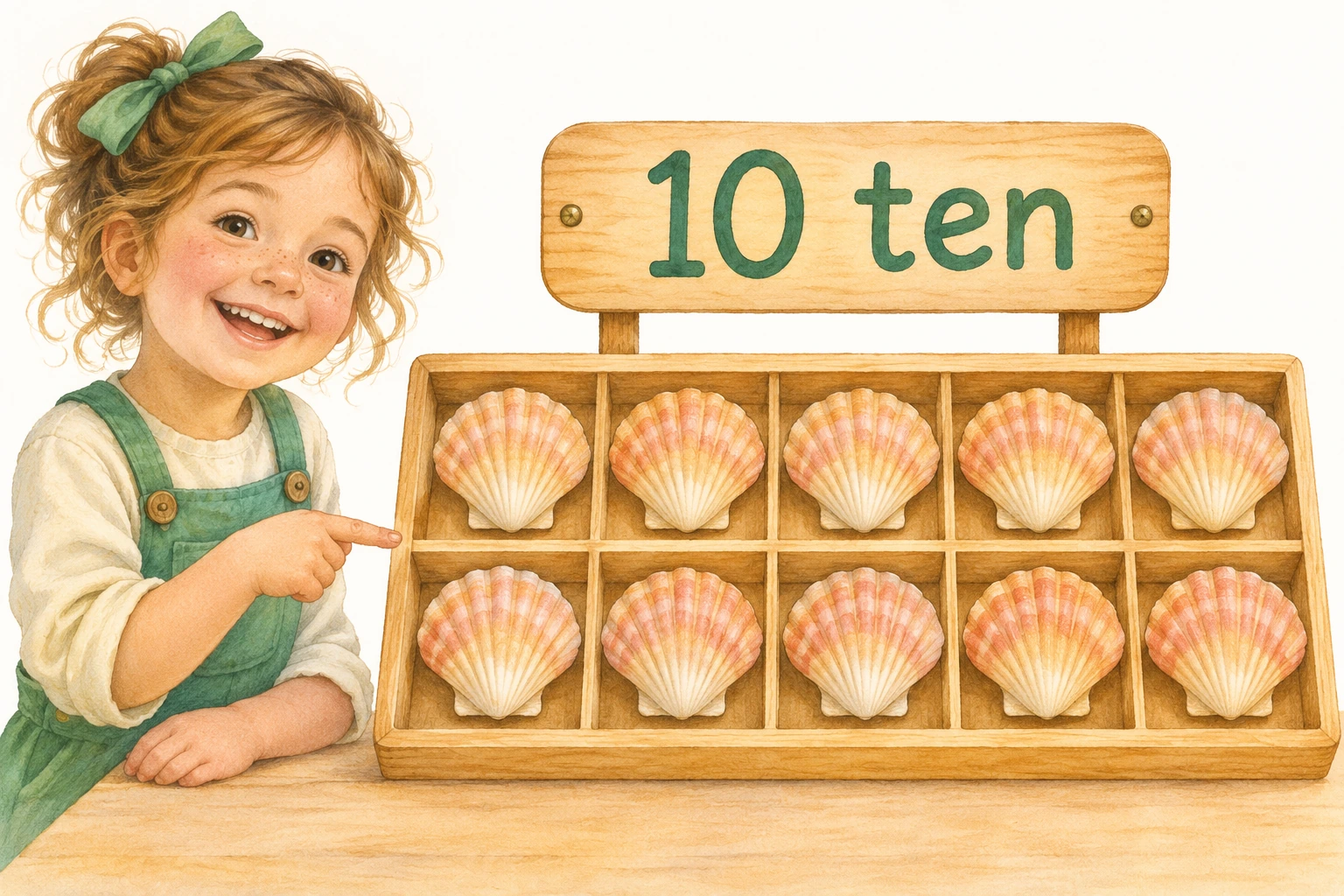
Once the exhibit agrees with its completed label, move a shell to another part of the table. The total collection may still contain ten even though the tray is no longer full. Discuss which collection the label now describes. The distinction between the whole exhibit and the tray's contents is worth making explicit rather than quietly changing the counting boundary.
Discovery note 04All ten printed shells belong to this selection
The picture bank contains ten complete shell outlines, and this time the instruction asks for ten to be coloured. Every outline therefore belongs in the selected group. That is different from earlier boards whose requested amounts were smaller than their supplies. Explain the quantity request rather than teaching a general rule that every picture on a worksheet must always be filled.
Count whole shells, not their ridges or fan-shaped sections. Joon may choose different colours for the outlines without changing how many shells are selected. If a partly coloured shell leaves the response uncertain, ask whether it is intended to be included. A pointing check can clarify the mathematical decision while the colouring remains a separate fine-motor activity.
Discovery note 05An adult's guide to the shore decisions
| Shore location | What is printed | Response to check |
|---|---|---|
| Picture bank | Ten complete shell outlines | Every shell selected |
| Dot comparison | 10, 3 and 7 dots | The left frame |
| Symbol hunt | Twelve numeral circles | 10 at positions 3, 5, 6 and 9 |
| Word-choice grid | ten, nine, four, three | ten in the upper-left box |
| Counting finish | 1 through 9, then a gap | The complete numeral 10 |
Read the reference as an adult checking aid after Joon has investigated a task. Supplying every location before the attempt would remove the decisions. The search positions are counted across four circles at a time, continuing on the next row, so the numbering describes where to look rather than adding a new written task.
Discovery note 06Five connections in a complete ten collection
- Capacity and occupancy: a two-by-five tray can show ten through one object in every available position.
- A complete selection: the child can explain why all ten shell outlines are required here rather than applying an automatic colour-everything habit.
- A two-digit symbol: reading 1 and 0 together links a new written form with the visible whole collection.
- A coordinated pencil pair: two marked starts belong within each complete 10 attempt, making spacing and order part of formation.
- An endpoint in sequence: the final gap completes the stated 1–10 range without needing another printed neighbour on its right.
These connections support comparison, attention, number language and controlled writing. They should be observed with the help provided in mind. A child may fill the tray accurately while needing an adult to read ten, or recognise the numeral while still practising the 0 movement.
Discovery note 07A classroom curator reports the complete exhibit
Allocate the jobs of arranger, label finder and checker to a small group. The arranger fills the tray, the label finder selects a completed 10 sign and the checker explains whether the displayed shells agree with it. Rotate those jobs after a shared observation. An adult can supply the surrounding spoken language while a learner points to the relevant objects.
Then invite an individual printed decision before discussing answers together. A child might choose the frame, locate ten or show which picture outlines belong to the order. Keep the physical exhibit visible during the explanation. This gives every response a reference and avoids turning a quantity lesson into recall of shells that have already been hidden away.
Discovery note 08Keep the 1 and 0 together in the hunt
The matching 10 entries occur at positions 3, 5, 6 and 9. Four circles should be coloured. The hunt asks for every copy of the complete target, not for ten marked circles. It also does not ask the child to treat the 1 and 0 within one circle as two separate search items.
Point beneath the full model and read ten before inspecting a candidate. If the learner names the digits separately, acknowledge the parts and model their combined number name in this context. A deliberate scan through each row can support organisation. The adult can show where the next row begins without selecting the remaining matches on the child's behalf.
Discovery note 09Two starting markers belong to each 10
The large formation model provides a start for 1 and another for 0. Follow those indicated routes in order, keeping the two digits together as one numeral. Demonstrate on a spacious separate sheet when the printed model is hard to follow. Joon may rehearse each movement with a finger before making a complete paired pencil attempt.
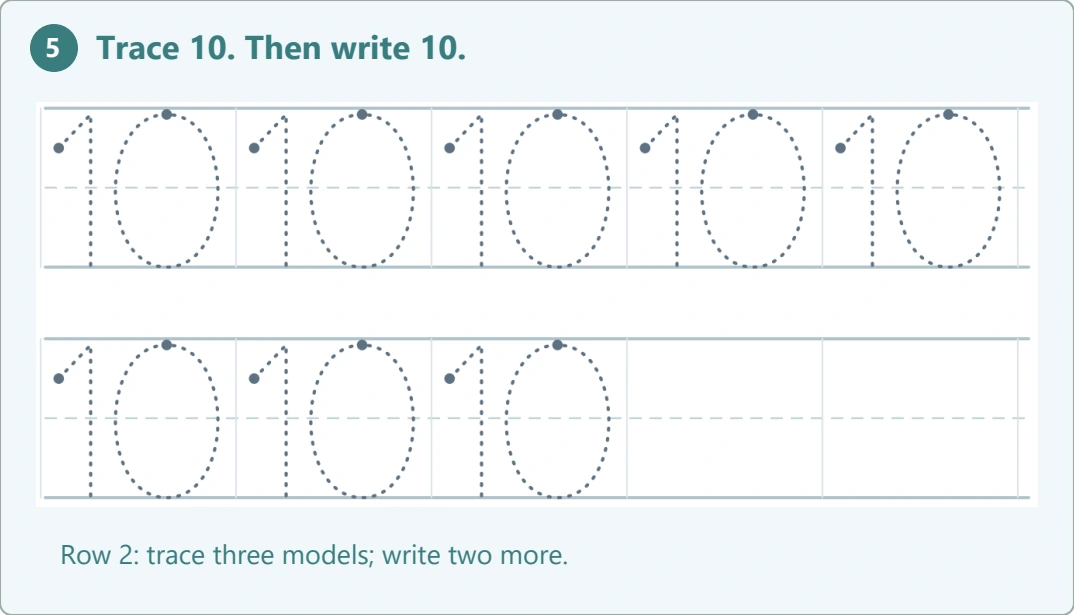
Five dotted 10s fill the upper practice row. The lower row contains three supplied 10 models, followed by space for two new complete pairs. The instruction to trace three means three of those 10 examples, not three individual digits or a change to the numeral 3. Check whether both digits have been included before considering neatness or the number of finished copies.
Discovery note 10Ten has a short written name
Ten is at the upper left of the word grid, beside nine and above four. Three occupies the lower-right choice. Ten and three share a first letter, so inspect the rest of the model when a first-letter guess is uncertain. An adult reading the choices can support this print comparison while leaving the quantity decision available to the child.
The separate writing strip shows an outlined ten and three dotted versions. Read the complete name beside the 10 card and the actual tray. A learner who can count the shells should not have that understanding dismissed because the spelling is unfamiliar. The word model offers another connection to explore, with support appropriate to the child's reading experience.
Discovery note 11Complete the range after nine
The final sequence prints 1 through 9, then leaves the last position open. Joon writes 10 to finish the stated range. No printed 11 follows the gap. Use the end of the spoken count or a completed ten card to support the decision without quietly extending the task to another number range.

Check that both digits fit inside the response area in their correct order. If Joon identifies ten aloud but writes only 1, revisit the complete numeral model rather than repeating the sequence question alone. The child's ordering knowledge and written notation can require different kinds of help, and the next attempt should address the part that is actually uncertain.
Discovery note 12Five further jobs for a shore curator
Check a tray with one empty place
Begin with nine large shell pictures and keep the tenth nearby. Ask Joon whether the display agrees with 10 and how it could be completed. The extra piece should join through a visible quantity decision rather than an unexplained adult repair.
Rearrange the entire collection
Move all ten pictures from the tray into a long row on the table. Keep every shell visible and let the child choose a checking method. A less compact arrangement can still agree with the same whole-collection label.
Make two different display signs
Place a completed 10 card beside one ten-shell collection and the written word ten beside another. Read both signs with the adult's help, then compare the actual amounts. Different written forms can identify agreeing quantities.
Dictate a museum note
Joon describes how the shells are arranged. An adult writes the unfamiliar words and invites the learner to add a supported 10. Read the completed note beside the exhibit so the numeral's purpose remains visible.
Transfer the label to new objects
Replace the shell pictures with ten large blocks on another visit. Check whether the quantity sign remains suitable, then discuss what changed about the display's subject. The number can describe a different material without changing its amount.
Discovery note 13Support a full count without requiring a full page
Guided preschool and kindergarten children, often around three to six, may approach ten through different levels of experience. Some need a slow one-object-at-a-time placement, while others compare two full rows or recognise the numeral immediately. Choose an accessible job and provide a visible model. Knowing the spoken count does not mean every print and motor task is equally familiar.
Return after a pause with a changed arrangement or another curator's role. Notice a concrete decision such as including both rows, keeping both digits together or recognising the endpoint after nine. Repeated full copies need not be Joon's only route back to the shore idea. One well-explained connection can justify ending the visit while the exhibit is still inviting.
Discovery note 14Explore another way to see ten
The ten-finger finishing lab gives the amount another representation. The neighbouring-number homes offer a different order question. For a separate handwriting visit, try the prewriting concept workshop pack. Broader adult-and-child play ideas can be found in NAEYC's family play collection and PBS Parents' learn-and-grow activities.
Discovery note 15Save the Seashell Shore file for the next exhibit
This page's free sample is the supplied original. Eligible active membership access adds the clean ten discovery board through the account download controls. Its printable omits the site's watermark, domain name and advertisement area. For the complete 1–10 series together, the linked collection is a separate $4 clean-PDF purchase.
Proof a single US Letter copy before making more. Both digits of every model, the complete shell silhouettes and all frame edges should remain visible. Save the selected version with the curator's materials so the next printing decision follows a particular number or formation question.
Related Topics
Popular Worksheets
Printable resources families and teachers are downloading now.
 Free
 Free
 Free
 Free