
Bakery Number 9: 7 Clever Cupcake Quantity Challenges
Continue beyond nine with the ten Number Discovery Boards. The clean 1–10 collection brings every lesson into one $4 PDF.
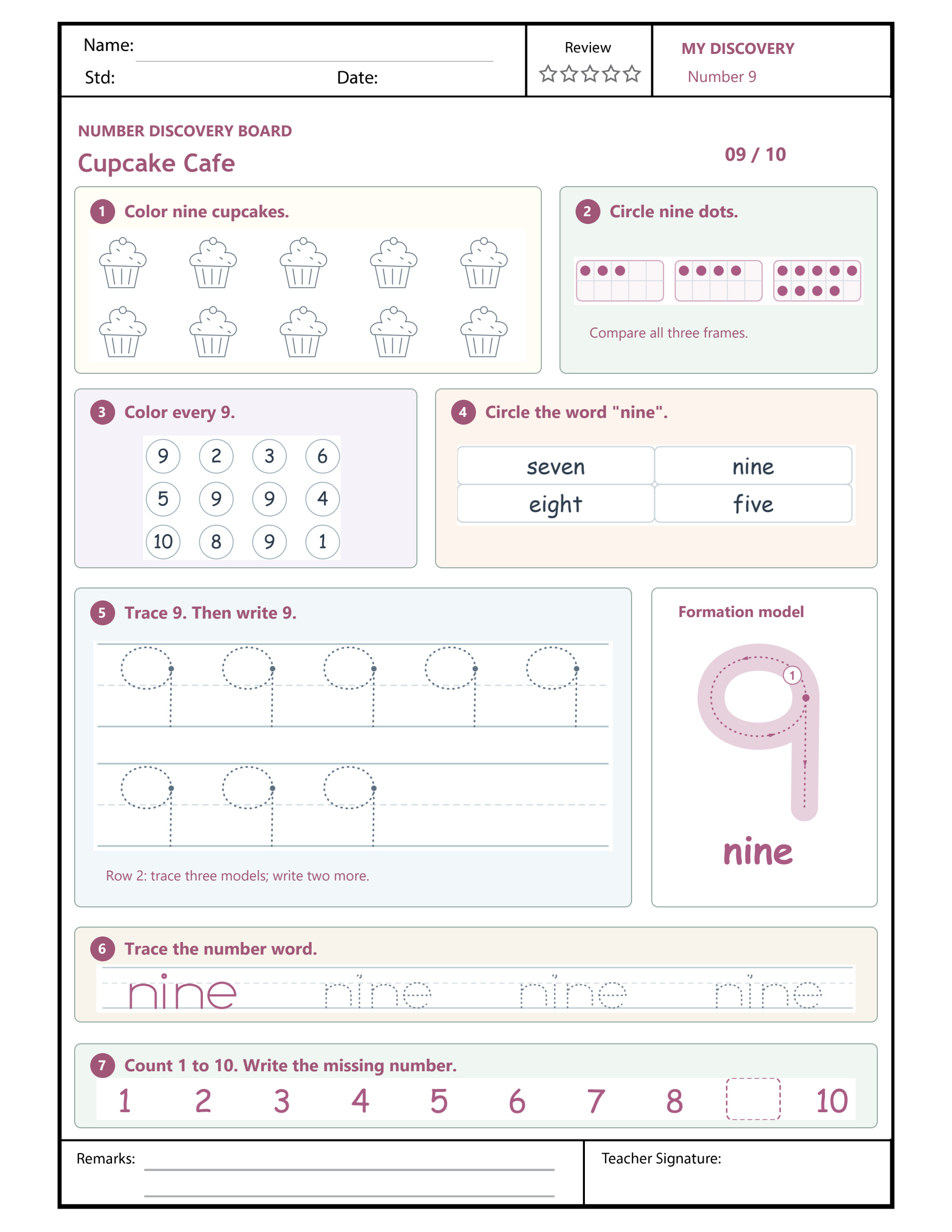
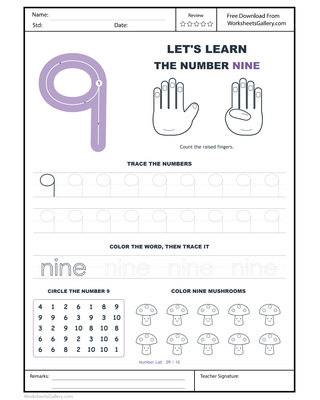
The entire nine board is shown without cropping.
Cupcake Cafe retains picture quantities, frame choices, print recognition, numeral and word practice, and a missing-9 sequence.
Iris checks a pretend bakery order against a tray with ten places. Nine cupcakes belong to the customer, so one place stays unoccupied. Number 9 uses that almost-full comparison on the Cupcake Cafe discovery board, alongside numeral and word recognition, tracing and a missing-number task. The seven activities do not all ask for the same kind of response. A picture bank needs nine selected cakes, while the numeral hunt needs every matching 9. Begin with a visible order and let Iris explain the intended collection before choosing the paper task that will clarify it.
Discovery note 01Number 9 leaves one place in a ten-frame
The matching dot box is the right-hand alternative. It contains five dots on the top row and four below, leaving the final lower place empty. The other two choices show three and four dots. Iris can count the occupied positions, or compare the nearly complete frame with a separate ten-place tray when that structure is familiar.
A child who chooses the middle four-dot frame may have focused on the lower row of the correct pattern without including its upper five. Keep both rows visible and ask which dots the requested amount includes. Large counters can help establish the whole group. The adult should not insist on recognising nine from the empty place alone before the learner understands the frame's ten-place capacity.
Discovery note 02A full display can still contain nine
The supporting bakery scene arranges nine cupcakes in three rows of three. Every place on that particular display is occupied. The worksheet's ten-frame, however, has ten available places and needs one left open to show nine. Both displays can represent nine, because being full depends on the structure being used rather than on a universal rule that full always means ten.
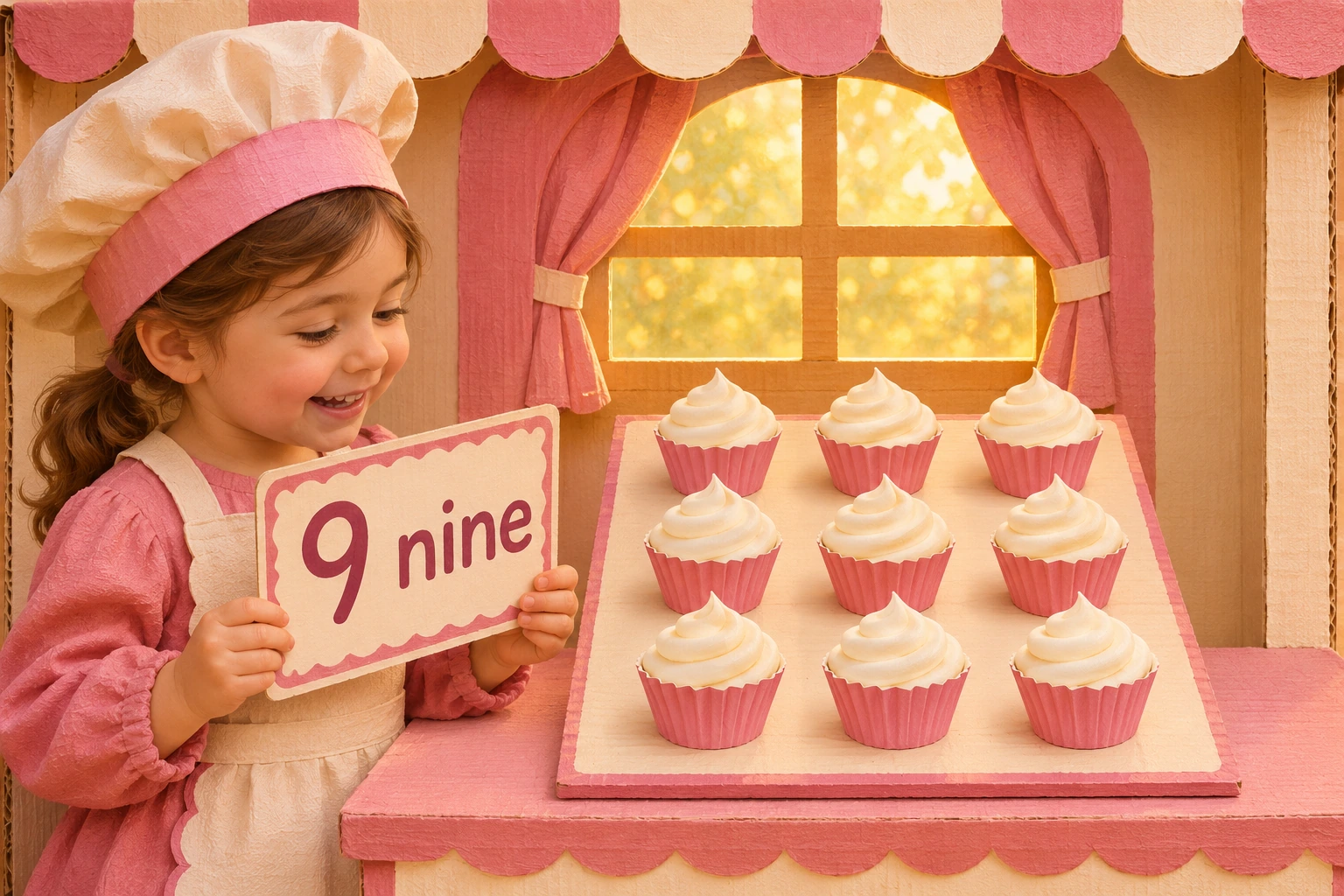
Compare the displays only with the actual pieces available. Move nine large cupcake cards from a three-by-three arrangement to a ten-place mat. Iris can inspect the single unused place after checking that every cake was transferred. This makes the difference between quantity and capacity visible, instead of asking the child to remember two unseen arrangements.
Discovery note 03Nine cakes are the order, ten pictures are the supply
The picture bank offers ten complete cupcake outlines. The child colours nine and leaves one unselected. The final uncoloured picture has not vanished; it remains part of the available supply while sitting outside the customer's chosen group. Let Iris identify that boundary with removable counters before decoration if the distinction is unfamiliar.
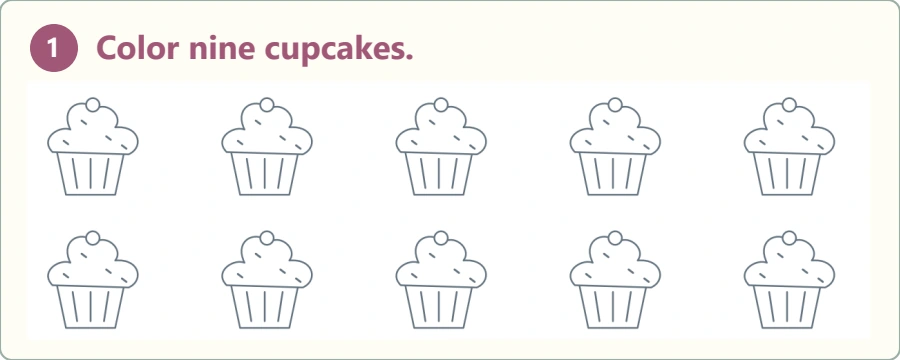
Count whole cupcakes rather than frosting swirls, cases or decorative marks. The same complete cake can receive several crayon colours and still count as one selected object. If the paper becomes difficult to interpret, ask which outlines the child intended to include. A fresh marked selection or a loose-card demonstration can clarify that intention without treating every uneven colouring edge as a quantity error.
Discovery note 04A home cafe order with a checking tray
Prepare ten large cupcake drawings and a completed 9 order card. Iris acts as the baker, selecting the customer's nine onto a ten-place tray. The adult checks the actual pieces in view, then becomes the baker on another turn. Keeping the remaining stock separate helps both partners describe the order and the supply accurately.
After the pretend exchange, connect the board's picture bank or right-hand frame with the checked tray. Choose one further print task if it would be useful. A child who has already made a thoughtful quantity explanation may prefer an adult-written order note to several lines of copying. The writing practice remains available for a later cafe opening.
Discovery note 05Six useful ideas inside the cafe order
- An almost-full comparison: nine occupied places can be checked against a frame whose complete capacity is ten.
- A boundary around the order: nine chosen cakes are distinguished from the ten available pictures and the unused stock.
- A whole-array count: three rows of three require including every row rather than reporting only the first convenient group.
- A comparison of print: a 9 search, a written name and a sequence gap connect the amount with different kinds of symbols.
- A planned loop and descent: the numeral model provides a visible handwriting route that can be demonstrated before an independent attempt.
- A reason to explain: a pretend customer gives the quantity decision a listener, allowing gestures and spoken reports alongside pencil responses.
Use these ideas to decide what to observe. A full page of correct marks does not show how much support was needed, while an unfinished page may already contain a clear explanation of a difficult relationship. Record the particular checking method when it is useful for planning another visit.
Discovery note 06The search has four matching 9s
Read the hunt in rows of four. The matching symbols appear at positions 1, 6, 7 and 11. Four search circles should be coloured. Selecting nine circles would apply the customer's quantity rule to a different instruction, since this panel asks for every printed 9 rather than for a group containing nine symbols.
Keep the formation model nearby for comparison. A distracting 6 in the first row may need a closer look at the loop's location and the rest of the printed route. Ask Iris to point out the feature being compared. Avoid rotating the page or relying only on a quick impression when the learner is still establishing the numeral's intended orientation.
Discovery note 07Find nine above the other number names
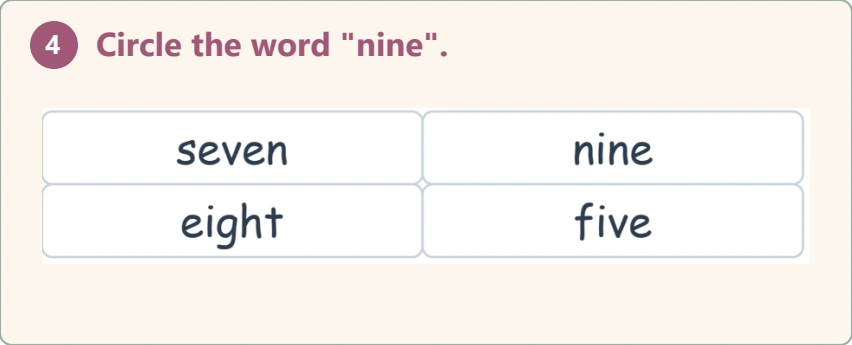
The word grid places seven at the upper left and nine at the upper right. Eight and five occupy the lower row. Nine is the intended response. Read its model aloud and allow Iris to compare the complete spelling with the choices. An adult can name the alternatives without requiring independent reading as a condition for participating in the bakery count.
The word-writing strip shows an outlined nine with three dotted versions. It offers an opportunity to connect the spoken order with n-i-n-e. The repeated n belongs in two positions of the written name. Supply the visible model and choose a manageable trace rather than expecting the spelling to be remembered after a single spoken introduction.
Discovery note 08Form the 9 after locating its start
The large model marks where its route begins. Follow the displayed upper loop and continuing downward movement slowly on spare paper. Iris can rehearse with a finger or choose a dotted copy. If the route is uncertain, demonstrate the relevant part again instead of turning the bakery's quantity explanation into a test of immediate handwriting independence.
The numeral studio contains five dotted 9s across the upper row. Three models start the lower row, followed by room for two more attempts. The instruction about tracing three describes those lower examples; the target remains 9. Choose only the amount of practice that serves the current formation question, and allow a pause when control or attention is becoming uncomfortable.
Discovery note 09Nine connects eight to ten
The sequence finishes with a gap between 8 and 10. Write 9 there after discussing the local relationship. A child can say nine correctly while still needing help with its written route, so a completed number card or an adult-supported mark can make the intended answer clear before more independent writing is attempted.
The printed 10 is one number despite containing two digits. It follows nine in this sequence. There is no need to split it into two counted positions or introduce a longer number range while Iris is working out the gap. A short eight-nine-ten card arrangement can make the neighbours easier to inspect before returning to the full line.
Discovery note 10Classroom checking without announcing every answer
At a teacher-led order desk, one learner prepares nine cakes, another checks the visible tray and a third reads the completed order label with support. Rotate after an explained response. The teacher can ask how the unused place helped, while accepting a complete recount when that remains the child's reliable method.
Then give learners time to make a frame or word choice before discussing their decisions. Partners may describe different checking methods, but should not remove another child's chance to point or arrange independently. Keep the bakery props available throughout. A report about a visible collection is different from a memory question about cakes that have already been put away.
Discovery note 11Four observations to guide a follow-up
| Cafe response | Question to investigate | A next step |
|---|---|---|
| A full tray is called ten | How many places does this tray contain? | Compare its actual layout with a ten-frame. |
| Only a row is counted | Which cakes belong to the whole order? | Mark the boundary around every row. |
| Nine hunt circles are coloured | Which instruction was followed? | Match each selected symbol with 9. |
| Nine is spoken, writing uncertain | Is formation the remaining difficulty? | Show the start and one slow route. |
Listen before choosing an interpretation. The child's intention may be clearer than the final marks. A practical demonstration, a different wording of the request or a larger model may provide more useful support than immediately assigning another complete page.
Discovery note 12Four cafe extensions with different checking jobs
Repair an eight-cake delivery
A puppet places eight large cupcake cards beneath the 9 order label. Keep extra stock visible and ask Iris how the order could be checked and completed. The added cake changes the quantity for a clear reason, rather than appearing through an unexplained adult correction.
Transfer between two tray layouts
Move the same nine cards from three short rows into a two-row ten-place mat. Track every card during the transfer. Discuss why the new tray has an unused place even though the previous display appeared full.
Describe the unselected picture
After nine outlines are chosen on spare paper, identify the one left outside the order. The adult can record Iris's explanation of its status. The picture remains available without becoming part of the customer's requested group.
Make an order note for another baker
Iris dictates what a new baker should prepare. An adult writes unfamiliar words and invites a supported 9 on the completed note. Read the message beside the actual order so its number has a visible reference and a listener.
Discovery note 13Choose a suitable cafe job for the return visit
The board offers adult-guided work for many children aged approximately three to six, depending on experience with quantities, print and pencil movements. Nine may need a patient practical count even when a learner can recite to ten. Start with the visible cards if the complete worksheet feels too demanding. Smaller familiar groups can be compared before making the whole order.
On another day, change the tray layout or the cafe customer while retaining a clear quantity request. Notice Iris's actual strategy, such as including all three rows or checking the unused ten-frame place. Avoid speed targets, compulsory independent spelling or repeated full-page copying as the only signs of practice. A manageable return should make its purpose clear to both adult and learner.
Discovery note 14Find another useful comparison after the cafe
The nine-mushroom counting lab represents the amount through another set of pictures. A number-neighbour home visit can extend the eight-nine-ten relationship. The prewriting concepts collection offers an independent movement focus. For other shared-play contexts, explore NAEYC's resources for play at home and PBS Parents' family activity collection.
Discovery note 15Prepare your Cupcake Cafe download
The uploaded source remains available free. An active account with eligible membership access can obtain the clean nine discovery board from the premium download controls. That printable contains no website watermark, advertising or domain credit. The collection link opens the separate $4 product containing all ten clean boards in a single ordered file.
Check one Letter-size print for complete cupcake outlines, readable word choices and the intact outer frame. Retain the selected edition with the cafe's order cards so the next copy supports a specific quantity or writing question that is worth returning to.
Related Topics
Popular Worksheets
Printable resources families and teachers are downloading now.
 Free
 Free
 Free
 Free