
Launchpad Number 8: 7 Exciting Rocket-Counting Tasks
Continue beyond eight with the ten Number Discovery Boards. The clean 1–10 collection brings every lesson into one $4 PDF.
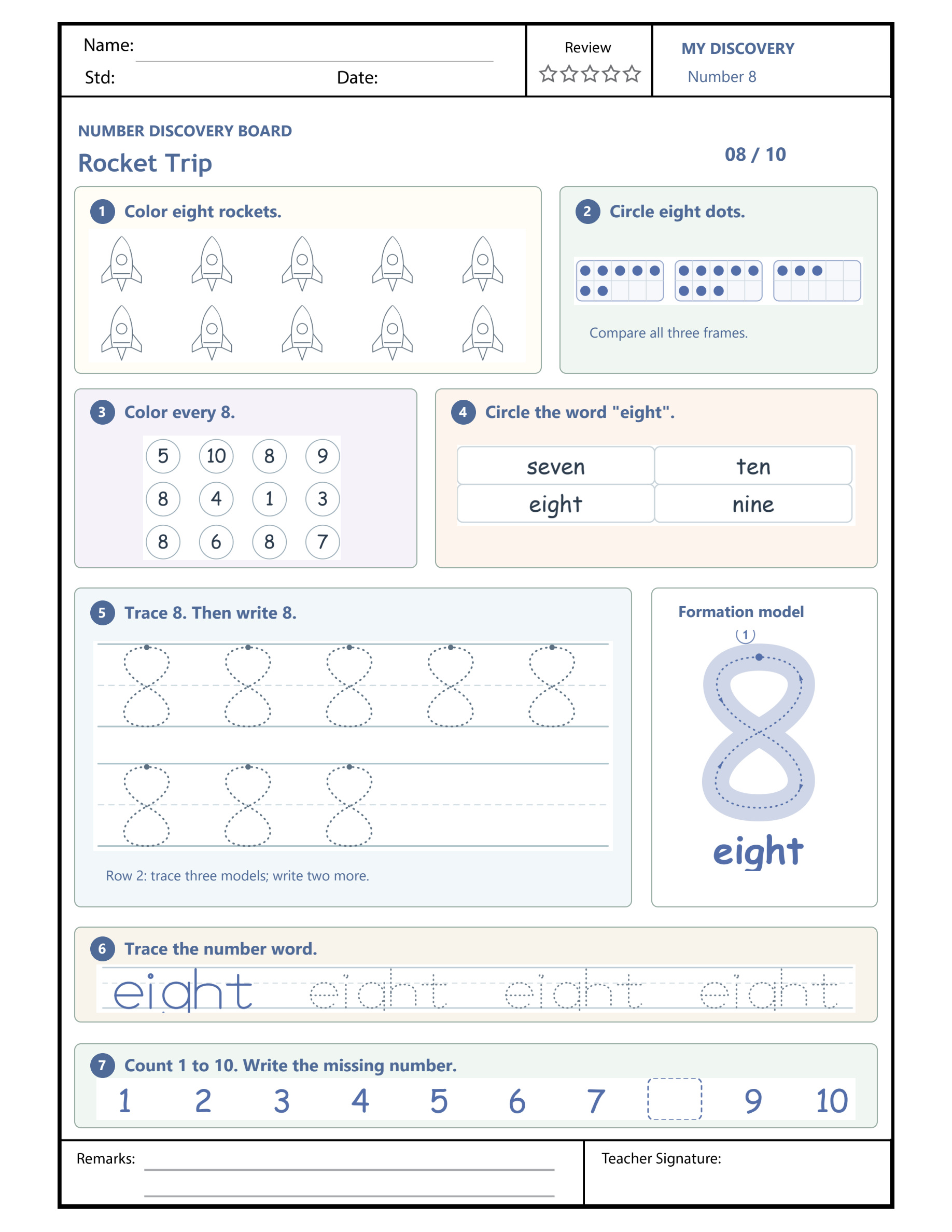
The entire eight board is shown without cropping.
Rocket Trip retains picture quantities, frame choices, print recognition, numeral and word practice, and a missing-8 sequence.
Hani's cardboard hangar displays two rows of four rockets. Counting the first row describes only part of the hangar, so the manager must include the second row before choosing a label. Number 8 links that complete inventory with the Rocket Trip discovery board. Its seven activities compare pictures, dot patterns, written names and numerals, then offer tracing and a missing-number response. Use the two equal rows as one way to see eight, not as the only arrangement that can represent it. The printed frame provides a different grouping to investigate alongside the rockets.
Discovery note 01Number 8 belongs to the complete hangar
Place four large paper rockets on an upper display strip and four on a lower strip. Ask Hani to identify which rockets the inventory includes. Pointing to both strips establishes the boundary of the collection. Then count the individual pieces or describe the two groups if the child already understands that approach. The adult can accept a recount without withholding the label as a reward for faster recognition.
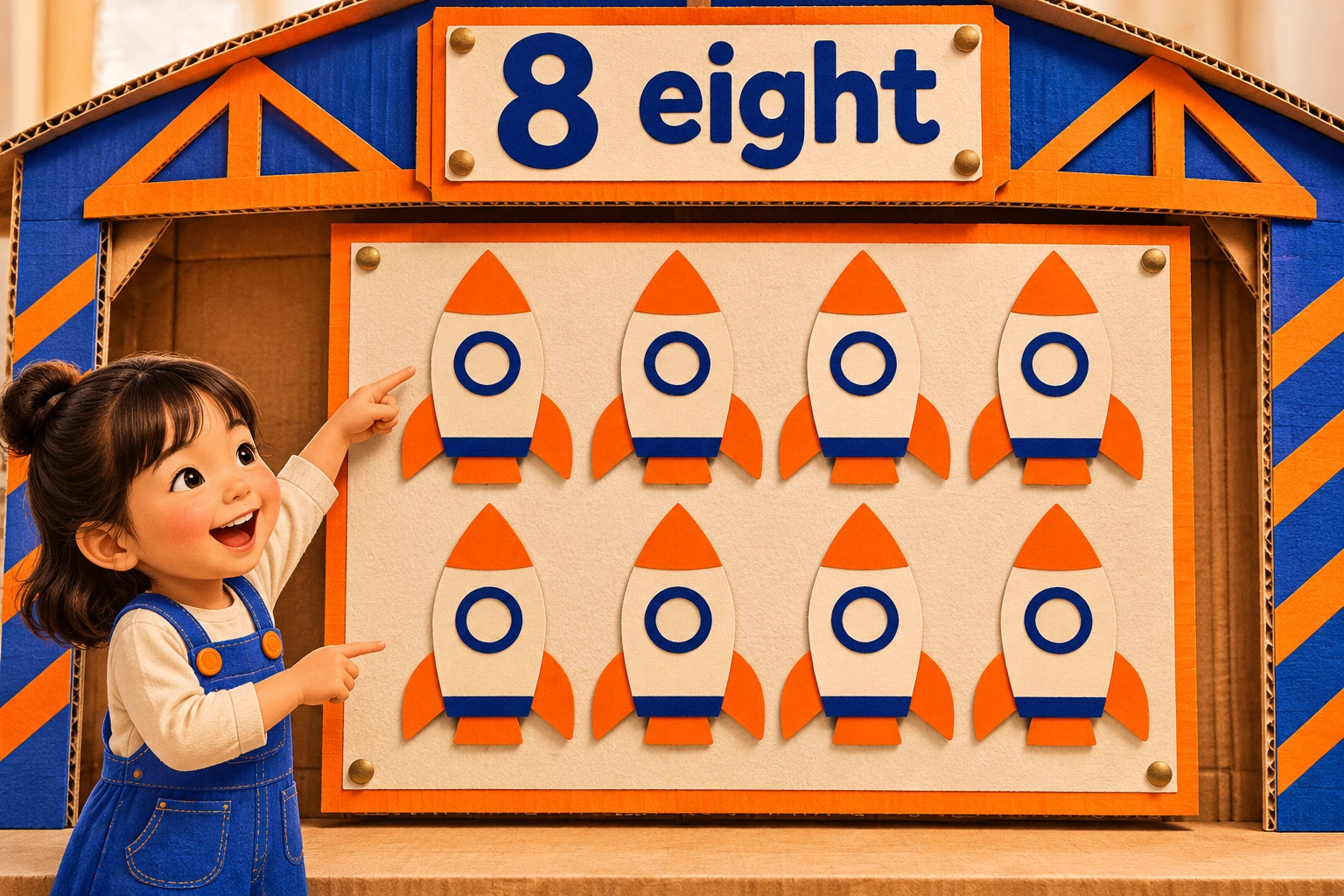
Keep the complete rockets separated. Windows, fins and pointed noses are parts of each rocket, not extra vehicles to include in the inventory. If a child counts the circular windows, show one whole cutout being moved between positions. The movement offers a clear unit to connect with the pictures on the worksheet.
Discovery note 02A different arrangement on the printed frame
Rocket Trip's dot alternatives contain seven, eight and three. The middle frame represents the target. It has five dots across its upper row and three below, leaving two lower spaces unoccupied. This grouping differs from the hangar's four-and-four display, though both can represent eight actual members.
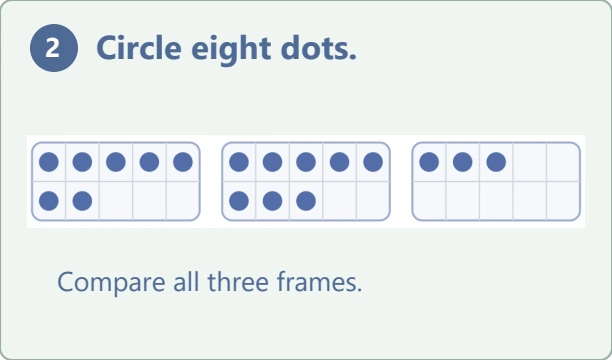
Use eight large counters to compare the two arrangements on spare paper. Move the same pieces from two rows of four into a five-and-three frame while Hani watches. No piece needs to be added. The child can check the total again after the movement, then compare that practical frame with the printed choice. Do not silently replace the inventory while also asking the learner to track its rearrangement.
Discovery note 03Prepare a home launch order without launching anything
Make a completed 8 order card and offer ten large paper rockets as stock. Hani chooses the vehicles assigned to the pretend order, leaving the two spare pieces clearly outside it. An adult plays the customer and asks which rockets are included. The practical boundary separates the order from the total supply on the table.
After checking, choose a relevant printed task. The picture bank repeats the selection question, while the word panel connects the order with its written name. A numeral attempt can wait until the quantity is clear. End the first exchange with a spoken inventory report, so participation does not depend on independently filling every practice space.
Discovery note 04Eight coloured rockets from ten outlines
The board's picture shelf supplies ten whole rockets in two rows. Select eight for colouring and leave two unselected. Hani can use removable counters to indicate the intended vehicles before adding colour. The worksheet does not demand a particular row or colour pattern; different sets of eight pictures can satisfy the instruction.

An outline that is coloured untidily may still represent an intentional selection. Ask the child which rocket belongs to the order before assuming that every stray mark means another vehicle was counted. Conversely, eight decorative marks inside fewer rocket outlines do not necessarily show eight selected objects. The explanation and the chosen units need to be considered together.
Discovery note 05Six connections that the hangar can support
- Including both rows: the inventory requires a whole-display count rather than treating one convenient row as the complete answer.
- Comparing equal parts: four rockets above and four below offer a visible way to discuss matching groups within eight.
- Changing the grouping: the five-and-three frame shows how the same total can be arranged differently without adding a member.
- Defining an object: a complete rocket is distinguished from its windows and fins when the pictures are counted.
- Inspecting a written route: the numeral model connects both loops into a deliberate handwriting path that can be rehearsed slowly.
- Linking names and order: eight can be found in print and placed between seven and nine while quantity remains visible in the display.
These connections are invitations for supported observation. A child may describe the whole hangar well and still need help with a loop crossing, or recognise the word after it is read aloud while continuing to count every dot. Those differences help identify the next useful step.
Discovery note 06Search for matching numerals, not eight circles
The numeral hunt contains twelve choices in three rows of four. The matching 8s occupy positions 3, 5, 9 and 11. There are four to colour. Because this area asks for every copy of the symbol, the learner should not choose four extra distractors merely to create a group of eight marks.
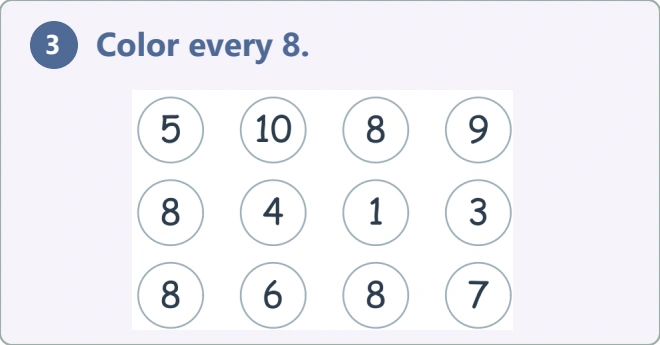
Keep the large 8 available while Hani checks the candidates. Its two connected loops distinguish it from other printed entries on the page. If the child loses a place between rows, use a loose guide to reveal one row at a time, then uncover the whole search for a final check. The guide supports organisation without changing the actual choices.
Discovery note 07Read eight beside the inventory label
Seven and ten appear on the top line of the word-choice grid, with eight and nine below. Eight is the lower-left response. An adult may read all the options, then let Hani compare the intended name with the model. Recognising a quantity of rockets does not require independent mastery of this particular spelling.

The writing strip provides an outlined eight and three dotted examples. Point to the complete word while reading it naturally beside the 8 sign. For a learner interested in spelling, inspect its letters in order using the visible example. Keep that exploration distinct from the object count; the number of printed letters is not a way of determining the hangar's quantity.
Discovery note 08Follow the connected loops on this model
The large 8 shows a starting point and a route through its middle crossing. Demonstrate the displayed movement on a separate large sheet so that Hani can watch before trying. A finger trace can make the crossing easier to discuss. Avoid turning an unfamiliar formation into a demand to copy increasingly quickly.
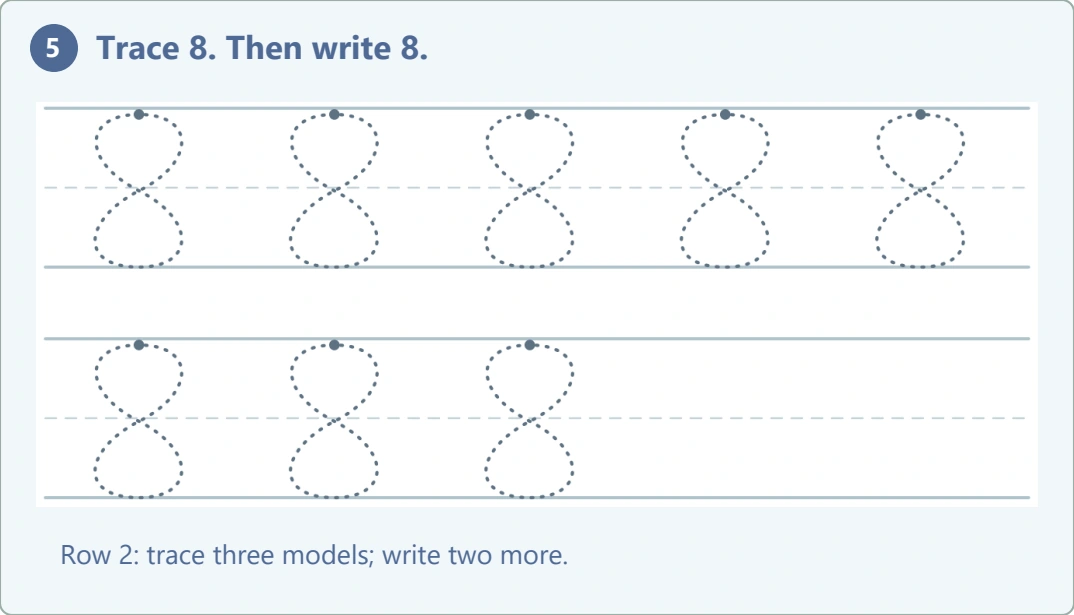
Five dotted 8s occupy the top practice row. The second row begins with three more and leaves room for two independent attempts. The reference to tracing three concerns those supplied models, all of which remain 8. If two disconnected circles appear instead, revisit the connected route with the child rather than erasing the entire session or questioning the already explained rocket count.
Discovery note 09The sequence has a place before nine
The bottom line leaves the eighth position open, after 7 and before 9. Hani can identify the missing number by speaking, pointing to a completed card or writing 8. These are different response modes to the same ordering question, and the adult can provide the formation model again for a pencil answer.
Try a short seven-eight-nine card arrangement when the full line to ten makes the local relationship hard to see. Remove the middle card in view and ask the manager to repair the sequence. Discuss why the neighbours matter, then return to the printed gap. The child can connect a local repair with the longer familiar count.
Discovery note 10A classroom inventory desk
Give a small group an eight-rocket display and the jobs of manager, stock checker and label reader. One child rearranges the vehicles, another checks the whole collection and another finds its completed sign. The teacher helps with unfamiliar language while allowing each learner an independent pointing or arranging response before partners offer explanations.
After a shared check, compare the hangar with the printed five-and-three frame. Invite the children to describe what changed in the arrangement and what remained present. Record the actual method used, such as counting from the beginning or recognising a completed five. A fluent spoken sequence alone does not show whether every rocket was included in the inventory.
Discovery note 11Use a response to choose the next support
| Inventory response | Investigate | Useful support |
|---|---|---|
| Only four reported | Was the second row included? | Mark the whole hangar boundary. |
| Windows counted separately | Which feature is the unit? | Move complete paper rockets. |
| Seven-dot frame selected | How many lower dots follow five? | Compare the two lower rows. |
| Quantity clear, loops disconnected | Is the numeral route unfamiliar? | Rehearse the middle crossing. |
These prompts should lead to another observation rather than an immediate label for the child. Ask what the response represents and keep practical materials available. A clearer instruction or a larger model may be enough to change the next attempt.
Discovery note 12Four return visits for a rocket manager
Change the hangar shelving
Move the same eight cutouts from two four-place strips to a five-place strip with three beside it. Let Hani check that no rocket was added or left behind. Compare the new structure with the board's matching frame.
Inspect the unused stock
After an eight-rocket order is chosen from ten, examine the two pieces left outside it. Discuss which group the original order card describes. This offers a clear distinction between the selected vehicles and the remaining supply.
Dictate a complete inventory note
Hani tells an adult how the rockets are grouped. The adult writes the surrounding words and reads the note back beside the actual display. The learner may add a supported 8 without having to write the full sentence independently.
Replace the vehicles
Use eight large blocks in the hangar places on another day. Ask whether the completed quantity sign can still describe the collection. A different-looking set can support the same amount while making the comparison worth discussing again.
Discovery note 13Choose an accessible job and a comfortable stopping point
Hani's hangar offers a guided investigation for preschoolers and kindergarten children, typically aged about three to six, with tasks chosen by experience. Some will need the complete paper objects and a slow count. Others may compare the two groupings or investigate the written name. Do not require equal fluency in speech, print recognition and handwriting before acknowledging a useful quantity explanation.
Regular practice can begin with a new stock arrangement after a break. Notice a particular decision, such as including the lower row or checking the third dot beneath five. Avoid treating a wider display as evidence of a larger amount, or a neat tracing strip as proof that the quantity is understood. The child should be able to explain what the visit was investigating.
Discovery note 14Continue with a related kind of number evidence
The eight-banana finger-counting page supplies another representation of eight. The picture-count selection activity offers another checking decision. A prewriting concept set can separate a pencil route from inventory work. Families may also explore NAEYC's guidance for playful family time and PBS Parents' shared learning resources.
Discovery note 15Choose a Rocket Trip download
The free route supplies the original uploaded sheet. Eligible active membership access provides the clean eight board through the account's premium controls. Its printable leaves out website watermarking, domain information and advertisement panels. The linked ten-board package costs $4 as a separate combined purchase, keeping the individual and collection options distinct.
Inspect one US Letter proof for the full rocket silhouettes, intact frame and legible dotted loops. Save the chosen edition with the hangar materials so another copy can support a specific counting or formation question when the manager returns.
Related Topics
Popular Worksheets
Printable resources families and teachers are downloading now.
 Free
 Free
 Free
 Free