
Skyward Number 7: 7 Brilliant Kite-Counting Missions
Continue beyond seven with the ten Number Discovery Boards. The clean 1–10 collection brings every lesson into one $4 PDF.
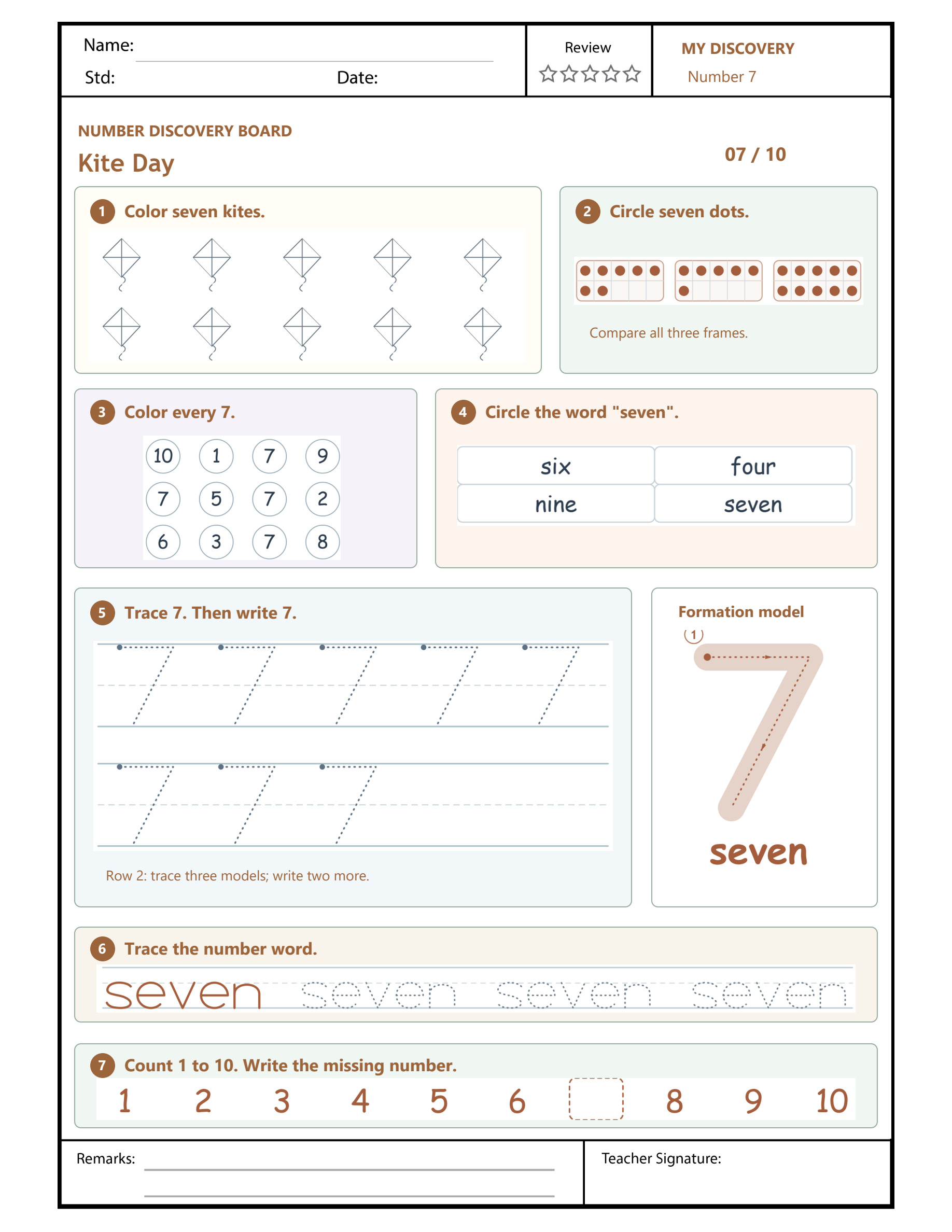
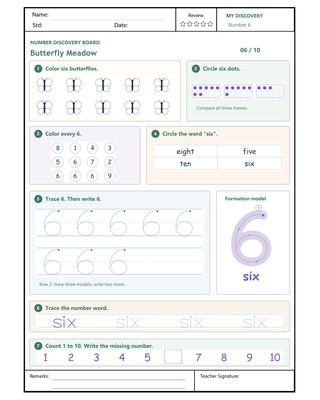
The entire seven board is shown without cropping.
Kite Day retains picture quantities, frame choices, print recognition, numeral and word practice, and a missing-7 sequence.
Gus's kite workshop has three paper kites on one mat and four on another. The workshop still needs one label for the whole collection. Number 7 invites a child to describe those smaller groups, check the total and connect it with the Kite Day discovery board. Seven tasks bring together picture selection, dot frames, number names, numeral routes and a missing sequence position. The paper does not require a written addition equation. Begin with the visible kites and let Gus choose a way to show that both mats belong in the complete seven-kite count.
Discovery note 01Number 7 can include different smaller groups
Keep three complete kites on one side of the workbench and four on the other. Count across both groups, touching each kite once if that support is useful. The adult can describe the result as three here, four there, seven altogether. That language gives the parts a visible relationship without expecting the learner to know formal addition notation.
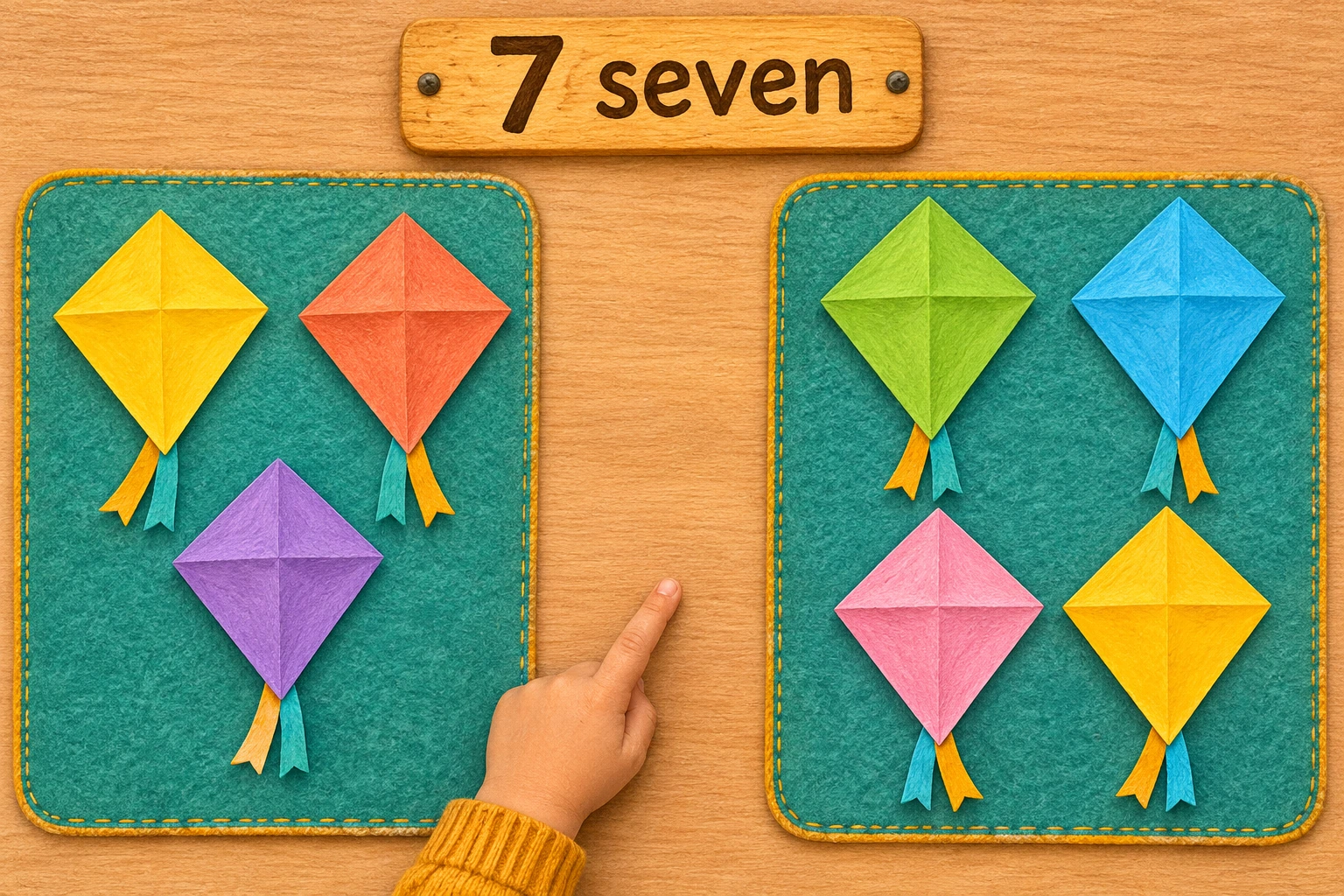
Move two kites from the four-kite mat to join the three. The new arrangement is five and two, with the same seven actual objects still present. Invite Gus to check before replacing the quantity label. Changing the grouping can be explored slowly; a child who chooses to recount is using a valid way to investigate the new display.
Discovery note 02A small classroom workshop with shared roles
One learner arranges the kite pieces, another prepares a completed numeral sign and another checks the whole bench. The teacher asks the checker to include both work mats in the report. If one mat is overlooked, bring attention to the visible kites there rather than simply supplying the total. The task makes the boundary of the whole collection worth discussing.
After the group agrees on seven, display the printed board. Children can each inspect a frame choice or make a picture selection before explaining it to partners. Rotate the handling and checking jobs on another turn. A learner who communicates mainly by pointing can still identify which kites belong to the whole and which printed arrangement agrees with them.
Discovery note 03The first frame shows five and two
The dot alternatives display seven, six and ten from left to right. The left frame is correct. It contains five occupied top-row places and two lower dots, leaving three lower places empty. Compare that structure with the rearranged work mats. The dots need not look like kites to represent the same amount.
If Gus selects the six-dot frame, inspect the lower row alongside the seven-dot choice. One has one extra dot after five; the other has two. Large counters can make the difference easier to handle. Do not require a mental shortcut when counting every dot remains the learner's clearest method. The printed choices are there to be checked, not guessed from their visual fullness.
Discovery note 04Seven chosen kites need not be one neat block
The picture bank contains ten complete kites in two rows. Gus colours seven, leaving three outside the selection. A full row of five plus two on the other row is a possible response, but the instruction does not demand that arrangement. Seven scattered choices can meet the same quantity request if the selected outlines are clear.
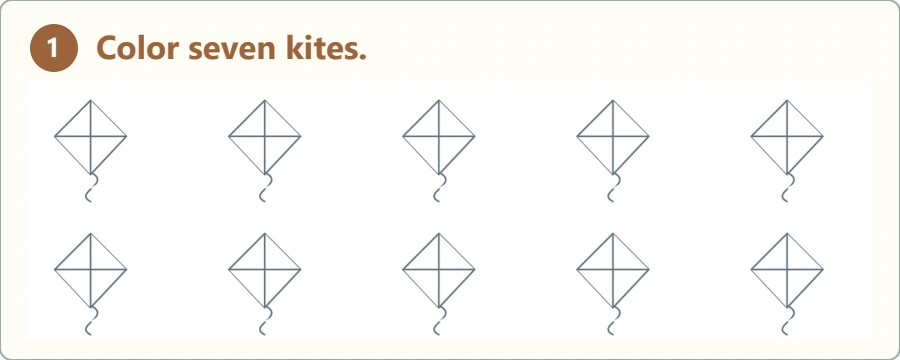
Count whole kites rather than tail ribbons, triangular sections or crossed support lines. A large loose kite cutout can demonstrate the intended unit. Before colouring, let the child point to or temporarily mark the proposed seven. That gives the adult a chance to understand the quantity decision before decorative choices make some outlines harder to distinguish.
Discovery note 05An answer reference for the workshop adult
| Kite Day decision | Source choices | Expected match |
|---|---|---|
| Dot quantity | 7, 6 and 10 dots | The left frame |
| Numeral search | Three rows of four circles | 7 at cells 3, 5, 7 and 11 |
| Written number name | six, four, nine, seven | seven at the lower right |
| Sequence position | A space between 6 and 8 | The missing numeral 7 |
Consult the reference after Gus has made an attempt, and use it to select one follow-up question. Giving every answer in advance would remove the comparisons the board offers. The cell numbers run across four search entries at a time before continuing on the next row.
Discovery note 06Six skills that can surface at the kite bench
- Defining a whole: including both mats in the report keeps a local group from being mistaken for the entire collection.
- Describing parts: three-and-four and five-and-two offer different spoken accounts of seven visible kites.
- Checking an arrangement: a changed grouping can be verified without assuming that a new-looking display must need a new number.
- Inspecting symbols: the search asks for a whole-numeral comparison across several rows of candidates.
- Following a route: the model provides a starting point, a top movement and a slant for a supported handwriting attempt.
- Using neighbouring numbers: the final gap connects seven with six and eight rather than treating it as an isolated label.
These are opportunities for adult observation. The worksheet cannot establish every skill from a single finished copy. Listen to the explanation, notice the help used and allow action or pointing to show an idea when writing is not yet comfortable.
Discovery note 07Find every 7 across the search rows
The matching search circles occupy positions 3, 5, 7 and 11. Four entries should be coloured, because the instruction requests every 7 rather than seven arbitrary circles. The first match lies near the end of the top row; the next appears at the start of the middle row. A learner may need help keeping that row change organised.
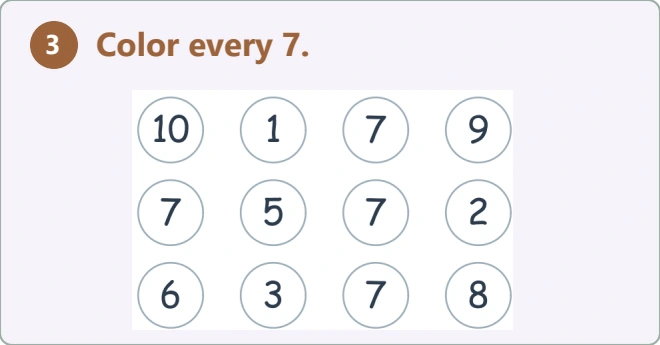
If a 1 is selected, compare its route with the top bar and slant of the printed 7 model. Keep the model upright and available. The adult can point out the feature being compared without colouring the answer on the child's behalf. A second checking pass is useful when it examines actual candidates instead of merely asking whether the child is sure.
Discovery note 08Make the top route before the slant
The large formation example shows the particular 7 used throughout this sheet. Follow its start dot across the top and into the descending slant, demonstrating slowly on a separate surface if needed. Gus may trace the movement with a finger first. A consistent visible example is more useful during an uncertain attempt than switching among several handwriting variants.
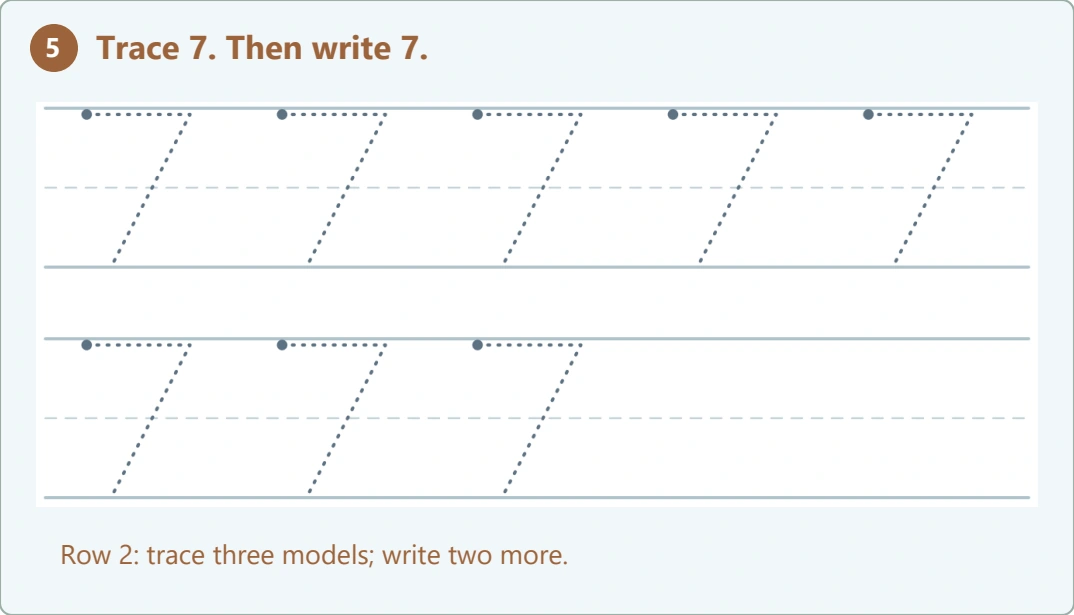
The first practice row supplies five dotted 7s. Three models begin the second row, then two spaces remain for new attempts. The lower instruction refers to a set of three examples, all still showing 7. Select a small amount of rehearsal when the slant is unfamiliar; requiring the complete strip before discussing the quantity would combine two different demands unnecessarily.
Discovery note 09Let seven's ending help identify its name
The word-choice panel offers six and four above nine and seven. Seven belongs in the lower-right box. Six shares its starting s, so a familiar first letter alone cannot decide the answer. Compare the complete model seven, including its ending n, with the offered words. An adult can read the alternatives while leaving time for Gus to inspect them.
The outlined seven and its three dotted versions offer another kind of practice. The repeated e belongs in two different spelling positions, even though a beginning learner may not be ready to write the name independently. Read it as a whole beside the 7 sign and the actual kite group. The quantity remains available through the objects while the spelling is explored with support.
Discovery note 10Repair the gap before eight
The counting line prints 6 to the left of the missing place and 8 to the right. A 7 completes that local sequence. Gus can select a completed number card first, then use the model if a written response is chosen. A correctly identified neighbour relationship should not be dismissed because the pencil slant needs another demonstration.

Use a short six-seven-eight card path on the floor or table when the full 1–10 row is distracting. After sharing the short count, lift the 7 card. Gus restores the missing workshop counter before comparing it with the worksheet. Connect that repair with the printed gap afterwards. This keeps the reason for the answer visible instead of making the task only an exercise in copying a shape.
Discovery note 11A home order for a pretend kite shop
Write a completed order card with 7 and place ten large paper kite pieces nearby. Gus chooses the seven for a toy customer, leaving the remaining stock on the bench. The adult asks which pieces belong to the order and which stay in the shop. That distinction connects the board's picture supply with a practical selection purpose.
Once the order is checked, Gus may choose whether to inspect the printed frame or rehearse one numeral. Keep the shop order visible during either task. On another day, change the customer or the grouping of the stock. A familiar quantity can then return through a different exchange without demanding a new pile of completed worksheets.
Discovery note 12Six kite-workshop extensions
Swap the two work mats
Exchange the mats holding three and four kites without hiding any pieces. Ask whether their new left-right positions change the complete order. Count or pair the objects when the learner wants a way to check.
Make a five-place rack
Put five kites on a rack drawing and two beside it. Match that display with the printed seven-dot frame. The rack gives the completed row of five a concrete workshop counterpart.
Dictate a packing report
Gus tells an adult how the order has been grouped. The adult writes the message, including the child's chosen part description. Read it beside the visible kites rather than asking for a report from an unseen collection.
Repair an incomplete delivery
A puppet packs six paper kites beneath the 7 sign. Keep the spare stock visible and invite the child to check the order. The additional required kite should be identified through the count, not through a hint about its colour.
Design a new seven display
Choose seven large blocks or leaves instead of kites. Compare the new collection with the quantity label. Different materials can carry the same amount while offering a fresh reason to inspect it.
Visit the number path
Lay out cards 6, 7 and 8 as neighbouring shop counters. Place the seven-kite order at its matching counter, then explain separately that the counter sign identifies a location while the order card states a quantity.
Discovery note 13Let the workshop stay welcoming
Gus and other early learners may take different jobs in this supported activity, often between ages three and six. Some need to handle the pieces and recount both mats; others are ready for frame comparisons, word endings or a short independent 7. Choose one meaningful challenge rather than expecting every part to be equally easy because the learner knows the counting rhyme.
For regular practice, retain a small set of kite props and record one useful observation. Perhaps Gus included both mats without prompting or checked the extra dot in the seven frame. Return to that idea with one changed feature after a break. Avoid scoring confidence by speed, perfect colouring or willingness to complete all seven activities at once.
Discovery note 14Try another number representation next
The seven-strawberry finger lab gives seven another visible grouping. The two-sided number homes extend the neighbouring-number idea. A separate prewriting movement workshop may help with a deliberate slant. Shared-play inspiration is also available through NAEYC's practical family play pages and PBS Parents' ideas for learning together.
Discovery note 15Prepare a Kite Day printable for the bench
The original worksheet is the page's free sample. The clean seven discovery edition is available through the premium route to eligible members with active access. Its printable excludes website watermarking, domain labels and advertisements. The native collection card links to the ten-board clean PDF, offered separately for $4.
Check a single US Letter copy for intact kite tails, legible numeral choices and the complete writing model. Keep the selected file with the workshop materials so another copy follows a useful teaching purpose, rather than being printed only to fill every remaining space.
Related Topics
Popular Worksheets
Printable resources families and teachers are downloading now.
 Free
 Free
 Free
 Free