
Number Home Neighbors: 5 Clever Before-After Visits
$5 collection companion: Number Home Neighbors. Keep the given middle number fixed while supplying its immediate predecessor and successor.
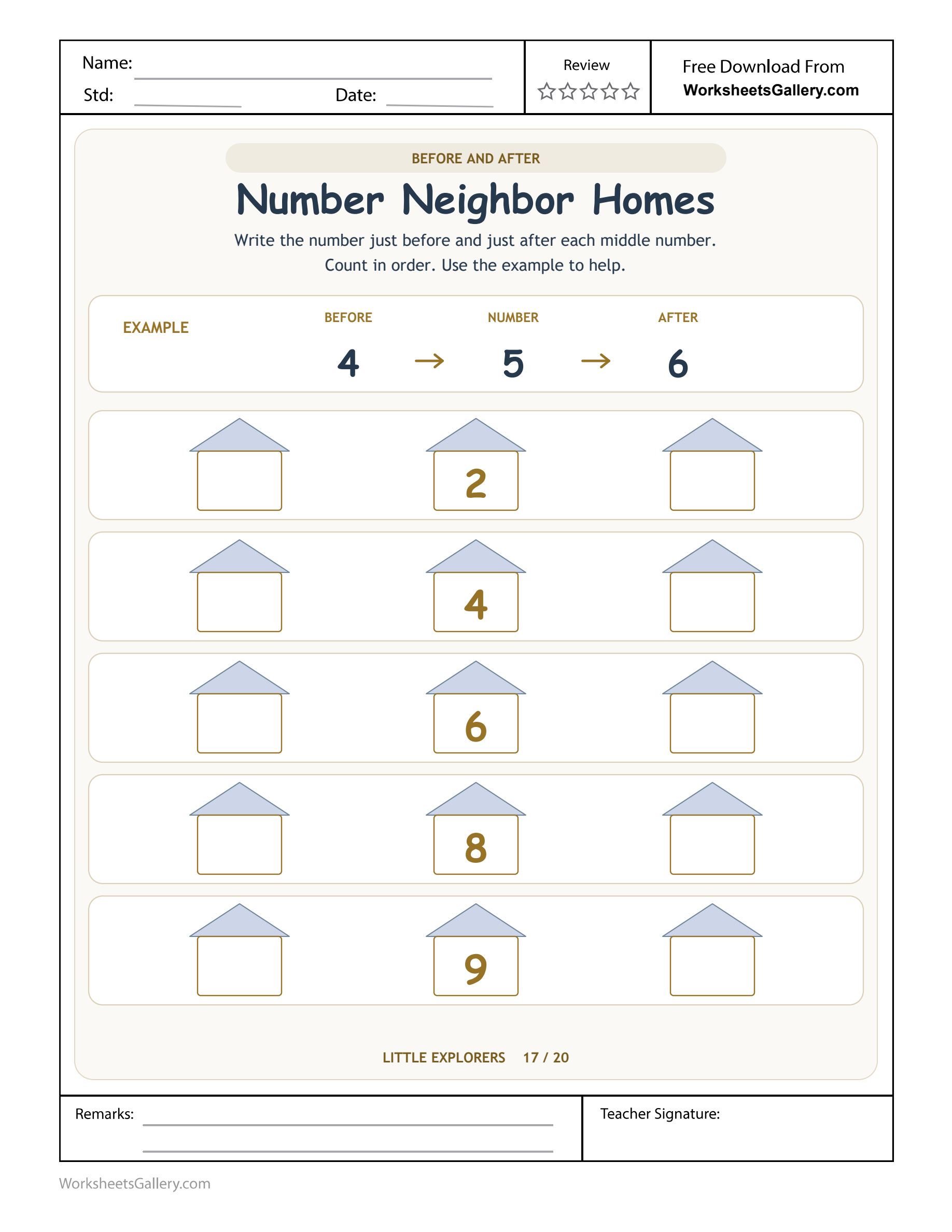
A number in the middle house needs two immediate neighbours. Number Home Neighbors gives children a fixed numeral and asks them to write the number just before it and the number just after it. A worked example shows 4, 5 and 6 before five new rows introduce different middle numbers. This is a one-step sequence activity rather than a count-by-twos pattern down the page. Begin by reading the given centre numeral, then use the local counting sequence to decide what belongs in each neighbouring home.
Read the model as three connected places — Number Home Neighbors
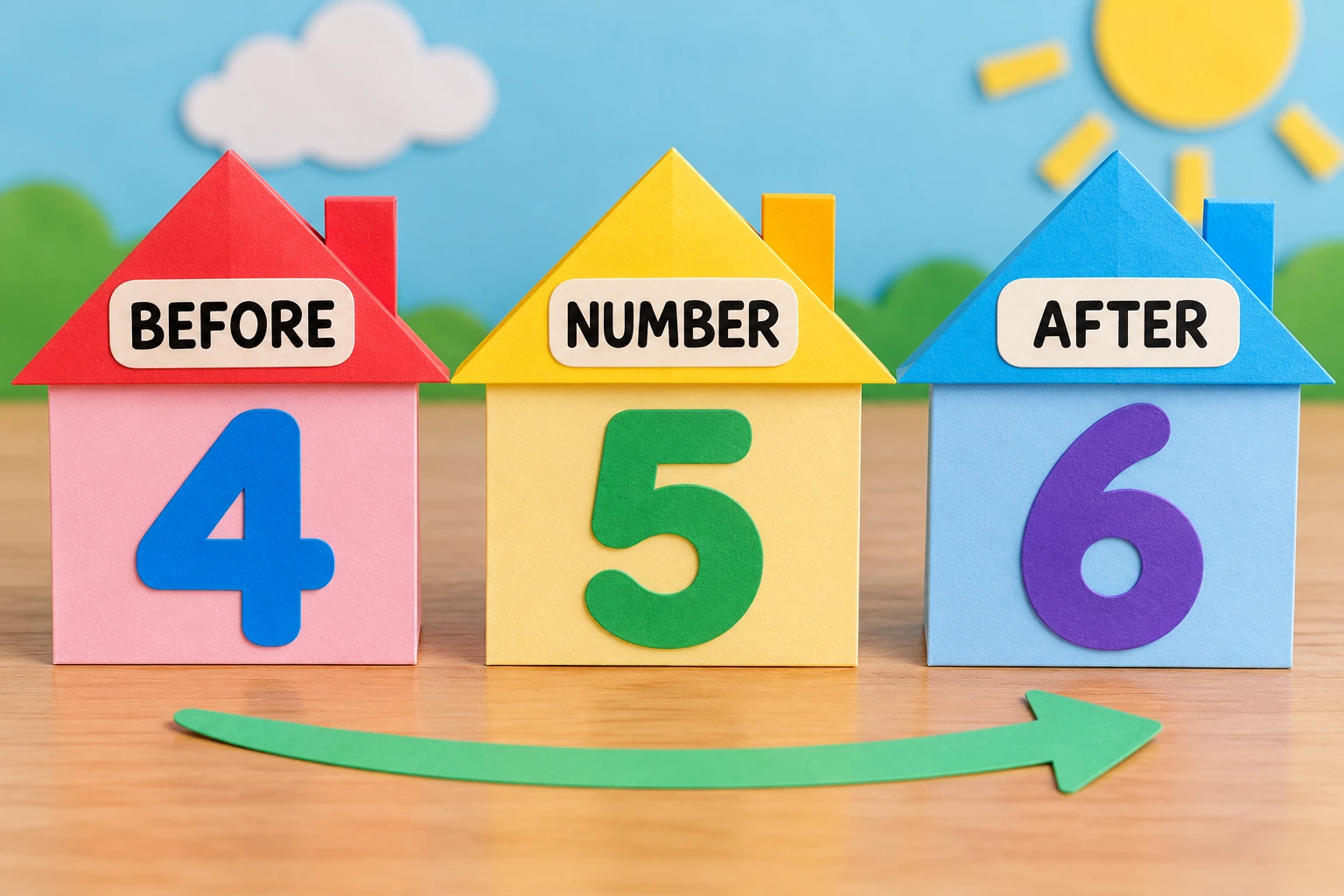
The completed example in Number Home Neighbors labels the homes BEFORE, NUMBER and AFTER. Four belongs before five, and six belongs after five. Invite Safa to point to the centre home first, so that the two empty places in later rows have a clear reference.
Read the example in order, then ask which numeral the source supplied in the middle. Keep that supplied numeral as the centre reference throughout the row. It remains the anchor while the neighbouring answers are chosen. This distinction matters when the next row's centre is two rather than five.

Immediate means no house is skipped
Many numbers come before six in the counting sequence, but the home beside it calls for five. The requested relationship is the next number on either side. Demonstrate this with three consecutive counters or number cards if the word before alone seems too broad.
Keep every row's middle number fixed: Number Home Neighbors
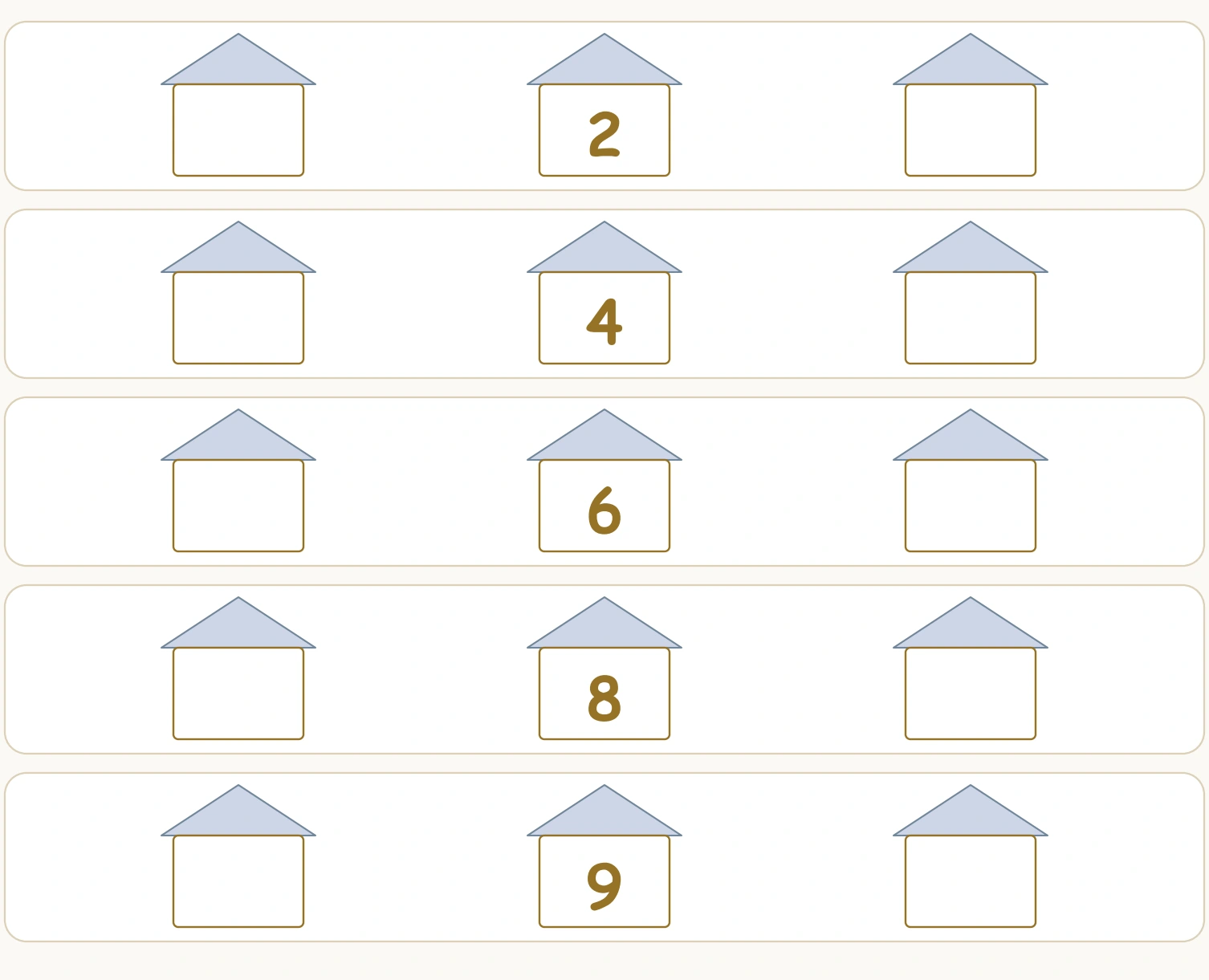
The five supplied centre numbers are 2, 4, 6, 8 and 9. Their order down the sheet can attract attention, especially the first four. However, Number Home Neighbors is completed horizontally around each given number. Filling the left or right column with a separate repeating pattern would bypass the intended question.
Ask Safa to read one row's centre, say the three-number run that includes it, and identify which spoken numbers go into the empty homes. She can point to the spaces before writing. This creates a chance to separate a sequence decision from a numeral-formation difficulty.
Nine has a two-digit neighbour: Number Home Neighbors
The final right-hand response is 10. It occupies one home even though its written form has two digits. Leave room for both marks and read them together as ten. The activity is about the neighbouring number, not about giving every house exactly one written character.
An adult's five-row answer map: Number Home Neighbors
| Before home | Given middle | After home |
|---|---|---|
| 1 | 2 | 3 |
| 3 | 4 | 5 |
| 5 | 6 | 7 |
| 7 | 8 | 9 |
| 8 | 9 | 10 |
Use this Number Home Neighbors map after listening to the learner's local sequence. The middle column is printed on the source, while the other two columns describe the intended entries. A response can be checked by reading all three homes from left to right and asking whether each step advances by one.
A number-card doorstep at home
Imagine Safa and her father choosing a card showing six. They place it in the centre of three drawn doorsteps and search a small set of number cards for its neighbours. Safa says five, six, seven while touching the cards in order.
Her father asks which card would disappear if the centre changed to eight. They rebuild the short sequence around the new anchor rather than shifting an entire memorised row. Back at Number Home Neighbors, Safa points to the printed centre numeral before choosing her two written answers.
This imagined game keeps the relation visible while making revisions easy. A child can move a card before trying to write a numeral. If a written seven later looks unclear, the adult can refer to the child's earlier card choice instead of assuming that sequence knowledge was absent.
Six things the three-house format can show
Recognising the supplied numeral
Safa first needs to identify the centre number accurately. If she reads eight as another numeral, both neighbours may reflect that different anchor. Ask her to name the given number before discussing the surrounding responses.
Finding a predecessor: Number Home Neighbors
The left-hand home in Number Home Neighbors asks for the number immediately before the anchor. This can feel different from reciting forwards. A short run beginning a little earlier may help the child hear which number directly precedes the centre.
Finding a successor: Number Home Neighbors
The right-hand home requires one more step in the ordinary counting sequence. Notice whether Safa gives the next number or jumps ahead. Pointing to a short row of consecutive cards can make the missing step visible.
Holding the anchor steady: Number Home Neighbors
The two answers describe relationships to the same centre number. A child who changes that centre midway through a row may produce two plausible but unrelated responses. Revisit the supplied numeral when checking both sides.
Recording the intended number: Number Home Neighbors
Number Home Neighbors leaves space for the child's handwritten entries. Numeral formation and sequence knowledge can be observed separately. A spoken response, a card choice and a pencil mark may provide different amounts of information about the same decision.
Verifying consecutive steps
Reading the finished row aloud offers a useful final check. Safa can listen for a skipped or repeated number. The check gives her a way to reconsider her own entries without relying only on an adult's answer announcement.
A classroom check with one deliberate gap: Number Home Neighbors
For a hypothetical small group, the teacher arranges number cards 7, 8, 10. Children compare the spoken sequence with the cards and decide what belongs after eight. The discussion stays focused on immediate neighbours, rather than asking for any number larger than the centre.
Learners then take turns explaining a row of Number Home Neighbors to a partner. One reads the centre numeral; the other says the complete three-number run. They can reverse roles before writing individual responses. This keeps the explanation cooperative while leaving each child's record their own.
If the group notices that some centre numbers increase by two down the page, acknowledge the observation and return to the horizontal instruction. A pattern in the layout does not replace the before-and-after relationship within each row. The final centre of nine makes this distinction particularly helpful to discuss.
Five short neighbour games away from the sheet: Number Home Neighbors
Put a number between its friends: Number Home Neighbors
Choose consecutive cards such as three and five, leaving a place between them. Ask Safa which card completes the local run. Then change which card is supplied first so the game does not depend on a single arrangement.
Speak a tiny staircase: Number Home Neighbors
Say three consecutive numbers while moving a counter up three drawn steps. Point to the middle step and name its neighbours. Keep the extension small enough that the child can explain each move rather than recite a long list automatically.
Check a toy's doorstep labels: Number Home Neighbors
Give a toy character homes labelled 5, 6, 8. Invite the child to inspect the sequence and replace the unsuitable neighbour. The toy can ask why seven belongs there, giving Safa a listener for her explanation.
Match speech to a number card
An adult describes “the number just before nine” and Safa selects a card. Reverse roles so that she gives a description for the adult to follow. This focuses attention on the relationship expressed in words.
Make a two-digit arrival: Number Home Neighbors
Place eight and nine cards beside an empty final space, then add ten as the next whole number. Talk about its two written digits together. The card occupies one sequence position, just as ten occupies one response home on the source.
Find which part of the task needs support: Number Home Neighbors
When an entry in Number Home Neighbors is unexpected, ask the learner to say the centre number and the intended three-number run. This can distinguish a misread numeral from a skipped counting step or a recording slip. The adult's next prompt can then address the actual difficulty.
Common mix-ups include writing the same numeral in both empty homes, continuing a pattern down a column, placing the successor on the left or treating ten as two separate house answers. Return to the labels in the worked example and compare one short sequence with the current row.
Keep before and after tied to this sequence: Number Home Neighbors
The words also appear in stories and daily routines, but here they locate immediate neighbours in number order. Use that concrete context when explaining them. An unrelated discussion of yesterday and tomorrow may introduce a new meaning before the numeral relation is clear.
Choose a manageable first visit: Number Home Neighbors
Adult-supported use of Number Home Neighbors can suit many children around four to seven. Begin with one centre the learner recognises confidently. Movable cards or an adult-written spoken answer can support participation when pencil control would otherwise obscure the sequence decision.
There is no requirement to complete every row in one sitting. A learner might explain two rows carefully and return to the others later. For a child who finds the sheet straightforward, ask how the completed row proves that neither neighbour skips a counting step.
On another visit, offer the rows in a different spoken order while leaving the source unchanged. Starting with the centre nine rather than two can show whether the learner is using each anchor or remembering the sequence of answers down the page. Keep the return about reasoning, rather than recalling a previous page performance.
Print the homes with enough writing room
The clean Number Home Neighbors single-sheet PDF is available through an eligible active member plan. Its premium file removes website watermark and domain promotion, with no embedded advertising. The supplied original is also retained as a separate sample choice.
Use the portrait preview to check all three homes in every row and preserve the worked example at the top. The last response needs room for the complete numeral 10. The related Little Explorers collection includes this activity in a clean twenty-page PDF priced at $5 as a separate purchase.
Other reasons to talk through an ordered choice: Number Home Neighbors
After Number Home Neighbors, explore Number Neighbour Trail beside Number Home Neighbors, Next Shape Thinking after Number Home Neighbors, Ocean Picture Counting beyond Number Home Neighbors. Keep each new instruction separate from Number Home Neighbors.
For ways to support spoken explanations alongside children's marks, explore NAEYC's family guidance for meaningful early writing. PBS Parents' age-four literacy resource offers further conversation ideas. With Number Home Neighbors, keep the given centre number, the immediate counting steps and the two neighbouring entries connected in the child's explanation.
Popular Worksheets
Printable resources families and teachers are downloading now.
 Free
 Free
 Free
 Free