
Number Neighbour Trail: 20 Clever Connected Stops
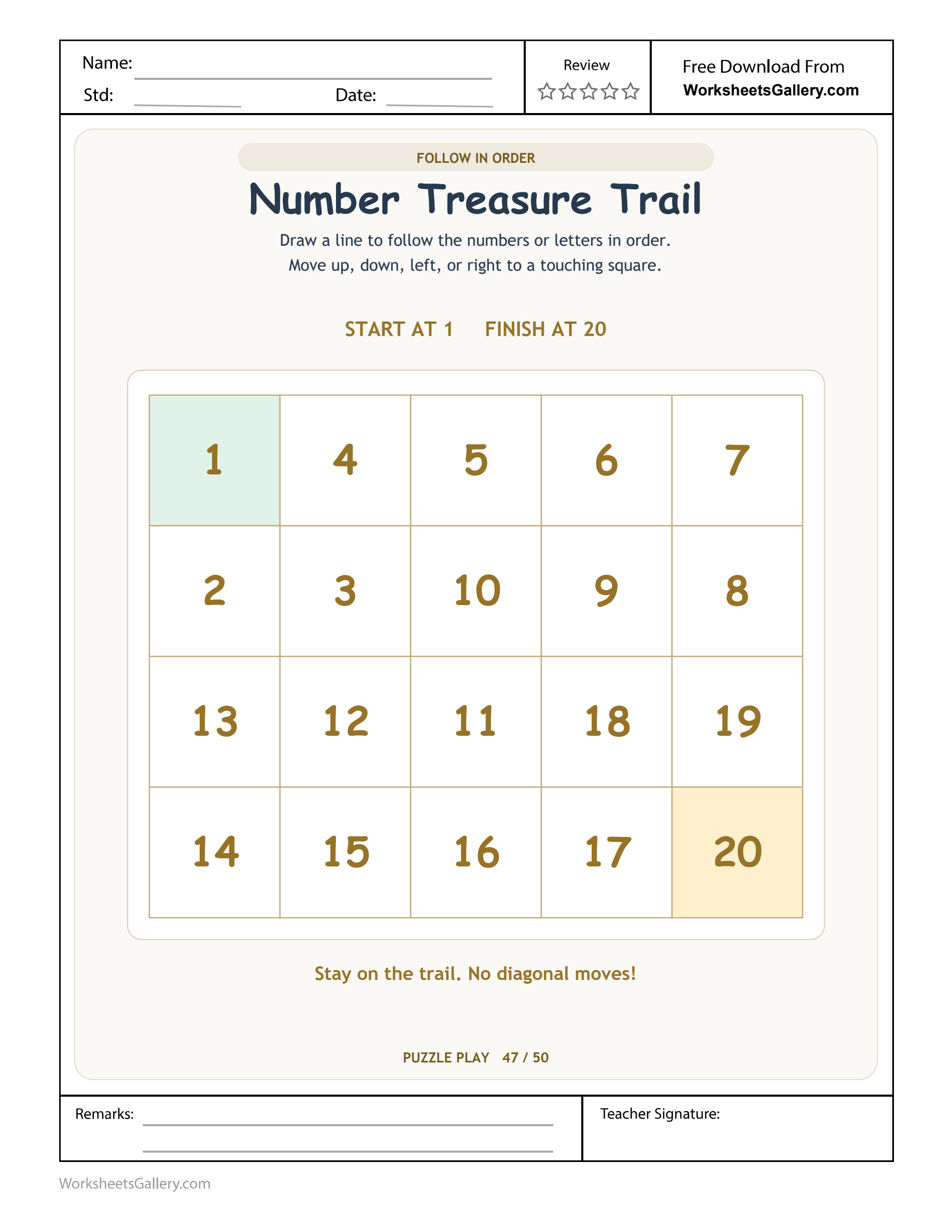
$5 · 25 supplied sheets: Number Neighbour Trail. Locate the next integer in an edge-sharing square, with diagonal shortcuts excluded.
The treasure trail is made from neighbouring numbered squares rather than a hidden maze corridor. Number Neighbour Trail starts at one and ends at twenty, following every integer in order through a four-row grid. Children may move up, down, left or right to a square sharing a side; diagonal jumps are excluded. Begin by finding two beside the starting square and explain the allowed contact before drawing. An adult can help name a numeral while the child locates its place. The route becomes a record of ordered decisions, not a shortcut to the highlighted finish.
Number Neighbour Trail: read the actual puzzle
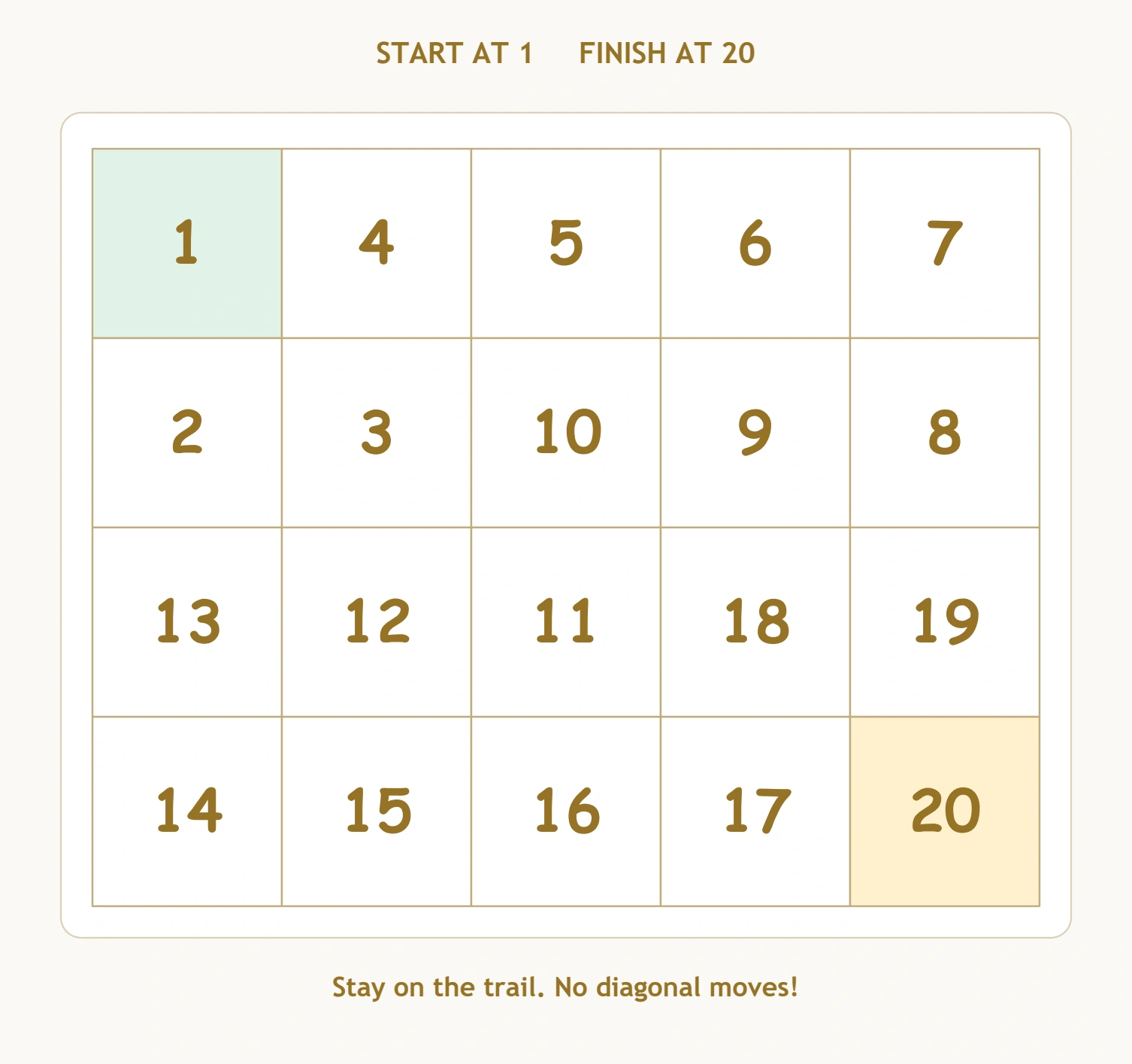
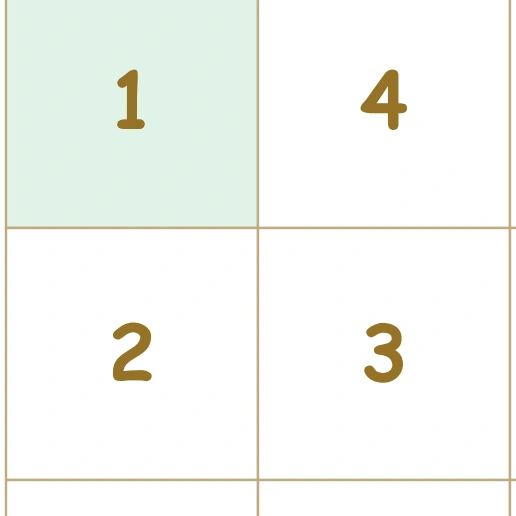
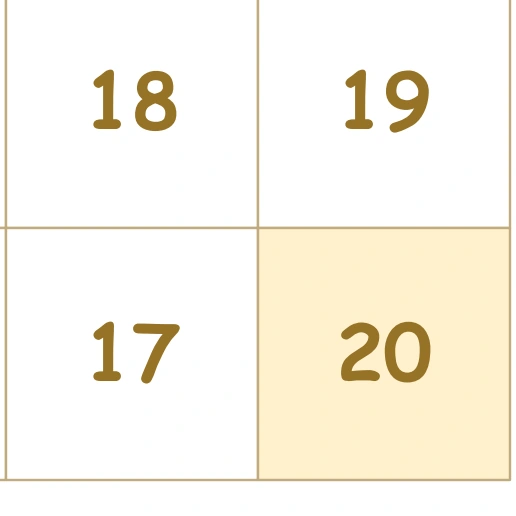
Number Neighbour Trail: All twenty numbers occupy a four-by-five field. The green start is one and the highlighted finish is twenty. Every integer has its own square, so the sequence determines which destination must be found at each step.
A legal move crosses a shared side. Squares that meet only at a corner do not qualify. Check both the next number and its contact with the current square before extending the pencil line.
Shared-side test deserves a second look
The trail turns upward as well as downward. From three, the next four is above; ordinary left-to-right row reading would not follow the sequence. Keep the numerical successor in charge of the route’s changing direction.
Draw through the ordered squares until twenty is reached. Recognising the finish early does not permit skipping the intervening numbers. The task is complete when a continuous legal route has visited one through twenty in order.
Eight closer readings of numbered start
Name the successor before searching
Ask what number comes immediately after the current stop before looking for a direction. That spoken target guides the spatial search. Choosing a nearby square first and only then reading its numeral can encourage a route based on convenience rather than the ordered sequence the worksheet requires. This Number Neighbour Trail distinction supports number sequence application.
An edge is different from a corner
Place two spare square cards side by side, then make them touch only diagonally. Compare the contacts with the printed move rule. The route permits the shared-side arrangement, so recognising a desired number across a corner does not make a jump to it legal.
A reading row is not this path
The first row contains one, four, five, six and seven. Reading straight across would skip two and three. Demonstrate the first move down to two, then let the child search for the next integer. The puzzle uses number order within a spatial arrangement, not ordinary row-by-row reading. This Number Neighbour Trail distinction supports directional flexibility.
The turn from three to four
After reaching three, inspect the square directly above for four. The upward move can surprise a child who expects progress to mean moving right or down. Point to the shared border and name the numerical reason for the turn before extending the pencil route.
Keep the current square available
A small marker can retain the reached square while the child scans its neighbours. Move it only after both the successor and side-contact checks succeed. This supports place keeping without supplying the next numeral or deciding which direction the child should follow. This Number Neighbour Trail distinction supports pencil continuity.
The finish does not remove intermediate stops
Twenty is highlighted and visible well before the route reaches it. Ask the child to explain which successor is currently required rather than drawing toward the finish. The intended journey must include every preceding integer, making its ordered record more important than simply arriving at a coloured endpoint.
Inspect a route already drawn
On review, trace the pencil line and name each number it visits. Check for skipped integers as well as illegal contacts. A line may look continuous while cutting diagonally or bypassing a successor; following the record aloud makes those different errors easier to identify locally. This Number Neighbour Trail distinction supports number sequence application.
Create a smaller transfer problem
Build a separate five-number route with legal turns and ask the child to explain every move. A new arrangement checks whether the successor-and-edge method transfers beyond remembered positions. Keep the rules explicit and use larger squares if small-line control would otherwise hide the child’s understanding.
Partners explore adjacency reasoning
Partners use successor-namer and edge-checker roles. The namer identifies the next integer while the checker confirms a shared side. Each child draws on their own sheet only after the two pieces of evidence agree.
A Number Neighbour Trail classroom note can describe following the next integer even when the route turns upward. Record the actual successor search prompt, too.
Readiness for successor search
Name the next numeral aloud if needed and leave the child to locate its square. Large numbered floor or table tiles can rehearse side-sharing moves before narrow pencil work on the printed grid.
Suggested Number Neighbour Trail range: ages five to seven. Lena’s readiness depends on number sequence application and interest in successor search. Shorten this Number Neighbour Trail visit when needed.

Six observations from numbered start
Number sequence application — numbered start
Number Neighbour Trail invites using successors to direct a changing spatial path. Notice Lena’s number sequence application explanation: “Which square starts this numerical journey?”
Adjacency reasoning — successor search
Number Neighbour Trail invites distinguishing side contact from a diagonal relationship. Notice Lena’s adjacency reasoning explanation: “What number must be reached next?”
Directional flexibility — shared-side test
Number Neighbour Trail invites following the next integer even when the route turns upward. Notice Lena’s directional flexibility explanation: “Do these squares share an edge or only a corner?”
Place keeping — ordered finish
Number Neighbour Trail invites retaining a current square while searching its neighbours. Notice Lena’s place keeping explanation: “Can you trace every number on your completed route?”
Pencil continuity — numbered start
Number Neighbour Trail invites drawing a visible route through successive legal squares. Notice Lena’s pencil continuity explanation: “Which square starts this numerical journey?”
Completion proof — successor search
Number Neighbour Trail invites checking all intermediate stops rather than recognising only the finish. Notice Lena’s completion proof explanation: “What number must be reached next?”
Five play invitations after successor search
Edge or corner with Number Neighbour Trail
Place two square cards in side-sharing and corner-touching positions, explaining which arrangement matches the trail rule.
Five-stop floor path with Number Neighbour Trail
Arrange five large numbered tiles in a turning path and move a toy through successors without diagonal jumps.
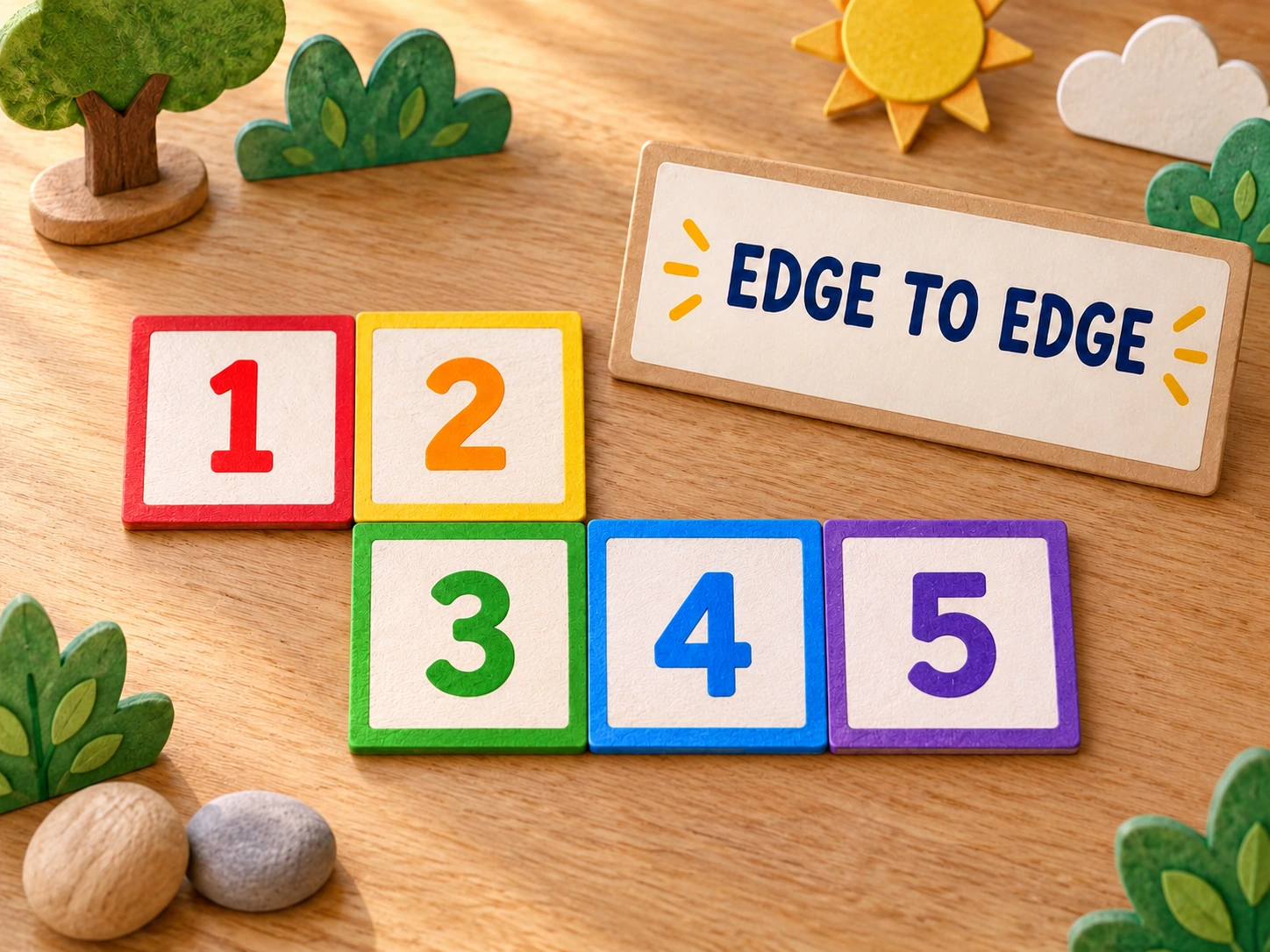
Unexpected up turn with Number Neighbour Trail
Build a tiny numbered layout where the next integer is above the current one, then explain the needed direction change.
Trail auditor with Number Neighbour Trail
An adult draws one illegal shortcut on a separate numbered model. The child identifies the skipped successor or diagonal contact.
Route storyteller with Number Neighbour Trail
Use first, next and finally to describe a small sequence of legal moves to a partner who cannot see the original route.
Distinctions behind shared-side test
Numbered start — the Lena discussion
Numerical order and spatial direction answer different questions. The successor identifies which square is wanted, while adjacency determines whether the proposed move is legal. Ask about both when a child chooses a visually nearby but numerically wrong destination.
Successor search — the Lena discussion
A marker can keep the current square visible while a child searches its neighbours. This support does not reveal the next integer; it reduces accidental restarts. Move the marker only after the successor and shared-side checks have been made.
Shared-side test — the Lena discussion
The page does not ask for counting objects or tracing individual numeral shapes. Its numbers serve as route instructions. A child can demonstrate the ordered path by pointing even when forming a steady continuous pencil line requires additional support.
Imagine Lena investigating at home
Lena’s father asks her to find four after reaching three. Lena first looks to the right, then notices four directly above. They point to the shared edge before adding that upward segment, keeping the number sequence separate from a reading-row habit.
Try “Which square starts this numerical journey?” during this imagined Number Neighbour Trail visit. Let Lena explain numbered start before recording.
Four checkpoints for Number Neighbour Trail
| Pause here | Inspect this clue |
|---|---|
| Numbered start | Place a finger at the highlighted one before beginning. |
| Successor search | Find the immediately following integer. |
| Shared-side test | Check that the candidate touches along a full side. |
| Ordered finish | Reach twenty after all preceding stops. |
Numbered start — Lena’s inspection
For Number Neighbour Trail, ask “Which square starts this numerical journey?” Place a finger at the highlighted one before beginning.
Successor search — Lena’s inspection
For Number Neighbour Trail, ask “What number must be reached next?” Find the immediately following integer.
Shared-side test — Lena’s inspection
For Number Neighbour Trail, ask “Do these squares share an edge or only a corner?” Check that the candidate touches along a full side.
Ordered finish — Lena’s inspection
For Number Neighbour Trail, ask “Can you trace every number on your completed route?” Reach twenty after all preceding stops.
Revisit the shared-side test difficulty
A diagonal can look like a convenient way toward the finish, but it violates the printed move rule. Check contact before drawing. Another slip is reading along a row even when its adjacent number is not the numerical successor.
Return to Number Neighbour Trail evidence by asking “Do these squares share an edge or only a corner?” Separate pencil execution from Lena’s numbered start reasoning.
Another visit through completion proof
Ask the child to inspect a short section of the finished trail and explain a turn that once looked surprising. A later review can focus on one legal move instead of redrawing all twenty stops.
Invite Lena to revisit ordered finish. Recognise explanations about ordered finish from Lena.
Save and print Number Neighbour Trail
The clean Number Neighbour Trail PDF is available under qualifying active membership access. Domain lettering and the website watermark are removed, and the file is ad-free. Download the original sample separately if needed. Before printing the premium edition, inspect the entire twenty-number field, especially the start at one and finish at twenty, in portrait preview.
Other choices beyond number sequence application
For Number Neighbour Trail, the saved catalog suggests road-following after number neighbour trail; aiming-and-stopping after number neighbour trail; picture-recipe drawing after number neighbour trail. Read each linked activity’s rule with Lena; its numbered start response may differ.
For Lena, browse NAEYC writing ideas alongside number neighbour trail or PBS Parents activities beyond number neighbour trail. Watch number sequence application with directional flexibility, then revisit numbered start.
Popular Worksheets
Printable resources families and teachers are downloading now.
 Free
 Free
 Free
 Free