
Jungle Route Following: 4 Brilliant Arrow Adventures
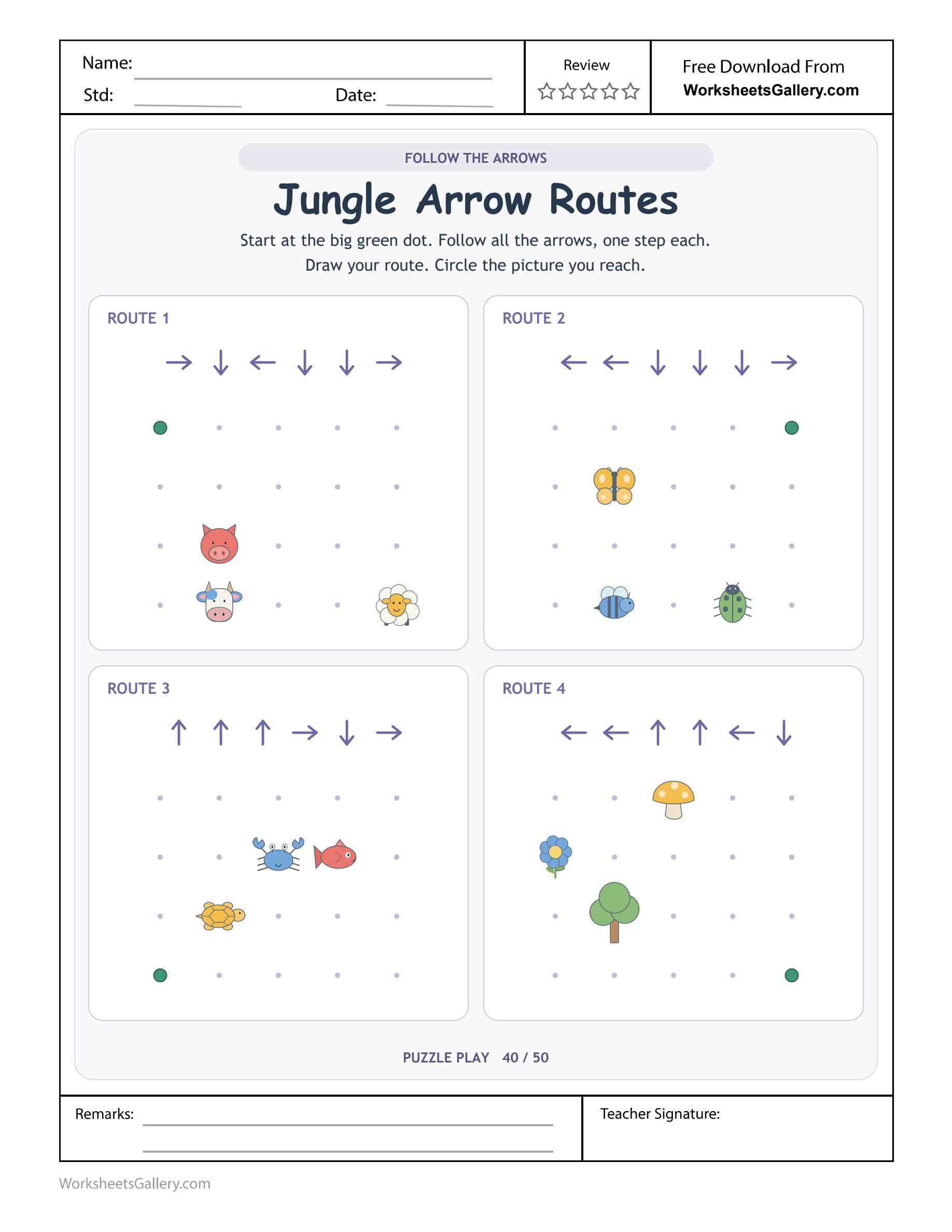
$5 · 25 supplied sheets: Jungle Route Following. Mark the current dot while checking the next instruction so turns do not reset the route.
The animal pictures make these journeys inviting, but the arrow instructions decide where they end. Jungle Route Following offers four routes, each beginning at a green dot and using six one-step commands. Children keep a place in the dot field while reading the next arrow, draw the travelled route and circle its final picture. An adult can read direction words aloud without choosing the movement. Start with one panel and pause whenever the current location is uncertain. The useful achievement is a journey that another person can reconstruct from the same start and commands.
Jungle Route Following: read the actual puzzle
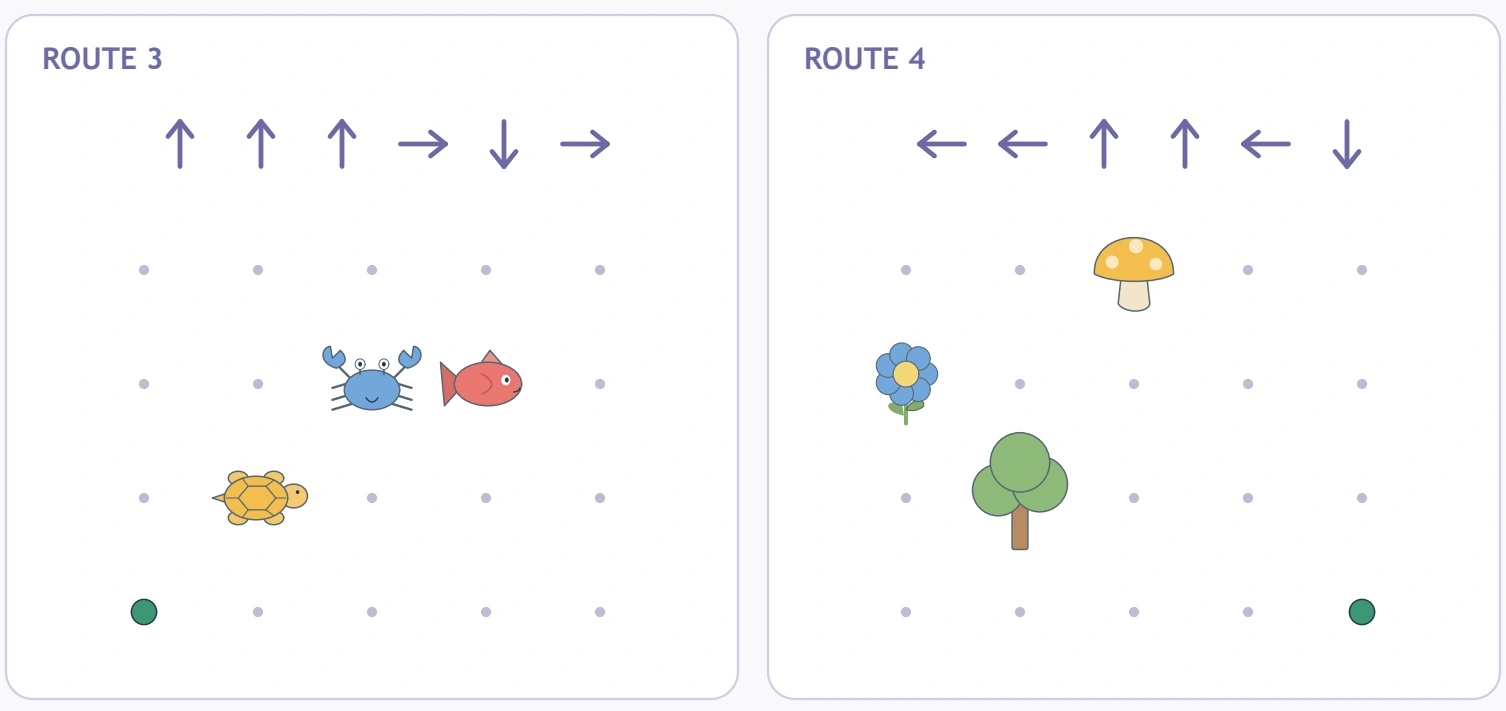
Jungle Route Following: Each panel has its own green starting dot and pictured choices. Some starts lie at the top and others at the bottom. Identify the current panel’s start before reading its first arrow instead of assuming every route begins in the same corner.
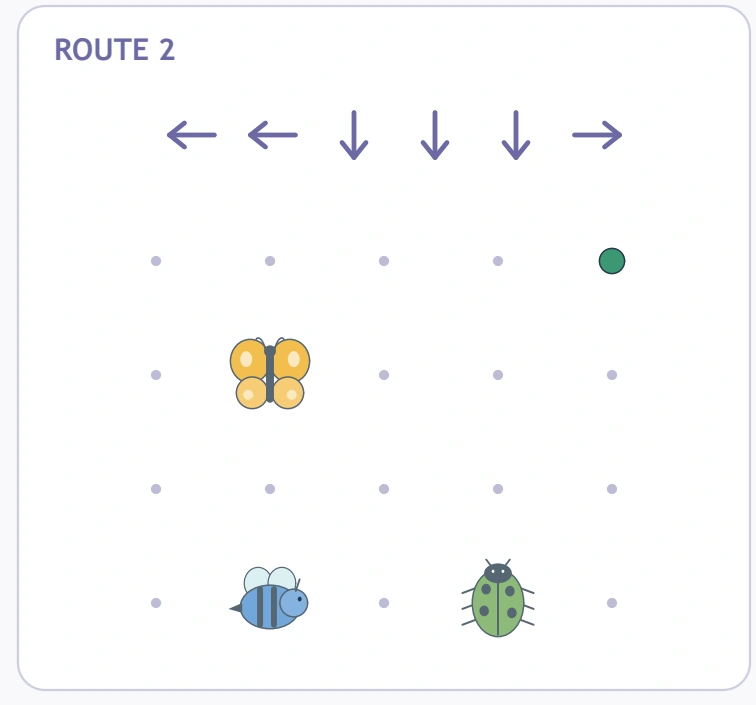
A command moves one dot left, right, up or down. Successive identical arrows still represent separate steps. The third route begins with three upward moves, so keep three individual positions rather than treating the arrow run as one large jump.
Current position deserves a second look
A finger or marker can retain the current dot while the child checks the next arrow. The route continues from the latest position, not from the original green point each time. Pair movement and instruction tracking deliberately.
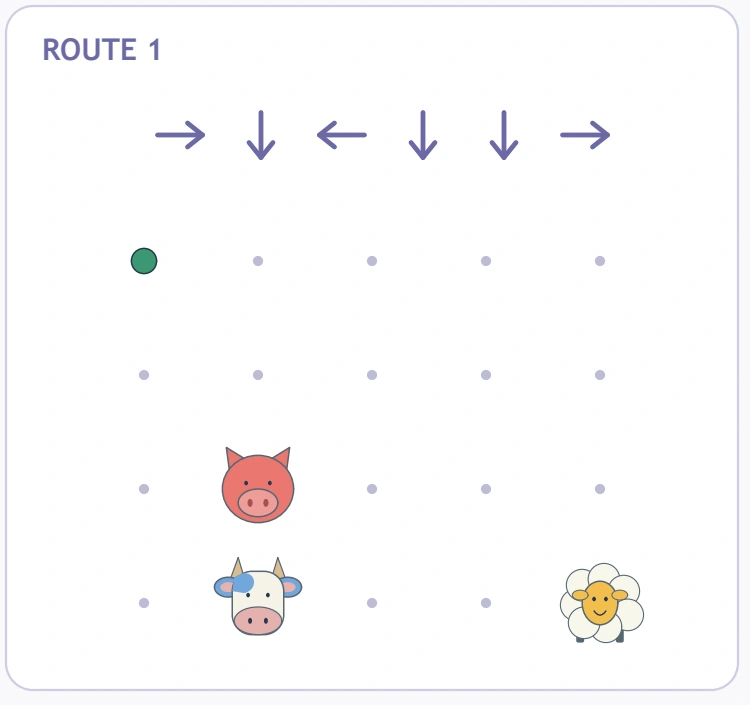
The destination is the picture under the position reached after all six commands. In the first route, following the complete string reaches the cow. Other tempting animals remain part of the field without becoming the answer to that particular journey.
Another visit through destination evidence
Invite the child to narrate one previously drawn journey to an adult. Reconstructing the same route from its start gives a fresh purpose to the recorded path.
Revisit Jungle Route Following through last-command result. Recognise explanations about last-command result from Soren.
Four checkpoints for Jungle Route Following
| Pause here | Inspect this clue |
|---|---|
| Panel-specific start | Find this route’s green dot before any movement. |
| Repeated commands | Count each identical arrow as another single move. |
| Current position | Hold the latest dot while checking the next instruction. |
| Last-command result | Finish the string before selecting the destination. |
Panel-specific start — Soren’s inspection
For Jungle Route Following, ask “Is this a top-start or bottom-start journey?” Find this route’s green dot before any movement.
Repeated commands — Soren’s inspection
For Jungle Route Following, ask “How many separate upward steps are written?” Count each identical arrow as another single move.
Current position — Soren’s inspection
For Jungle Route Following, ask “Where are you now, before the next arrow?” Hold the latest dot while checking the next instruction.
Last-command result — Soren’s inspection
For Jungle Route Following, ask “Which picture is under the final position?” Finish the string before selecting the destination.
Partners explore position updating
Pairs use traveller and command-reader roles. The traveller moves only after hearing one arrow, while the reader keeps a token beneath the next unused command. Children switch roles for a route starting in a different corner.
A Jungle Route Following classroom note can describe matching a visible arrow with a neighbouring movement. Record the actual repeated commands prompt, too.
Eight closer readings of panel-specific start
A new corner changes the setup
The four jungle panels do not all begin in the same corner. Name whether the current start is at the top or bottom, then point to its green dot. That brief setup prevents a child from applying a familiar command sequence to a location borrowed from the previous route. This Jungle Route Following distinction supports command sequencing.
The traveller keeps moving forward
After one command, the new dot becomes the starting place for the next command. The original green marker does not need to be revisited each time. A large movable token makes this state change concrete, especially when the child looks away to read another arrow.
Three up arrows are three steps
The third route begins with three separate upward commands. Move once for each and note the intermediate stops. Treating the run as one jump loses two instructions, while continuing upward indefinitely invents additional moves. Pair each written arrow with exactly one completed action. This Jungle Route Following distinction supports directional interpretation.
Read orientation before naming it
If left and right words are still uncertain, compare the visible arrow with the possible neighbouring dots. An adult can provide the direction name while the child selects the corresponding move. This keeps the spatial interpretation available without turning the task into a vocabulary test alone.
Hold the next unused instruction
Place a small counter beneath the arrow that has not yet been carried out. Advance it after the traveller completes that move. The counter helps distinguish a repeated command from one already used, reducing accidental omissions when several arrows point in the same direction. This Jungle Route Following distinction supports pencil-path clarity.
A destination needs the whole history
Recognising a cow or ladybug in the field does not establish that it is the final stop. Ask the child to reconstruct how the instructions reach the chosen picture. A route that can be shown from green to endpoint provides evidence for the answer beyond familiarity with an appealing animal.
Draw the route you followed
When the finger rehearsal is secure, the pencil line should record the same sequence of neighbouring-dot moves. If the drawing and command count disagree, pause and compare a small section. Do not let a partly remembered endpoint replace the movement evidence that justifies the final circle. This Jungle Route Following distinction supports command sequencing.
Offer a navigator’s return visit
Let the child read commands to an adult on another day. The adult can make one deliberate extra step and ask for help checking it. Explaining the mismatch offers a different role and reinforces one-to-one instruction use without requiring the entire printed page to be completed again.
Five play invitations after repeated commands
Jungle marker keeper with Jungle Route Following
On a homemade dot field, pause after each move and name where a toy traveller is standing before reading another command.
Three separate climbs with Jungle Route Following
Use three upward arrow cards on a large path, moving a marker once per card and checking the intermediate stops.
New corner start with Jungle Route Following
Execute a short invented instruction strip from two different valid starts and compare the resulting positions.
Animal destination reporter with Jungle Route Following
After following an invented route, ask a partner to explain the final animal using the full instruction history.
Command-reader swap with Jungle Route Following
Let a child read directions to an adult traveller, correcting a mistaken restart by pointing to the current marker.
Distinctions behind current position
Panel-specific start — the Soren discussion
A line already drawn on paper can become another place-keeping aid, but only if it records the executed moves accurately. Rehearse a small portion with a finger when the line and the command count stop agreeing, rather than simply extending an uncertain path.
Repeated commands — the Soren discussion
Repeated arrows invite both counting and movement. Say a brief count as each command is used, then return attention to the remaining instructions. The count tracks commands consumed; it is not a licence to jump across several dots at once.
Current position — the Soren discussion
Finding a familiar animal quickly does not prove the journey was followed. Ask the child to show the route from green to that endpoint. A reconstructable sequence explains the answer more clearly than recognition of a pleasing picture.
Imagine Soren investigating at home
Soren’s mother asks him to leave a marker at his current jungle dot while he looks back at the arrow strip. He returns to that marker for the next move. They discover that remembering the destination animal is less useful than preserving the traveller’s changing place.
Try “Is this a top-start or bottom-start journey?” during this imagined Jungle Route Following visit. Let Soren explain panel-specific start before recording.
Readiness for repeated commands
Try the commands with a large movable token before drawing a narrow line. Offer spoken direction names when helpful, while asking the child to select the actual next dot from the visible field.
Suggested Jungle Route Following range: ages four to six. Soren’s readiness depends on command sequencing and interest in repeated commands. Shorten this Jungle Route Following visit when needed.
Six observations from panel-specific start
Command sequencing — panel-specific start
Jungle Route Following invites keeping all six instructions in their printed order. Notice Soren’s command sequencing explanation: “Is this a top-start or bottom-start journey?”
Position updating — repeated commands
Jungle Route Following invites continuing from the newest dot rather than an earlier location. Notice Soren’s position updating explanation: “How many separate upward steps are written?”
Directional interpretation — current position
Jungle Route Following invites matching a visible arrow with a neighbouring movement. Notice Soren’s directional interpretation explanation: “Where are you now, before the next arrow?”
Repeated-step counting — last-command result
Jungle Route Following invites executing several identical commands as separate actions. Notice Soren’s repeated-step counting explanation: “Which picture is under the final position?”
Pencil-path clarity — panel-specific start
Jungle Route Following invites recording the same journey that was followed with a finger. Notice Soren’s pencil-path clarity explanation: “Is this a top-start or bottom-start journey?”
Destination evidence — repeated commands
Jungle Route Following invites explaining an animal choice through the completed instruction list. Notice Soren’s destination evidence explanation: “How many separate upward steps are written?”
Revisit the current position difficulty
Restarting at green for every command can make the same few dots seem relevant repeatedly. Show the difference between the original start and the current position. Another slip is collapsing three upward arrows into one move, losing two intermediate steps.
Return to Jungle Route Following evidence by asking “Where are you now, before the next arrow?” Separate pencil execution from Soren’s panel-specific start reasoning.
Save and print Jungle Route Following
Choose the clean Jungle Route Following printable through its premium control; an eligible active member plan is required. Jungle routes remain intact while domain wording and website watermark are absent, with no advertising in the PDF. The original upload has a distinct sample control. Inspect every green start and its complete arrow strip within the portrait page boundary before printing.
Other choices beyond command sequencing
For Jungle Route Following, the saved catalog suggests road-following after jungle route following; aiming-and-stopping after jungle route following; picture-recipe drawing after jungle route following. Read each linked activity’s rule with Soren; its panel-specific start response may differ.
For Soren, browse NAEYC writing ideas alongside jungle route following or PBS Parents activities beyond jungle route following. Watch command sequencing with directional interpretation, then revisit panel-specific start.
Popular Worksheets
Printable resources families and teachers are downloading now.
 Free
 Free
 Free
 Free