
Copycat Picture Checks: 6 Clever Exact-Match Tests
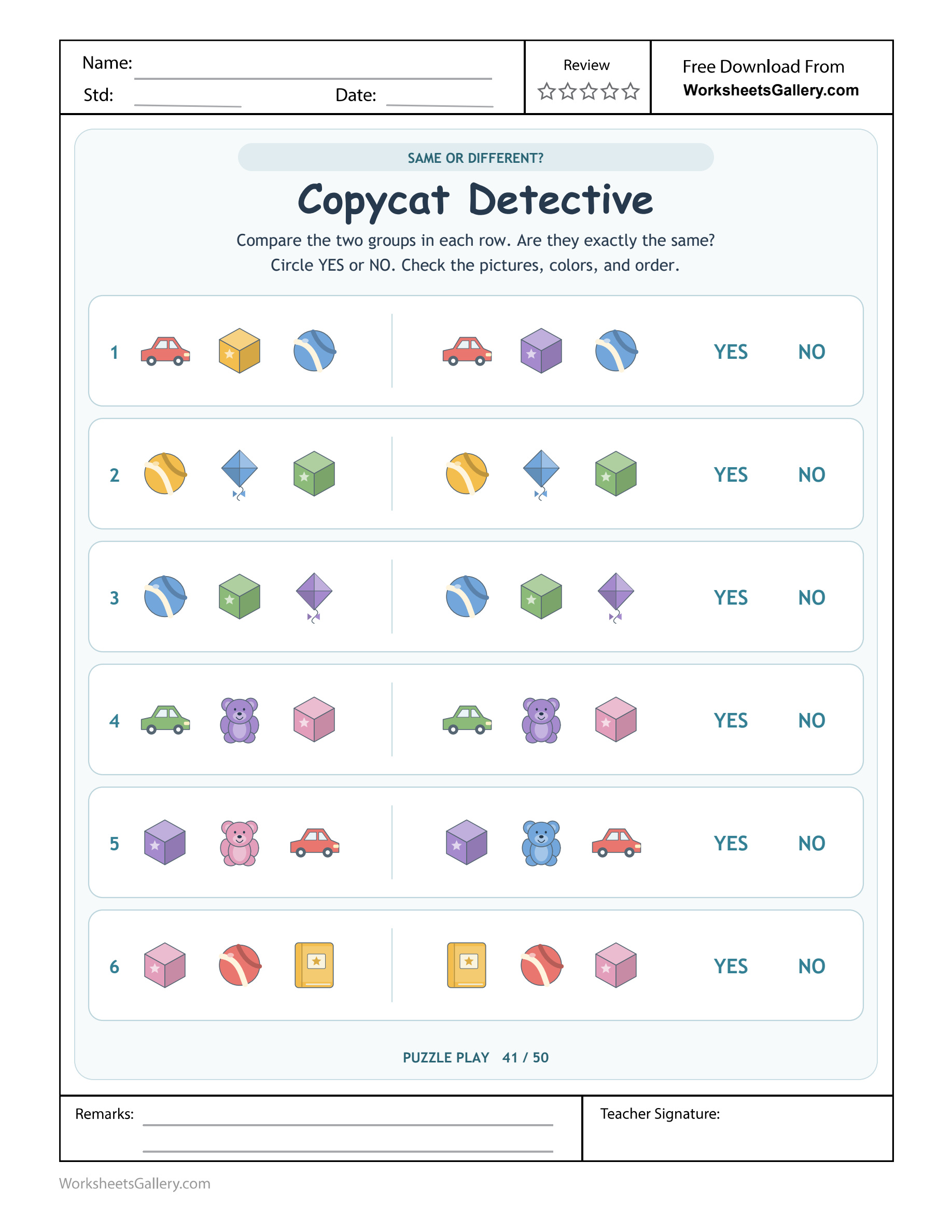
$5 · 25 supplied sheets: Copycat Picture Checks. Compare identity, colour and position; a group with the same objects can still differ.
A familiar toy trio invites a quick yes, but a closer comparison can change the answer. Copycat Picture Checks presents six pairs of groups and asks whether each pair is exactly the same. Children inspect the objects, their colours and their order before circling YES or NO. Begin with corresponding positions rather than naming everything on one side and relying on memory. An adult can ask what evidence supports the response while leaving the decision open. A single changed feature is enough for NO; a confident YES needs all the relevant features to agree.
Copycat Picture Checks: read the actual puzzle
Copycat Picture Checks: Each row contains a left group, a right group and two response words. Compare within that row. The task does not ask whether one row matches the next or whether all its pictures belong to the same category.
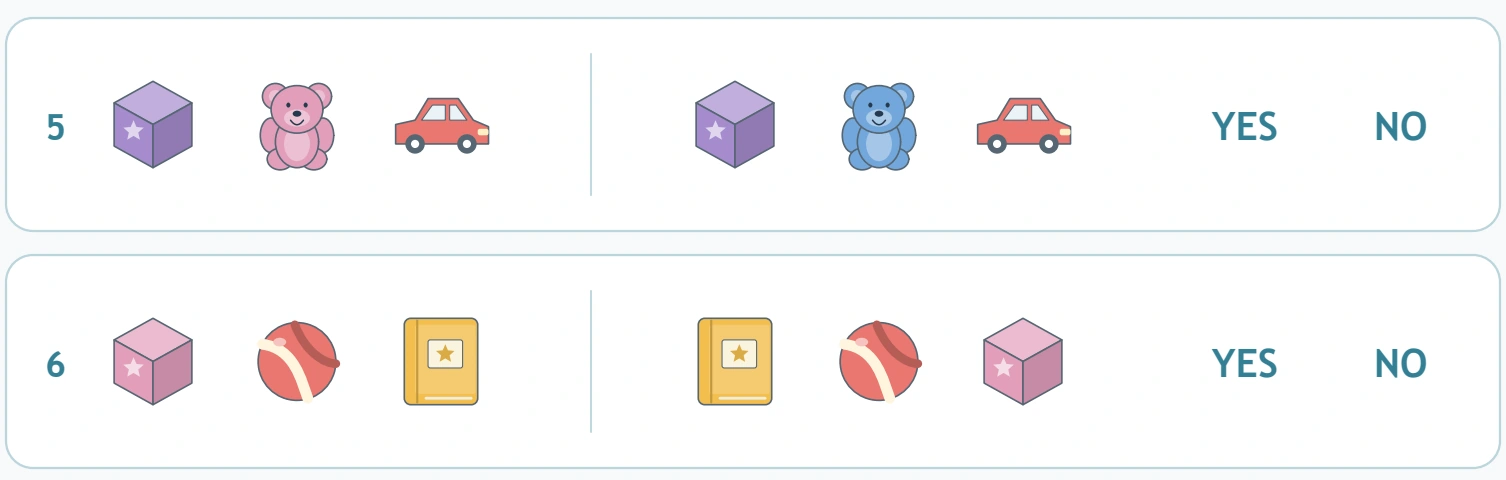
Identity alone is insufficient for an exact match. In the first pair the car and ball agree, while the block changes colour. A child can recognise the same kinds of toys and still need to answer NO because one visible feature differs.

Order inspection deserves a second look
Order also counts. In the last row, the outer pictures exchange positions while the middle ball remains. Naming the same inventory on both sides does not establish that their arrangements are exactly alike.
Circle YES only after checking every corresponding position. For NO, invite the child to point to one specific difference before marking the response. There is no instruction to circle changed toy pictures on this sheet.
Revisit the order inspection difficulty
Treating any shared object as evidence for YES skips the rest of the group. Conversely, a child may assume every row hides a difference. Use an unchanged pair to show that a complete agreement is a valid finding too.
Return to Copycat Picture Checks evidence by asking “Have any toys exchanged places?” Separate pencil execution from Rina’s row pairing reasoning.

Distinctions behind order inspection
Row pairing — the Rina discussion
An exact-match rule demands agreement across every required feature, while a NO response can rest on one clear mismatch. Discuss that difference in the evidence needed for each verdict without suggesting that one answer is more desirable.
Feature inspection — the Rina discussion
Pointing between corresponding positions reduces the need to memorise an entire group. Let the child look back and forth freely. The task concerns comparison, not recalling pictures after one side has been hidden.
Order inspection — the Rina discussion
An unclear circle around both response words may hide a precise spoken judgement. Ask which answer was intended before reteaching the comparison. A smaller pencil loop or a pointed response can clarify the record.

Six observations from row pairing
Exact comparison — row pairing
Copycat Picture Checks invites checking several properties rather than recognising a broad resemblance. Notice Rina’s exact comparison explanation: “Which two groups belong to this question?”
Position matching — feature inspection
Copycat Picture Checks invites linking corresponding first, middle and final objects. Notice Rina’s position matching explanation: “Is this block the same colour on both sides?”
Colour attention — order inspection
Copycat Picture Checks invites noticing a colour change within the same kind of toy. Notice Rina’s colour attention explanation: “Have any toys exchanged places?”
Reasoned rejection — response evidence
Copycat Picture Checks invites using one demonstrated mismatch to justify NO. Notice Rina’s reasoned rejection explanation: “What visible fact supports your answer?”
Careful confirmation — row pairing
Copycat Picture Checks invites checking all required features before accepting YES. Notice Rina’s careful confirmation explanation: “Which two groups belong to this question?”
Clear response marking — feature inspection
Copycat Picture Checks invites circling the intended word rather than a distracting toy. Notice Rina’s clear response marking explanation: “Is this block the same colour on both sides?”
Imagine Rina investigating at home
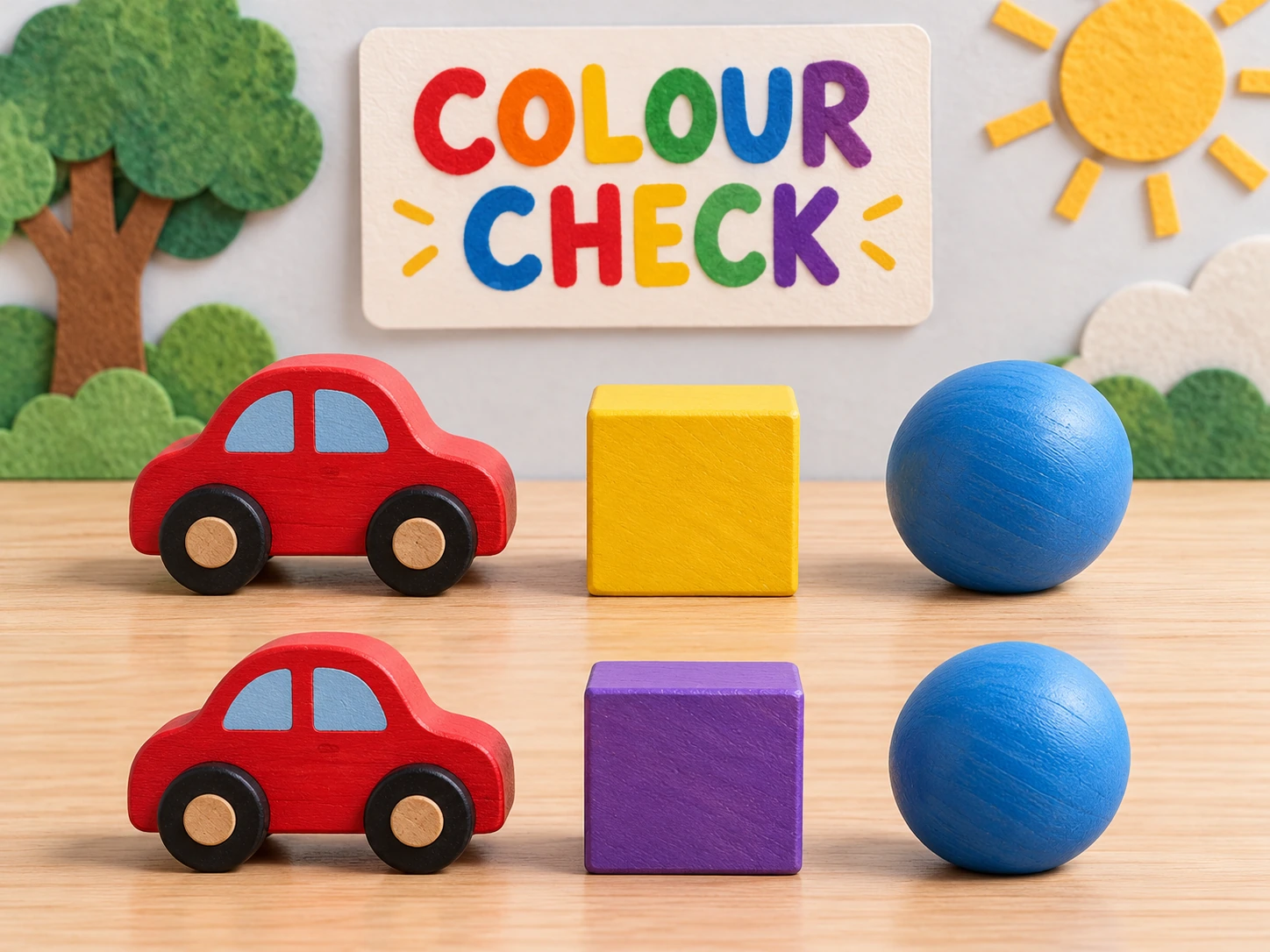
Rina’s uncle sets three real toys in two rows, changing only a block’s colour. Rina names the identical toy types, then notices the colour mismatch. They use that separate demonstration to clarify exactly same before returning to the printed response words.
Try “Which two groups belong to this question?” during this imagined Copycat Picture Checks visit. Let Rina explain row pairing before recording.
Readiness for feature inspection
Read YES and NO aloud and let the child point to a response first. Offer a shorter comparison of one corresponding pair before restoring the entire three-position question.
Suggested Copycat Picture Checks range: ages four to six. Rina’s readiness depends on exact comparison and interest in feature inspection. Shorten this Copycat Picture Checks visit when needed.
Five play invitations after feature inspection
One feature swap with Copycat Picture Checks
Arrange matching toy trios and alter only one colour. Name the property that changed before giving a verdict.
Order inspector with Copycat Picture Checks
Exchange the outer toys in a separate row while keeping its middle object fixed. Compare inventory with arrangement.
Convince the checker with Copycat Picture Checks
One player states YES or NO about two small groups; another asks for visible evidence supporting that response.
Build a real YES with Copycat Picture Checks
Invite a child to recreate a three-object model exactly, checking object identity, colour and position together.
Word-choice rehearsal with Copycat Picture Checks
Use large written YES and NO cards for an invented comparison before returning to the smaller printed response words.
Eight closer readings of row pairing
A shared inventory is not enough
Name the three toys on each side, then compare their individual positions. Both groups can contain a car, block and ball without matching exactly. A complete verdict also considers which object occupies the first, middle and last slot and whether its visible colour agrees with its counterpart. This Copycat Picture Checks distinction supports exact comparison.
Check colour within an identity
The first row preserves toy types while changing the block’s colour. Ask about the block specifically after the child notices the same car and ball. This demonstrates why a true observation about two matching objects does not settle the question about the entire three-object arrangement.
One mismatch can justify NO
When a child points to a clear colour difference, ask whether an exact match is still possible. There is no need to invent further mismatches once a decisive one has been demonstrated. The evidence for rejection differs from the evidence for accepting every required feature as equal. This Copycat Picture Checks distinction supports colour attention.
YES needs a complete inspection
A matching first object does not guarantee that the rest agree. Move between corresponding positions until all three have been considered. An adult can ask which parts remain unchecked, supporting a systematic comparison without implying that every row must contain a hidden difference.
Use the middle as an anchor
An unchanged centre toy can help align the left and right groups. From that stable position, inspect both ends rather than assuming the whole row matches. The final reversed arrangement makes this especially useful: a fixed ball can coexist with two outer toys exchanging places. This Copycat Picture Checks distinction supports careful confirmation.
Do not make memory the obstacle
Leave both groups visible and allow repeated glances. Covering one side would add a recall task the printed comparison does not require. A child who checks back frequently may be using the available evidence carefully rather than demonstrating weaker understanding of the exact-match rule.
Record a verdict, not a difference circle
The sheet asks for a circle around YES or NO. A child may correctly identify a changed toy yet mark that picture instead. Read the response instruction again and translate the demonstrated observation into the appropriate word choice, preserving recognition of the sound comparison already made. This Copycat Picture Checks distinction supports exact comparison.
Let an adult defend a wrong answer
On a separate small toy model, an adult can claim YES despite a colour change. Invite the child to show the contradiction. Explaining why the proposed verdict fails offers another social role while keeping attention on visible properties instead of treating the game as a competition for speed.
Partners explore position matching
A pair takes pointer and reporter roles. The pointer checks corresponding positions while the reporter explains the result. They swap after one row so the child holding the pencil is not always the person providing the evidence.
A Copycat Picture Checks classroom note can describe noticing a colour change within the same kind of toy. Record the actual feature inspection prompt, too.
Another visit through clear response marking
Invite a child to demonstrate a truly matching row to an adult who pretends to be doubtful. Defending YES can feel like a new challenge after practising how to spot differences.
Invite Rina to revisit response evidence. Recognise explanations about response evidence from Rina.
Four checkpoints for Copycat Picture Checks
| Pause here | Inspect this clue |
|---|---|
| Row pairing | Keep the comparison within one numbered row. |
| Feature inspection | Compare the object and colour at each position. |
| Order inspection | Check the first, middle and last positions. |
| Response evidence | Choose YES or NO after a specific comparison. |
Row pairing — Rina’s inspection
For Copycat Picture Checks, ask “Which two groups belong to this question?” Keep the comparison within one numbered row.
Feature inspection — Rina’s inspection
For Copycat Picture Checks, ask “Is this block the same colour on both sides?” Compare the object and colour at each position.
Order inspection — Rina’s inspection
For Copycat Picture Checks, ask “Have any toys exchanged places?” Check the first, middle and last positions.
Response evidence — Rina’s inspection
For Copycat Picture Checks, ask “What visible fact supports your answer?” Choose YES or NO after a specific comparison.
Save and print Copycat Picture Checks
Choose a qualifying active membership for the clean Copycat Picture Checks PDF. The premium file omits the website watermark and domain while keeping all six paired groups and their YES/NO choices; advertisements are absent. Use the original sample independently when reviewing the upload. A portrait print check should show complete pairs at both edges before you make a copy.
Other choices beyond exact comparison
For Copycat Picture Checks, the saved catalog suggests road-following after copycat picture checks; aiming-and-stopping after copycat picture checks; picture-recipe drawing after copycat picture checks. Read each linked activity’s rule with Rina; its row pairing response may differ.
For Rina, browse NAEYC writing ideas alongside copycat picture checks or PBS Parents activities beyond copycat picture checks. Watch exact comparison with colour attention, then revisit row pairing.
Popular Worksheets
Printable resources families and teachers are downloading now.
 Free
 Free
 Free
 Free