
Picnic Change Detectives: 6 Clever Evidence Finds
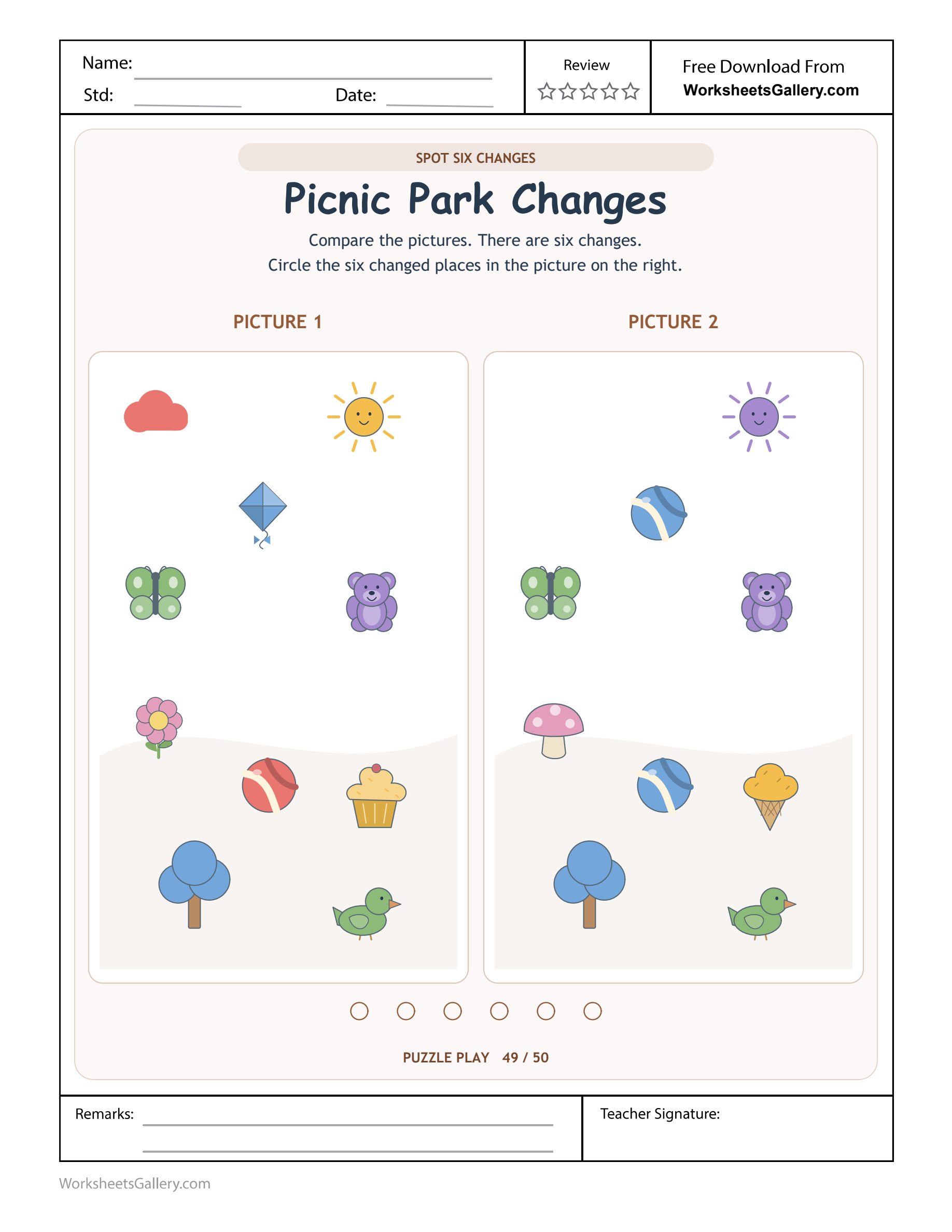
$5 · 25 supplied sheets: Picnic Change Detectives. Compare corresponding locations and circle each changed area in the right-hand scene.
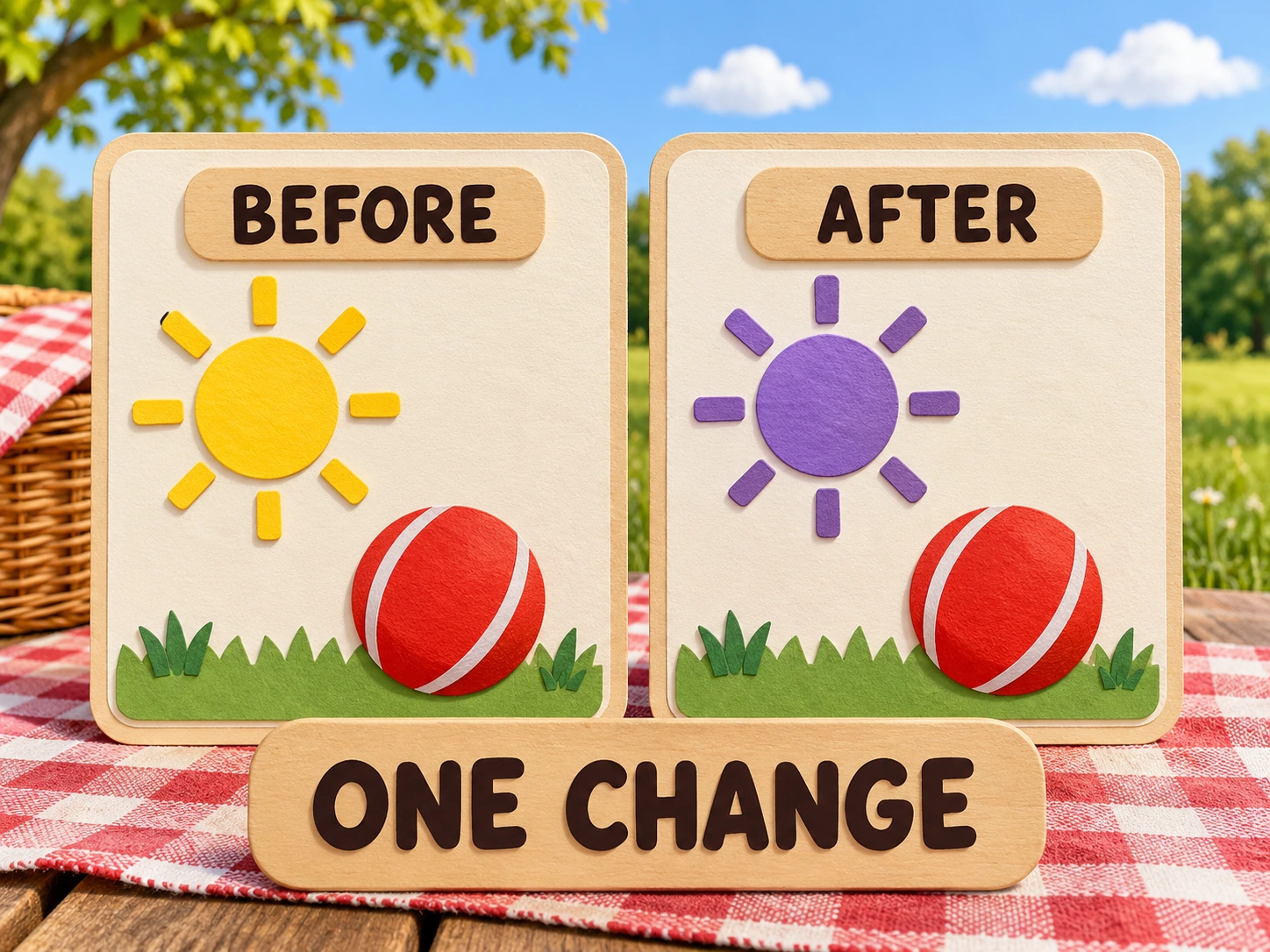
Two picnic scenes look familiar until corresponding places are compared carefully. Picnic Change Detectives asks children to find six changes and circle those locations in the picture on the right. Some changes alter colour, others replace an object, and one removes an object entirely. Start with a small scene region and compare it with the same region next door before marking. A child can describe what stayed the same as well as what changed. The aim is six distinct pieces of visual evidence, with circles placed on the requested right-hand scene.
Picnic Change Detectives: read the actual puzzle
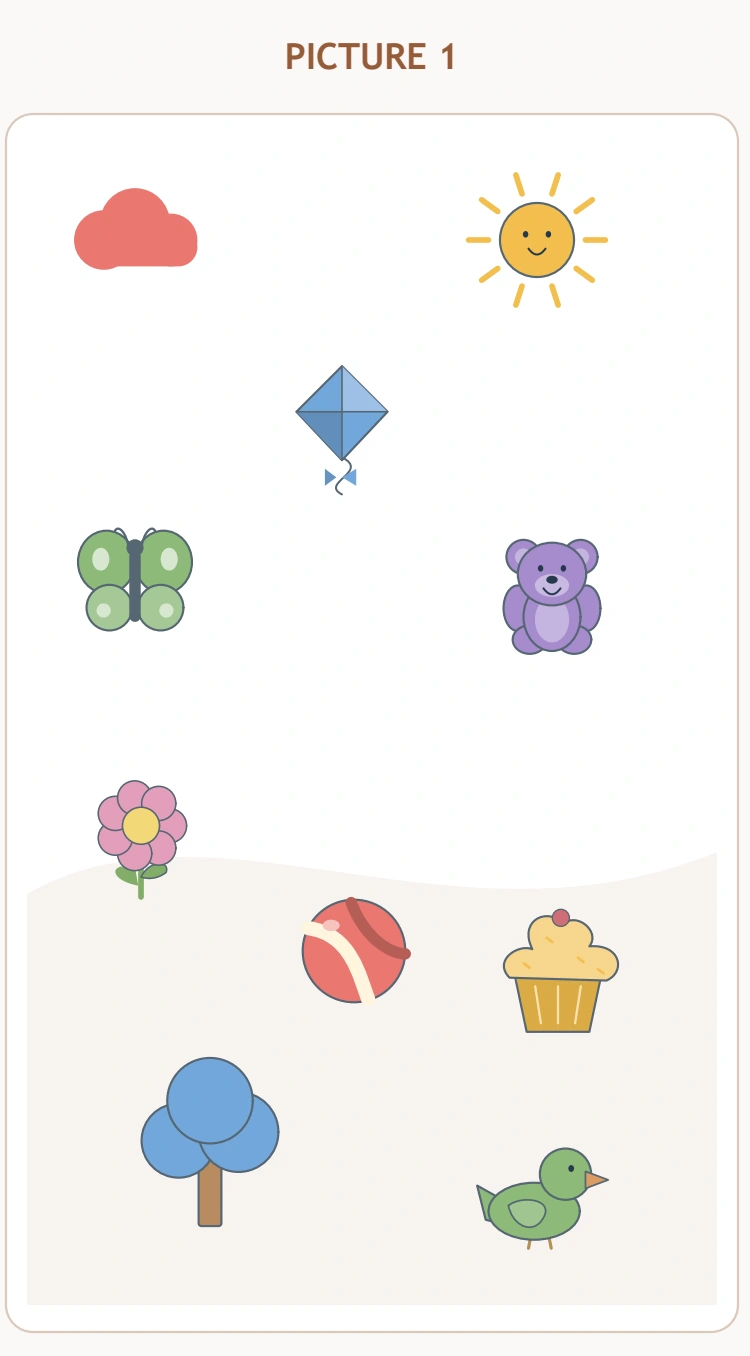
Picnic Change Detectives: The page labels two side-by-side scenes PICTURE 1 and PICTURE 2. Use the left as the comparison reference and mark the changed places on the right. Circling the original object on the left would record the evidence in a different place from the printed instruction.
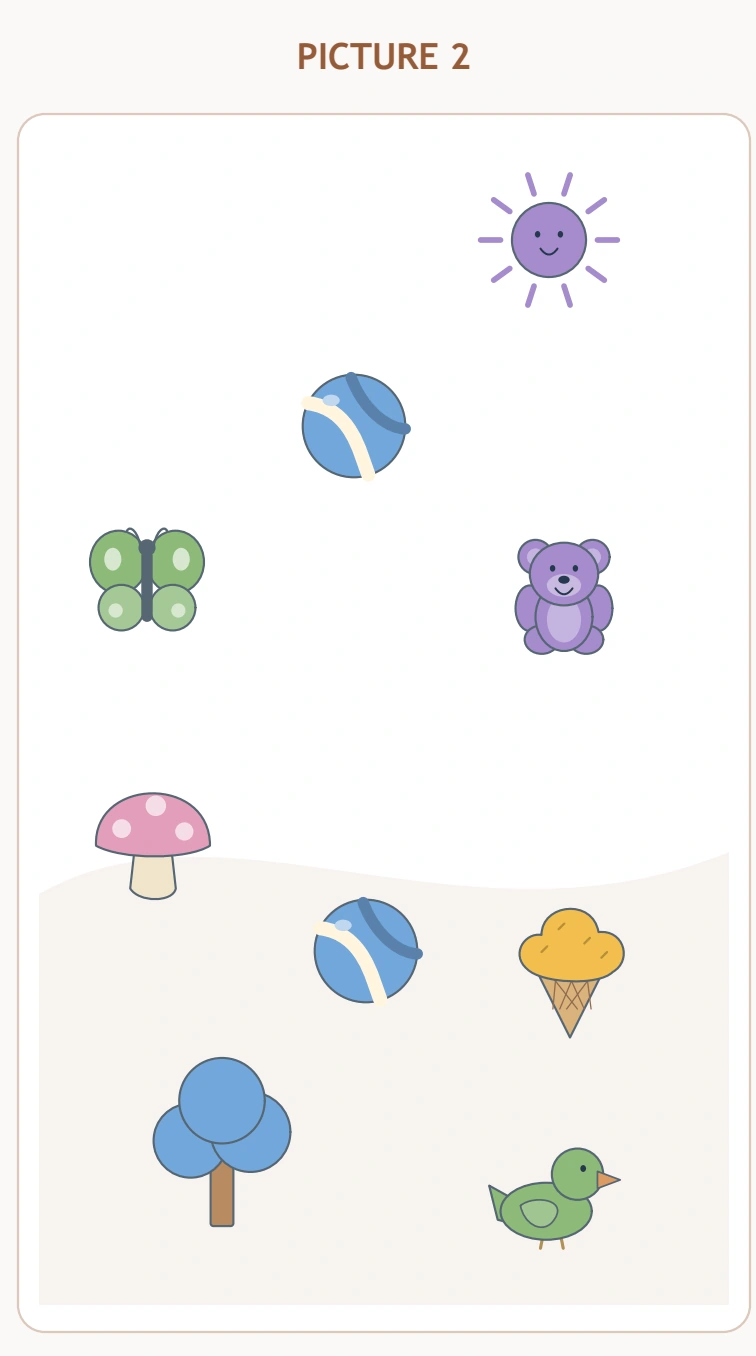
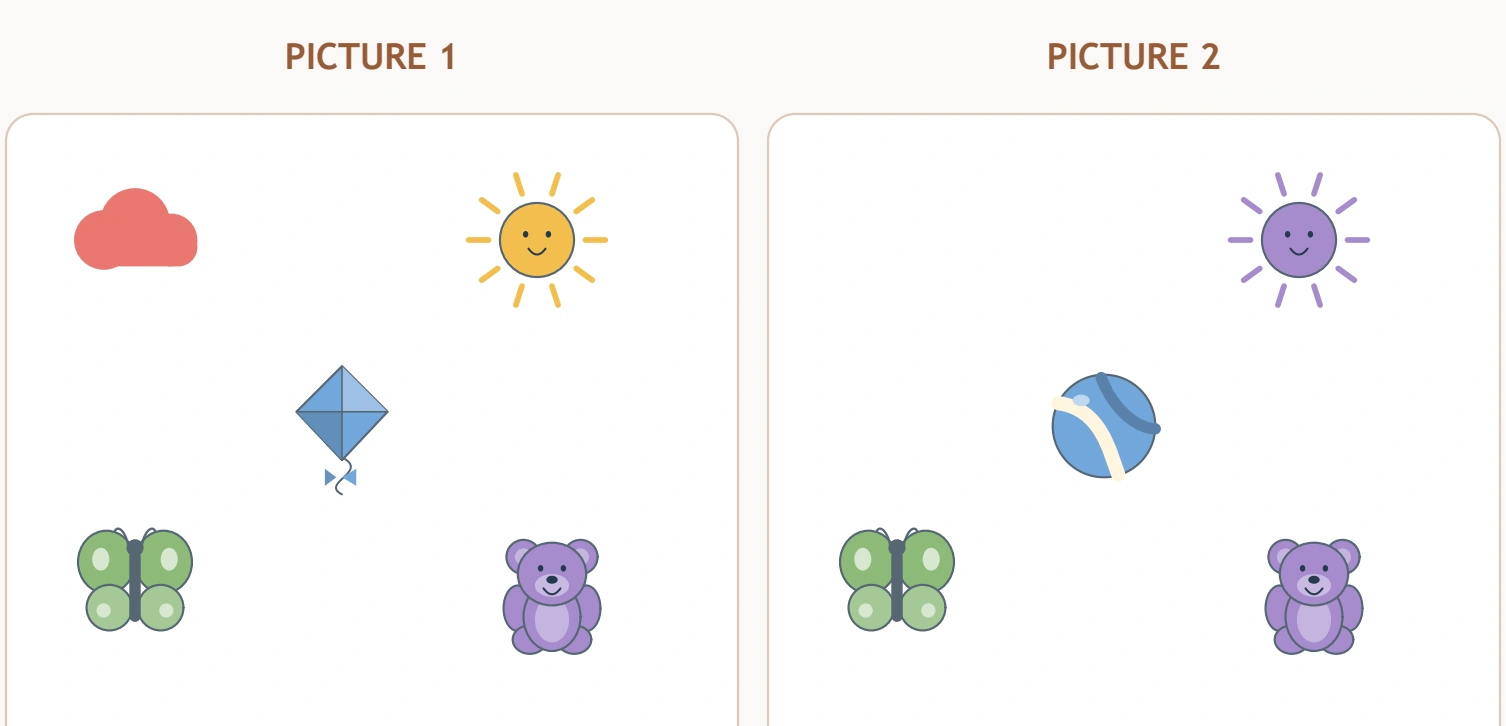
The upper cloud disappears in the right-hand scene, while the sun changes colour. These are different forms of change. A missing object can be recorded by circling its corresponding empty location rather than inventing a new drawing there.
Right-side record deserves a second look
Other changes include object replacements and a recoloured lower ball. Compare identity and colour separately so a ball or mushroom is not overlooked merely because it occupies a familiar position in the scene.
Find six distinct changed locations, checking the same area on both sides before adding each circle. Unchanged butterfly, teddy, tree and bird pictures can act as useful anchors for aligning the two scenes.
Distinctions behind right-side record
Scene correspondence — the Mabel discussion
A changed location and an altered object count are not always the same. A replacement removes one pictured object and introduces another at that place, yet it represents one of the six changes. Keep the counting unit clear when discussing progress.
Change type — the Mabel discussion
Scanning a scene in regions can make the comparison more systematic. Use a matching teddy or butterfly as an anchor, compare nearby details, then move to another area. The method should help the child retain a place rather than become another elaborate task to memorise.
Right-side record — the Mabel discussion
The empty place left by a missing cloud should remain empty in the faithful worksheet. Circling that area records its absence. Drawing a new cloud there would change the comparison evidence and answer a different creative prompt.
Readiness for change type
Reduce the visible search area with a loose paper window while keeping corresponding parts accessible. Allow pointing and oral descriptions before requiring six small circles on the printed scene.
Suggested Picnic Change Detectives range: ages four to six. Mabel’s readiness depends on detailed comparison and interest in change type. Shorten this Picnic Change Detectives visit when needed.
Five play invitations after change type
One picnic change with Picnic Change Detectives
Build two tiny object scenes differing in one colour, then ask a partner to describe the exact altered feature.
Missing visitor with Picnic Change Detectives
Remove one object from a small paired arrangement and point to its former location in the changed version.
Replacement reporter with Picnic Change Detectives
Exchange one toy for another while keeping its place fixed; explain why this is one changed location.
Region explorer with Picnic Change Detectives
Divide an invented scene into simple top and bottom regions and compare one corresponding area at a time.
Unchanged anchor with Picnic Change Detectives
Choose a matching object in two scenes and use its position to align the surrounding comparison before searching again.
Eight closer readings of scene correspondence
Compare places before objects
Choose a small region of the left scene and locate its counterpart on the right. Then inspect what occupies each place. Comparing whichever two objects attract attention can create apparent differences between unrelated positions. The same-location routine keeps evidence tied to the paired scene rather than a loose inventory of pictures. This Picnic Change Detectives distinction supports detailed comparison.
Absence is still visible evidence
The cloud’s former location has no replacement object in the second picture. Invite the child to point to that corresponding area and explain what was there before. The circle records a changed place; drawing a new cloud into the gap would alter the very evidence the comparison asks them to inspect.
A recoloured object keeps its identity
The upper sun remains a sun while its colour changes. Name both the stable identity and altered property. This careful description distinguishes recolouring from replacement and gives the child vocabulary for explaining why two recognisably similar pictures can still count as different in this scene. This Picnic Change Detectives distinction supports spatial correspondence.
One replacement is one changed location
A kite becoming a ball removes one object and introduces another at the same place. Count that position once rather than reporting a missing kite and an extra ball as two findings. Clarifying the counting unit helps keep the six required changes distinct during the search.
Use an unchanged picture to align
The teddy, butterfly, tree or bird can act as a stable anchor. Locate the same anchor in both scenes and compare nearby details. Unchanged evidence is useful even though it should not be circled; it supports correspondence and helps a child return to the right area after looking away. This Picnic Change Detectives distinction supports targeted circling.
Mark the requested scene
The instruction places the circles on the right-hand picture. A correct difference noticed on the left can first be pointed out there, then located on the right for recording. That translation preserves the valid observation while making the final mark consistent with what the printable requests.
Track findings without recounting one
After recording a change, describe it briefly before moving to another region. A child can use a finger or separate counter to retain the number of distinct findings. Revisiting the same recoloured ball should not increase that count, even when its difference is noticed from another direction. This Picnic Change Detectives distinction supports detailed comparison.
Keep the search enjoyable and bounded
Inspect one scene region or one new change during a short return visit. Let the child explain the finding to a pretend picnic guest. A limited, purposeful invitation can sustain interest better than requiring all six locations to be rediscovered repeatedly after their positions have become familiar.
Partners explore change classification
Partners take region-finder and change-reporter roles. One chooses a small area and the other compares its counterpart before proposing a mark. They record each new finding once and exchange jobs so both learners contribute visible evidence.
A Picnic Change Detectives classroom note can describe locating the same region across two separate pictures. Record the actual change type prompt, too.
Four checkpoints for Picnic Change Detectives
| Pause here | Inspect this clue |
|---|---|
| Scene correspondence | Compare equivalent regions rather than unrelated pictures. |
| Change type | Notice disappearance, colour change or replacement. |
| Right-side record | Place the circle in the picture requested by the instruction. |
| Distinct six | Count changed locations without recording the same one twice. |
Scene correspondence — Mabel’s inspection
For Picnic Change Detectives, ask “Where is this same place in the other scene?” Compare equivalent regions rather than unrelated pictures.
Change type — Mabel’s inspection
For Picnic Change Detectives, ask “Did this object vanish, change colour or become something else?” Notice disappearance, colour change or replacement.
Right-side record — Mabel’s inspection
For Picnic Change Detectives, ask “Which scene should receive your mark?” Place the circle in the picture requested by the instruction.
Distinct six — Mabel’s inspection
For Picnic Change Detectives, ask “Is this a new change or one already counted?” Count changed locations without recording the same one twice.
Imagine Mabel investigating at home
Mabel’s aunt asks her to compare the upper-left corners. Mabel notices the cloud has disappeared and wonders what to circle. They point to its corresponding right-side location, explaining how an absence can still be evidence of a change.
Try “Where is this same place in the other scene?” during this imagined Picnic Change Detectives visit. Let Mabel explain scene correspondence before recording.
Six observations from scene correspondence
Detailed comparison — scene correspondence
Picnic Change Detectives invites checking corresponding scene positions rather than a general impression. Notice Mabel’s detailed comparison explanation: “Where is this same place in the other scene?”
Change classification — change type
Picnic Change Detectives invites distinguishing removal, replacement and recolouring. Notice Mabel’s change classification explanation: “Did this object vanish, change colour or become something else?”
Spatial correspondence — right-side record
Picnic Change Detectives invites locating the same region across two separate pictures. Notice Mabel’s spatial correspondence explanation: “Which scene should receive your mark?”
Verbal evidence — distinct six
Picnic Change Detectives invites describing what changed and what remained stable. Notice Mabel’s verbal evidence explanation: “Is this a new change or one already counted?”
Targeted circling — scene correspondence
Picnic Change Detectives invites marking one changed place without covering neighbouring details. Notice Mabel’s targeted circling explanation: “Where is this same place in the other scene?”
Progress checking — change type
Picnic Change Detectives invites tracking six distinct findings rather than repeated observations. Notice Mabel’s progress checking explanation: “Did this object vanish, change colour or become something else?”
Another visit through progress checking
Reopen the picnic comparison and invite an explanation of one unchanged anchor that helped align the scenes. Finding stable evidence offers another kind of inspection without demanding that every difference be rediscovered.
Revisit Picnic Change Detectives through distinct six. Recognise explanations about distinct six from Mabel.
Revisit the right-side record difficulty
Circling both sides can obscure which scene the instruction selects. Revisit the right-side recording rule. Another slip is counting a replacement twice, once for the old object and once for the new one, even though it is one changed location.
Return to Picnic Change Detectives evidence by asking “Which scene should receive your mark?” Separate pencil execution from Mabel’s scene correspondence reasoning.
Save and print Picnic Change Detectives
The premium Picnic Change Detectives option supplies eligible active members with a clean comparison PDF. Website watermark and domain wording are absent, as are embedded advertisements. The original-upload sample stays independently accessible. Inspect both picnic scenes and their outer borders before printing the portrait page, leaving room to mark the six locations on the right.
Other choices beyond detailed comparison
For Picnic Change Detectives, the saved catalog suggests road-following after picnic change detectives; aiming-and-stopping after picnic change detectives; picture-recipe drawing after picnic change detectives. Read each linked activity’s rule with Mabel; its scene correspondence response may differ.
For Mabel, browse NAEYC writing ideas alongside picnic change detectives or PBS Parents activities beyond picnic change detectives. Watch detailed comparison with spatial correspondence, then revisit scene correspondence.
Popular Worksheets
Printable resources families and teachers are downloading now.
 Free
 Free
 Free
 Free