
Space Change Search: 6 Brilliant Before-After Clues
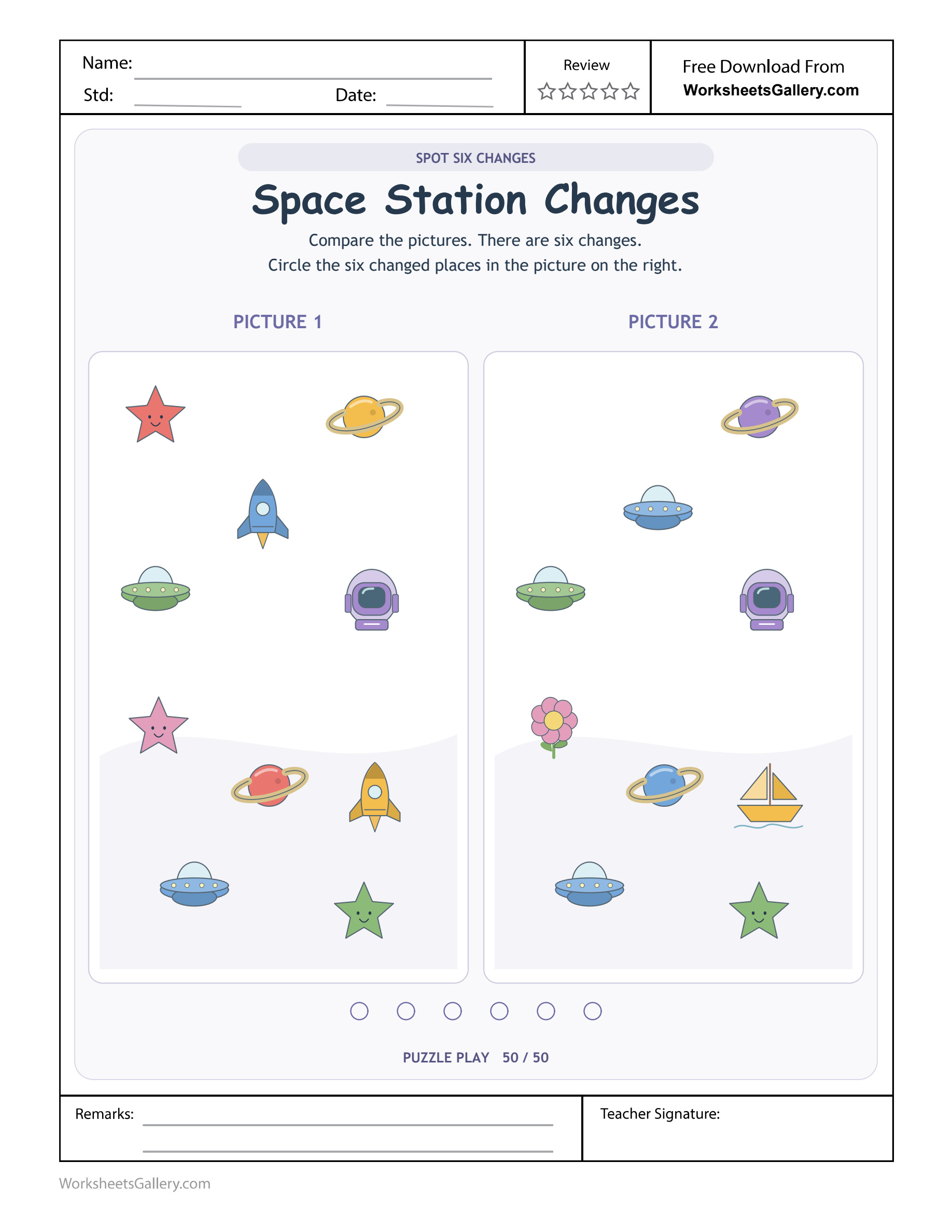
$5 · 25 supplied sheets: Space Change Search. Separate a missing object from a replacement or colour change while checking the same scene region.
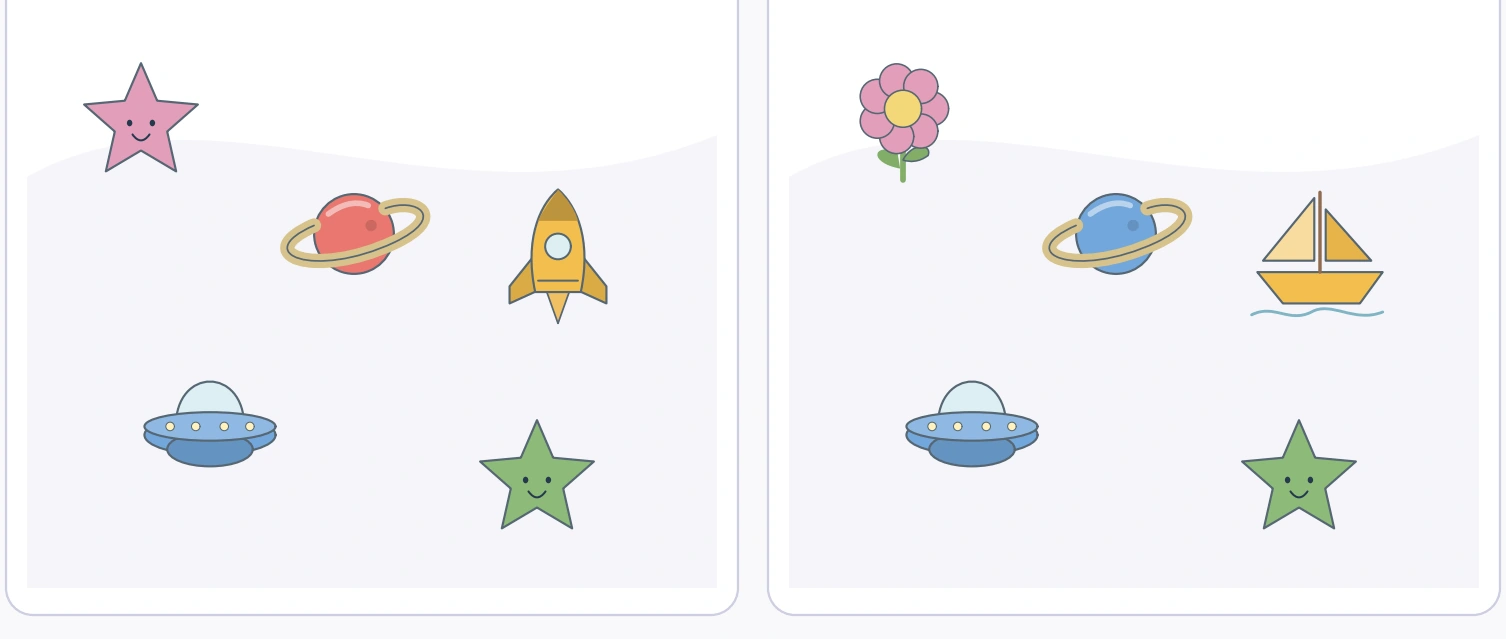
The second space picture contains six deliberate changes to inspect. Space Change Search compares matching scene regions, looking for a missing object, new identities and altered colours. Children circle the changed places on the right-hand picture, using the left scene as their reference. An adult can ask for a precise description before a mark is added, leaving the discovery with the child. Begin near an unchanged anchor such as the helmet, then compare nearby details. Six separate findings complete the search; a familiar space theme does not make every repeated-looking object identical.
Space Change Search: read the actual puzzle
Space Change Search: The paired scenes preserve much of their arrangement, making corresponding positions useful evidence. Match the upper region with the upper region and the lower region with the lower region instead of comparing whichever space objects happen to attract attention first.
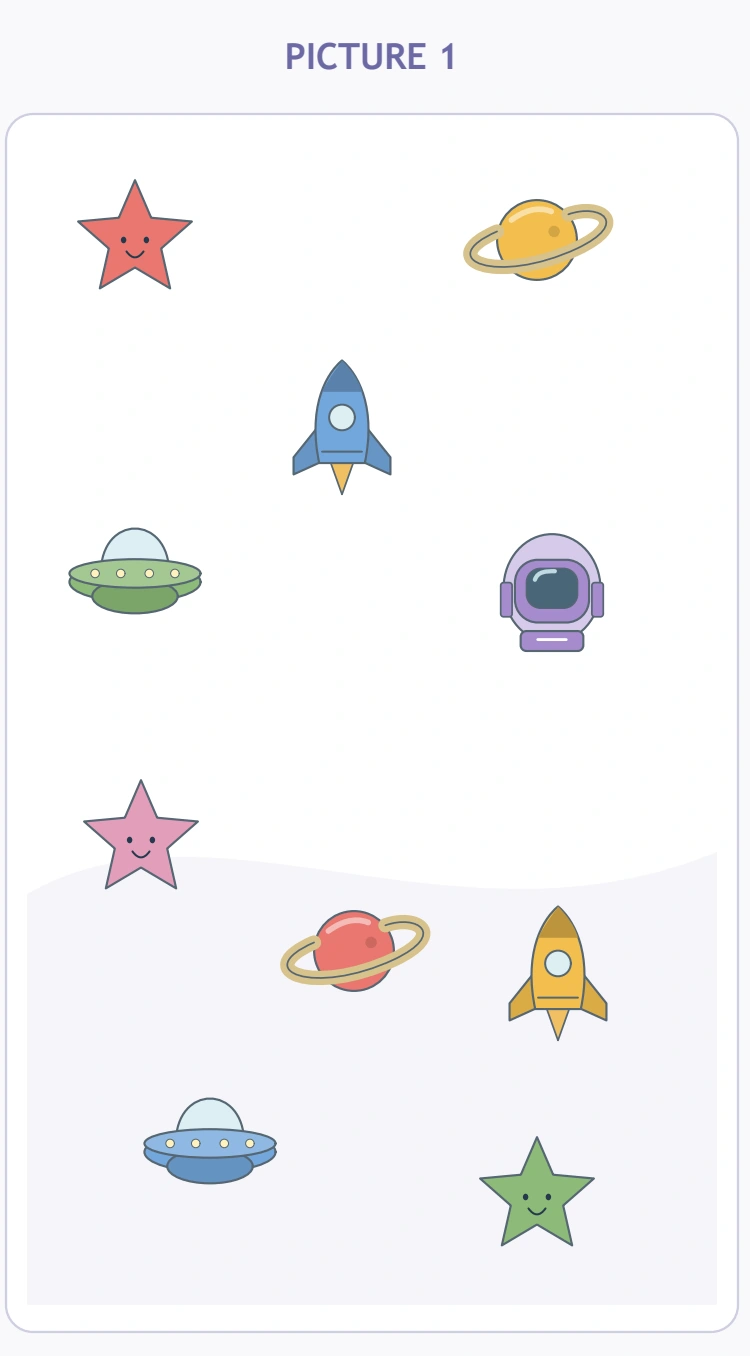
The top red star is absent from the right scene and the upper ringed planet changes colour. One difference is a disappearance, the other a property change. A child can point to the right-side location of the missing star without filling it with a new picture.
Absent star deserves a second look
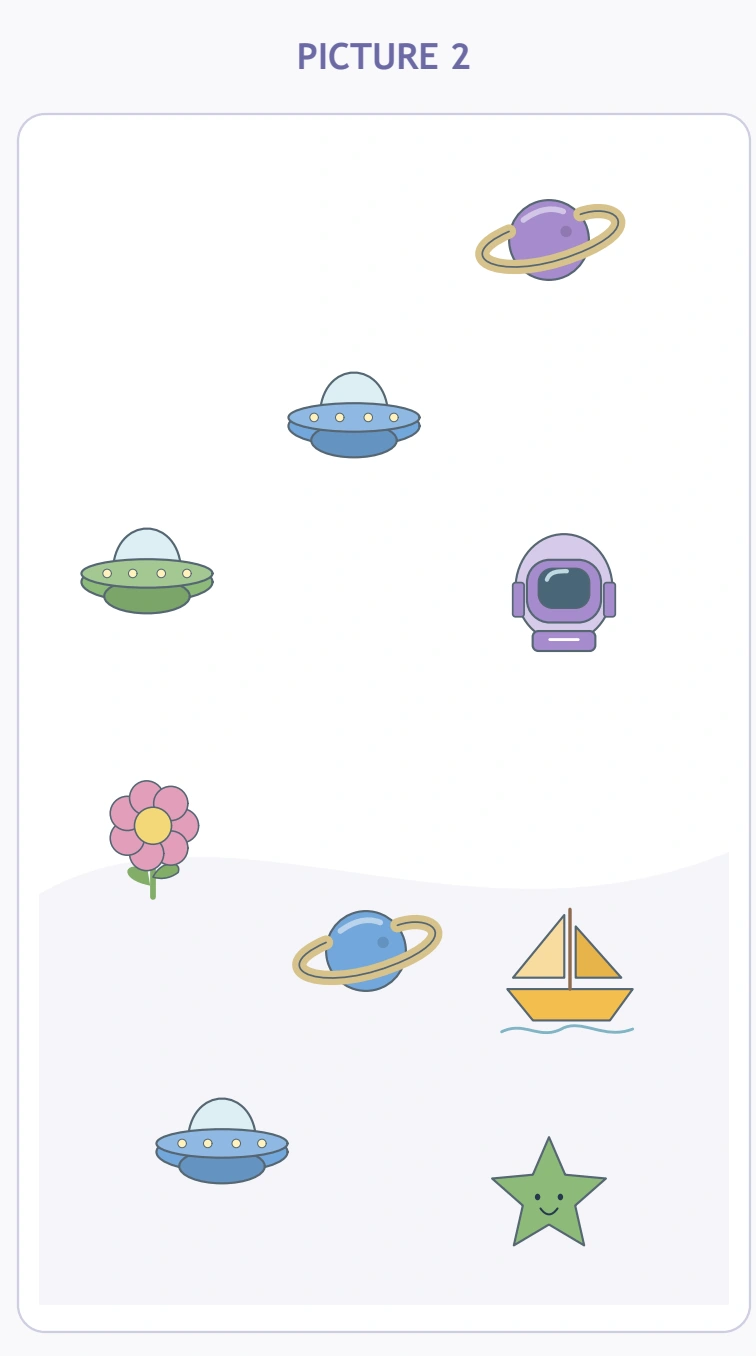
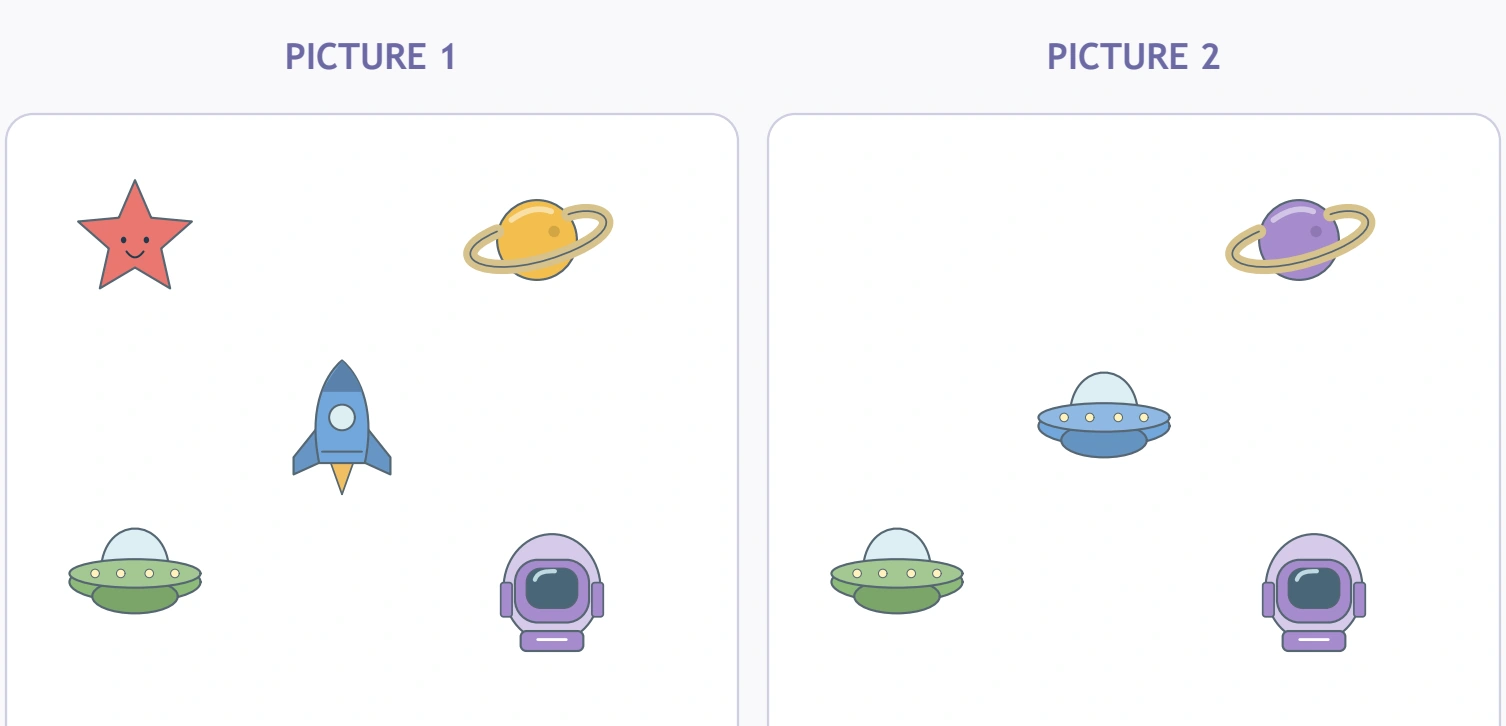
A blue rocket becomes a blue UFO. Shared colour does not make their identities match. Other replacements and recolourings occur lower down, so inspect both object type and visible colour when checking a familiar-looking position.
The instruction asks for six changed places in the picture on the right. Treat each replacement as one location, keep the circles local and compare a doubtful finding with its left-side counterpart before counting it as new evidence.
Eight closer readings of matched region
Align the same space region
Use an unchanged helmet or lower object as a reference, then compare the nearby upper or lower area in each scene. This alignment prevents unrelated stars or rockets from being treated as counterparts merely because they share a theme. The evidence concerns what changed at corresponding positions. This Space Change Search distinction supports attribute inspection.
Blue does not settle identity
The blue rocket’s counterpart is a blue UFO. Ask separately whether the colour matches and whether the object matches. A true colour agreement cannot cancel the changed shape and identity. This example makes a partial match visible without requiring the child to reject the useful observation that both objects are blue.
The missing red star has a place
The upper red star disappears from the second scene. Locate its corresponding empty area on the right before marking. An absence can be described and circled even when no new object occupies that position; the child need not invent a picture to make the difference count. This Space Change Search distinction supports absence recognition.
Separate hue from replacement
The ringed planets retain their object type while changing colour, whereas other positions acquire different objects. Encourage a precise report of which property changed at a chosen place. Describing the distinction makes the finding easier for a partner to verify than a general statement that the pictures look different.
Count changed locations only once
A rocket replaced by a boat is one transformed place, not two independent findings. Ask the child to identify the corresponding position before adding to the total. That location-based count prevents old and new object names from being counted separately within the six requested changes. This Space Change Search distinction supports local pencil marking.
A right-hand circle records the report
The child may first point to the original object to explain the change. Move that observation across to the specified right-hand scene before drawing its circle. Keep the mark local enough that a partner can identify the exact absence, recolouring or replacement being reported.
Unchanged objects are useful too
An object that remains identical can reassure the child that the paired regions are correctly aligned. Ask why the helmet or another matching feature was left unmarked. That explanation demonstrates a deliberate comparison rather than treating every unrecorded picture as one the search overlooked. This Space Change Search distinction supports attribute inspection.
Stories follow the inspection
A child may invent a reason a rocket became a UFO or a star turned into a flower. Enjoy that story after establishing the visible difference. The printable asks what changed, not the fictional cause; separating those questions keeps both careful observation and imaginative play available without confusing their evidence.
Revisit the absent star difficulty
A colour match can hide an object replacement, while an empty location may be dismissed as nothing to find. Ask separately about identity, hue and absence. Count one changed place for a replacement rather than treating its old and new objects as two findings.
Return to Space Change Search evidence by asking “What occupied this place in the first scene?” Separate pencil execution from Yara’s matched region reasoning.
Imagine Yara investigating at home
Yara’s grandfather points near the helmet as a stable reference. Yara compares the nearby blue rocket with its right-side counterpart and notices the UFO shape despite their shared colour. She explains the object change before circling that location.
Try “Are these two pictures occupying the same scene position?” during this imagined Space Change Search visit. Let Yara explain matched region before recording.
Four checkpoints for Space Change Search
| Pause here | Inspect this clue |
|---|---|
| Matched region | Locate the corresponding place in the other space scene. |
| Identity and hue | Inspect object type separately from colour. |
| Absent star | Recognise an empty corresponding position as a possible change. |
| Right-scene count | Record six distinct locations on the requested side. |
Matched region — Yara’s inspection
For Space Change Search, ask “Are these two pictures occupying the same scene position?” Locate the corresponding place in the other space scene.
Identity and hue — Yara’s inspection
For Space Change Search, ask “Is it the same object as well as the same colour?” Inspect object type separately from colour.
Absent star — Yara’s inspection
For Space Change Search, ask “What occupied this place in the first scene?” Recognise an empty corresponding position as a possible change.
Right-scene count — Yara’s inspection
For Space Change Search, ask “Has this changed place already been counted?” Record six distinct locations on the requested side.
Partners explore paired-region tracking
A small space-observation group allocates upper and lower regions to separate partners. Each finding must be described against its corresponding first-scene position before the team counts it. Roles rotate so every child has a chance to inspect and explain.
A Space Change Search classroom note can describe using a missing object’s former location as evidence. Record the actual identity and hue prompt, too.
Six observations from matched region
Attribute inspection — matched region
Space Change Search invites checking object identity and colour as separate properties. Notice Yara’s attribute inspection explanation: “Are these two pictures occupying the same scene position?”
Paired-region tracking — identity and hue
Space Change Search invites holding corresponding positions across side-by-side scenes. Notice Yara’s paired-region tracking explanation: “Is it the same object as well as the same colour?”
Absence recognition — absent star
Space Change Search invites using a missing object’s former location as evidence. Notice Yara’s absence recognition explanation: “What occupied this place in the first scene?”
Change explanation — right-scene count
Space Change Search invites describing a replacement without confusing it with recolouring. Notice Yara’s change explanation explanation: “Has this changed place already been counted?”
Local pencil marking — matched region
Space Change Search invites placing a clear circle around the intended changed area. Notice Yara’s local pencil marking explanation: “Are these two pictures occupying the same scene position?”
Finding management — identity and hue
Space Change Search invites keeping six distinct locations separate during the search. Notice Yara’s finding management explanation: “Is it the same object as well as the same colour?”
Five play invitations after identity and hue
Blue but different with Space Change Search
Compare a blue rocket and blue UFO model, discussing identity separately from their matching colour.
First and second reports with Space Change Search
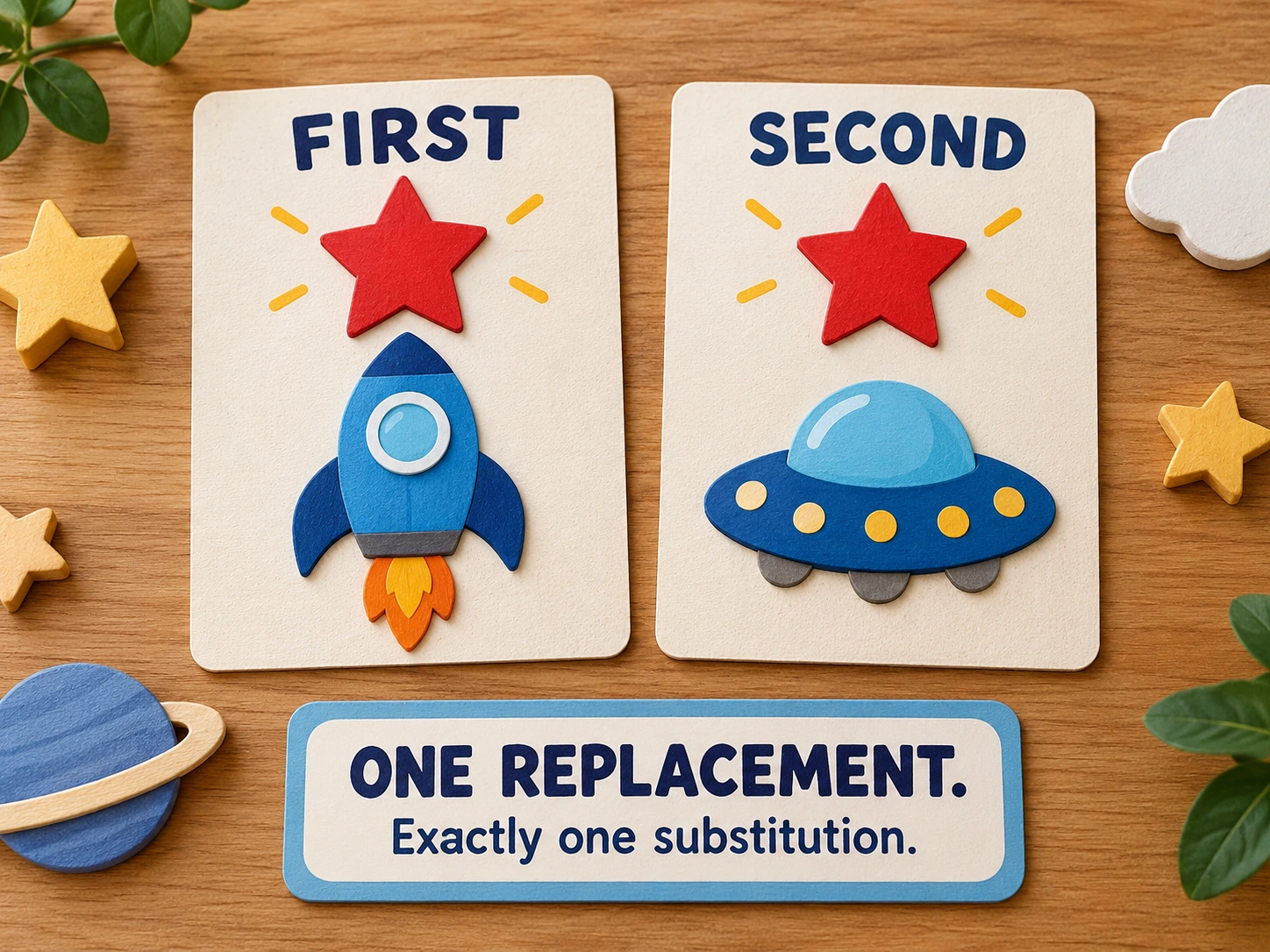
Arrange two small scenes with one substitution and have a partner describe the old object, new object and shared position.
Missing star patrol with Space Change Search
Remove a star from one of two simple arrangements and identify its empty corresponding place.
Colour-only mission with Space Change Search
Keep an object’s shape fixed while changing its hue in a separate comparison, contrasting that with replacement.
Six-finding clerk with Space Change Search
Use counters to represent distinct findings in an invented scene, rejecting a duplicate report of an already counted location.
Readiness for identity and hue
Name the depicted space objects together before comparing them. Use a finger to retain a corresponding location while looking across, and allow an oral report before managing a precise circle.
Suggested Space Change Search range: ages four to six. Yara’s readiness depends on attribute inspection and interest in identity and hue. Shorten this Space Change Search visit when needed.
Distinctions behind absent star
Matched region — the Yara discussion
An unchanged helmet or lower UFO can provide a stable reference without becoming a target to circle. Explain why matching details are still useful: they help align the search and make a nearby mismatch easier to locate precisely.
Identity and hue — the Yara discussion
The space setting can encourage elaborate invented explanations for a transformation. Enjoy those stories after checking the visible difference. The worksheet asks what changed between two pictures, not why a fictional event might have caused it.
Absent star — the Yara discussion
A right-side circle can enclose a location where an object disappeared. Keep it small enough to identify that place, then compare with the original star. The absence is a legitimate visual change even though there is no replacement object inside the circle.
Another visit through finding management
Invite the child to explain how one unchanged object helped locate a changed neighbour. That strategy-focused revisit offers a fresh observation even after the six differences are familiar.
Revisit Space Change Search through right-scene count. Recognise explanations about right-scene count from Yara.
Save and print Space Change Search
A qualifying active membership unlocks the clean Space Change Search download. That premium PDF removes domain text and website watermark without adding advertisements; the original space-scene sample is a separate option. Check the saved portrait view before printing so both scenes and the instruction to find six changes remain visible inside the paper edges.
Other choices beyond attribute inspection
For Space Change Search, the saved catalog suggests road-following after space change search; aiming-and-stopping after space change search; picture-recipe drawing after space change search. Read each linked activity’s rule with Yara; its matched region response may differ.
For Yara, browse NAEYC writing ideas alongside space change search or PBS Parents activities beyond space change search. Watch attribute inspection with absence recognition, then revisit matched region.
Popular Worksheets
Printable resources families and teachers are downloading now.
 Free
 Free
 Free
 Free