
Target Landing Lines: 6 Wonderful Ways to Aim and Stop
A planned stopping point can begin a wider practice visit. This target-landing sheet joins nineteen companion concepts in the premium package. For $4, the collection provides all twenty clean pages together.
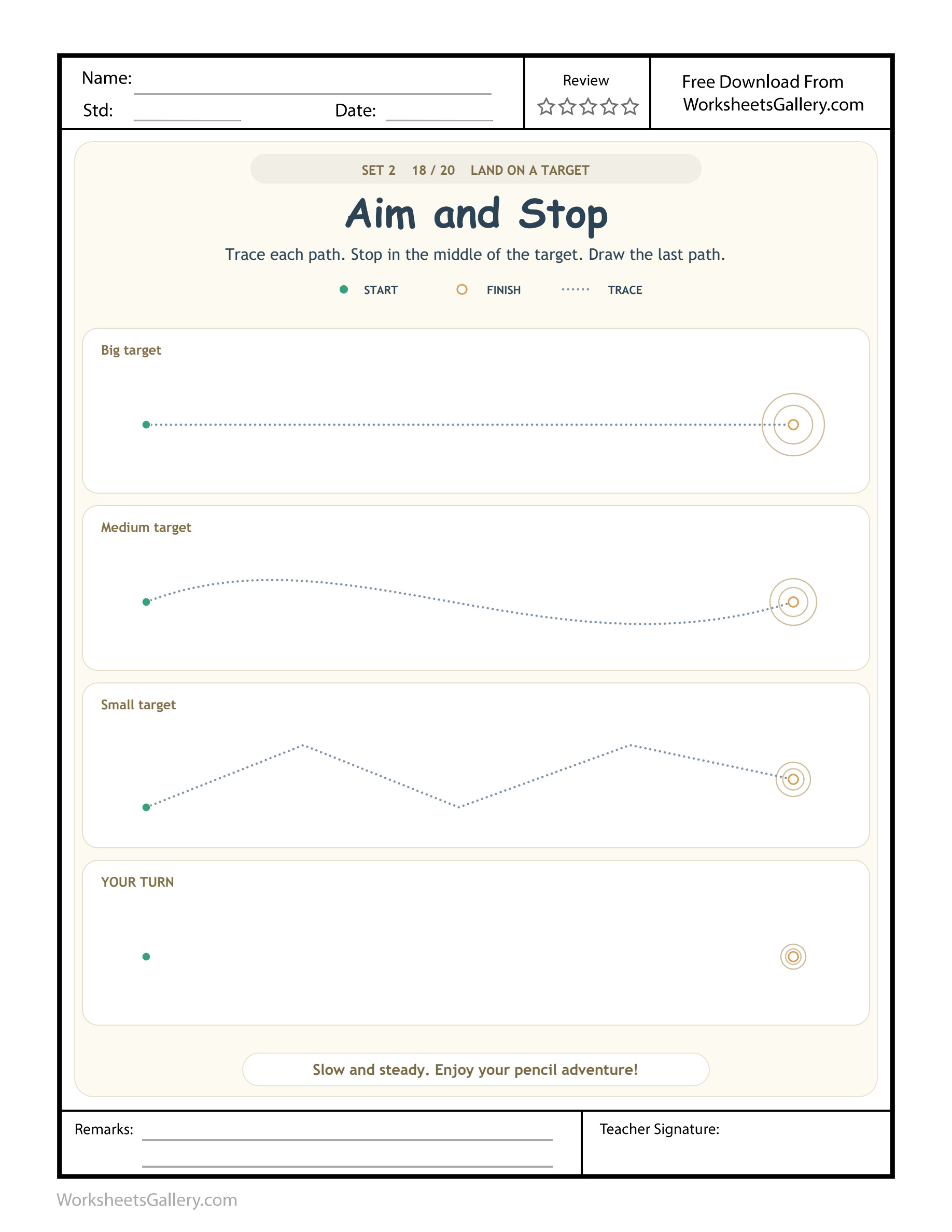
Finding a destination is only part of a pencil journey; stopping there is another decision. Target Landing Lines uses the Aim and Stop worksheet to explore that arrival. Children around three to six follow straight, curved and angled guides toward differently sized targets, then draw a final route of their own. Each begins at a green dot. Target Landing Lines asks the child to notice the target's middle before moving, keep that destination in mind along the way, and end the mark there instead of continuing beyond it.
Target Landing Lines begins by inspecting the finish
Before discussing how to travel, point to the centre of the selected target. Its surrounding rings make the destination easy to inspect. Target Landing Lines asks the child to stop in the middle, rather than merely touch the outer edge or continue through the whole target.
Find the green starting dot next and look at the path between the two places. Target Landing Lines combines that route with a deliberate landing. A child can point from the beginning toward the destination before drawing, giving the endpoint a role in the plan from the outset.
Four Target Landing Lines rows change the available support
| Row label | Path information | Landing invitation |
|---|---|---|
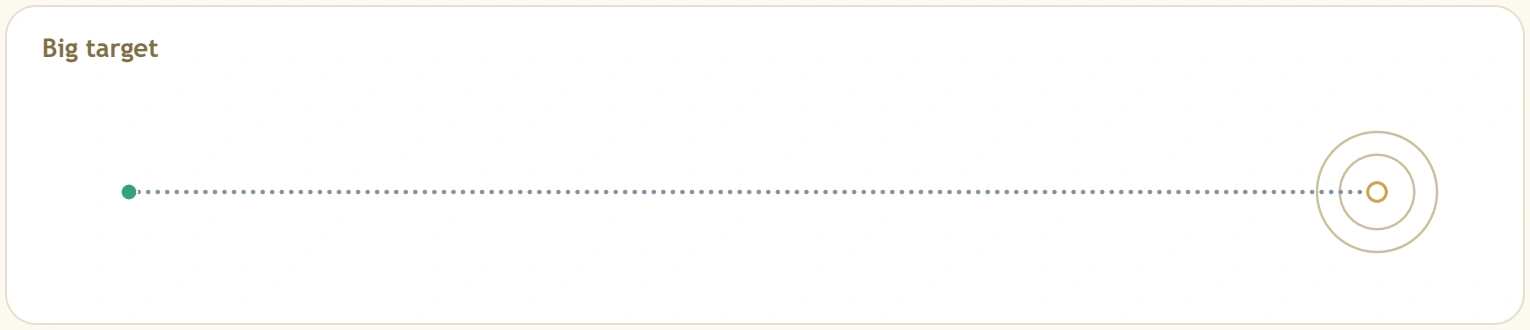
| Big target | A straight dotted guide | Stop at the target's middle. |
| Medium target | A curved dotted route | Carry the destination through the bend. |
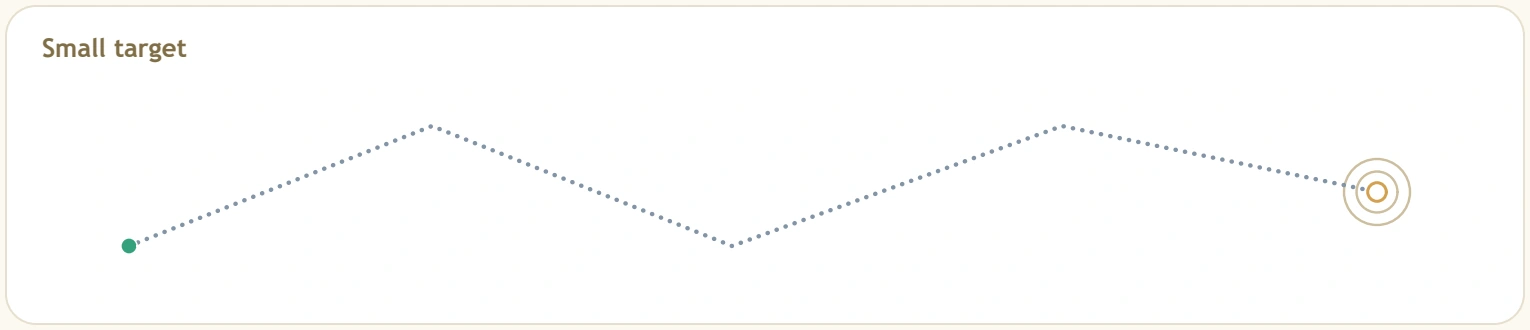
| Small target | An angled dotted journey | Inspect the centre before the final approach. |
| Your turn | No complete dotted path | Choose a route and stop at its target. |
Target Landing Lines changes both path shape and target size across the guided rows. Avoid attributing every difference in a child's attempt to target size alone. A new curve or angle may also affect the movement they are managing.
Max notices a line that kept travelling
Max traces the first route at his classroom table. His pencil reaches the middle and then carries on a little farther. His teacher asks him to point to the intended stopping place. Target Landing Lines gives them a visible comparison between arriving and continuing beyond arrival.
They rehearse a short journey above the paper, with Max choosing when to stop his hand. Target Landing Lines becomes a destination decision rather than a command to draw more neatly. On another row, he looks toward the target before the final stretch and explains that the pencil has reached its place.
Six useful observations around a landing
- Destination awareness: Target Landing Lines makes the intended finish visible before movement begins.
- Route attention: the child follows a guide while remembering where it leads.
- Approach adjustment: a final stretch can be considered separately from the earlier journey.
- Stopping control: Target Landing Lines gives a concrete reason to end the mark.
- Spatial vocabulary: middle, ring, near and beyond describe features the child can point to.
- Independent planning: the last row keeps the destination while leaving the route undrawn.
These are things to notice, not a score for pencil readiness. A child may identify the centre accurately while still making an uneven arrival. Ask what they intended and inspect the particular endpoint rather than judging the whole attempt at once.
A straight route leaves the destination in clear view
The first row's straight dotted guide leads to the large target. Target Landing Lines can begin with that clear relationship. Ask the child to find the start, show the centre and inspect the distance between them before choosing whether to rehearse with a finger.
The goal is not to make the line as fast as possible. Target Landing Lines gives a child time to notice the finish approaching. An adult can supply one brief cue near the destination if needed, but should avoid a stream of instructions that competes with looking at the target itself.
A home delivery game gives the finish a meaning
At home, a child can imagine delivering a tiny drawing parcel to the target's centre. An adult asks where the parcel should arrive and lets the child point before tracing. Target Landing Lines can then become a paper journey with a destination the child has already named.
Keep the story separate from any new obstacles or extra rules. Target Landing Lines has a printed path and target; it does not require avoiding toy blocks placed on the sheet. If a larger play route uses props, explain that it is a different game and keep the worksheet's original information unobstructed.
The medium row asks for a destination through a curve
The second dotted route rises and falls before arriving. Target Landing Lines invites the child to follow that change without forgetting the intended finish. Locate the centre first, then inspect the curved path as a whole. A pause to look ahead can be useful during the journey.
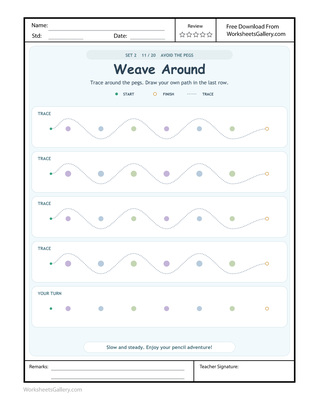
The ocean-wave tracing resource offers another curved movement context. Target Landing Lines adds a visible target centre whose arrival matters. Explain that distinction when a child wants to explore curves separately before combining the route with a deliberate stop.
A smaller target comes after an angled journey
The third row's guide changes direction through angles. Target Landing Lines asks the child to manage those changes and then land at a smaller centre. Inspect the final segment before drawing so the destination is connected with the last approach, rather than considered only after the pencil has passed it.
If the mark stops short, ask where the child meant to arrive. Target Landing Lines supplies visible information for a small continuation or a later new attempt. Avoid insisting that every imperfect endpoint must be erased immediately. The original line can show exactly which part of the arrival needs discussion.
Six landing games with their own small purpose
Park a toy at a named centre
Make a separate large completed target mat and move a toy to its middle. The child names the destination before travelling. Target Landing Lines provides a smaller pencil invitation afterward. Keep the toy journey gentle and clear, without turning the game into a timed race to reach the rings.
Choose the finish before the route
Show two finished destination cards and ask which one a pretend traveller will visit. Only after choosing does the child describe a route. Target Landing Lines uses a fixed target on each row, but the play game can make destination-first planning tangible before a printed attempt.
Be an arrival inspector
Draw two completed example lines on spare paper, one ending at a target centre and one continuing beyond it. Ask what differs. Target Landing Lines can follow when the child wants to try an arrival. Keep the comparison specific rather than calling one entire drawing good and the other bad.
Give a counter a final approach
Move a counter along a short tabletop route, then pause near its destination to inspect the last stretch. The child decides when it has arrived. Target Landing Lines can borrow that looking moment, while the physical game remains a separate large-scale example.
Design a finished delivery map
On spare paper, make a completed simple route ending at a labelled target. Let the child explain what the traveller delivers. Target Landing Lines includes an independent final row, but the home-made map can have its own story and does not need to duplicate the printed guide shapes.
Report where the journey ended
After a route, ask the child to point to the intended finish and the actual endpoint. Target Landing Lines makes both visible when a mark is drawn. The child can describe a successful arrival or a useful discovery, with no requirement to provide a polished spoken account before the play ends.
The independent row keeps the finish and removes the guide
The final row supplies a green dot and a target without a complete dotted route. Target Landing Lines now invites a chosen path between them. Ask the child to show a possible journey above the paper and decide where it will stop before making a mark.
A straight, curved or otherwise sensible route can be discussed according to the child's plan. Target Landing Lines does not prescribe one exact independent answer. The destination remains the target's centre, so keep that requirement clear while leaving the route choice genuinely available.

✎ Common landings deserve a precise question
Stopping at an outer ring, continuing through the centre, or beginning without locating the target can change the task. Target Landing Lines lets an adult ask, “Where were you aiming to finish?” That question can reveal whether the centre was understood before a movement cue is offered.
Try arrive in the middle, then stop when useful. Target Landing Lines should not become repeated erasing after every slight overshoot. A later attempt can use what the child noticed, while the first mark remains evidence of the original plan and movement.
Support ages three to six with a visible destination
Some children will enjoy pointing to centres on a large separate target before drawing. Others may want a guided row and then an independent route. Target Landing Lines can be shared at either level. Keep the sheet stable and choose a tool whose mark leaves the rings easy to inspect.
The rain start-and-stop sheet gives shorter directed journeys. The rocket ramp activity offers another direction-change comparison. Target Landing Lines combines its particular route information with a deliberate target arrival, so choose related work according to the feature that needs clarification.
Return to an arrival the child wants to explore
Remember which target or route prompted an explanation. Another visit can offer a different approach or a larger play destination rather than a demand for faster, neater repetition. Target Landing Lines can remain a manageable choice, with one considered finish enough for the session.
For additional family inspiration, NAEYC writes about supporting young writers at home. The PBS Parents age-four section collects literacy resources. Target Landing Lines can accompany meaningful maps, pictures and pretend delivery notes created in everyday play.
Download the clean aim-and-stop activity
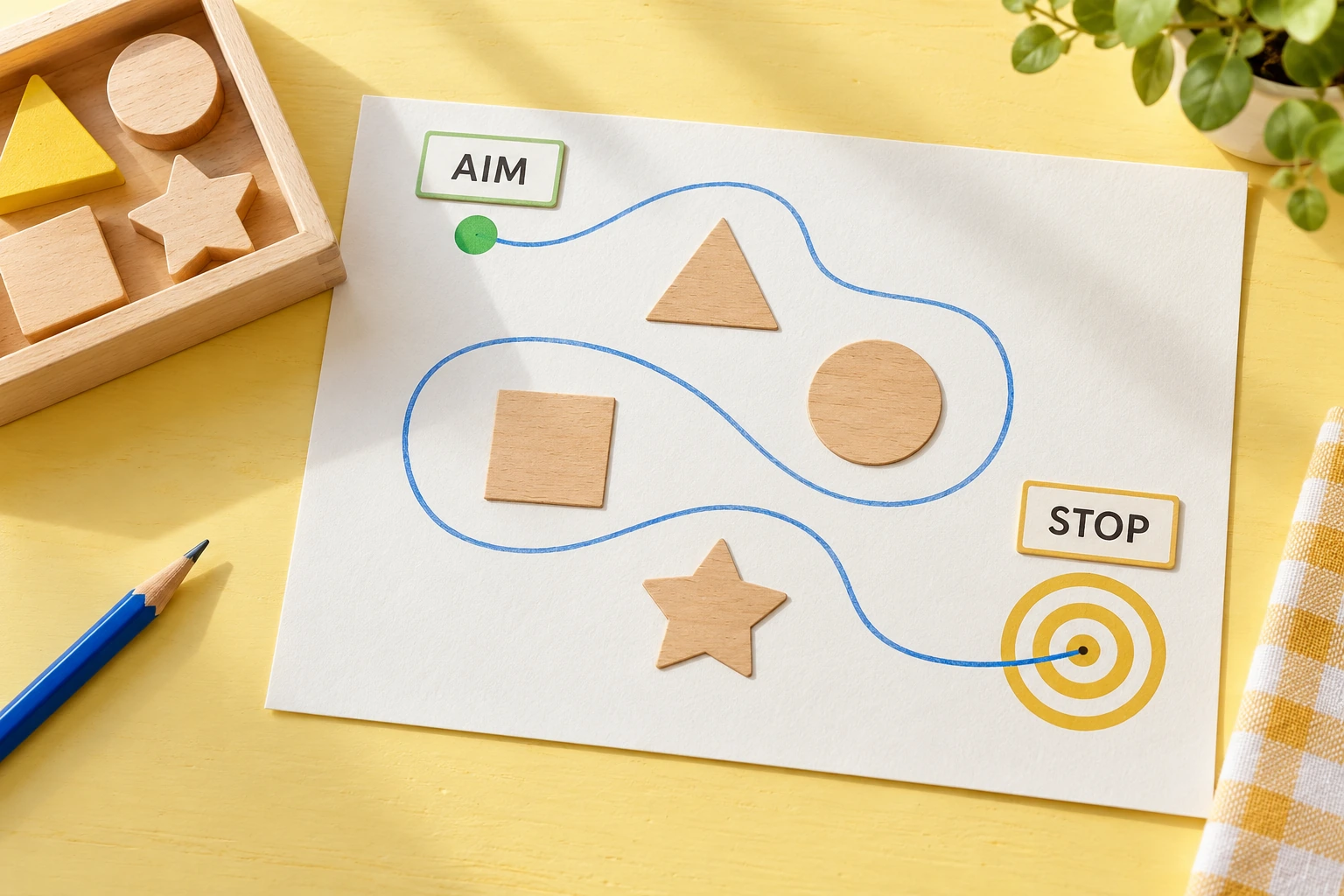
The original branded page is available as the free sample. For the clean Target Landing Lines PDF, request the premium version through the account where your eligible membership is current. After the site's access authorisation, save the protected file and inspect the four rows in a PDF viewer before printing.
Target Landing Lines keeps its original targets and path guides in the premium edition. The worksheet has no watermark or advertising copy, and no site name or domain is printed on it. Check every page edge in the printer preview. The native collection card offers the separate twenty-sheet purchase for $4. The centre gives the final movement somewhere to finish.
Popular Worksheets
Printable resources families and teachers are downloading now.
 Free
 Free
 Free
 Free