
Grid Drawing Growth: 5 Powerful Bigger-Picture Games
A bigger-grid picture has nineteen other concepts to explore. The $4 collection includes this transfer activity within a merged twenty-page PDF. Every supplied sheet retains its learning content without promotional website marks.
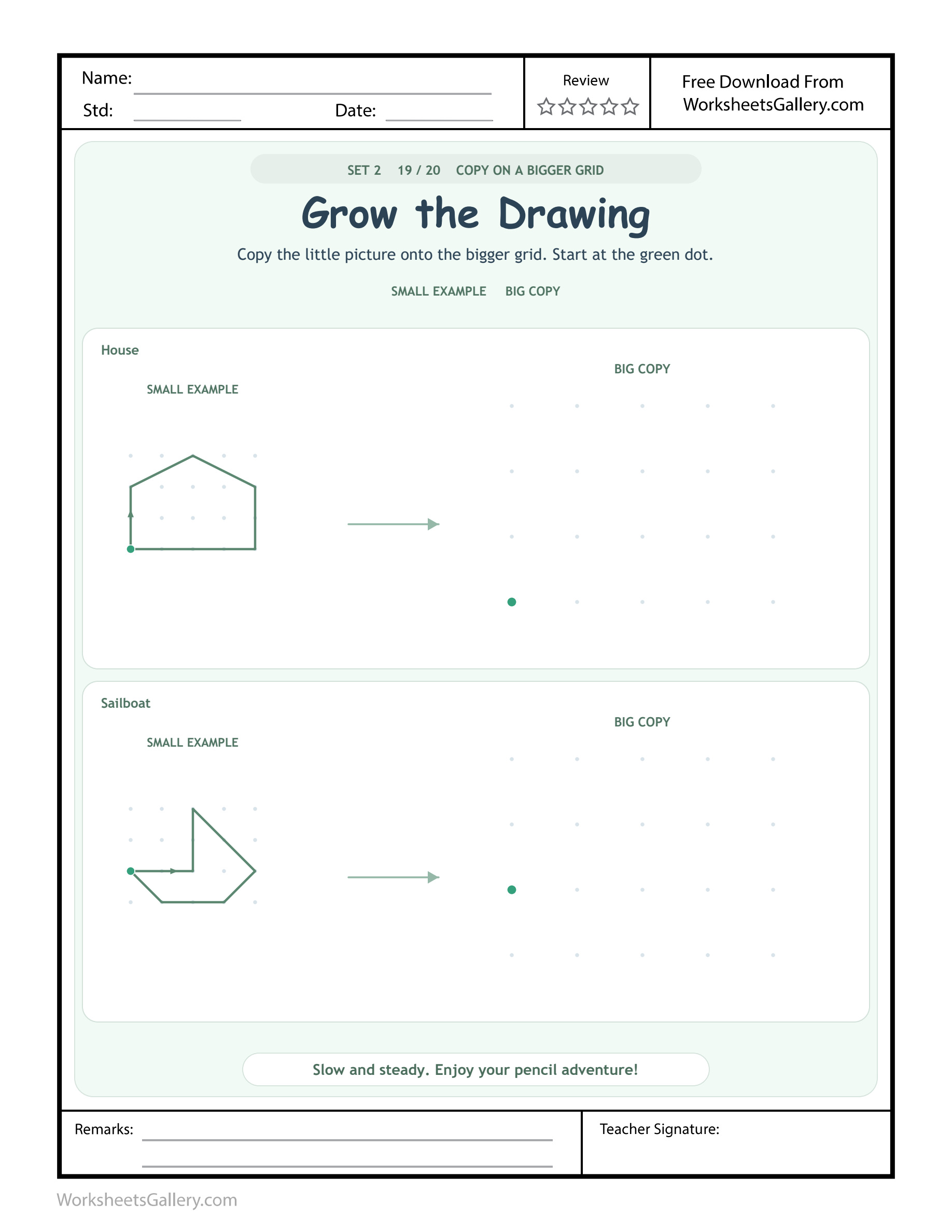
A bigger drawing needs more than a longer first line. Grid Drawing Growth invites children around four to six to keep the relationships within a picture as the space between guide dots increases. The Grow the Drawing worksheet supplies a small house and sailboat, each beside a larger copy grid with a green start. The examples stay visible. Grid Drawing Growth asks the child to compare corners and directions across the two spaces, building a recognisable larger outline rather than stretching one part while leaving the rest behind.
Grid Drawing Growth uses corresponding places
Each model sits on a small dot grid and has a larger neighbouring grid for the child's response. Both grids use five columns and four rows of dots. Grid Drawing Growth changes the spacing between those reference positions, giving the child more physical room while retaining a structure to compare.
The task does not supply a dotted answer in the larger area. Grid Drawing Growth asks the child to inspect the small outline, locate its corresponding start and decide where the next feature belongs. Keep the model available rather than turning the activity into a hidden-picture memory challenge.
Read the small house before drawing a big one
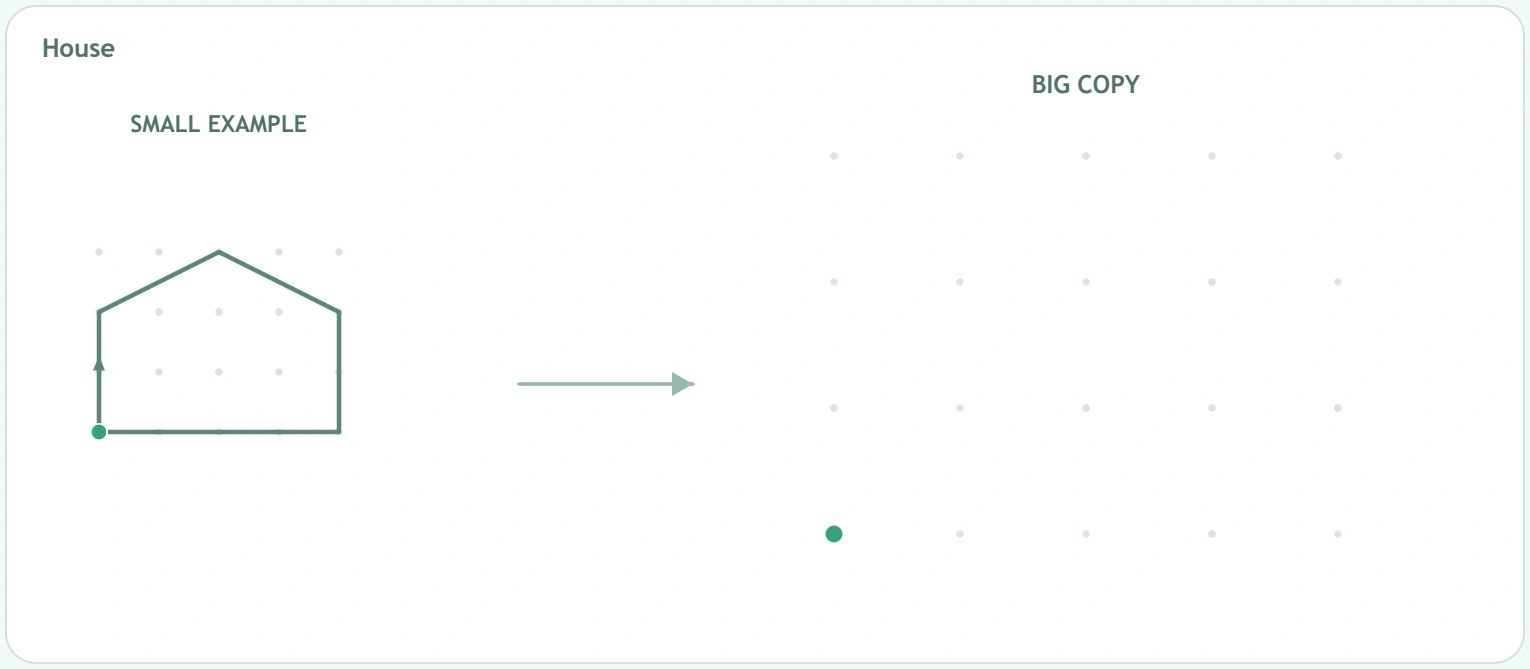
The house model is an outline with straight sides and a peaked roof. Grid Drawing Growth keeps attention on those supplied features; it does not require adding a door, windows or other invented decorations. The child can explore those additions later on separate art paper if wanted.
Find the green start and follow the model's travel direction with a finger above the page. Grid Drawing Growth becomes clearer when the child notices one corner relationship at a time. Ask where a side ends relative to the guide dots, then look for the corresponding place on the larger grid.
Lila discovers Grid Drawing Growth needs room for every part
At home, Lila begins a large house with a long wall but makes the roof very small. Her mother asks her to compare the model's wall and roof together. Grid Drawing Growth gives them a visible relationship to inspect: how the roof and body occupy their parts of the example's guide.
Lila points to the roof peak and nearby guide positions on both grids. She rehearses a new roof in the air, then explains where its top could go. Grid Drawing Growth has made the dots useful information. Her first attempt remains available to discuss, while another drawing can wait until she wants to try it.
Six observations across a pair of grids
- Correspondence: Grid Drawing Growth links a model position with a related place in the response area.
- Relative size: the child compares parts within a whole picture rather than enlarging one isolated stroke.
- Direction checking: the next side or diagonal still needs to travel in the model's intended direction.
- Visual reference use: Grid Drawing Growth gives guide dots a practical role during planning.
- Look-and-draw coordination: repeated glances between example and copy support the emerging outline.
- Explanation: a child can point to a corner and describe why it belongs in a particular place.
These observations do not require a perfectly proportioned result. A child may understand where a corner belongs while still drawing an uneven line toward it. Discuss the plan as well as the appearance of the mark.
Compare a position before comparing a length
The guide dots can help locate a feature without measuring its distance in centimetres. Grid Drawing Growth asks for a bigger copy, but the practical question is where the next corner sits in relation to the grid. A corresponding interval occupies more space on the larger side.
Avoid adding an exact enlargement factor unless you are deliberately making a separate measurement activity. Grid Drawing Growth can be explored through matching positions and preserving relationships. The source instruction asks the child to copy onto a bigger grid, not to calculate a ratio before drawing.
Two Grid Drawing Growth models with different relationships
| Model | Features to inspect | Useful comparison |
|---|---|---|
| House | Side walls, lower edge and roof peak | Where each corner belongs on the larger guide |
| Sailboat | Hull changes, sail edge and diagonal outline | How the next part connects with the current one |
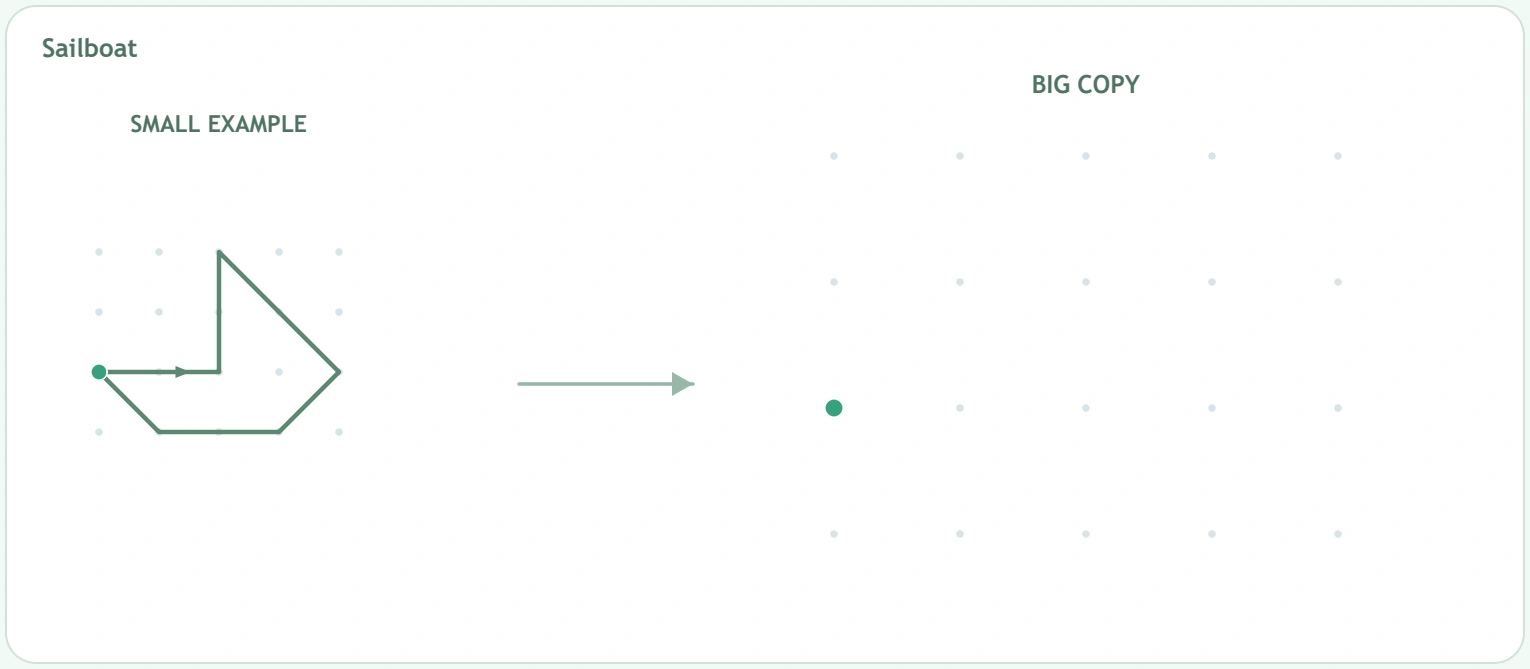
Grid Drawing Growth provides two independent picture tasks. The sailboat should be examined afresh rather than drawn using the house's remembered movements. A green start helps locate the beginning, while the visible model supplies the information for what follows.
Set up a home comparison with both sides visible
Choose one row and leave the model and response grid clear of spare pencils or an adult's arm. Grid Drawing Growth depends on seeing both. A child may want to point through the model first, then locate the corresponding beginning on the larger side.
Offer one question about the next feature and allow time to inspect it. Grid Drawing Growth does not need a running adult commentary over every stroke. If the child is already comparing places, a quiet pause may support the task more usefully than another explanation about making the picture larger.
A classroom map of corresponding corners
A teacher invites children to point to one model corner and show where its partner might belong on the large grid. Each child chooses a row on an individual copy. Grid Drawing Growth can begin as a shared looking conversation, with no requirement to complete an entire outline before explaining a decision.
After a few marks, ask which reference helped the child most. Grid Drawing Growth may prompt an answer about a green beginning, roof peak or sail edge. The teacher can record that observation without ranking copies by neatness. Different attempts can reveal different relationships that children have noticed.
The sailboat needs a new reading of the model
The sailboat combines a lower hull with an angled upper outline. Grid Drawing Growth asks the child to inspect how those parts connect before transferring them. A familiar freehand boat drawing may use different parts, so keep attention on the actual supplied example rather than an adult's preferred boat symbol.
Point to the next corner on the small grid and locate its counterpart on the larger one. Grid Drawing Growth can proceed through those comparisons at a manageable pace. The child may look back repeatedly; those glances are useful information gathering rather than evidence that the drawing should be completed from memory.
Five larger-picture games with finished examples
Pair a small and larger outline
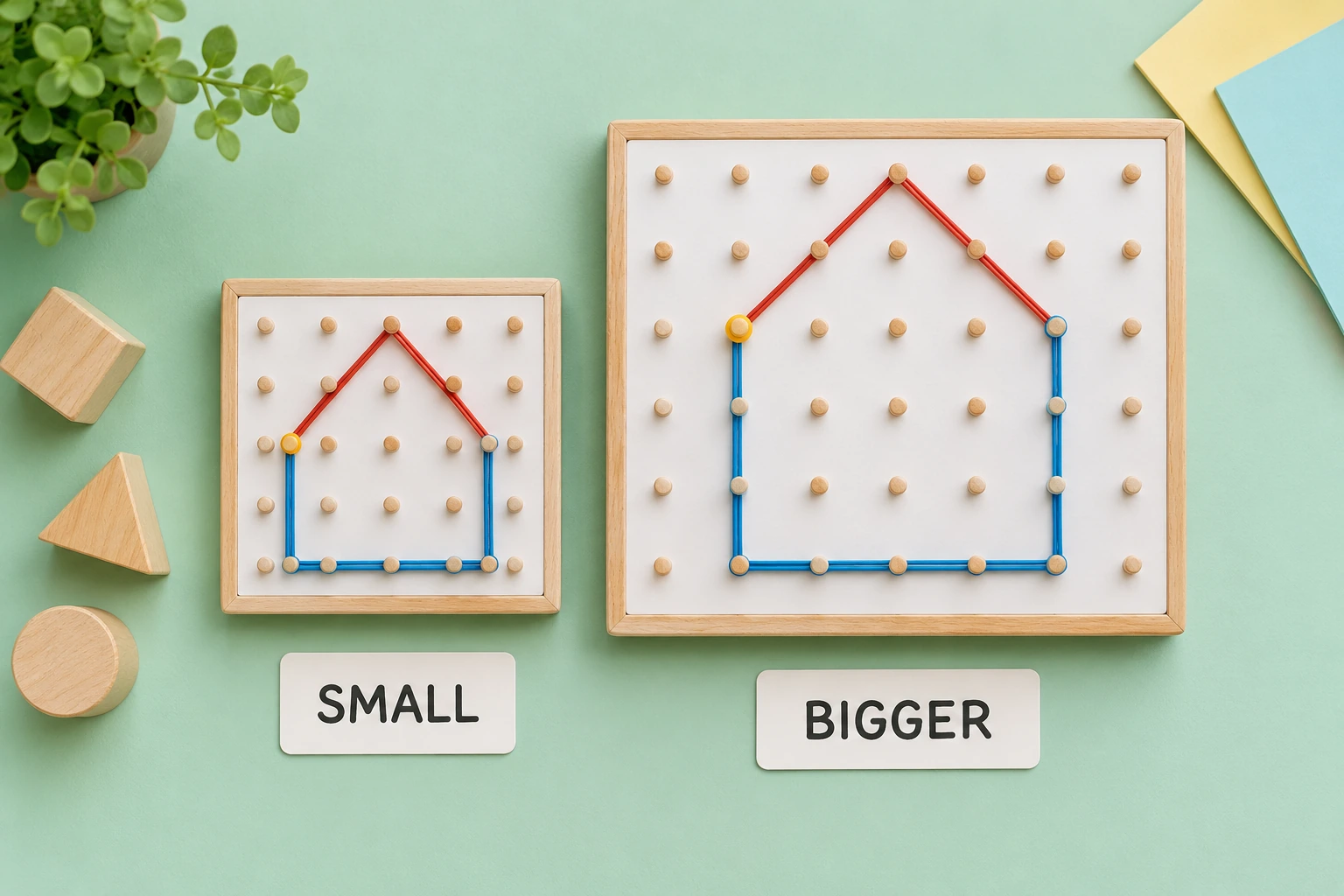
Make two completed versions of a simple house on separate cards. Ask the child which features make them recognisably related. Grid Drawing Growth supplies a guided comparison later, but the cards can introduce the idea without requiring grid counting. Keep both examples finished and visible.
Be a corner correspondence guide
On two separate completed drawings, point to a corner in one and invite its partner in the other. Grid Drawing Growth uses dot guides to support that relationship on paper. The game can remain a pointing activity when the child is more interested in finding places than making a pencil response.
Build the same picture with larger pieces
Arrange a small completed house from paper strips, then use longer strips for a larger version. Discuss which parts need to grow together. Grid Drawing Growth can follow as a drawing task. The construction is a separate demonstration, not a claim that the worksheet requires a particular measured scale factor.
Describe a model to a visitor
Let the child show a finished outline and explain one feature before a visitor attempts a separate drawing. Grid Drawing Growth can inspire the conversation about walls, peaks or hulls. Keep the model visible to the visitor too, so the game remains about using information rather than testing hidden-image memory.
Curate a picture-size pair
Display a willing-to-share small and larger drawing together and ask the artist what relationship they tried to preserve. Grid Drawing Growth offers a reference for that explanation. A visitor can listen to one chosen corner decision without judging every difference between the two outlines.
✎ Common enlargements can lose a relationship
Making only the first line bigger, copying a corner to a mismatched position, or adding familiar details absent from the model can change the task. Grid Drawing Growth gives the adult a particular feature to revisit. Ask what the child was trying to reproduce before deciding whether the difficulty concerns position or movement.
Use find the matching place on the bigger grid when helpful. Grid Drawing Growth should not become repeated erasing until every side looks adult-made. A separate large demonstration may clarify one relationship, while the child's original response remains available to inspect and explain.
Support ages four to six through visible references
Children interested in dot patterns and picture copying may enjoy a shared look at one row. Grid Drawing Growth can be approached through pointing, one corner comparison or a whole outline attempt. There is no requirement that every child manage both models independently at a particular age.
For related feature work, the shape-builder page explores sides and corners. The triangle-tent activity offers another sloping-outline comparison. Grid Drawing Growth adds transfer onto a larger grid, so explain that additional job before offering it as another copying turn.
Return to a feature that became interesting
Remember which relationship prompted the child's question. Another visit might focus on a roof peak or the sailboat's next corner instead of repeating the whole page. Grid Drawing Growth can remain a choice with a specific purpose, allowing an explanation to be a satisfying return even before another drawn attempt.
The mountain route resource gives a third way to discuss direction changes. For wider family ideas, browse home-writing guidance from NAEYC or PBS Parents material collected for four-year-old readers. Grid Drawing Growth can accompany meaningful maps and pictures created during ordinary play.
Download the Grid Drawing Growth paired page
The original branded sheet is the free sample option. The clean Grid Drawing Growth edition requires premium access through a qualifying membership. Open your membership account and request that version here; the website confirms permission before releasing its protected file. Save the PDF and inspect the two complete rows before printing. Keep both model and copy grids within the preview margins.
Grid Drawing Growth retains the original models and dots in its premium file. It contains neither watermark nor printed advertising, and the site's promotional name and domain have been removed. The package card links to the separate $4 discovery collection containing all twenty concepts. A bigger outline can still be built through one compared relationship at a time.
Popular Worksheets
Printable resources families and teachers are downloading now.
 Free
 Free
 Free
 Free