
Picture Step Recipes: 4 Brilliant Build-a-Drawing Games
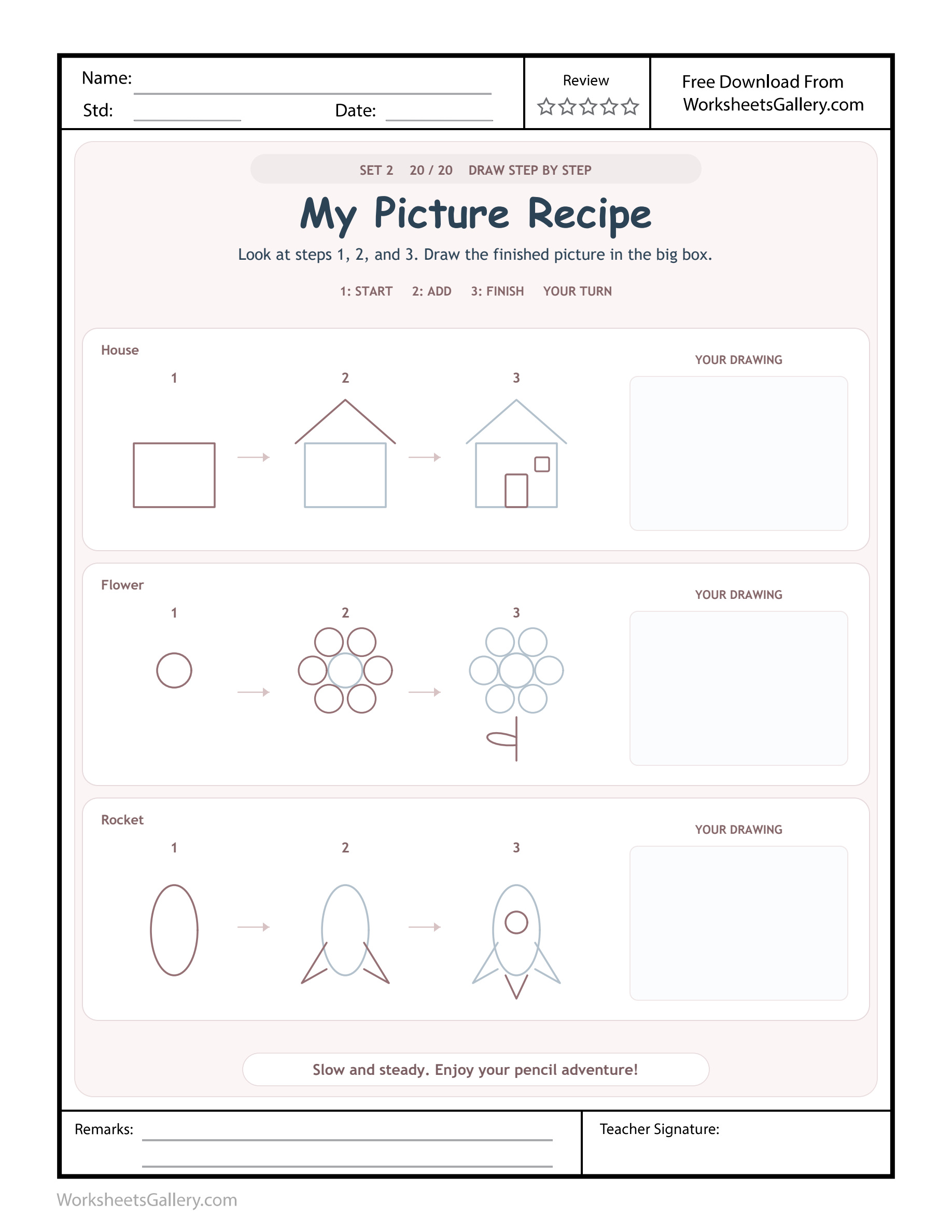
A drawing recipe completes this twenty-concept group. Keep the house, flower and rocket stages with worksheets 21-39 through the $4 clean collection. The purchased package supplies one combined PDF of all twenty sheets.
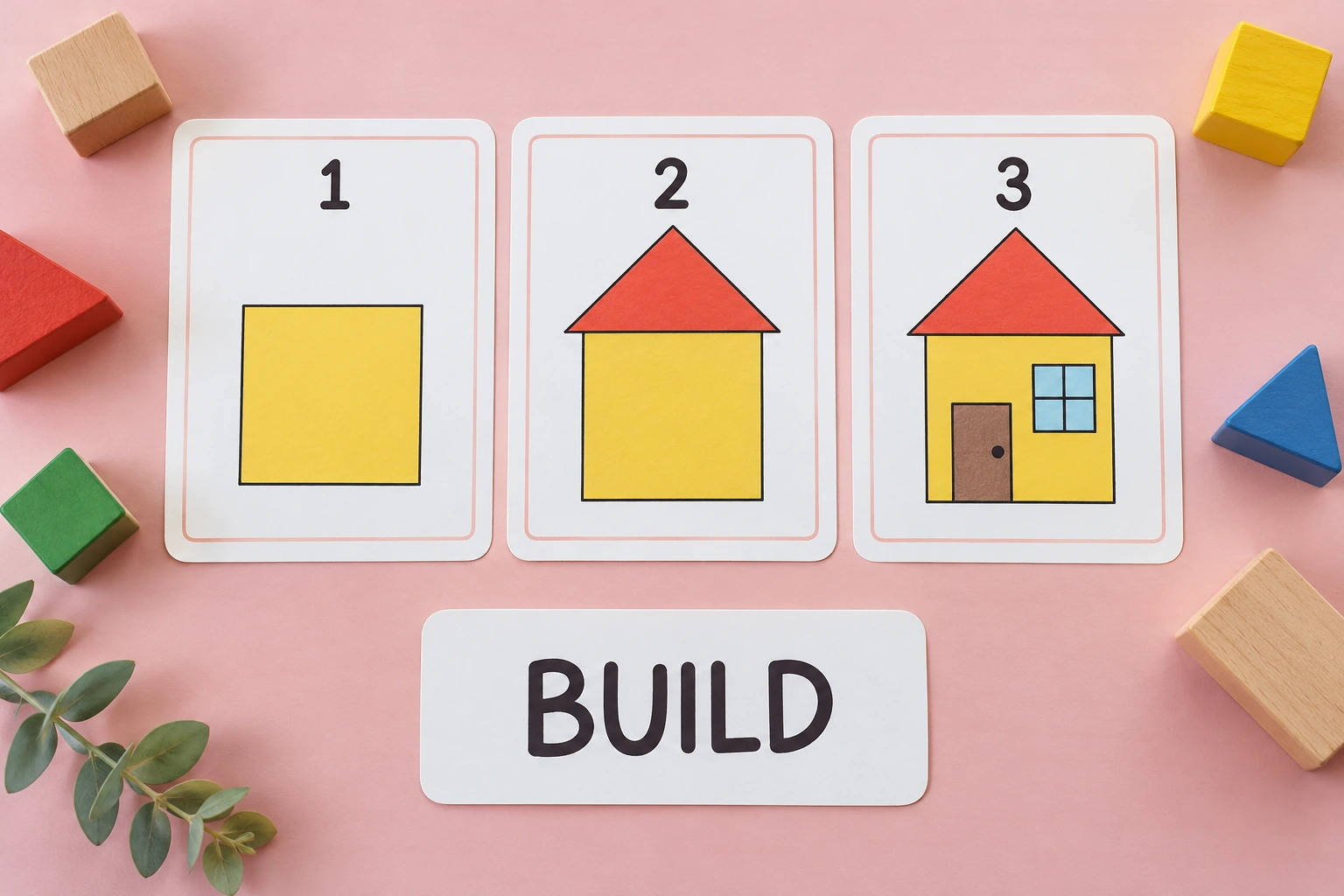
A square can become a house when a roof and small details join it. Picture Step Recipes makes that growing picture visible through three cumulative examples. The My Picture Recipe worksheet offers a house, flower and rocket, with a separate area for each finished response. Children around four to six can inspect what comes first, what is added and what makes the picture feel complete. Picture Step Recipes gives drawing an understandable order without asking for hidden-image memory, a perfect copy, or the mistaken idea that three stages must mean exactly three pencil strokes.
Picture Step Recipes shows additions, not replacements
Look across one row from stage 1 to stage 3. The earlier structure remains while new parts are added. Picture Step Recipes asks the child to notice that growing relationship before drawing the finished picture in the larger response area. Stage 2 is not an instruction to discard the first shape and make an unrelated second one.
The models stay visible throughout the activity. Picture Step Recipes can involve as many checking glances as the child finds useful. An adult should not cover the examples and turn the task into remembering a hidden sequence unless a different game is explicitly being proposed on separate materials.
Three Picture Step Recipes rows with different additions
| Picture | Stage 1 | Stage 2 | Stage 3 |
|---|---|---|---|
| House | A square body | Add the roof. | Add the door and window. |
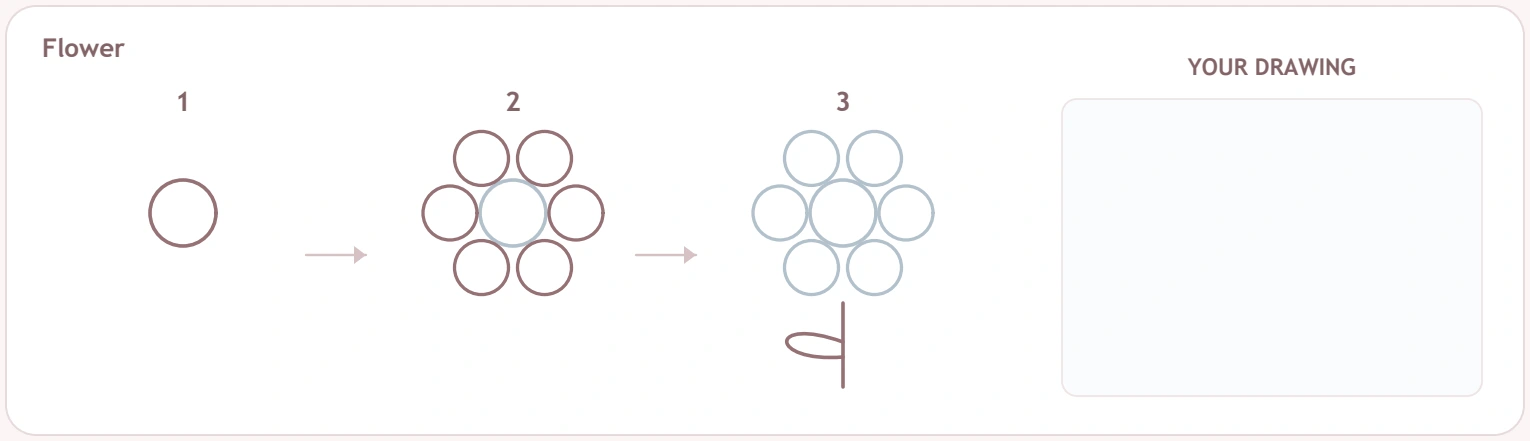
| Flower | A centre circle | Add the surrounding petals. | Add the stem and leaf. |
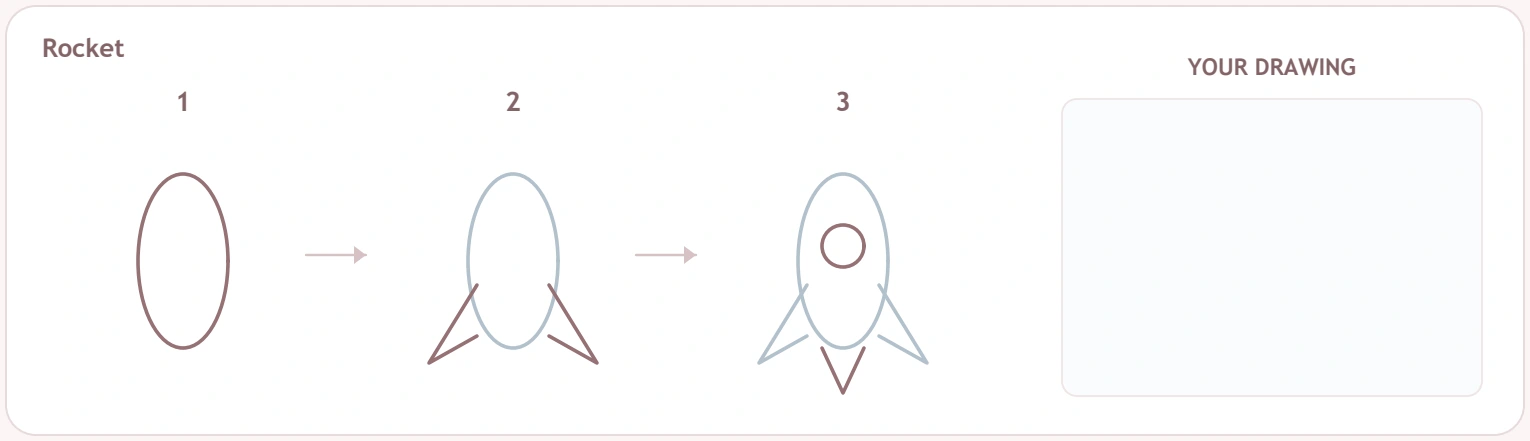
| Rocket | An oval body | Add the fins. | Add the window and flame. |
Picture Step Recipes uses three stages for each row, but some additions contain several separate marks. The numbers organise picture construction. They do not prescribe an exact count of pencil strokes, and they do not replace looking at the actual forms being added.
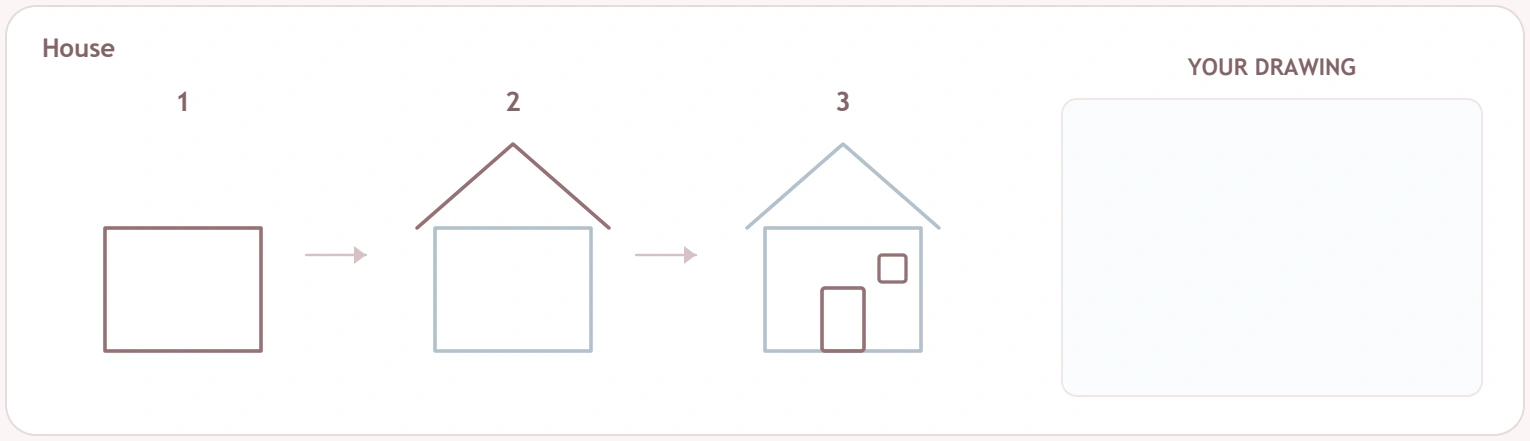
A house grows from a body that leaves room above
The first model establishes the house body before the roof appears. Picture Step Recipes invites the child to consider that roof when deciding where the first square will sit in the response area. Beginning too close to the upper edge can leave little room for the later addition.
Point to the roof in the second model, then compare how it relates to the body. Picture Step Recipes gives the adult a visible relationship to discuss. The door and window arrive in the third stage, making a reason to leave some room inside the house as well as above it.
Asa predicts the next Picture Step Recipes addition
Asa's grandfather asks what changes between the first and second house examples. Asa points to the roof and makes two slanting gestures. Picture Step Recipes gives him an addition he can identify before attempting the finished drawing. They inspect the third example next and name the smaller details.
Asa begins his own house and glances back when deciding where to place the window. His grandfather waits rather than drawing it for him. Picture Step Recipes has made looking back a sensible part of constructing the picture. Asa then invents a resident for the house, letting the completed drawing become a setting for his own story.
Five observations behind a finished picture
- Cumulative thinking: Picture Step Recipes shows that an earlier part remains useful when a new part is added.
- Visual comparison: the child identifies what changes from one stage to the next.
- Space planning: later additions need room even before they are drawn.
- Movement variety: Picture Step Recipes combines straight, curved, rounded and pointed features in meaningful objects.
- Explanatory language: first, add, above, beside and finished can describe decisions made while building the picture.
These are opportunities to inspect rather than promises of a particular artistic result. A drawing may be uneven while still showing a thoughtful sequence. Ask which addition the child intended and how it connects to the part already present.
Read all three flower stages before placing the centre
The flower begins with a circle, then gains petals, a stem and a leaf. Picture Step Recipes can prompt a question about where the centre should sit so those later features fit. Inspect the whole completed example before beginning, while keeping each intermediate stage available for another look.
The response does not need an adult-perfect petal arrangement. Picture Step Recipes asks for the finished picture built from the visible recipe. Compare the parts the child intended to include, rather than demanding that every curve duplicate the printed model precisely or that petals be drawn at a fixed speed.
Set up a home recipe-reading turn
Choose a row and ask the child to show the first structure, the next addition and the final details. Picture Step Recipes can begin through pointing and conversation. A finger or air movement can rehearse a feature before the child chooses where to place it in the response box.
Offer a stable page and a comfortable tool, leaving the three models unobstructed. Picture Step Recipes gives enough information without an adult drawing guide dots into the independent area. If a particular form needs demonstration, make a similar example on spare paper and let the child's own drawing remain theirs to construct.
A classroom builder explains what changed
At the classroom table, children select a recipe and describe one new feature to a partner. The listener can indicate the earlier structure as the artist explains the addition. Picture Step Recipes supports that comparison before each child draws on an individual copy.
After a response, ask which stage helped the child plan. Picture Step Recipes may prompt an explanation about leaving roof space, finding a flower centre or adding rocket fins. A teacher can listen to those particular decisions without comparing the group by how closely every finished picture resembles the printed example.
A rocket's oval remains while details join it
The rocket body begins as an oval. Fins are added in the second stage, followed by a window and flame in the third. Picture Step Recipes asks the child to retain the body while adding those details, rather than drawing each stage as a separate unrelated object in the final box.
The oval orientation resource offers a separate exploration of that rounded form. Picture Step Recipes uses an oval as one useful component within a larger picture-building plan. Explain the difference if the child wants to practise the body shape before combining it with the rocket's additions.
Four recipe games with completed stage cards
Find the newly added feature
Make two finished examples on separate cards, one before and one after an addition. Ask the child what changed. Picture Step Recipes supplies three-stage examples later, but the two-card comparison can make cumulative growth clear first. Keep the earlier parts visible in both cards so the addition is easy to inspect.
Tell a first-add-finish story
Choose a simple picture and narrate its construction while pointing to completed stage cards. Picture Step Recipes can inspire that order without requiring the child to draw during the telling. Swap roles so the child can describe the additions while an adult listens and asks about one chosen feature.
Give a builder a space plan
Show a completed house recipe and ask where a new drawing might begin to leave room for its roof. Picture Step Recipes makes that question practical. The planning can happen through pointing in the air over spare paper, with no need to mark a compulsory adult-chosen starting position in the worksheet response area.
Host a growing-picture gallery
Display a few completed stage cards and a willing-to-share finished response. Invite the artist to explain which part came first and what was added. Picture Step Recipes gives that tour a visible reference. The visitor listens to the child's construction choices rather than judging the whole display by drawing precision.
Picture Step Recipes needs stages, not a stroke count
A roof can require more than one stroke, and a door and window may involve several short movements. Picture Step Recipes numbers the stages of construction rather than individual pencil actions. Make that clear before telling a child they must complete a picture in three movements.
The shape-builder activity can help discuss separate forms and corners. The triangle-tent sheet offers another slanting-outline context. Picture Step Recipes brings such forms together as parts of a recognisable object with an ordered construction plan.
✎ Common recipe misunderstandings have different clues
Drawing only the final added detail, copying three disconnected pictures into the response box, or beginning with no room for later parts can each change the task. Picture Step Recipes lets an adult inspect a specific relationship. Ask what the child thought the next stage was asking them to do before supplying another explanation.
Use keep this part, then add the next when helpful. Picture Step Recipes should not become a sequence of adult-controlled marks. A child can inspect, choose a beginning and make a recognisable response without every feature matching the printed model's exact size or position.
Support ages four to six with visible construction clues
Children interested in building pictures may enjoy comparing the stages with an adult. Picture Step Recipes can be explored through naming an addition, pointing to its location or attempting a whole response. The invitation does not require all three finished pictures from every child in one sitting.
Keep the model accessible and choose an amount that preserves interest. Picture Step Recipes can be enlarged as a complete page if the small stage details are difficult to inspect. Demonstrate a particular curve at a larger scale on spare paper when requested. If the child is ready for different play, put the recipe aside for a future visit.
Return to a new addition or a new story
Remember which feature the child enjoyed adding. Another visit might choose a different recipe or use a previous drawing as a story setting. Picture Step Recipes can stay inviting through a fresh construction question, rather than a demand to repeat the same house with increasingly adult-like precision.
For more family reading, NAEYC's family resource explores writing support at home. PBS Parents organises a literacy collection for age four. Picture Step Recipes can accompany meaningful pictures, pretend instructions and drawings made for someone who wants to hear the child's idea.
Download the clean picture-building recipes
The original worksheet is the branded free sample. The clean Picture Step Recipes PDF uses the premium membership download shown here. Open your account with current qualifying membership access and request that version; the website confirms permission before providing the protected file. Save it, then inspect the three model rows and response areas in a PDF viewer.
Picture Step Recipes retains every construction stage in the premium edition. The printed page is without watermark or advertising, with website-name and domain promotions removed. Check the whole sheet in the print preview so later details remain visible. The native collection card leads to the $4 purchase of all twenty new concepts. The finished picture can become the beginning of the child's own story.
Popular Worksheets
Printable resources families and teachers are downloading now.
 Free
 Free
 Free
 Free